Trump’s Venezuela Policy Isn’t Any Clearer a Month After Maduro’s Capture
Outside the determination to control Venezuelan oil sales, much of the Trump administration’s plan for post-Maduro Venezuela seems improvised.
By experts and staff
- Published
 Roxanna VigilInternational Affairs Fellow in National Security, sponsored by Janine and J. Tomilson Hill
Roxanna Vigil is an international affairs fellow in national security, sponsored by Janine and J. Tomilson Hill. She previously served as the director for Andean affairs at the National Security Council, where she handled foreign policy and national security issues for Bolivia, Colombia, Ecuador, Peru, and Venezuela.
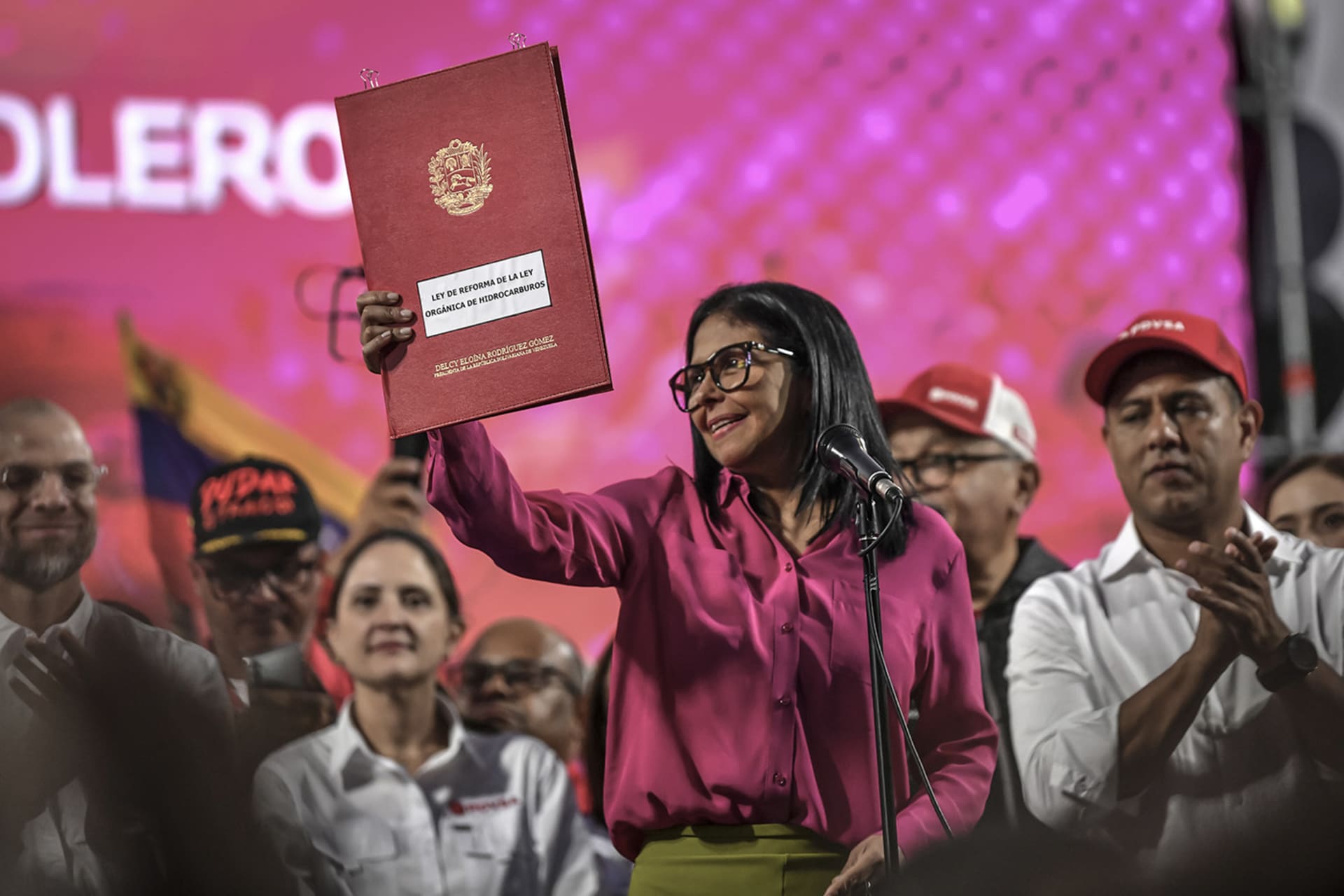
It has been more than a month since Operation Absolute Resolve led to the capture of Nicolás Maduro in Venezuela, but neither President Donald Trump nor his administration have clearly outlined next steps for the country—or the United States’ involvement there. The president has only consistently stated his intention to control Venezuela’s vast oil resources. To do so, he appears comfortable working cooperatively with the current Venezuelan government under interim President Delcy Rodríguez, a longtime Chavista and Maduro’s vice president.
Trump did meet with opposition leader María Corina Machado (and accepted her Nobel Peace Prize) on January 16 and vaguely indicated he was considering getting her involved in the country’s future somehow. However, he also dismissed Machado, claiming she did not have sufficient support to lead in Venezuela despite the opposition’s victory in the most recent election. Both Democrats and Republicans in the U.S. Congress balked at this treatment of Machado, but Trump did not address these concerns by committing to a timeline for elections or democratic transition process in Venezuela.
Instead, Trump indicated he would run the country for years to come and stressed how well he was working with Rodríguez, who has maintained the same regime apparatus as Maduro—evidenced by the U.S. government’s ongoing warning against traveling to Venezuela due to the risk of wrongful detention, torture, and repression. Meanwhile, there are more than seven hundred political prisoners still in prison (approximately three hundred have been released), and hard-liner Diosdado Cabello continues to control security forces and armed street gangs known as collectivos, with the same corrupt military leadership in charge. Although Trump has consistently characterized his relationship with Rodríguez positively, he isn’t necessarily committed to working with her for the long term, either. Trump has made clear that the U.S. naval deployment in the Caribbean Sea will remain in place and has threatened that the new Venezuelan leader will “pay a very big price, probably bigger than Maduro” if she doesn’t cooperate.
As of now, the only apparent policy in practice toward Venezuela is for the United States to control its sale of oil on the open market indefinitely, starting with a 50-million-barrel tranche. Trump said the revenue will be split between the two countries, but he did not provide specifics on how that might work. To complicate matters further, Trump said during a meeting with oil executives in early January that major U.S. oil companies will need to invest at least $100 billion to rebuild Venezuela’s oil sector—despite several of the firms’ stated concerns about political instability and the lack of security guarantees.
While the U.S. military operation that captured Maduro was undoubtedly a tactical success, the Trump administration’s overarching strategy remains impossible to assess more than a month later. The president has done little to illuminate the path forward, leaving Americans, Venezuelans, and the world in the dark.
Rubio tries to flesh out Trump’s plans but remains vague
It became clear soon after the U.S. operation in Caracas on January 3 that the Trump administration was improvising its plan for a post-Maduro Venezuela. The only long-term aims that have been shared with the public since then are those that Secretary of State Marco Rubio outlined before the Senate Foreign Relations Committee on January 28. He said that the Trump administration is adopting a three-phase plan—stabilization, recovery, and transition—in his testimony.
In the stabilization phase, he said, the administration would create a long-term mechanism allowing sanctioned Venezuelan oil to be sold at market prices. In the short term, Rubio described a payment mechanism in which oil proceeds are going into Venezuelan accounts in Qatar. But this does not account for Trump’s statement that the oil proceeds would be split between the United States and Venezuela.
Rubio then said that the recovery phase would focus on releasing political prisoners, normalizing Venezuela’s oil industry through new laws, and creating space for diverse political voices. Rubio has also stressed the need to eliminate Venezuela as a base of operations for China, Iran, and Russia in the Western Hemisphere, curb drug trafficking, and reduce China’s access to discounted Venezuelan oil. Efforts toward progress in this field are mixed. The Venezuelan authorities have released some political prisoners and approved a new law that reforms aspects of its oil industry. However, most importantly, there is no current path for a democratic transition or elections, and neither Rubio’s nor Trump’s plans include a seat at the table for the Venezuelan opposition or civil society. This means that the Venezuelan people are not represented in the deals—which are supposedly for their benefit—that the Trump administration is making with Rodríguez’s team.
Rubio did say that the end goal is for Venezuela to hold legitimate democratic elections, but he refused to provide a timeline. He only said that the country “three or four, five months from now cannot look like what today looks like.” When pressed on what progress towards a transition would look like, Rubio loosely described a “process of internal reconciliation” in Venezuela that would eventually include the opposition.
It remains surprising that, in the meantime, the Trump administration has chosen to empower the same Venezuelan leaders it had once maligned. Officials had previously argued, correctly, that the regime had caused one of the worst peacetime humanitarian disasters in the world, violently repressed political dissent, and committed widespread human rights violations.
Follow the money
The only substantive aspect of U.S. involvement in Venezuela that can be addressed right now is the United States’ involvement in the country’s oil sales. How the money will move through those transactions, however, raises several concerns. The clearest, if incomplete, explanation from the Trump administration to date about how the oil proceeds from the sale of Venezuelan assets will flow came from Rubio’s testimony. He described the oil payment mechanism as follows: The short-term mechanism in place now has funds going to a Venezuelan account in Qatar, which is somehow restricted because it has “U.S. sanctions as a blocking mechanism on it.”
The permanent structure would involve Venezuelan oil being sold at market prices with oil proceeds deposited into a “U.S. Treasury blocked account” located in the United States, and the U.S. government would then specify what the Venezuelan government could spend the money on. Venezuela would submit a budget request to the Trump administration detailing what they want to use the money for, and they are on the hook to pay for an auditing system acceptable to the United States.
Rubio justified the short-term mechanism with Qatar as necessary because the United States does not recognize Venezuela’s government and because it will help mitigate the risk of creditors seizing the assets if they were in a U.S. bank (Venezuela’s total estimated external debt is $170 billion). Rubio confirmed that approximately $500 million worth of oil has been sold, with $300 million disbursed to Venezuela while the remaining $200 million was still sitting in the account in Qatar. He explained that the first $300 million payment would be audited retroactively.
But Rubio’s description of the short-term mechanism that places oil proceeds in an account in Qatar doesn’t align with the limited written guidance issued by the administration to date. This includes:
- Department of Energy factsheet issued on January 7. It indicates Venezuelan oil proceeds will first settle in U.S.-controlled accounts at internationally recognized banks to ensure transparency, then be disbursed at the discretion of the U.S. government.
- Executive Order 14373, which Trump signed on January 9. It aims to protect Venezuelan assets from creditors by preventing them from attaching their claims against Foreign Government Deposit Funds—defined as Venezuelan oil revenues held in U.S. Treasury accounts.
- Targeted sanctions exemption (General License 46) [PDF], which was issued by the Treasury’s Office of Foreign Assets Control (OFAC) on January 29. It carves out certain activities involving Venezuelan-origin oil that would otherwise be restricted by the Venezuela Sanctions Regulations. Among other requirements, it mandates that payments to blocked persons—such as Venezuela’s state-owned oil company PDVSA—be made into Foreign Government Deposit Funds, as specified by Trump’s January 9 executive order, or into another account as instructed by the Treasury Department.
Despite written guidance by the administration indicating that funds would be deposited into U.S. Treasury accounts or U.S.-controlled accounts, Rubio’s testimony indicates proceeds have gone to Venezuelan accounts in Qatar, with Venezuelan oil being sold by oil traders that operate as middlemen. It is unclear whether the executive order applies to the assets in Qatar, given that they do not appear to be in Foreign Government Deposit Funds, and whether creditors could attempt to attach their claims to those assets.
A further issue is that, without adequate anticorruption controls and independent oversight, the mechanism the United States is establishing risks repeating the failures of Iraq’s Oil-for-Food program, which involved approximately $1.8 billion in kickbacks and illicit payments and $10.9 billion in oil smuggling. This is a particularly acute concern given Rubio’s own acknowledgment that corruption is “the glue that keeps the regime together” in Venezuela. Yet there is no indication that an independent third party will oversee the oil revenue disbursement process or that the Venezuelan opposition or civil society will have any formal role in deciding and monitoring how funds are disbursed.
Self-inflicted sanctions consequences as pretext for oil control
Rubio has offered justifications for controlling Venezuela’s oil that fall apart under scrutiny. He repeatedly cited China’s receipt of Venezuelan oil at a $20-per-barrel discount as evidence of exploitation that warrants U.S. intervention. Yet this discount was a direct consequence of U.S. sanctions that pushed Venezuelan oil into the black market—a pattern similar to what occurred with Iranian oil after 2018 sanctions and Russian oil [PDF] after 2022 sanctions.
In fact, the oil blockade Trump announced in December 2025 widened the discount to China from approximately $14–15 per barrel to as much as $21 per barrel. Before the U.S. government imposed these sanctions, the United States was the primary destination for Venezuelan oil, sold at market prices through legitimate channels. After the sanctions were imposed, China became the primary destination for Venezuelan oil. Rubio testified that China can continue purchasing Venezuelan oil “at the normal price.” India was another major destination for Venezuelan oil prior to U.S. sanctions. Trump also recently announced India would be able to buy oil from Venezuela to replace its imports of Russian oil.
Similarly, Rubio touted that Venezuela now receives 100 percent of its diluent (the light crude needed to process Venezuela’s heavy oil) from the United States rather than Iran or Russia. However, prior to U.S. sanctions, Venezuela sourced [PDF] most of its diluent from the United States before being forced to turn to alternative suppliers.
The administration is citing the negative consequences of its own sanctions policy—consequences that were largely predictable and self-inflicted—as justifications for an intervention that essentially reverts to pre-sanctions commercial dynamics, with the crucial difference of the United States now directly controlling Venezuelan oil sales.
Despite Trump’s insistence that major U.S. oil companies should invest in Venezuela and Rodríguez’s team passing a new hydrocarbons law, the same concern from day one remains: although changes are necessary, they will be insufficient to attract major investments so long as the same regime is in power, as it cannot provide the political stability, legitimacy, and confidence that only a future democratically elected Venezuelan government can.
This work represents the views and opinions solely of the author. The Council on Foreign Relations is an independent, nonpartisan membership organization, think tank, and publisher, and takes no institutional positions on matters of policy.