Using PSYOP against North Korea
By experts and staff
- Published
- Guest Blogger for Asia Unbound
Andrew Injoo Park is is a former intern for Korea Studies at the Council on Foreign Relations (CFR).
DISCLAIMER: The views expressed in this blog are Mr. Park’s own and do not reflect those of CFR or its staff and members. CFR takes no institutional stance and prizes independence for the organization’s members and staff.
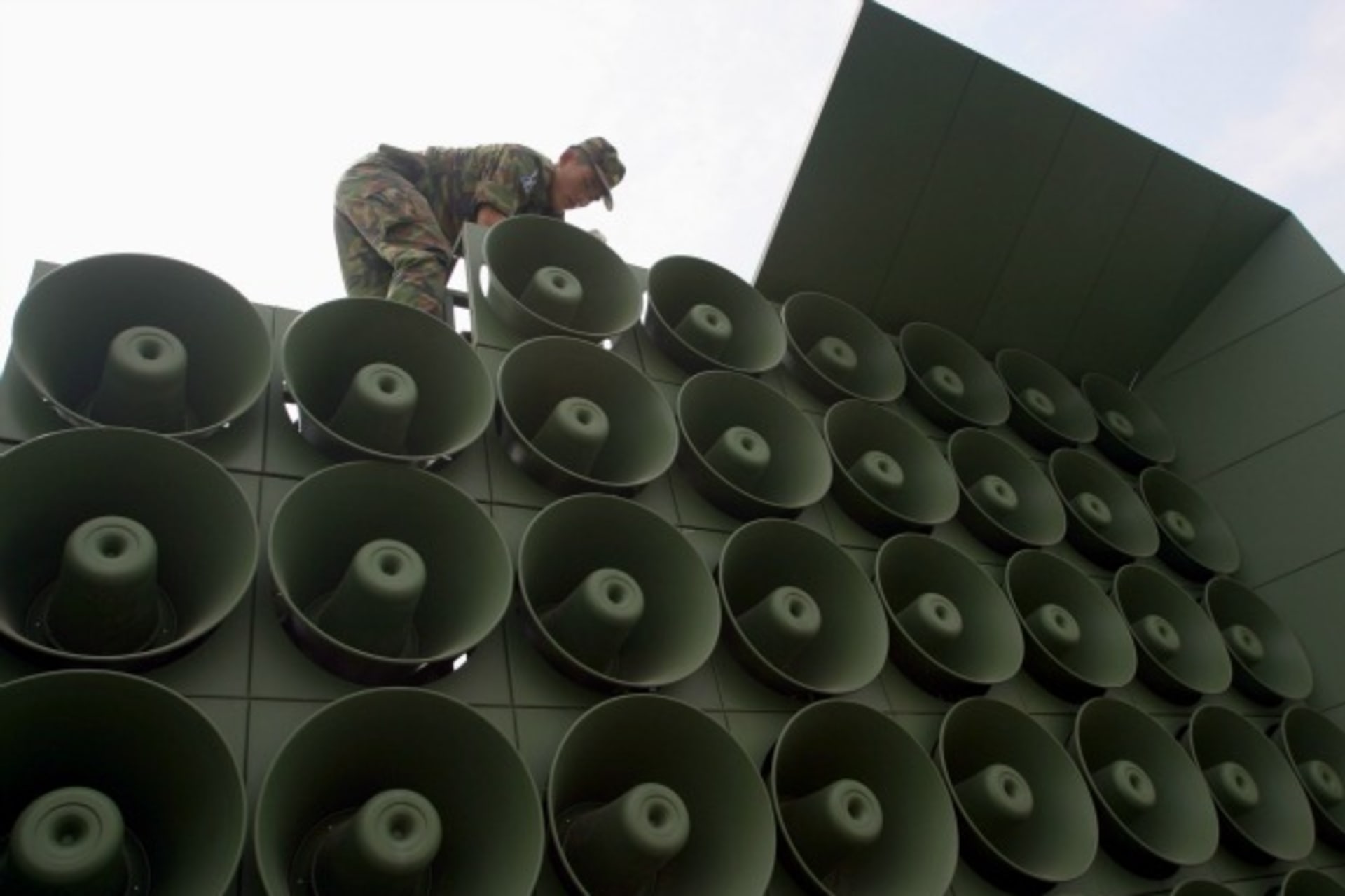
This past August was a stressful month for Koreans. North Korean mines at the demilitarized zone (DMZ) maimed two South Korean soldiers. In response, Seoul resumed propaganda broadcasts for the first time in eleven years, and the two Koreas even exchanged artillery fire, although the incident did not escalate further. Until the two sides reached an agreement after three days of marathon negotiations, the possibility of war (however unlikely) loomed over the Korean peninsula yet again. To better deter and respond to Pyongyang’s provocations such as the August incident and to obtain greater leverage over the North Korean regime, the United States and South Korea should utilize more psychological operations, also known as “PSYOP.”
PSYOP refers to strategies or tactics that exploit an adversary’s particular psychological and cultural propensities and its means of communication. PSYOP also employs psychological means other than conventional military methods. Most importantly, PSYOP seeks to induce confusion, fear, hopelessness, and distrust in an adversary’s mind through sabotage, propaganda, special operations, psychological and economic pressure, or guerilla warfare.
The two Koreas have been using PSYOP for decades. The first PSYOP on the Korean peninsula was conducted during the Korean War (1950–1953), when both sides utilized propaganda leaflets to induce each other’s troops to defect. Until the early 2000s, the two Koreas continued to send propaganda leaflets and broadcasts over the DMZ. Since June 2004, however, after making an agreement with the North, the South Korean government stopped utilizing PSYOP.
North Korea, however, continues to deliver its leader’s New Year’s address to the South every year and has been urging for the ”Korean ethnics” to unite and cope with American imperialists’ nuclear pressure together. The North Koreans have also been asserting that “cooperation among [Korean] ethnics” is patriotism and a shortcut to unification and that cooperation with a foreign power is a betrayal of one’s country and an act of dividing the Korean nation. Through propaganda, North Korea has fostered friendly groups that promote anti-South Korean and anti-U.S. narratives within the South’s civil society. These groups even conducted violent anti-government demonstrations and planned to attack police stations and military arsenals to accumulate weapons for a future revolution. One of the sympathizers, Kim Ki-jong attacked U.S. Ambassador Mark Lippert recently. North Korea also influenced South Korean political factions that targeted conservative interests such as the Saenuri Party and President Park Geun-hye. While the South Korean Supreme Court later disbanded many of these groups, North Korea has amply demonstrated that PSYOP could be used to wreak much havoc within South Korea.
By forgoing the use of PSYOP, South Korea is failing to utilize a tool of potential leverage against the North, which appears to be more concerned about loudspeaker broadcasts than conventional military exercises. In the aftermath of North Korea’s third nuclear test in 2013, the United States sent two nuclear-capable B-52 bombers three times to the Korean peninsula in order to simulate raids over the North. Yet, North Korea did not fire a single shell toward the South and simply denounced the sorties, threatening that “the event could imperil regional stability.” Back in 2010, however, when the South Korean military dispersed four-hundred thousand propaganda leaflets into the North as a response to the Yeonpyeong shelling, North Korea responded by conducting a live-fire artillery exercise near Yeonpyeong Island. Furthermore, when a human rights non-governmental organization (NGO) sent balloons filled with leaflets to the North in 2014 and 2015, the North Korean military shot at balloons to prevent them from crossing the border. During the recent DMZ negotiations, the main request by the North Korean delegates was for the South stop the loudspeaker broadcasts.
Why is North Korea so irritated by PSYOP?’ According to Lee Kwang-baek, the president of Radio Free Chosun (an NGO that has been transmitting radio broadcasts to North Korea since 2005), “the majority of North Korean citizens, thirsting for the news from the outside world, listen to the propaganda broadcasts, which fan the flames of their doubt about Kim Jong Un’s regime.” Also, according to the 2012 White Paper on North Korean Human Rights by the Database Center for North Korean Human Rights, a survey on 1,983 defectors living in the South in 2011 showed that North Koreans’ longing for experience with foreign societies grew by 44 percent and that desire to defect grew by 32.8 percent after watching or hearing South Korean broadcasts.
Hence, the United States and South Korea should capitalize on North Korea’s psychological weakness and greatly expand the use of PSYOP as a tool of leverage toward Pyongyang. Specifically, the United States and South Korea should take following measures:
The recent DMZ crisis has demonstrated the North Korean regime’s acute sense of vulnerability with regard to PSYOP, which could be an excellent tool of leverage against the regime. In addition, more exposure to the outside world could gradually reshape how ordinary North Koreans think and could bring about unification of the two Koreas.