What to Expect Ahead of Next Week’s Trump-Xi Summit
CFR President Michael Froman analyzes the issues on the table ahead of a highly anticipated meeting between U.S. President Donald Trump and Chinese President Xi Jinping next week.
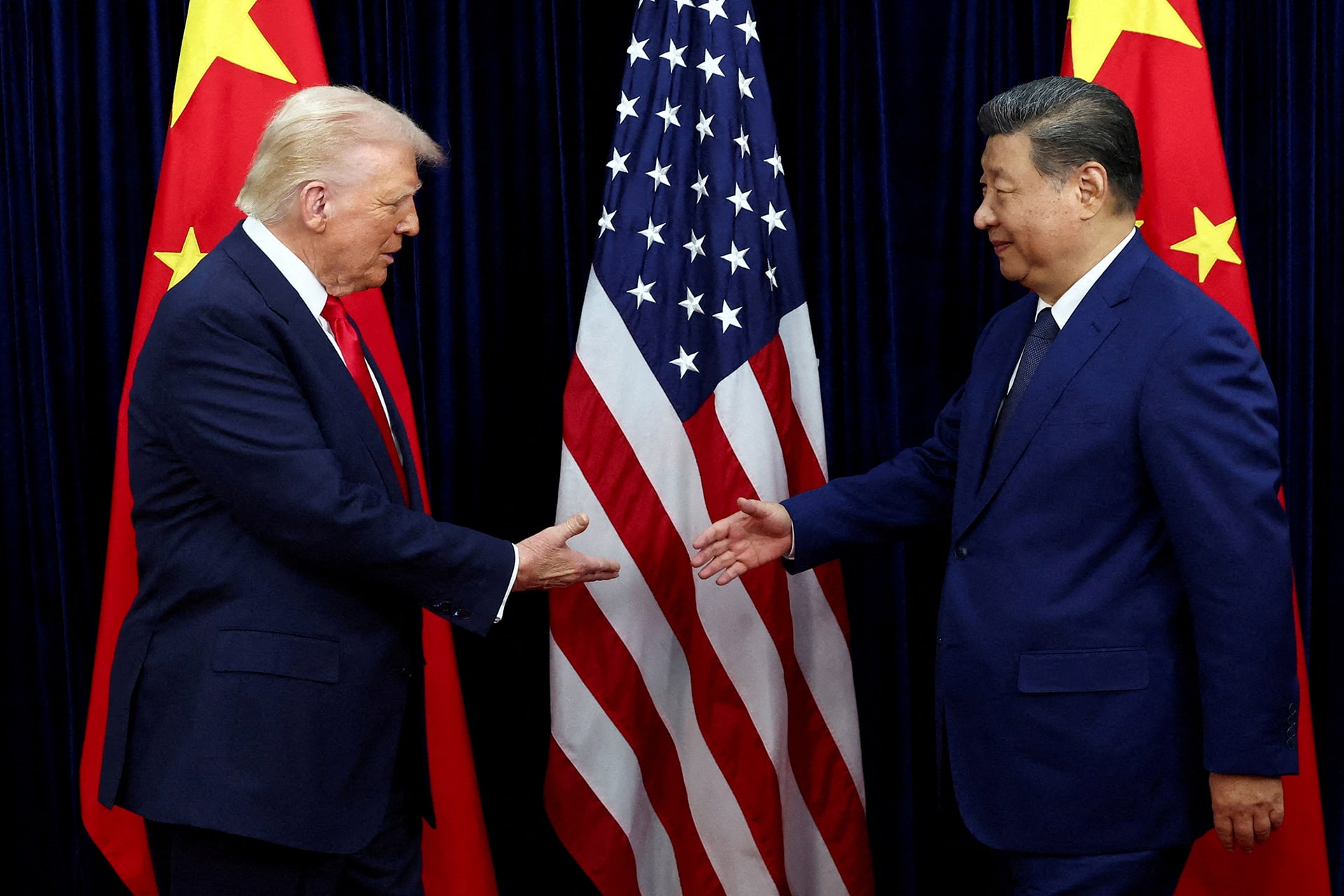

Next week, U.S. President Donald Trump and Chinese President Xi Jinping will meet in Beijing for a highly anticipated summit, the first of four potential meetings over the next year. It is unclear what the scope of discussion will be and what will come out of this meeting. But that is all well and good. The world is a safer place when its two largest economies and most powerful countries are on speaking terms. As Trump wrote on Truth Social, “President Xi will give me a big, fat hug when I get there in a few weeks. We are working together smartly, and very well! Doesn’t that beat fighting???”
“Not fighting” appears to be the new north star of the United States’ new China policy. This policy is defined, in large part, by low expectations, and the pursuit of what the Trump administration’s National Defense Strategy calls “a decent peace.”
Gone is any pretense of solving the major structural issues at the heart of the world’s most important bilateral relationship: China’s mercantilist economic model, its designs on absorbing Taiwan, and its active support of U.S. adversaries such as Iran and Russia, not to mention any discussion of freedom of navigation through the South China Sea. As such, the summit is unlikely to alter the character and course of the U.S.-China relationship long-term. It is about managing for stability, not solving outstanding concerns.
The appeal of this pragmatic, tactical, and transactional approach is understandable. Decades of ambitious, if wishful thinking about the United States’ ability to influence the Communist Party of China on core elements of its economic or national security priorities have borne little fruit. Having a clear-eyed view and pragmatic expectations is not necessarily a sign of weakness. But there is a difference between measured cynicism and complacency. At some point, the fundamental issues at the heart of the U.S.-China relationship will need to be resolved, lest they boil over.
I was one of the few Americans in the room in Sunnylands, when former President Barack Obama and Xi rolled up their sleeves in June 2013. It was a rare moment for a real, substantive, and fairly unscripted conversation about some of the most significant issues in the relationship. But it was also the early innings of a strategic deadlock.
So, what will Trump actually leave the summit with? First, if the past is prologue, we’re likely to see a number of commercial deals. The Chinese side is expected to announce or reaffirm buying commitments for U.S. commodities, particularly soybeans and other agricultural products, in addition to a rumored large-scale purchase of Boeing passenger aircraft. Many of these transactions were in fact delayed amid post-Liberation Day spats about trade and export control, though new purchase agreements may also be in the cards.
These deals hint at what might be the most substantive policy outcome to emerge from the summit: a move toward a “Board of Trade,” first floated by U.S. Trade Representative Jamieson Greer after talks with Chinese officials in Paris this March. That is, a strategy of managed trade, run through a standing body that would determine what China should buy from the United States and the United States from China, including through the use of purchase commitments and tariff reductions in non-strategic sectors, plus a forum for resolving disputes before they escalate.
The idea would be to identify some $30 billion of U.S. products China would import to be matched by an equivalent amount of imports of Chinese goods into the United States. The closest historical analogy might be the targets set in the framework talks between Japan and the United States during the first Clinton administration, which were later abandoned as ineffective and unmanageable. Still, such an approach would call for a conversation about what is strategic and non-strategic trade, with lower tariffs conceivably being applied to the latter and high tariffs or export controls being applied to the former. The board would represent an effort to move away from episodic escalations and deescalations of trade tensions and tariffs toward an institutionalized channel for managing the bilateral trade relationship.
A Board of Trade could potentially manage the bilateral trade relationship, one soybean and plane at a time. But it will do little to address China’s imbalanced economic model—described by U.S. Treasury Secretary Scott Bessent as the “biggest risk” to the global economy—now flooding third-country markets with heavily subsidized electric vehicles, steel, aluminum, solar panels, and batteries, hollowing out strategic manufacturing bases from Brasília to Berlin. Beijing’s goods trade surplus hit nearly $1.2 trillion in 2025 and is on pace to clear that mark again this year.
Beyond China’s global economic imbalances, there are a number of other critical issues to discuss, including the disposition of Taiwan, where Xi has told his cadres the issue must “reach a final resolution and it cannot be passed on from generation to generation.”
Add to this the nuclear file. China is racing to build an advanced arsenal of roughly 1,500 warheads by 2035—the most rapid buildup since the early Cold War—just as New START, the last remaining treaty between the United States and Russia limiting nuclear weapons, expired in February. In other words, the previous era of arms control and limits is consigned to history with no successor frameworks in place.
A similar race is playing out with artificial intelligence (AI), where we have neither arms control nor crisis communications, nor an answer to the routine distillation of frontier U.S. models by Chinese labs. In recent days, the Trump administration sent mixed signals about whether it might seek to restart the AI consultations former President Joe Biden launched after his meeting with Xi in Woodside, California, in November 2023.
Finally, there are the activities of the clique of malign actors that Xi continues to support or tolerate to various degrees, despite the risks they pose to the United States and the world. In North Korea, the Kim Jong Un regime is now operating with relative impunity and testing new generations of nuclear-capable weapons with alarming frequency. In Ukraine, Beijing remains the single most important external prop to the Russian war economy—supplying the dual-use components, machine tools, and microelectronics—while buying large volumes of Russian energy products that finance Putin’s revanchism. And, with regard to Iran, where Beijing has every reason to lean on Tehran given its dependency on petroleum products that transit the Strait of Hormuz, Xi has shown little appetite to apply acute pressure on the regime, preferring to let the United States embroil itself in another Middle East conflict while Chinese firms sell satellite imagery used to target U.S. forces in the region.
A cynic might argue that these issues are intractable and that the focus ought to be on smaller, more resolvable irritants in the relationship. Indeed, there may be tactical benefits to lowering the temperature of the bilateral relationship and maintaining stability. As we saw last year, the escalation of U.S. tariffs led China to escalate its use of its chokepoint to threaten global supply chains dependent on Chinese-made magnets and other products containing critical minerals.
Now, to borrow a Chinese aphorism, the United States is hiding its assets and biding its time, using this period of relative détente to invest in domestic processing, organize coalitions of the like-minded as part of its Forum on Resource Geostrategic Engagement (FORGE) initiative to reduce our collective dependence on China, and prepare for the day when we can push back on China and withstand possible retaliation. In the meantime, leaving most of these issues unaddressed runs the risk that one or more of them will create a future conflict that cannot be swept under the rug.
Let me know what you think about the state of U.S.-China relations and what this column should cover next by replying to [email protected].