Why Rules-Based Orders Fail
For a brief period after the Cold War, Americans persuaded themselves that the liberal order had become self-sustaining. And yet, any rules-based system elaborate enough to govern and interpret its own operations will eventually confront questions that its rules cannot answer.
Originally published at Project Syndicate
By experts and staff
- Published
 Benn SteilCFR ExpertSenior Fellow and Director of International Economics
NEW YORK—In 1980, Douglas Hofstadter, an obscure young computer science professor at Indiana University, won a Pulitzer Prize for his first book, Gödel, Escher, Bach: An Eternal Golden Braid. Equal parts brain-straining, witty, and epiphanic, “GEB”—as its devotees call it—leveraged math, art, and music to illuminate a remarkable feature of reality. Though systems may appear solid and self-sustaining, they also may contain contradictions that they can never resolve from within.
Consciousness itself is such a system, Hofstadter argued. My brain constructs symbolic representations of the world, and among those symbols is a model of my brain as “myself.” But “I” am not an entity apart from my brain. The idea of “me” emerges from my own brain’s recursive symbolic activity. The self is both real and illusory: a stable experience generated by a process that can never fully explain itself.
This recursive structure, Hofstadter showed, is a source of human creativity and self-awareness. But it can also produce paralysis or collapse. I may fear something, observe that I am fearful, fear that my fearfulness is weakness, and fear that others may disdain me for it. In this case, I will have become trapped in a recursive loop in which my consciousness destabilizes my action.
Can political orders fall into the same pattern? I believe that they can and often do.
Turtles All the Way Down
Consider the so-called rules-based international order. Formulated and largely enacted by the United States at the end of World War II—at the apex of US military and economic dominance—a latticework of global rules and standards took shape, covering security, nuclear nonproliferation, trade, finance, navigation, aviation, communications, public health, food safety, cross-border crime, and human rights. America’s ambition was to create an order that functioned much like a model liberal democracy, in which the rule of law prevailed and political actors operated wholly within and according to its strictures.
Yet the work of philosopher-mathematician Kurt Gödel—the first central figure in Hofstadter’s bestseller—suggests that a fully self-regulating rules-based political order is unattainable. Gödel’s famed “incompleteness theorem,” published in 1931, used an ingenious mathematical argument to demonstrate that any rules-based system elaborate enough to govern and interpret its own operations will eventually confront questions its rules cannot answer.
In a political context, such a system must have rules not just for governing society, but for governing, interpreting, and modifying the rules themselves. Once a political order becomes sufficiently recursive, however, situations inevitably arise in which the rules themselves become contested.
For example, if constitutions must be created through pre-constitutional means, who decides when they are legitimate? Who determines whether an emergency justifies suspending rights? When may judges overrule elected majorities? What if institutions deadlock? Who decides whether a state is acting in legitimate self-defense? Does a treaty obligation supersede national sovereignty?
Though Hofstadter does not mention him, the Nobel laureate economist Kenneth Arrow’s famed “impossibility theorem,” published in 1950, is closely related in structure and implication to Gödel’s theorem. Arrow used mathematics to answer a deceptively simple but profoundly important question about democracy: Is it possible to design a voting system that converts individual preferences into a logically coherent collective decision, while simultaneously satisfying basic standards of democratic fairness?
The answer, perhaps surprisingly, is no. Though countless political theorists had assumed democracy to be a valid mechanism for discovering the public will, Arrow showed that the aggregation problem is insoluble. Democracy cannot reliably transform private preferences into a coherent collective rationality. It tends, instead, to produce incoherence or unfairness.
Gödel’s and Arrow’s findings cast logical doubt on Francis Fukuyama’s famous proposition that liberal democracy represented “the end of history”—the telos of human political evolution. The “liberal” part of liberal democracy relates to the rule of law, which Gödel’s theorem showed to be insufficient for a fully stable political order. The “democracy” part relates to elections, which Arrow’s theorem showed to be insufficient for identifying a coherent collective will.
States of Exception
This brings us to Hofstadter’s second central figure, the Dutch graphic artist M.C. Escher, whose famous mind-bending drawings show how systems governed by simple component rules can generate larger structures that appear paradoxical, self-creating, or logically impossible. These include hands drawing themselves, staircases rising endlessly, waterfalls powering themselves, and worlds in which figure and background reverse position. Escher’s art offers a way to visualize the interaction between the liberal-democratic order and its borderlands.
Hofstadter’s third figure is the German composer Johann Sebastian Bach, but our analysis is better served by substituting for him the German legal scholar Carl Schmitt. As the Nazi regime’s “crown jurist” from 1933 to 1936, Schmitt is best known for his pithy, unsettling assertion that the “sovereign is he who decides the exception”—meaning the exception to the prevailing constitutional order in which the decider finds himself.
Schmitt rejected the idea that the rule of law is, or can be, sovereign. Consistent with Gödel, there will always be emergency situations in which the law offers no guidance. Not only is liberal democracy inherently fragile, but, according to Schmitt, its obsession with rules, procedures, and debate—rather than timely and effective action—poses a danger to national security.
That sounds plausible, until one considers that “exceptions” have been numerous and momentous in American history, while commitment to the constitutional order has generally remained strong. Consider Thomas Jefferson’s Louisiana Purchase in 1803, Abraham Lincoln’s suspension of habeas corpus in 1861, or the more ambitious elements of Franklin D. Roosevelt’s New Deal. None rested on a firm constitutional foundation, yet all came to be widely regarded as legitimate.
The Louisiana Purchase was later seen as foundational to national development. Lincoln’s suspension of habeas corpus took place alongside continued elections and was followed by restoration of constitutional order after the Civil War. And in the wake of FDR’s New Deal, expansive executive regulatory authority was absorbed into the normal structure of governance. In each case, discretionary departures from established rules were not repudiated but retrospectively validated, reinforcing rather than undermining constitutional legitimacy.
Schmitt emphasized the critical historical role of figures who assume extra-legal powers. Those of whom he approved, such as Lincoln, did so to conserve the constitutional order; he referred to them as “commissarial dictators.” By contrast, those who had wrecked the prevailing constitutional order, such as Joseph Stalin, were “sovereign dictators.”
But Schmitt neglected the critical role of public demands and expectations for ensuring restoration of a constitutional order. The best way to understand this dynamic is to visualize liberal democracy as an Escher woodcut in which figure and background are reversible. A Schmittian might identify the black birds in the woodcut below as the foreground of liberal democracy—the rules-based constitutional framework—with the white space representing the realm of exceptions beyond that framework.
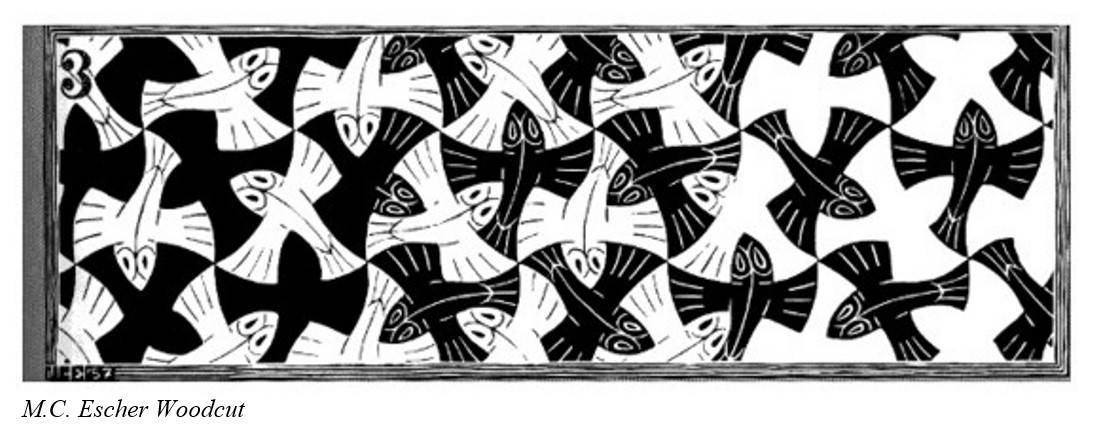
Yet, just as the white “background” in the woodcut can be perceived as white birds in the true foreground, so exceptions in liberal democracy can be understood, contra Schmitt, as a cooperative domain—the space where actual governance occurs when rules prove insufficient to determine outcomes. Far from undermining liberal democracy, action in this realm often reinforces public confidence by demonstrating that competence and integrity can substitute temporarily for the inherent incompleteness of rules. If confidence remains that the constitutional order will return to the foreground once the crisis has passed, the sovereign is not “he who decides the exception,” but the public that retrospectively legitimizes the decision.
What we may call an “Escher equilibrium” is a condition of political stability in which a rules-based constitutional order retains legitimacy even as governance periodically operates through discretionary action. Like an Escher figure-background reversal, rules occupy the visible foreground of public justification, while the management of exceptions, a necessary but less visible domain, operates in the background. The equilibrium holds so long as discretionary action is perceived as bounded, impersonal, and temporary. It breaks down when exceptions are experienced as limitless, selectively applied, or fundamentally inconsistent with the principles the constitutional order is meant to sustain.
Up Schmitt’s Creek
Over the past quarter-century, however, the US has experienced exceptions that large segments of the public have strongly resisted. These are best understood as Schmittian threats to constitutional order, not merely because they involved departures from ordinary legal constraints, but because they weakened confidence in the system’s ability to manage crises through neutral, rule-bound procedures.
Four cases stand out.
The first was the post-9/11 expansion of the national-security state, which included mass electronic surveillance and assertions of broad executive detention authority, both of which undermined confidence that the rule of law remained operative. Then came the bailout of major financial institutions during the 2008 financial crisis, which appeared to reward the well-connected at the expense of ordinary households.
The third exception consisted of the COVID-era interventions—including sweeping public-health mandates and emergency administrative measures—which were inconsistently applied and, in some instances, appeared to exceed statutory authority.
The fourth case was the January 6, 2021, attack at the US Capitol and the broader effort to delegitimize the 2020 election. President Donald Trump’s subsequent mass pardon of many participants further deepened divisions between those who saw the attack as an assault on the constitutional order and those who accepted Trump’s false claim that the election had been rigged.
These episodes not only tested the constitutional order but altered how it was perceived. In each case, the exercise of extraordinary power was accompanied by a growing suspicion that the rules were selectively applied, politically manipulated, or simply inadequate. Across very different crises, a growing share of the public came to doubt that liberal-democratic procedures could manage emergencies in both an effective and an impartial manner.
Domestically, the result has been consistent with Schmitt’s critique of the failing Weimar Republic of the 1920s, which exhibited increasing polarization and declining tolerance for liberal-democratic proceduralism. Trump has exploited similar sentiment to test the judicial branch’s willingness and ability to enforce constitutional limits on executive power.
What about internationally? The global rules-based order has always relied on what Canadian Prime Minister Mark Carney has called a useful fiction—that the rules themselves, rather than the distribution of geopolitical power, governed international conduct. In reality, the system depended heavily on the one country capable of operating simultaneously within and beyond the rules. The erosion of American predominance, and the rise of China as a near-peer competitor, has shattered that sensitive equilibrium. The US now increasingly demands discretionary freedom of action and rejects the institutional constraints that it created and upheld for decades.
The implications of Gödel and Arrow’s theorems strike directly at the two foundational assumptions of postwar liberal internationalism: that sufficiently comprehensive rules can govern international conduct; and that sufficiently inclusive rules can generate coherent and legitimate collective outcomes. Consider the contrast between the remarkable success of the General Agreement on Tariffs and Trade—which helped reduce average industrial tariffs from roughly 35% in 1947 to 4% by the early 1990s—and the paralysis of the World Trade Organization under the combined pressures of Chinese mercantilism and American protectionism.
Arrow’s theorem implies that as a rules-based regime becomes more inclusive and diversity of preferences increases, coherent and broadly legitimate outcomes become harder to sustain. The GATT excluded the Soviet Union, resulting in a relatively high degree of systemic compatibility among its market-oriented members. But the US wanted a universal WTO, and therefore assented to China’s admission before it had demonstrated adherence to core market principles. A single rules-based system, as Arrow might have anticipated, has proven unable to reconcile the conflicting economic principles under which the two behemoths operate.
The early 1990s represented the apex of the liberal international order, overseen by a single dominant power that both animated the system and broadly operated within its rules. The exemplar was the 1991 Gulf War to liberate Kuwait from Iraqi occupation. Though set in motion by US President George H.W. Bush, it was conducted strictly in accordance with United Nations Security Council Resolution 678. Because the resolution did not authorize regime change, Bush halted offensive operations once Iraqi forces had been expelled. By the time his son returned US forces to Iraq in 2003, such restraint had become almost unimaginable.
Today, the conditions that sustained the liberal international order have eroded further. The Escher equilibrium that long underpinned it has fractured. The US—sliding toward Schmittian “plebiscitary democracy,” in which an autocrat rules by staged acclamation—is now pursuing a predatory deformation of the Monroe Doctrine in the Western Hemisphere. Meanwhile, China seeks to dominate its Asia-Pacific neighborhood through economic coercion and military pressure, and Russia and the European Union contest the political and territorial order of Europe. The global system is no longer anchored by a single hegemonic power willing to subordinate itself to rules that it established and that define the global system.
For a brief period after the Cold War, Americans persuaded themselves that the liberal order had become self-sustaining—that universal rules, democratic legitimacy, and economic interdependence had rendered old-fashioned power politics obsolete. But the order rested less on the autonomous authority of rules than on a historically exceptional concentration of American power and institutional confidence.
That foundation has eroded. The institutions remain, but they have been drained of authority. The rival major powers invoke rules selectively, interpret them opportunistically, or ignore them outright. The exceptions are no longer hidden in the background, as in an Escher woodcut. They have moved to the foreground. And once seen, they can never be unseen.