Primary Sources from the Cold War
Analyze the factors that shaped U.S. strategy during the Cold War
Do your students have questions about AI? We asked an expert.
Analyze the factors that shaped U.S. strategy during the Cold War
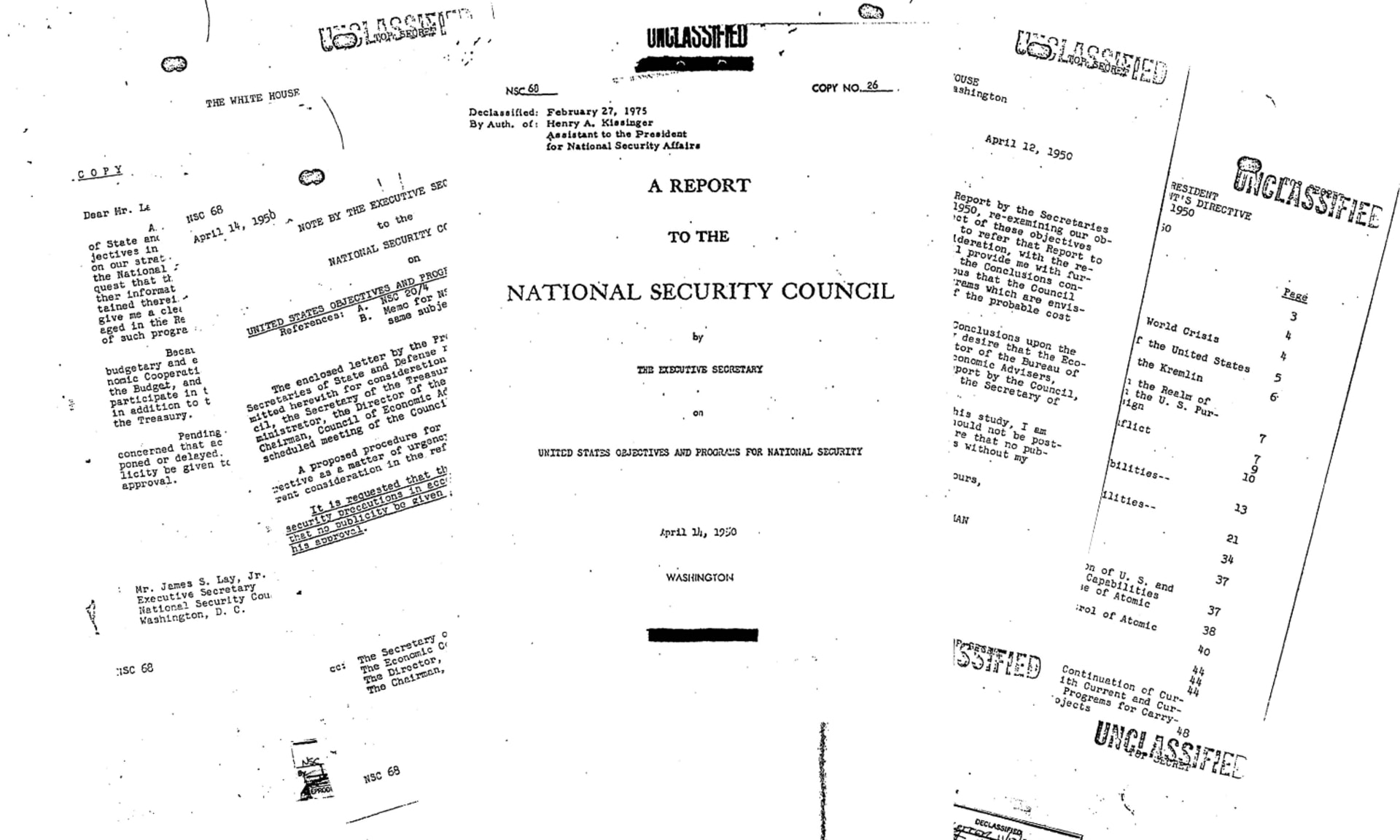
Context: The first Soviet nuclear test and the establishment of a communist China dented American confidence that containment was working. President Truman ordered a review of U.S. national security strategy. That review recommended a dramatic expansion and militarization of U.S. Cold War activities.
Excerpt:
Two complex sets of factors have now basically altered this historical distribution of power. First, the defeat of Germany and Japan and the decline of the British and French Empires have interacted with the development of the United States and the Soviet Union in such a way that power has increasingly gravitated to these two centers. Second, the Soviet Union, unlike previous aspirants to hegemony, is animated by a new fanatic faith, antithetical to our own, and seeks to impose its absolute authority over the rest of the world. Conflict has, therefore, become endemic and is waged, on the part of the Soviet Union, by violent or non-violent methods in accordance with the dictates of expediency. With the development of increasingly terrifying weapons of mass destruction, every individual faces the ever-present possibility of annihilation should the conflict enter the phase of total war.
On the one hand, the people of the world yearn for relief from the anxiety arising from the risk of atomic war. On the other hand, any substantial further extension of the area under the domination of the Kremlin would raise the possibility that no coalition adequate to confront the Kremlin with greater strength could be assembled. It is in this context that this Republic and its citizens in the ascendancy of their strength stand in their deepest peril.
[…]
Four possible courses of action by the United States in the present situation can be distinguished. They are:
[…]
A program for rapidly building up strength and improving political and economic conditions will place heavy demands on our courage and intelligence; it will be costly; it will be dangerous. But half-measures will be more costly and more dangerous, for they will be inadequate to prevent and may actually invite war. Budgetary considerations will need to be subordinated to the stark fact that our very independence as a nation may be at stake.
A comprehensive and decisive program to win the peace and frustrate the Kremlin design should be so designed that it can be sustained for as long as necessary to achieve our national objectives. It would probably involve:
For more information about the National Security Council report, NSC-68, or to access the complete report, visit Office of the Historian.