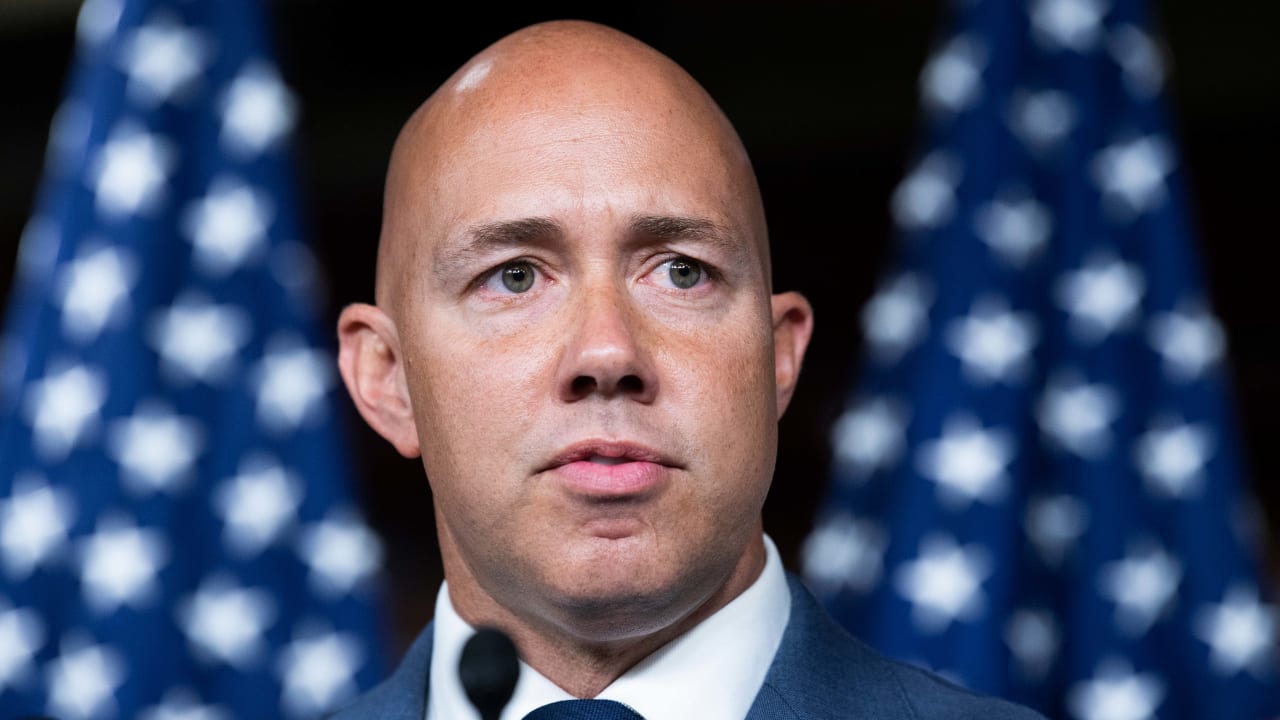
A Conversation With House Foreign Affairs Committee Chairman Brian J. Mast
Event date
Speaker
- U.S. Representative from Florida (R); Chairman, House Foreign Affairs Committee
Presider
- Coanchor, PBS NewsHour; CFR Member
NAWAZ: Thank you for being here. Good day, everyone. Hello. Thank you so much for having us both here. Thank you for joining us, both in the room and virtually. Welcome to today’s Council on Foreign Relations meeting with Chairman Brian Mast. Thank you so much for being here.
MAST: I’m glad to join you all.
NAWAZ: My name is Amna Nawaz. I’m the co-anchor of the PBS Newshour. I’ll be presiding over today’s discussion. And it is my honor to engage with Chairman Mast for about thirty minutes or so. Then we’ll turn to questions in the room and to members joining us virtually. You already know a lot about the chairman. I’m going to do a brief introduction before we jump in here.
MAST: Hope it’s really brief.
NAWAZ: Very brief. Congressman Brian Mast represents the Twenty-First District in Florida. He’s currently serving his fifth term in Congress—serves, of course, as chairman of the House Foreign Affairs Committee as well. Prior to his congressional service, Mast served for more than twelve years in the U.S. Army, including sustaining serious injuries in the war in Afghanistan, being awarded a Bronze Star, a Purple Heart, among many, many others. Chairman, thank you for your service and thank you for being here.
MAST: Thank you. Your intel is all accurate.
NAWAZ: Excellent. That’s what a journalist likes to hear. I’m going to try to prioritize the headlines in our conversation right now because I feel like we could probably talk for three hours and not get to cover everything you have to worry about every day. But let’s start with China, because the president just concluded a high-stakes visit there. The president has talked about fantastic trade deals that he secured. He says China bought more than 200 Boeing airplanes, $10 billion worth of agricultural products. We’ve not yet seen full details, and Chinese officials haven’t yet confirmed this. But if I can just ask if you can add to anything that you’ve heard about what was secured on the trip, and what you think was achieved in the U.S. interest?
MAST: So, obviously, what you just mentioned. And what you just mentioned, while they’re headline trade deals, they are deals that are long lasting. When you talk about Boeing having a backlog of hundreds of jets already, and you add a couple hundred jet purchase to that, that’s jobs for the United States of America, that supply chain needs across the board. It supports a host of different industries. The industries that are supported go well beyond that. And I think probably one of the most significant things to come out of this that’s not exactly a headline piece is just simply what happens when you have two leaders squarely looking each other in the eye. Two leaders—especially two leaders that are probably the leaders of, what I said to you, you know, before we walked in, which are the leaders of probably the most important bilateral relationship of the entire—what will be the entire twenty-first century, in my opinion.
This relationship—regardless of who the leader will be—the relationship between the two nations probably the most important to define this century. And so to have them looking squarely in the eye, talking behind closed doors, all things whether it’s what will take place with Taiwan, and the president choosing to utilize selective ambiguity with Xi Jinping to say he’s not going to talk about it, or conversations of a tougher nature to say, you know, stop stealing this, stop trying to destroy markets in this way, stop espionage in this way. And, you know, if not, there are repercussions as well.
NAWAZ: You mentioned Taiwan. And I know, as you mentioned, the president has not disclosed any details. Going into the summit, though we did see very firm messaging from the Chinese side. President Xi saying without any kind of reservation the Taiwan question is the most important issue in China-U.S. relations. And we know they reiterated too their strong opposition to U.S. arms sales to Taiwan. The president, as you mentioned, has not commented on it. But what is your view? Will those billions in U.S. arms sales go forward to Taiwan?
MAST: I suspect they will continue to go forward to Taiwan. Taiwan is proving to be a great partner. And it’s something that I think they realize, as so many partners across the globe are realizing, the best thing that they can do to ensure their relationship with the United States of America is prove how their fight is more important to themselves every day, because you can’t ask Americans to make their fight more important than what they want to make it, right? It has to be more important to them than it is important to us. As long as they’re doing that every day with the arm sales that they’re wishing to purchase, with the way that they’re looking to arm up their militias, their groups, their things like that, with the way that they’re addressing what is that very difficult relationship with China where so many have roots, of course, you know, many identifying even as Chinese across their population, but a younger population not wanting the future that the older population had there, they balance a very difficult dynamic. But they’re showing on a daily basis that they want to be in the fight of independence. And that’s what they have to do. They have to want it more than us.
NAWAZ: There was some concern, though. I’m sure you’ve seen, from lawmakers going into the summit that they haven’t yet been formally notified by the president about those arm sales. And that hasn’t moved forward. There was a bipartisan group of senators that sent a letter urging the president to do that. And then there was some concern, because we haven’t heard specifics from the administration, that the president, in seeking to gain economic deals, might be willing to make concessions on Taiwan. Are you saying that you don’t share those concerns?
MAST: I would say, being in the middle of all of this, some things are timing and some things are purposeful in timing. And wanted to elaborate on that. Obviously, the president’s visit was postponed, right? So, there were many that were trying to posture, hey, can we move this bill? Can we move it through the House? Can we move it through the Senate? Can we, you know, introduce this—something that they wanted to use to fence in President Trump, on either side of the aisle. These things happen on both sides of the aisle. I think what you’re seeing in the sending of that letter was an effort to fence in President Trump from not having a capability to be ambiguous in the way that he wanted to have conversation, conduct his negotiations, to being more public. And the president wasn’t going to have any of that, simply because he’s going to leave maximum options open always for his discussions.
That upsets people constantly, whether you go back to conversations of would the president—will the president refuse to use nuclear weapons in Iran, or refuse to use nuclear weapons in this, or refuse to use infantry or troops, or put people on the ground in this way. No matter what the circumstances, the president is not going to fence himself into anything because it doesn’t reach a high level of strategy for him.
NAWAZ: So if the goal going in, what we heard time and again was the goal is stability, right? Do no more harm, essentially, especially after some of the trade war issues of last year. You feel like the president achieved that coming out of this summit?
MAST: Time will tell. I think time will tell whether that’s achieved. We have—I would say, what China balances with what they could call their closest allies, they balance even less with the United States of America. And what that—what that point I would make would be is this: China does not fundamentally balance relationships of trust with their allies. Let’s put some of those allies—the provocative allies of China, Russia, Iran, North Korea, Venezuela, even, you know, bordering—they do not balance relationships of trust.
Even to the point of Iran, they have a substantial relationship with Iran. They have bought a—purchased a significant amount of oil from Iran and would love to continue to do so, or not have other Gulf oil bottled up from them. They are not coming to Iran’s defense. They did not come to Venezuela’s defense. They probably wouldn’t come to the defense of others. They don’t balance relationships of trust. And the whole of those alliances do not.
And to an even greater extent, we do not balance a relationship of trust with them. So it is a—not even trust, but absolutely we will verify. We want to see if what you say comes to fruition. There’s not a high level of trust there, with all of the espionage, all of the intellectual property theft, spy balloons, everything else that goes on. There’s not a high level of trust.
NAWAZ: You mean to say they didn’t step in militarily to support Iran, is that what you’re saying?
MAST: No, they—yes. That’s one example. They did step in, in part. They didn’t dive into supporting Iran. Have there been some items in ships that China was sending in? Absolutely, yes. Did China participate in targeting assistance for the Iranians? Absolutely, yes. Would I say that they dove into this? No, they didn’t. Are they, in my assessment, weighing what is better for them? Is it better for them to, in some way, force the United States of America to be bogged down there for a long term because they extend what’s going on there? Or is it better for them to assist in freedom of navigation so that they can get more Gulf oil out of them? I think they’re absolutely trying to balance which one of those is better for them, not which one is better for a relationship of trust.
NAWAZ: So say more on that. How do you see that balance and how they’re weighing it, especially based on what we heard out of this summit? Because we did see President Trump say China said that they will not be sending military support to Iran. We haven’t heard details on that from the Chinese side. He also said that both sides share this goal of wanting to reopen the Strait of Hormuz. Obviously, China needs that for oil movement as well. But it’s also worth pointing out, while the U.S. has been at war in Iran, President Xi was hosting members or leaders, dignitaries from Europe, from the Gulf, about ending the war, right? The Iranian Foreign Minister Abbas Araghchi had been in Beijing right before President Trump. So does the U.S. need China to end the war in Iran?
MAST: In no way, shape, or form do we need China to—now, let’s bear in mind, we’re, let’s say, not even, you know, ninety days into this, right? Just beyond sixty days. The amount of damage that we’ve done militarily, their navy, their air force—(coughs)—excuse me for a moment—their navy, their air force, their caches of weapons system, their mobile launching platforms, their fixed launching platforms, significantly degraded nuclear program, significantly degraded ballistic missile program, significantly degraded drone program, significantly degraded command and control across the whole—from the ayatollah on down to any military leaders that wanted to wear a title. The damage probably rivals, in terms of actual infrastructure, what Ukraine had done to Russia over the course of four years. And, what, we did this in just, literally, a matter of days.
Do we need them to do it? No, we don’t. Would it be great to have assistance from anybody to work to say freedom of navigation is something that we’re willing to participate in, whether they come from Europe or whether they come from the ASEAN region? Yes. It’s in their interest. And this is something that the president has been, you know, preaching to all of them. Listen, it’s in your interest. You’ve all been complaining about this for year after year and decade after decade. When push comes to shove, we see that you’re the kind of, you know, partner, ally, adversary. Whatever the relationship is with whomever, looking at, broadly, relationships here from all of those places, that for some of them, they’re—you know, they might step in a foxhole with us at first, but as soon as bullets start flying they’re going to jump out of that foxhole and run the other way. And those aren’t the kind of partners that we’re looking for.
And that’s, you know, kind of the—what you’re seeing come out of—you know, Spain, as an example. Spain is the one running out of the foxhole in the other direction. That’s going to have long-term ramifications. You know, others saying—maybe doing the bare minimum of saying, OK, we’ll still allow you to do overflights over our territory, move things back and forth, you know, from Europe, things like that. I would say that’s a bare minimum of an effort, but it’s reflected. OK, it’s recognized. It’s reflected. Others saying they’re not going to do anything. All of that is recognized. Do we need China to do it? No. We can go it alone. Is it great to have partners to do things? Yes, absolutely it is.
The other point that I’d make on this, just very quickly is this. As you look at the Straits of Hormuz, I think it’s important to realize something Admiral Cooper mentioned yesterday or the day before. He was on the Hill one of these days and he mentioned this. You know, in the last, basically, two and a half—rather, in the two and a half years prior to these combat operations beginning, Iran had attacked something like 350 times broad-based nations, whether it’s the—you know, the U.S. naval ship this or the cargo ship this from Europe, from Asia, from the Gulf, from the Middle East. Something like 350 separate attacks, some from the IRGC, some from Iranian proxies.
This had been broad-based and ongoing. The difference is this is now under essentially what is just captured as a war. And I think that makes a significant difference about why you have captains making different decisions as well as, let’s say, Lloyds of London or other insurance companies that are saying, you know, these are going to be the rates to move through the straits.
NAWAZ: You mentioned the missile degradation among Iranian capabilities. And I’m sure you saw the reporting that they actually maintain significant missile capabilities still, some thirty out of the thirty-three missile sites along the Strait of Hormuz alone. Have you seen anything that backs up that intelligence?
MAST: I think there’s an important word that I saw used in trying to capture that: access. You know, Iran has regained access to these places. News for everybody. Guess what? We hit a site. They have—you know, if we’re not on the ground, they have access to that site ten minutes after we leave it. It doesn’t mean in any way, shape, or form that that’s a usable site, that it’s a usable platform, that everything that was in that weapons cache is a usable cache. Absolutely, they have access to places that they’ve been. It is not the same thing as usable. You can say the same thing about some of those nuclear facilities. Is there fissile material buried under the ground in places that we’ve hit in the past? Absolutely. Do they have access to those places now? Yes, they have access. Are they utilizing that access to start digging a new hole in a mountain? Not necessarily, but they certainly have access.
NAWAZ: What about the U.S. munitions supply? I know there’s been some concern about the depletion of some of those precision weapons, in particular air defense capabilities, specifically that those are now running low because of the war in Iran. What have you seen in the way of where those supplies are? And are you concerned about those munitions running low?
MAST: Running low is not a way that I would capture it at all. Being utilized, obviously, yes. The way that I would capture how it most concerns me. I would say everybody can bet that China is counting every single piece of ordnance that goes through the sky to try and decide whether they want to be daring and roll the dice on something, whether it be Taiwan, whether it be something else. They’re saying Patriot one, Patriot two, Patriot three, or whatever it is that they’re looking at. You can believe that they’re counting. That doesn’t mean that our supplies are running low. Obviously, if you’re utilizing something, you’re going through supply. It doesn’t mean that we have a lack of it. And we don’t.
NAWAZ: Can you say how depleted those resources are?
MAST: I wouldn’t—I wouldn’t in any way, shape, or form try to indicate that to any one of you in this room.
NAWAZ: Well, the secretary of defense did say on Capitol Hill it would take months to replenish. Do you agree with that assessment? And does that—if it takes months, does that leave the U.S. more vulnerable?
MAST: I think that’s a very, very obvious thing to say, right? Anything that’s produced is not produced in a day. Let’s take something rudimentary, old technology, not even new technology. Let’s say 155-millimeter artillery round, right? To make one you have to have the TNT created, you have to have the actual shell made. You have to have the fuse system on it made. These things are not made in a day. It doesn’t mean that we don’t have stockpiles and it doesn’t mean that we don’t have the capabilities to replenish them. It just doesn’t happen in a day. And so it’s not a provocative thing to say this is going to take months to replenish. That’s a very obvious thing.
Many things, as a part of these weapon systems, are far more advanced than a 155-millimeter round, but the more that you have the need for these—whether from allied countries that are purchasing through our defense commercial sales, our foreign military sales process to keep these lines going, and the use of them through our use of them, that’s something that keeps these lines going, keeps the workers on the line, and gets them produced faster in the end.
NAWAZ: You mentioned China’s counting those missiles. You don’t believe that taking months to replenish the depletion of munitions so far, and enemies potentially watching that, that doesn’t leave the U.S. any more vulnerable in the time to replenish?
MAST: I’m not trying to give you a headline that says: Congressman Mast says China—United States of America left more vulnerable, so nobody go away and write this. But that is an obvious thing. If we fire one 5.56-millimeter NATO round out of a rifle, we are, to some degree, more vulnerable, because we have one less round. Now, if we use that one round to go out there and put it square between the eyes of an enemy, then in the end we ultimately conducted a de-escalation for the United States of America, de-escalating the capabilities of our enemy. And we substantially, with every single one of those pieces of ordnance, de-escalated the capabilities of an enemy that has been trying to wage war on us for the last fifty years.
Whether through what they’ve been doing to commercial ships, what they did to three U.S. service members at Tower 22, what they did in hitting our places in Syria and Iraq. These are all examples of before this conflict even beginning—their pursuit of a nuclear weapons program. Every single one of those rounds that we fired at them, yes, we used it, we depleted it, but we used it in good cause to degrade their capabilities against us. And their capabilities against us are beyond degraded. Doesn’t mean they have nothing, but they’re beyond degraded. You layer that on top of what we’re doing to the economy with our blockade of their ports, significant damage.
NAWAZ: Can I ask what winning this war looks like to you? How would you define that, from your view?
MAST: I would say, number one, going back to the original mission set of this, destroy any and all pieces of Iranian military hardware that have reached out and touched the United States of America in the past, our allies, or can reach out and touch us in the future. That’s an objective. I don’t know that that objective will totally be reached in totality, but, you know, I love the places that we’ve got to and everything that we’ve degraded. You know, obviously, we have been in a very fragile ceasefire for a while now, so we’re not seeking and destroying targets. We’re seeking and destroying those that are seeking and destroying us, or an ally, or a ship, or something like that. That’s the only operations that are ongoing in that.
Number two, you know, to bring an end to their nuclear program, their nuclear ambitions. Much of it buried under rubble. We want to see an end in philosophy in just their approach to the world that they are going to be a nuclear power, that in any way shape or form we would say—and let’s bring Russia into this, right? Why is it that we could—I would assess, my personal Brian Mast assessment would be, if we took almost any one of our major NATO allies that said, we’re going to go all-in to helping Ukraine defeat Russia, they could probably tip the scales in a significant way and immediately, if any one of our major NATO allies decided they were going to go in in that way. They could do it.
Why hasn’t that happened? It hasn’t happened because Russia is a nuclear power. And Vladimir Putin says, if you do this, America, or NATO, or anybody across the EU, then I consider that an attack. I consider that an act of war. And everybody assumes that Vladimir Putin means a nuclear act of war, and they back off. We’re not going to allow Iran to play those same cards that Vladimir Putin and Russia play every single day. So, again, that’s something significant that has been accomplished. If we could accomplish that, both by destruction of what’s under the rubble and by negotiation of we’re giving up this program, that’s victory.
NAWAZ: Can I ask—
MAST: And the proxies.
NAWAZ: —from where—from where you—that was the third thing you ended on, and the proxies as well. (Laughs.) OK.
From where you sit in Congress—I want to point out just last night there was another vote on the war powers resolution, which ended in a tie, right? You had three Republicans join Democrats to support the legislation; one lone Democrat opposed it as well. But this is the first time that the House voted on this since that sixty-day timeline expired, right? What does it say to you that Republicans, it seemed, do not want to exercise that oversight right now? And do you think that there are any limits to the authorities that the president should have right now in this war?
MAST: This is a big conversation. It’s one of my favorite conversations. One I’ve had to have about five times on the floor of the House of Representatives now. So the limits of the president, number one. So, when you look at that, there’s—you know, this is a partisan issue. Let me just start by saying how partisan of an issue this is. This is so partisan that if you went back to the Biden administration you had almost unanimously Republicans and Democrats vote to say literally use any and all means necessary to prevent Iran from obtaining a nuclear weapon. There’s a literal vote that almost everybody voted unanimously on. And that was under Joe Biden. That’s direction for the executive branch. That’s an executive branch direction. You know, executive branch, do this—any and all means to prevent this.
You fast-forward to the Trump administration, prior to President Trump doing anything kinetically, when he’s just speaking to them but, but Democrats see him moving assets into the region, there were war powers resolutions introduced that say the exact same thing. Remove U.S. forces from any and all hostilities in or with Iran. They said this even before anything ever took place. Well, what changed? What changed? I thought you said use any and all means necessary to prevent them from having a nuclear weapon. What happened? The only difference is President Trump is in office. Literally, that’s the only difference.
And it’s such provocative politics because I already pointed out Iran, over the last two and a half years before this operation, hit us something like 350 times—us and our allies. So it’s like—you know, we have people in the House of Representatives in the national security sphere making decisions that are saying, oh no, America never got hit. No, no. We didn’t get hit in the face. Let’s ignore that that happened. You know, it’s like, saying, no, no America—we ran into a wall to get that black eye, not that they fired something at us, not that they attacked our Navy, not that they killed our people in Jordan, not that they did this. That’s how—that’s how political this is.
Now, to go to the constraints. The constraints are 1973 War Powers Act saying you got sixty days in order to, you know, in the case of an imminent threat—Democrats have all denied that there was an imminent threat, even though they said there was before. I would argue there is, and everything I pointed to says that. And then after that you have to explain it to Congress, ask permission, or you have thirty days in which to exit. The president has ended this conflict. There was a peace—a ceasefire, began on October 7. That ceasefire, to me, is justification that he has conducted those operations within—actually beyond—you know, within that sixty-day window, not butting right up to the exact sixty days. So I think he is well in compliance with the 1973 War Powers Act.
But when you are talking about combat operations, war, kinetics, life and death of U.S. servicemembers, if this country and the 435 representatives and one hundred senators are not having serious debate about war, conflict, war powers, all those things, then we are absolutely failing you. You know, reasonable minds can agree to disagree. I think it’s largely politics, as I just outlined. But we should be debating it. It’s important that we debate it. It’s real lives. It’s real conflict. It’s real strategy. It’s real future for this country. But I believe the president is well within his authorities.
NAWAZ: I hear you saying you don’t believe there should be any congressional limits imposed on the president’s ability to conduct the war right now, is that accurate?
MAST: The only thing that I would critique of what’s going on is, because of the way that Democrats are using this War Powers Act—Democrats largely—you have a Yo-Yo effect that is going on with our servicemembers. Which is something that our service members are never owed. That being said, even within his sixty days outlined by the War Powers Act, this constant, hey, we’re going to introduce, remove all U.S. forces from hostilities again and again and again and again, and now afterwards, that is a Yo-Yo effect that our servicemembers do not deserve. And it shouldn’t have happened to begin with. In the year-plus that President Biden was conducting operations against the Houthis towards the end of his administration, not one Republican or Democrat introduced any one war powers resolution for Joe Biden. Again, it’s pure politics. And it’s pure politics that’s hurting our servicemembers. The only ones that I would constrain are the morons that are doing that.
NAWAZ: Do you believe that the president needs congressional authority before taking any potential military action in Cuba?
MAST: In Cuba? Well, it depends on whether Cuba is posing an imminent threat against the United States of America.
NAWAZ: Do they pose an imminent threat?
MAST: And if—are they are posing an imminent threat against us right now? I don’t think in this moment they are. I think they are hugely degraded by the secondary sanctions that the administration just put on them, which are affecting them. They’re hugely degraded by the fact that they’re no longer getting crude, gasoline, or diesel out of Venezuela, which largely they were just selling to China. And our capabilities to do things surrounding them, I don’t think they’re—you know, they’re not posing a nuclear threat against us. Do they pose some threats as a base of operations? Really, the only thing that they have to sell at this point, because they’re not a good tourist—base of tourist operations.
Really, the only thing they have to sell at this point is their geographic high ground to the United States of America, which is what they’ve been trying to leverage for years whether it was the Cuban Missile Crisis or whether it’s with China, whether it’s with Russia, whether it’s with Iran, or others. You know, them trying to essentially conduct fleet weeks for our adversaries in Cuban ports. It’s something that they’ve always been trying to sell is their strategic high ground. I think it’s about the only thing that they have to offer as a threat.
NAWAZ: I wish we had, like, half an hour more for me to just talk about Cuba, but I want to try to kind of bring up—
MAST: I try to talk fast.
NAWAZ: You do talk very quickly. I appreciate that. A couple of big picture questions that I hope may even inspire some more questions from members here and online. Because if you can pull back a little bit on all these many topics we’ve already talked about, it’s fair to say you self-identify as a member of the MAGA wing of the party, is that accurate?
MAST: Proudly. I would probably hope that everybody, again, I know it’s very partisan, says we want to make America great.
NAWAZ: OK. And so this idea of America first is at the core of that.
MAST: One hundred percent. And let me make a point on that.
NAWAZ: Please.
MAST: I chair the Foreign Affairs Committee. Some of you have probably heard me say this before. Foreign Affairs Committee was deeply derelict in the State Department, deeply derelict in not really looking at—we’re supposed to deal with soft power, Department of War/Department of Defense dealing with hard power. And are we actually accomplishing soft power? And to me, the way that I conduct the Foreign Affairs Committee is to ask three questions always when I’m meeting with an ambassador, a prime minister, a trade minister, a foreign minister, defense minister, king, queen, crown prince, anybody that’s coming to meet with me. It’s to say, number one, what does the United States of America need from your nation or from your region? What do we need? We need to know. Tell me every time. What should we be looking at? What’s your strategic advantage that we should be wanting?
Number two, what is it that you want from the United States of America? Because I guarantee for Ecuador it wasn’t drag show training. I guarantee for Bangladesh it wasn’t transgender job fairs. I guarantee for Nepal it wasn’t helping them expand atheism in Nepal. These are things that the State Department was doing before. So, number two, what is it that you guys want from us? And number three, if we’re giving you what you’re looking for, does the United States of America get what it needs, or does it not? Because that’s the question that we’ve been failing to ask in soft power for a very long time. Many in Congress and in various administrations, just looking at the State Department as benevolence, as charity with the American people’s dollar. We’re not looking at it like that anymore. That’s part of the aid to trade transition that you see. That’s how I look at it.
And the one other sixty seconds that I’ll give you on this, because I know you have more questions, is simply to say, when we’re looking at it in that way, you have to go out there and you have to say, it’s not just transactional and, in the case of we need currency for a weapon system. Sometimes it’s that. Sometimes it’s currency for a weapon system which benefits our military industrial complex. But do we need a strategic high ground for ourselves? Do we need a port? Do we need a place to refine something that we’re not refining here? Do we need a mineral out of the ground? Do we need a strong ally? Do we need you to stop ethnic cleansing something? Do we need an end to, you know, whatever’s going on between two minorities? Do we need a—what is it that we need? But, you know, if you’re asking for something, do we get what we need out of it? And that’s the other side that’s taking place now, layered on top of our making sure we’re not taken lightly.
NAWAZ: You’ve raised a lot of issues we’re going to get together and talk about again in more detail. But I’ll ask you this before we turn to member questions. I know you’ve seen the criticism from other people who also self-identify as MAGA supporters—former Congresswoman Marjorie Taylor Greene, for example—who say that intervention in Iran, intervention in Venezuela, that is not America first. That’s not what this president ran on. So, if you can address that. And also, give us your take on how you would identify what this current Republican or MAGA foreign policy is. It’s not neoconservatism. It’s not isolationism. It’s not economic nationalism. How would you describe it?
MAST: Yeah. So don’t let me forget these questions, because I might start rambling, and, you know, I’ll forget one of the things that you said. So, let me make, you know, a counterpoint number one. Even if this was the Biden administration, it’d be the Biden administration but you’d see that there are members of the Democratic Party that wouldn’t agree with this policy. You can find AOC, Rashida Talib, Ilhan Omar, or somebody like that, that might not agree with what he—you know, what he says, right?
NAWAZ: Sure, that’s why I’m asking you what you make of it.
MAST: So it doesn’t mean that it’s this broad-based divide. Go to the GOP, which obviously I can speak better to because I’m a part of it. So, number one, if you want to call it a fracture, if you want to call it a debate, I’d say, you know, healthily, the point that I made before, minds should be arguing about actions of war, of conflict, of taking a life, of putting U.S. servicemembers in the line of fire where it could take their lives. Absolutely, there should be intense argument about that. The conversation going, whether, you know, Iran is in our best interest, I would look at all of these individually to say whether they’re in our best interest. One is one—you know, Venezuela is not the same as Iran, is not the same as Cuba, is not the same as anywhere else, Russia, Ukraine, you name it.
So, to look at Iran, number one, I made the point, all of the attacks that they’ve been doing for years, their desire for a nuclear missile program. Why do we keep bases throughout the Middle East? You know, whether it’s across the straits in Qatar, whether it’s in Bahrain, UAE, why do we keep all these military operations there, whether they’re engaged in combat or not? Because of that constant threat. It’s absolutely in America’s interest, whether for energy, whether for the places that we sell weapon systems, a host of different things. The largest American population anywhere else outside of America, that being in Israel, those are all reasons that it’s absolutely in our interest. On top of they’ve been killing Americans, whether in Iraq, Afghanistan, or whether in Jordan at Tower 22, or other places that we could bring up. Absolutely in our interest.
Venezuela. Base of operations for China, Russia, Iran, North Korea. Being utilized in our backyard. The transport of narcotics to the United States of America was fundamentally a law enforcement operation that took place there. Absolutely in America’s best interest. And, you know, the wing that you’re talking about would like to see a lot more of deal with the Western Hemisphere, protect the homeland of the United States, whether it’s our southern border or whether it’s our borders against narcotics. That would be the argument from them. They want to see more of that instead of the more of, you know, it’s 3,000 miles away. But if it’s in our best interest, if it’s in our interest, then to me it’s America first.
NAWAZ: Fair to say you don’t see foreign intervention counter to the idea of America—
MAST: Say that again?
NAWAZ: You don’t see foreign intervention as counter to the idea of America first?
MAST: Some could.
NAWAZ: Some can.
MAST: Some—
NAWAZ: Case-by-case basis.
MAST: You know, again, you’ve seen one, you’ve seen one. Not any one of those situations is the same. Syria—
NAWAZ: We’re going to come back to you.
MAST: Syria, different dynamic.
NAWAZ: On how you would phrase this current—how you would characterize this current idea of foreign policy. But I do want to keep things running on time, if I can, and invite members both in person and joining us on Zoom, to join our conversation. A quick reminder to everyone here, this meeting is on the record. So we’ll start with questions in the room, if that’s OK. When we have questions online in the queue, we will turn to those. Yes.
Q: Hi. Thank you, Mr. Chairman. Hans Nichols with Axios.
You mentioned the military targeting that you believe that China is providing to Iran. Could I ask you to expound upon that? Is it just commercial or is it PLA? And also if you could maybe weigh in a little bit more on the extent that there are weapons sales from China to Iran, and what the U.S. Congress is prepared to do about that. Thank you.
MAST: Yes. So, one, historically there has been weapon sales. There were vessels that were captured, detained, that it was absolutely realized they were trying to move things into Iran, since this conflict has been going on. So, those would be the two points that I’d make on that. On the specific questioning of targeting, I will only say that there are targets that, factually speaking, they could have only acquired by the means of—in coordination with Russia and China, different targets, different outcomes, than providing them with those target packages.
China has—I’m sorry, not China—Iran has a capability to be precise. Everybody certainly realizes that now. They can be precise. They are drastically degraded. They don’t have the capability to deliver in volume. Why? Because we have the capability to say let’s knock, you know, 80 to 95 percent of what they fire into the sky out of the sky. But they have the capability to be precise. So, if five out of a hundred get through, it doesn’t mean that they’re not hitting something that they were trying to hit. They do have that precise capability. But they also need the eyes on, the targeting capability to do that. And that’s come from other places.
NAWAZ: You’re saying China and Russia have been providing that intelligence, to be more specific?
MAST: Yes.
NAWAZ: And, Hans, what was your follow up?
Q: Well, just is it Chinese—is it on the commercial side? Because oftentimes we see with China they sort of filter this through, and say, well, this is commercial technology, not directly from the PLA. So, if we could ask you to localize your charge to the PLA, or is it more on the corporate commercial side?
MAST: Everything China, for me, is military, CCP, and commercial fusion. Everything across the board for them in pretty much any conversation that you could bring up with me with China, it is a fusion between the two. Doesn’t mean that—you know, again, two things can be true at once. Doesn’t mean that always in every silo it’s being used for both, but that is what they reserve is that ability to flip the commercial that they’re using, whether it’s a port, whether it’s a piece of technology, whether it’s something else, and flip that to the fusion of this is a kinetic or a military something related.
NAWAZ: Next question. Yes, please.
Q: Thank you, Mr. Chairman, for being here. We really appreciate it.
China is one of those areas where there’s been a bipartisan consensus in Congress and around the country to be harder, pretty hard-edged vis-à-vis China. President Trump has been more open to establishing what he calls a decent peace with China, selling advanced semiconductor chips to China. Are you surprised where the administration is vis-à-vis China compared to what the bipartisan committee in Congress was focused on vis-à-vis the CCP, or where you think the bipartisan consensus is in Congress?
MAST: Not surprised at all, for a couple of reasons. Number one, maybe—you know, I don’t know the entire partisan, bipartisan makeup of this audience—but I hope something everybody could agree on is what does President Trump respect above all? He respects strength. So whether you’re looking at the strength of Xi Jinping or the CCP as a whole, whether you’re looking at the strength of Vladimir Putin, whether you’re looking at strength in other places, he respects strength and he assesses the strength. But always in every circumstance you see him looking for a solution to peace, number one, by negotiations.
Now to go back to the Iran negotiations as a part of this conversation, many in the midst of those negotiations we’re saying, they were so short. They were so brief. You know, it wasn’t nearly as long as John Kerry was sitting at the table, or something like that. You know, they can’t be serious. When the president is going to negotiate, or those that are negotiating on his behalf, whether it be, you know, Steve Witkoff, or Jared Kushner, or Marco Rubio, or J.D. Vance, or others that are a part of that, they have what the United States’ position is, whether we’re going to be willing to back off of that or not. And in the case of Iran, nuclear is always on the table. And it doesn’t take weeks necessarily to know whether they’re going to be at the table with it or not. You’re going to be at the table with us or you’re not. And if you’re not, here’s the other side of the coin that we can use if you’re not at that side of the table. You have a window of time to use it, but our preference would be let’s do this by cooperation instead of by kinetics. And that has been the opportunity that he’s given every single time. But not surprised, because he always respects strength.
When it goes to something that you brought up in terms of technology, chips, the AI stack, the full AI stack, this is something that there’s steep disagreement on Capitol Hill. But when you look at the administration and you look at all the mechanisms to actually get chips to other places, the bulk of chips being smuggled illegally into China, whether it be, you know, NVIDIA Blackwells, or H200s, or things like this, smuggled in there. You know, that’s a real problem. Why is it a problem that they’re smuggled in there? Because we don’t want China to have that compute to power their AI for all things, whether it be supporting their military or supporting what could be their version of the next greatest version of Mythos, you know, an Anthropic product that was very capably pointing out holes in systems from local municipalities to satellites in the sky, you name it. What could be China’s version of that, right? So we don’t want to sell China the compute to be able to compete in that.
In that, there are a number of varying strategies and approaches to say, how do you best prevent China from having that compute, having the stack of capabilities to advance on the frontier of AI? And all of those voices are speaking to the president, all right? If you could have Jensen Huang in here, Jensen Hwang would say, you know, listen, let me sell every single chip that I can into China because I will win the market, and I will prevent them from ultimately developing their own indigenous chips through Huawei that are going to beat ours, and they’ll have to be dependent on the United States of America, and in being dependent on the United States of America we’ll have more money going into R&D, which will fund us even more. That would be his argument. And then he’d also say, hey, we’re only selling them, you know, older ones right now, the H200s. We’re not selling them the latest and the greatest.
Jensen and I do not agree on this, all right? If I was giving the president my advice, and remember there are a number of layers to actually get them out the door. They’re not exactly going out the door yet, right? It has to go through the State Department, the Department of War, John Radcliffe at the CIA. Everybody has eyes on this. So just because BIS might say they’re OK with—Bureau of Industry Security—is OK with moving something, doesn’t mean that it actually moves across the pond. That being said, where Jensen and I would disagree on this, in my opinion if Jensen goes and wins by selling all of the compute that he can into China, he made NVIDIA win. Good for him. He made NVIDIA win. Which is a great American company. But if NVIDIA wins in China by selling all of the chips that they want to there, then in my opinion the United States of America loses.
Why? Because that means China has all of the compute that they need to layer on the significantly more energy that they have than the United States of America, the significantly more engineers and developers that they have than the United States of America, that put them in a very significant place to compete and say they’re no longer six months, or twelve months, or however many months or years behind us, to they’re advancing past us. And now instead of us being able to have a company like Anthropic that says we’re not going to release Mythos those publicly, we’re going to let you figure out your liabilities that you have, your problems that you have, and then also give you the program to help fix it, instead you have an America with financial institutions, and departments of government, and a host of other places, all points in between, that are instead on defense.
So, you know, there are a number of different ideas and approaches on this. And this is being hashed out between the House, the Senate, the executive branch. There are different ideas between Department of State, Department of War, CIA, Bureau of Industry Security, across the board. Everybody is debating this, hashing this out. Thank you for the question. Obviously, I’m passionate about it. (Laughter.)
NAWAZ: We’ll turn now to a question from a member joining us virtually. Please go ahead.
OPERATOR: We’ll take our next question from Matt Aks.
Q: Hi, Chairman Mast. Thank you so much for being here. I’m Matt Aks with Evercore.
I actually just wanted to pick up on exactly this.
MAST: You sound just like Darrell Issa.
Q: (Laughs.) I’ve never heard that before. I wanted to actually just pick up on this exact point and ask you about the MATCH Act specifically, which I think is one of the approaches. And how are you thinking about the prospects for that legislation and the diplomacy around it? It’s something that I think we’ve seen the Chinese already comment on and even threaten retaliation if it were to pass. Obviously, the Europeans are also watching very closely, because it directly implicates them. Thank you.
MAST: Yeah. So the MATCH Act is one of the bills that we recently moved through committee. And what it says, it matches what are our export controls, and some European export controls, on specifically things like technology coming out of countries, Dutch companies like ASML, who makes the specific machines—the most advanced machines that China doesn’t have, that others don’t have, that make those most advanced frontier chips. You can’t make them without that ASML equipment. And so it says, they might make the equipment but they’ve got a hell of a lot of American inputs inside of that equipment that we’re not going to allow to go there, or there’s tools that need to be used to check the chips to make sure that they work, to figure out whether they have a yield of 80 percent or a yield of 20 percent in the chips that they’re producing, things like that.
You can’t—you know, if we say we’re not going to allow American companies to sell these, then, you know, others aren’t going to be able to sell these. It’s matching export controls in a myriad of different ways. Netherlands doesn’t like it. Why? Because they want to be selling their most advanced DUV equipment to make the most advanced chips into China. China wants to be receiving the most advanced DUV equipment, so that they can have Huawei competing with NVIDIA and Advanced Micro Devices, and every other American company, Taiwan Semiconductor, you name it. They want to be competing at the highest level. Them not being able to get the chips for compute is hurting China. Them not being able to get that DUV equipment is absolutely hurting China. And, as mentioned already, they’re beating us on a number of different fronts. We don’t want them to have that.
That argument is complicated further if they start receiving NVIDIA Rubin or Nvidia Blackwell chips. If they’re receiving the chips that are made with that, then the Dutch come to us. And they come to us with the argument to say, well, if they’re receiving those, why can’t we sell this equipment? And that’s, you know, a bit of the conundrum that goes on with all of this.
NAWAZ: I’ll turn now to a question in the room. Yes.
Q: Thank you. Carter Page.
Just following up on your points regarding—you know, the conversation has really been more focused sort of on military-related topics. I’m curious, in terms of diplomacy, you know, and those, the impact. And I think it ties back to the themes you were talking about in terms of the headwinds on Capitol Hill and some of those issues. So both—each of the presidents in their speech—in their toasts yesterday talked about mutual respect. And I’m just curious to hear your thoughts in terms of pathways forward on that. And thank you for your efforts to push forward on surveillance reform and some of the things which have kind of stemmed from that lack of respect in prior administration.
MAST: It’s hard for me to answer the question better than what you asked it. The mutual respect that we want to see is, you know, stop with the espionage, stop with the spying, stop with the things that you’re doing, you know, specifically in terms of unfair trade practice within industry very specifically. It’s reasonable to say we want American companies to succeed as Americans, and Dutch want Dutch companies to succeed, and China wants Chinese companies to succeed. That’s, of course, a reasonable thing to say. But largely, with the relationships that we balance of trust that China doesn’t—China doesn’t balance those relationships of trust in the same way—where we balance those relationships of trust, they’re also largely balanced in fair trade practices where we trust a rule of law, where we’re not conducting them in the same kind of ways, whether it’s through intellectual property theft, or, you know, straight out espionage from the government into our most advanced military hardware making companies, or you name it.
It’s not as generally the practice by us in that way. So that’s where you see that very specific difference that I would point to as the most important thing I want to see in terms out of them, in terms of respect. So I’m sure we could come up with a few other examples, but, you know, it comes down to just that fundamental direction. And I think one of the other points, maybe I’d—now on the tip of my mind, going back to why did we have 150 percent tariffs on China? Those 150 percent tariffs on China was because China sent around a letter across, you know, the region and the globe essentially to say, you know, look, if you’re having whatever mineral refined out of, you know, China or touching China in this kind of way, you can’t export that, you know, to the United States of America. So it’s something that we’re going to retaliate in our ways, they’re going to retaliate in their ways. And in the end we’re going to fight to make America great and make America first.
NAWAZ: Thank you for the question. We’ll go back to a member joining us virtually. Please go ahead.
OPERATOR: We’ll take our next question from Mike Poznansky.
Q: Hi, Chairman Mast. Thanks for the conversation. The Naval War College.
The initial conversation focused a lot on kinetic activity around the world. I was curious if you could speak to your sense of the threat of gray zone activities, China, particularly in Asia and the South China Sea, the maritime militias, cyber, things like that. How big of a threat do you believe that is? And what are we doing to counter it, given how difficult it is? Thanks so much.
MAST: Thank you. An exponential threat, because they’re always looking to expand whatever those threats, whatever those capabilities are. Have locations where they can say, we’re going to operate this under commercial capabilities, this port, this area, this airstrip, this anything, but have that capability to flip the switch, create a threat if they want to transfer that to some kind of military capability. In the ASEAN region, that’s being specifically countered by an expansion of—you know, we haven’t brought AUKUS into this conversation, but by working to expand our relationship between Australia, the U.K., expand what is probably the most advanced piece of military hardware that exists anywhere on the globe, that being nuclear submarines, and have them be in that space.
That’s, I think, one example of what would be a counter to, you know, trying to deal with some of those threats in the region. I understand you’re looking for gray zone. That’s a kinetic example of looking to be a counter in the area, but in no way, shape, or form do I assess that China puts any limits on any place that they can work to advance and pose a threat. They’re wise. They’re smart. They utilize their resources in a very tactical way. And if they see an opening, I assess that they will use that opening in any way, shape, or form, and any location.
NAWAZ: Thank you for the question. Yes, all the way in the back.
Q: Thank you so very much. Alex Raufoglu with Radio Free Europe. Chairman, thanks so much for being here.
On Russia and Ukraine, if I may, is the current administration’s policy for Russia, do you think it’s working, or adjustment is needed in this—on this front? And very quickly, on Ukraine Support Act, is it time for the Congress to discuss and pass more sanctions against Russia, instead of debating over whether Ukraine needs more help? Thanks so much.
MAST: Was the first part of it do I think current strategy on Ukraine is working? Was that the first part?
Q: Is strategy towards Russia working or adjustment is needed?
MAST: Look, I think, you know, for myself and certainly for the president, the president would say he wants to see peace there. Wants to see an end to this conflict. Let’s say, you know, a million-plus Russian soldiers killed, Ukrainians killed, Ukrainians captured, children captured, just a terrible conflict across the globe. But for many in Europe, even with all of that going on, many Europeans would tell them—tell you that it feels very distant to them, despite the fact that their governments are dealing with it. Their populations would say it feels very distant. And they’re not paying attention to it in the exact same way, except for in headlines, despite the fact that it’s in their backyard.
I think that’s a point that brings me to where you don’t see the United States of America saying we’re going to be the number one diving in on this, Europe needs to protect their own backyard. They are an economy of scale. They are—it is a conflict that is in their backyard directly. This is in the wake of them having, in many cases, freeloaded off the United States of America, whether it be not hitting their NATO commitment, which President Trump addressed in the forty-five administration, and now many of them have been ramping up trying to do a better job, and even trying to approach 5 percent or beyond. Poland would be a good example of that, you know, of exceeding the expectations there, but others not. Getting the whole of their oil and gas and energy and other things out of Russia, while they’re asking us to protect them from them. And this is a—you know, an example of saying they need to do a better job of protecting their backyard.
Our strategy in this? We’re happy to be negotiators of peace. I don’t think you’re going to see another U.S. supplemental appropriation of $60 billion or $6 billion or any other amount on that. We’ll support them in terms of intelligence. We’ll support them in terms of allowing, you know, weapon sales, weapon sharing, things like that. But I think our strategy is sound for what is our—the way that we are being affected by this conflict. And the extent to which we are supporting it I think are sound. I don’t think it needs to go beyond what it is that we are doing, given that it’s in the backyard of Europe. Juxtapose that to Ukraine—or, juxtapose that to Iran. Iran might not be directly in their backyard. They all agree about how they’ve been harassed, attacked by Iran, how much they’re affected by Iran’s harassment of the Straits of Hormuz, or attempt to use it as a toll road, or whatever it is that they want to do. They are steeply affected by that. We’re carrying the water on that. But in the end we can carry the water on it, but it’s recognized that they’re not participating. I think there are two different circumstances.
NAWAZ: Can I just clarify on that point? You’re saying there will be no additional U.S. supplemental for support for Ukraine?
MAST: My assessment would be—look, I can’t—I’m not a—you know, I don’t have a crystal ball. But my assessment would be I do not believe that you will see a U.S., call it a security supplemental, to Ukraine for $6, 6,000, 600,000, 6 million, 6 billion, 60 billion (dollars), anything.
NAWAZ: Another question in the room? Yes,
Q: Thanks. Jeff Pryce.
What about sanctions on Russia?
MAST: Sanctions on Russia I think, are a great thing. I’m all for continuing them. Secondary sanctions, sanctions—you know, in the end when we’re having a conversation about sanctions—I’m giving you my opinion now—the sanctions have to make sure that they’re doing more harm than good. More harm to our enemies and more good to us as allies, not more harm to our allies. And if it’s a situation that, of course, obviously, there were reasons that Russia—or, not Russia—European partners were still in the midst of fighting Russia, but also spending in many cases more than what they were putting into defense against Russia, putting it into purchasing energy from Russia. There were reasons for those things because, in the end, they assess—those individual nations assess, you know, shit, we allowed ourselves to become too dependent on Russia. We can’t get off of them. We can’t do anything if we don’t have that oil and gas.
NAWAZ: I want to try to get to as many member questions as we can. Yes, please.
Q: Thank you. And thank you for your service. You’ve tackled a very tough question when it comes to the reauthorization of the State Department. My name is Allan Goodman at the Institute of International Education.
Could you share your philosophy on how often reauthorization ought to take place?
MAST: Now you’re just giving me a softball. This goes to my heart, right? State Department reauthorization. Let me bring in National Defense Authorization Act and the Armed Services Committee. Every year, every Congress Armed Services Committee authorizes the Department of War, the Department of Defense. And it would be considered heresy, blasphemy if they decided they weren’t going to do it. House of Representatives and Senate together had not reauthorized the State Department in something like twenty-two, twenty-four years. Which I would argue, even though our budget is smaller, is significantly more important. Why? Because with the Armed Services Committee and the Department of War you’re talking about bombs and bullets from America for America. You know, that’s pretty clear. When you’re talking about the Department of State you’re talking about ideas and diplomacy and things moving forward.
Often that—I mentioned some of them already that I didn’t agree with, that were not really diplomacy they were just radical ideas—that are going to foreign countries, foreign adversaries, foreign nonprofits. And, you know, sometimes foreign terrorist organizations, like the Taliban, that are operating as state sponsors of terrorism at this point. So we hadn’t done State Department authorization in twenty-plus years. I said, this is something that, like the Armed Services Committee, we need to be doing this every year or every Congress. We are working to make that the drumbeat of the Foreign Affairs Committee, that if we do nothing else legislatively we make sure that we go in there and we either expand, contract, you know, build new ones, get rid of old ones, whatever it might be, all of those programs within the State Department or those programs that are also adjacent to the State Department, which there are many, like National Endowment for Democracy, or U.S. Institute of Peace, or Peace Corps, or things like that, that are diplomacy aligned but not exactly under them. Looking at all of those and saying, we’re going to put eyes on them every single year now. That’s the goal.
NAWAZ: Thanks for the question. Yes.
Q: Thanks for taking my question. Cate Winston with S&P Global Energy.
MAST: I don’t think I have a choice.
Q: (Laughs.) President Trump has really urged companies to go into Venezuela to increase oil production. So far, it’s largely the companies that were already there that are continuing to invest there. What more could or should the U.S. do to make Venezuela and their oil sector more investable?
MAST: There’s a lot going on there. Venezuela is a great—you know, it looks like we’re—you know, I don’t know that this will be the last question, but it’s certainly a great positive example of things going on. So, to outline a few things, you no longer have the limited Venezuelan oil and gas going out of there on broken down Russian ships, you know, headed off to China at half price. You have things going to legitimate markets. You had an absolute brain drain in Venezuela because of what was going on with the Chavez and the Maduro regimes that were going on there. Absolute brain drain.
So you had companies that remained, like Chevron, that remained, but their operations were de minimis compared to what they were, you know, previously when the brain power was there. So it doesn’t matter to me that it’s the same company that there, or other companies that are coming—you know, that had been there, that are coming back in. It matters that they’re coming back in. It matters that they’re rebuilding infrastructure. It matters that they’re scheduling ships to come into ports. It matters that, you know, yes, we want to see expansion of other industries going in there, but across the board you are seeing a desire to say, can we come in there with cruise ships? Can we come in there for commercially? Is this a new market open to us? Can we come in there to extract something out of the ground and move it somewhere else? You’re seeing those questions across the board. Very, very positive.
You have, of course, a dynamic between Machado and Rodriguez right now. Rodriguez is there functioning in a high level of stability, knowing where, you know, the keys are to open the doors, who to call on the police force, the generals, the relationships, the neighbors, you name it. But I think ultimately that dynamic between Machado and Rodriguez will come down to there will be elections in Venezuela. I’m sure both of them will have names on the ballots, and a number of others because you actually have democracy flourishing there. People walking out of their house and saying, wait, I can be a part of a political party? I can be a part of a different party? I can start my own party? It’s an interesting problem to have. And so you’ll have numbers on the ballot—a number of individuals on a ballot, at a certain point, that ultimately decide that direction of Venezuela. But just an absolute success story. Maybe not for Maduro and his wife, but a success story for us.
NAWAZ: Do you have a timeline for when you’d like to see those elections unfold?
MAST: You know, would love to see them by the time that we have elections. That would be a Brian Mast personal desire, right? It would be great to see those—
NAWAZ: Midterms or presidential? (Laughs.)
MAST: Good question. Midterm elections, right? I mean, I would love to see them in this year. I can’t sit here and tell you that that’s what’s on the horizon. But would I love to see that take place? Yes, I want to see that future for the Venezuelan people to have that opportunity for their—you know, for their elections. It’s just a great natural transition to the way that things are going.
NAWAZ: I think we have time for one more question in the room. Your hand went up first, so.
MAST: It better be good. It better be a good question.
Q: Thank you, Chairman Mast, for your service and continued comments of—and coming to the CFR today.
It’s an adjacent question to diplomacy. What’s your vision for CDC’s global role with the State Department, pandemic preparedness, global security, now in light of the hantavirus. And it’s cheaper and more effective to keep America safe by stopping diseases at the point of origin.
I’m Matthew Brown. I’m with the State Department, Global Health Security and Diplomacy, until I retire very soon.
MAST: I think two fronts on that. So, first front, I’m going to say goes to something that I spoke about already, which is, you know, we want to make sure, as Americans, that we are—and as American lawmakers—that we’re putting America first. So, if we need a program on the ground somewhere to prevent something from spreading to the United States of America, or even help protect Americans that are traveling abroad, like the spread of HIV in Africa and PEPFAR and things like that, that’s a positive for Americans. You have to weigh that also with the soft power of it. In an example like PEPFAR, if we’re doing HIV medication for thirty million Africans a year, are those individual African countries getting closer to China or getting closer to the United States of America? If they’re not getting closer to America, then it was a failed soft power program for that specific example of it. And that’s something that we need to review if, in fact, that is the case, right?
Now, as it goes to the moment that—the instance that we’re talking about, the real time of what we’re talking about right now, I think you’re seeing—because of the way that we’re moving from, you know, the conversation of aid to trade, across governments, across relationships, you’re seeing us say: What do we have to do to build up your indigenous capabilities to deal with a health care system that has a supply chain, a healthcare system that has nurses and doctors that can get around to very remote areas, in a way that PEPFAR has produced things, using Africa as an example? What do we have to do to be able to deliver to very rural places? What do we have to do to get things at a cost that can be affordable for that specific economy?
And then, by the way, if it’s going to go to that economy for that cost, we’re not going to pay a dollar more either, because we’re just not. I think all of those are part of that conversation. But it’s being looked at, I think, through those specific lenses in a different way. It’s not just going to be a charity. It’s going to be looked at through the lens of, you know, is America getting what it needs out of the soft power? Are we protecting American people, because that’s our priority as an American government? And then beyond that, are we helping to develop long-term pipelines for that country to have indigenous capabilities instead of, you know, what’s that old joke that President Reagan always said? You know, the closest thing to, what is it, perpetuity or infinity, is, you know, a government program, or something like that. Are we not developing those things because we started something new? So, thank you for the question.
NAWAZ: We will have to leave it there. We’re out of time.
MAST: Thank you for all the questions.
NAWAZ: I think we could have easily gone another hour. Hopefully you’ll come back again.
MAST: Appreciate it.
NAWAZ: Thank you to all the members joining us here and virtually. Thank you, Chairman Brian Mast. (Applause.)
(END)
This is an uncorrected transcript.