2026 International Affairs Fellowship (IAF) Summer Series: U.S. Policy and the Indo-Pacific
Event date
Speakers
- 2025-26 Hitachi International Affairs Fellow in Japan, Council on Foreign Relations
- 2025-26 International Affairs Fellow in National Security, Council on Foreign Relations
- 2025-26 International Affairs Fellow, Council on Foreign Relations
Presider
- Visiting Assistant Professor, Chicago-Kent College of Law, Illinois Institute of Technology; Former International Affairs Fellow in Japan (2022-23)
As U.S. foreign policy priorities shift, Indo-Pacific nations are reassessing their strategic relationships. Panelists discuss how the region is interpreting American policy signals and what the consequences are for regional stability, security, and cooperation.
This is the first session in a special series of summer meetings featuring a selection of CFR’s recent IAFs, IAFs in Canada, IAFs in India, IAFs in Indonesia, IAFs in Japan, IAFs for Tenured International Relations Scholars, and IAFs in European Security.
The International Affairs Fellowship (IAF) Summer Series is made possible through a generous gift from Janine and J. Tomilson Hill in support of CFR’s flagship International Affairs Fellowship (IAF) program. For more information, please visit CFR’s Fellowship Affairs Page.
DUBIN: Welcome to our first of our IAF Summer Series Programs. Want to alert all of you that our second panel will be next week on Wednesday. And we hope to see many of you return for that panel as well.
For those who I do not know, my name is Ian Dubin. I’m the director of fellowship affairs. And if opportunities allow, would love to continue conversations more directly than this introduction.
And last, and most importantly, where we celebrate our current fellows with the summer series we have our applications for our ’27-’28 cycle opening on September 8. So please tell your friends, your colleagues, and your networks as we continue to spread the word about the outstanding opportunities that the IAFs provide. Thank you very much.
OPERATOR: Daniel, over to you.
MANDELL: Hi, great. Thanks, Talia. Thanks, Ian.
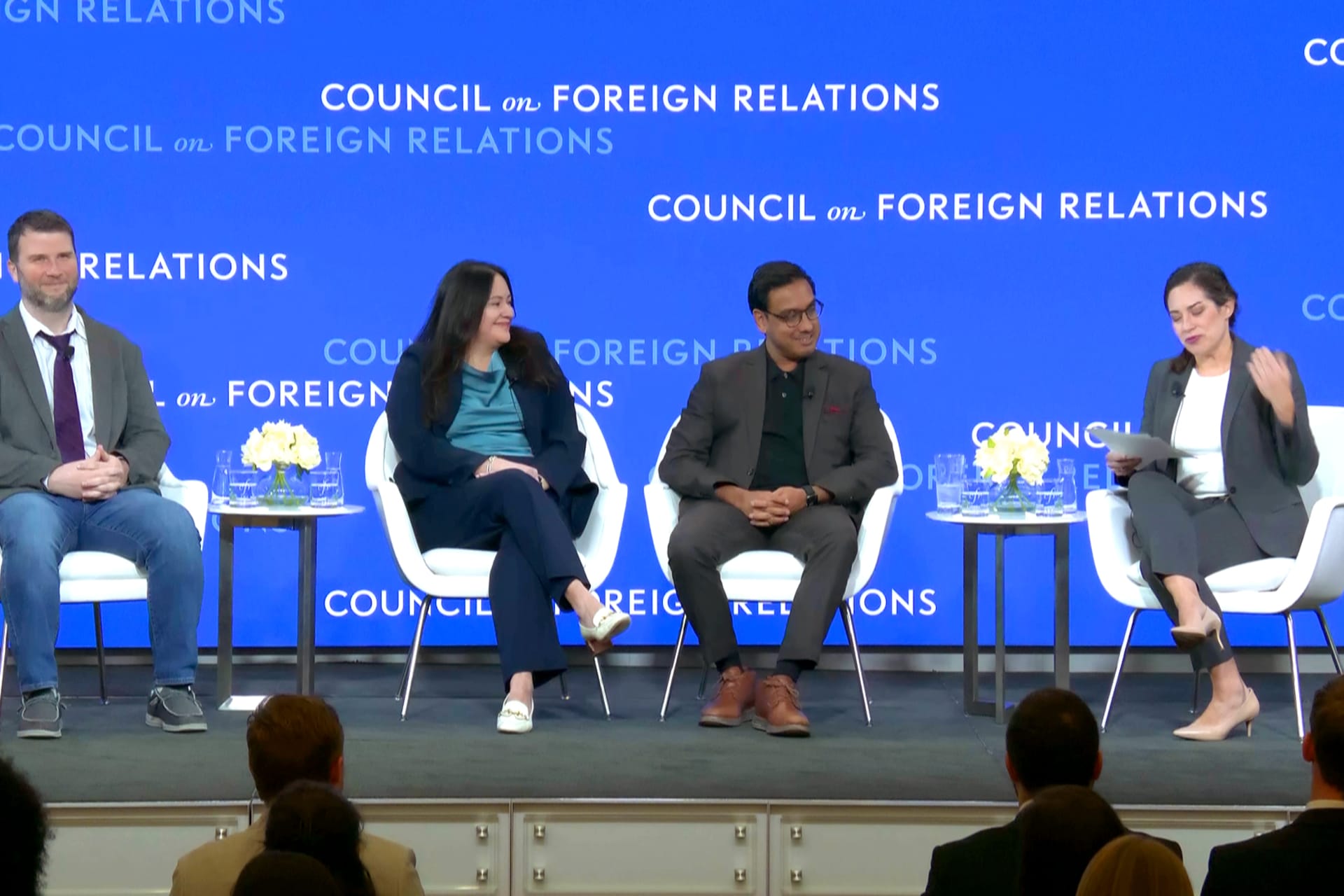
Good afternoon, good evening, good morning, depending on where you are. Welcome to today’s Council on Foreign Relations virtual meeting on U.S. Policy and the Indo-Pacific. This is the first in this year’s IAF Summer Series. My name is Daniel Mandell, and I’m a visiting assistant professor at Chicago-Kent College of Law. I was also a 2022-2023 Hitachi international affairs fellow in Japan.
Joining us today are three current or recent international affairs fellows.
First, we have Matt Finkel, a 2025-2026 Hitachi international affairs fellow in Japan. Matt recently completed his six-month international affairs fellowship in Japan earlier this year, where his Defense Technology Project was hosted by the Yokosuka Council on Asia-Pacific Studies. He currently conducts research as a technology and human rights fellow at the Harvard Kennedy School and previously served in the Biden-Harris administration as an appointee in the State Department.
Second, we have Kristina Obecny, a 2025-2026 international affairs fellow in national security. Most recently, she was detailed from the Department of Defense to the National Security Council as director for India, where she led national security strategy and policy coordination on India.
And, third, we have Mike Rattanasengchanh, a 2025-2026 international affairs fellow. Mike is a fellow with the House Committee on Foreign Affairs and also an associate professor at Midwestern University, from which he is currently on leave.
I want to begin our conversation this morning by asking each of our speakers to speak for a couple of minutes about the current state of play with respect to U.S. policy towards the Indo-Pacific, from the perspective of the specific part of the region on which they are focused. What’s the most significant issues that you see right now? And what is the U.S. currently doing in the region with respect to those issues? Why don’t we start with Japan. Matt, what did you see during your time there with respect to U.S. policy and the issues that are dominating in the relationship right now?
FINKEL: Certainly. Well, thanks, Daniel. I’m very glad CFR is putting this on. And thanks to everyone for tuning in. It’s certainly an interesting time to be talking about this.
I wrapped my Japan fellowship a couple of months back, and will keep my remarks fairly Tokyo focused, then it sounds like we’ll move regionally. But the most consequential change to the U.S.-Japan relationship in the last year has really centered around Japan’s big push to rearm after decades of anemic defense spending, and to begin paving the way to export defense articles to friends and partners in the region. Japan’s rearmament arises really both out of a real sense of insecurity, publicly held and politically, around Chinese maritime coercion, as well as from a strong desire to get ahead of American burden sharing demands. So it’s been a year of big steps forward on that multi-year goal.
You know, Japan’s defense spending has surged, as planned. Decades-old legal barriers to defense exports have come down. And these actions are very much in line with long-standing requests from U.S. ambassadors across administrations. As a result, China has reacted quite negatively to what they’ve termed “Japan’s return to militarism.” I’ll touch on just how negatively in a little bit. But the rest of the region does not seem to be buying into that line of thinking. The Philippines is eagerly awaiting the expected transfer of Japan’s retired excess Abukuma-class ships early next year. Japan’s Ministry of Defense also agreed just this past month to export more advanced Asagiri-class destroyers to Indonesia.
And, on a principal level, the Trump-Takaichi visits, despite some deeply uncomfortable televised moments, did go well. Publicly the Trump team has remained complimentary towards the Takaichi administration, even after conversations became quite difficult around Japan’s unwillingness to take a more active maritime role in the Iran conflict. Tokyo has largely managed to stay out of the crosshairs. While, in comparison, South Korea, you know, received a couple tongue-lashings in public. And, you know, Japan’s defense planners can, and certainly have, tried to scour our 2026 National Defense Strategy for a better understanding of the Trump team’s changing interest in the region, but really the clearest measure of U.S. Indo-Pacific policy this last year, as it relates to Japan, probably can’t be found in, you know, one of our strategic documents so much as in our delivery schedule.
Hegseth called Koizumi-san, Japan’s minister of defense, just this past month to share that there would be very serious delays in the delivery of, I believe it was, 400 Tomahawk missiles to Japan, as the Pentagon instead must prioritize rebuilding weapons stockpiles that were severely depleted during its campaign against Iran. Japan had expected this in kind of two large batches, each by April 2028. And these Tomahawks were felt to be critical, because Tokyo has almost no real equivalent for China’s 2,000-plus long-range missiles that are now capable of hitting targets in Japan.
Just this past week, I guess it was two days ago now, the joint Chinese and Russian live-fire drills inside Japan’s claimed economic exclusion zone really underscores the pain of that delay. These drills were a notable provocation. They represent sort of a new level of Chinese ire at Japan’s continued rearmament. And now Washington is telling Tokyo that they will have to wait two years longer before it can credibly build up its counterstrike capability.
And all of this sort of comes on the heels of the Takaichi government successfully reaching its 2 percent of GDP defense spending target two years early, and opening expedited revision of all three of its strategic documents, you know, beginning to upgrade its intelligence capacity, removing its arms transfer restriction, expanding regional partnerships, about eight or nine other really consequential moves that all show that Japan has been really quickly working to address a number of major U.S. asks. And Japan has been such a responsive partner in part because strategic hedging against a U.S. withdrawal or a U.S. loss of interest in the region is just not seen as viable. In mainstream political thought in Tokyo, there is sort of a consensus belief that the country cannot see to its own security without the U.S.
That is certainly my belief as well. And it’s reflective of the strategic reality, which is why we will likely continue to see Japan try to take U.S. unpredictability, and oftentimes unreasonableness, in stride. Per President Trump’s demand, Japan has been working to find banking and financing for the $550 billion investment in U.S. energy projects that they certainly cannot afford. Some portion of that money has already been allocated to planned projects. They’re debating the specifics now. But that helped to secure, you know, what we live under now, which is a 15 percent tariff regime, instead of sort of the threatened 25 percent We’re all waiting to see, with bated breath, kind of what the newly announced tariff wall will look like, after the White House’s recent legal setbacks.
But Japan has been a demonstrably receptive partner. And despite the Tomahawk delays, they’ve also—they’ve gotten positive feedback from the U.S. delegations about continued regional interest and belief in the strength of the U.S.-Japan alliance. Likewise, the U.S. has no way to comparably counter Chinese maritime influence in the region without Japan. And so we’re still very much each other’s only game in town. And for now, that understanding has taken hold on both sides of the Pacific. So with that, Daniel, I’ll turn the mic over to you and our other speakers. And I’ll look forward to engaging questions.
MANDELL: Great. Thanks, Matt.
So let’s go a little bit further onto the continent now and look at Southeast Asia. Mike, what are you seeing there? There’s an ASEAN meeting that’s been happening. What are the big issues? What is U.S. policy in the region? What are the actions, the activities that are going on there?
RATTANASENGCHANH: Yeah. Thank you. It’s interesting that—(laughs)—this is a meeting that’s supposed to be centered around ASEAN foreign ministers, ASEAN members, but you do have these other partners that are involved or participate—or at the meeting, like Russia, China, and the United States. And we’ve just heard recently that Secretary Marco Rubio is having discussions with the Chinese and the Russians about problems that—or, issues that are adjacent or tangential to what’s going on in ASEAN. So I think it’s just kind of funny that this is a meeting that’s supposed to be more centered on ASEAN problems, but we have these bigger powers trying to figure out their own issues.
But, with that being said, there are issues that are connected to Southeast Asia. And one of them is Iran. So one of the biggest concerns among ASEAN members, and I would say in more particular Thailand, Vietnam, and the Philippines, is that—is energy, specifically crude oil and LNG. From some statistics, 80 percent of the crude oil and LNG is destined to Southeast Asia. And so there is some real major, major concern. And it’s interesting that this happens on the heels of—I wouldn’t say maybe on the heels, but just after 2025, when the White House rolls out its new tariff negotiations and policies.
Southeast Asia, many Southeast Asians—Southeast Asian nations were caught off guard with some of the new tariff restrictions or deals that the White House was trying to push. And so a lot of them had to adjust. And some of them did successfully. I guess maybe successful is depending on your point of view. And then all of a sudden this happens, with this really big energy scare. And so Southeast Asia is being hit by just what seems like one thing after another. And so what’s happening, I guess?
So what are—so there are talks from Southeast Asian nations to try to find alternatives to this issue. And so there are talks about working closer with Japan, Australia, maybe in thinking about more nuclear. But also renewable energy. I would say Southeast Asia is maybe on the cutting edge of new green power, new green technology. Indonesia, Singapore, Thailand, and Malaysia are making a lot of strides in renewable energy. And so it’s—you know, we’ll have to wait and see how the new ASEAN grid and that policy and those initiatives pan out. And then some ASEAN countries are talking about looking at China and Russia for alternatives to get off this overreliance on fossil fuels coming from the Middle East.
And so what is the U.S. doing? This is where it seems more targeted, in certain ways. There is the Mekong-U.S. partnership, where Congress is—the United States with Congress is trying to work on critical mineral supply chains, giving funding to Mekong—the Mekong Mineral Partnership. And then there’s the Japan-U.S.-Mekong Power Partnership. And so these are—at least, these new funding amounts are new. And so it—again, it’s kind of one of those things where we’ll have to wait and see. The other big thing that we’re seeing is the United States and the Philippines. And, as I mentioned, Philippines is really concerned about their energy issues. And then they’re also very concerned about the South China Sea, and especially the recent incident of a physical altercation between Chinese and Philippine military officers, and that incident. But that’s just one of several other incidents that have happened more recently.
And so one big development that at least came as a surprise to me is that Vietnam and the Philippines signed a strategic agreement to really elevate their partnership. And with that partnership, one of the big goals is to make sure that the South China Sea is stable, and open, and free, and really to push back against China’s claims in the South China Sea. So that was a big surprise, but when we look at now the United States and the Philippines, there are a lot of major things happening. And they’re very recent. Pax Silica, which is a White House initiative specifically focused on Subic Bay. And then the Bases Conversion and Development Authority, really trying to make that waterway or that bay a strategic point of technology transfer, technology innovation. There’s just recently, hot off the press, U.S. ASEAN AI SPARK. So really trying to help wean the United States, but also its partners, off of this overreliance on critical minerals that are controlled by China, when we’re looking at semiconductors and AI.
And then there’s, like, the Millennium Challenge Corporation funneling—not funneling—but just more money into helping the Philippines with their energy sector investments. And then there’s massive amounts of security. There’s, like, a whole list of expansions on foreign military financing, training, counterterrorism, AI, and cybersecurity. And so there’s a lot going on there. And a lot of these things are very recent. And we could see this as really it’s a reaction to the Philippines not only reaching out to the United States, wanting some security in its efforts against China, but also the Philippines really struggling with this this energy scare.
And then the last one is maybe not so much new, but it’s ASEAN and Southeast Asia generally as practicing hedging. And so it’d be very interesting to see how things pan out with Iran. I know, at least from what we’ve read—from what I’ve read so far, is that ASEAN’s pretty united in the fact that they want a resolution with the conflict in Iran, because of the energy issues. But the more detailed—the details and the particulars, I guess we’ll see, because ASEAN—though it runs on a consensus-type basis decision-making process—they’re not all united all the time. And so the Philippines and Vietnam are generally more—and I it all depends on the issue—but when it comes to the South China Sea, they’re more—they lean more towards the U.S., whereas, like, countries like Laos, and Myanmar, and Cambodia are more China.
And so, and I’ll end with this, the ASEAN’s grand strategy that came out, it’s a 2026 to 2030 specifically the ASEAN-plus-one free trade agreement, is one of those things that stood out to me as really symbolic of their policy of hedging. Or their—maybe not policy, but just their international relations activities of just really trying to figure out where do they fit in, in U.S.-China rivalry. And so—and then—and it’s being—and it’s interesting. We’ll see how, after this meeting ends, what ASEAN leaders thought of, essentially, the United States, China, and Russia figuring out their problems at this meeting, when to me it should have been more ASEAN-focused. But—so, yeah. We’ll see what happens. And I look forward to questions later. Thank you.
MANDELL: Thanks, Mike.
So, finally, let’s look a little bit further to, well, I guess the west on the map, and let’s look at India. Kristina, can you tell us a little bit about what you’re seeing there, and what U.S. policy is right now with respect to India?
OBECNY: Sure. Thanks, Daniel. And thanks, Ian, for pulling together this event. And appreciate the opportunity to speak to the India issue set.
So, you know, I think there have been a lot of folks over the past year that have wondered, you know, what is the way forward? We had twenty-five years of, you know, relative stability and bipartisan support for U.S.-India relations, which is a rarity in D.C., and pretty much growth across every issue you could imagine—from defense, regional security, health, I mean, you name it, humanitarian assistance. And we hit a period, I would say, of probably the most significant turbulence we’ve seen in the U.S.-India relationship last year. I think coming into the second Trump administration, based on the first Trump administration, you know, India was sort of postured to work through maybe some irritants in bilateral opportunities and areas that had not been sort of fully fulfilled under the last Trump administration, but unprepared, I think, for the change in policy that ultimately came to—bore out.
We did see, you know, an early Modi visit last year, and I think a broad agenda was outlined in a joint statement. But a lot of that agenda sort of got sidetracked, if you will, by the bilateral trade issue. And then, of course, later that summer the India-Pakistan crisis, that ultimately became a little bit politically contentious for the Indians as a result of the U.S. taking sort of a more public and robust mediation posture in the context of the crisis, which is an area of pretty, you know, intense political sensitivity for the Indians. And then later in the fall last year, we saw 25 percent tariffs related to India’s purchase of Russian oil, on top of the 25 percent tariffs that were already there, bringing them in a category I think only matched by Brazil in terms of the level of tariffs imposed on any country worldwide.
So by fall of last year I think a lot of India watchers were sort of hailing a new era of, you know, potentially a more transactional relationship. You know, no longer sort of the more aspirational prior thought about, you know, maybe India would reach a more sort of ally-like status, given the state of the strategic partnership up to that point. That said, there seems to be a bit of a reset going on coming into this year. You’ve seen a lot more calls between President Trump and Prime Minister Modi. There have been a series of visits, most recently Secretary Rubio, and before that Undersecretary Colby from the Department of War. And there are sort of rumors around—in D.C. about, you know, this trade agreement finally—or, at least a first tranche of it being finalized within the next couple of months, following the interim agreement that was met earlier this year in February, which then reduced tariffs—resulted in reduced tariffs for India.
So we’re in a little bit of a gray area. I think what makes sense is, you know, to kind of walk through in more specific details what has changed and what I think—you know, what I think is going on in terms of recalibration in the relationship. And I would characterize it that way. I don’t think that the sort of core tenets of U.S. policy towards India have changed dramatically. And I don’t think, you know, India’s role in the Indo-Pacific, and how the U.S. sees India, has changed dramatically. But I do think that, based on the change in sort of broader U.S. foreign policy, India is sort of figuring out, you know, how to operate under this new paradigm.
So, what are some of the big things that have changed? You know, I think U.S. policy on, you know, how it approaches strategic competition in the Indo-Pacific, and how it approaches China specifically, you know, has changed. And there is some ambiguity in, for example, you know, what our economic policy will be on a number of issues that India watches closely. And of course, they’re always a little concerned that, you know, there’ll be a sort of détente moment that takes them by surprise.
So whereas prior—you know, the prior administration was pretty focused on, you know, a little bit more of a robust U.S.-India, especially defense, cooperation vis-à-vis China as an organizing principle for the relationship, that has sort of taken a little bit of a backseat. And bilateral trade issue is sort of the new organizing principle, with trade and, sort of, commercial reciprocity driving policy. A lot of that cooperation continues, but sort of below the surface. But that was something that I think the Indians had come into this administration assuming would be again the organizing principle. We have the sort of aligned interests that haven’t changed in the Indo-Pacific. And that is ultimately going to drive most of the conversation between the U.S. and India. And I think it’s just more complicated than that now.
Second, I think, you know, India became very accustomed to having the U.S. very openly, publicly, and then privately, boosting their position in the Indo-Pacific, as a core part of our strategy, and a fair amount of primacy in South Asia, and then deference on certain sort of sensitive geopolitical issues. So, you know, most prominently the India-Pakistan crisis that played out last year, in prior iterations the U.S. had tended to sort of follow India’s lead with respect to the diplomatic back and forth, and while playing some sort of, you know, behind-the-scenes mediation role, along with other members of the international community. You know, I think our desire to sort of take a more front seat, I think, rattled the Indians a bit, and sort of signaled that we wouldn’t necessarily have the same level of deference on geopolitical issues.
The reason why that’s important is, you know, under the last Trump administration there was also a border crisis between India and China, where the U.S. posture was also, you know, fairly robust in its support of India, but, again, deferential in terms of, you know, what is the—what is the sort of public message and, you know, what support do you need, how should we handle this crisis? I think in the current context there would be a lot of questions within Delhi on, you know, what would the U.S. do if there were another border crisis? And this is something that, you know, the Indians really do see as existential. Modi didn’t have any engagement with Xi for years. I mean, that tells you, like, the level of friction between the two countries. They’ve recently sort of tamped some of that down with a more tactical agreement along the border, but the strategic tensions are still there. And so I know, you know, the Indians will be watching closely what U.S. policy is towards China with that in mind.
And then last, I think the way the U.S. manages its irritants with India has changed a bit. Again, I think India became accustomed to us making sort of strategic accommodations to them, and vice versa, them making accommodations towards us, where we have, you know, some misalignment. So, namely, Russia is sort of the big elephant in the room for us. And previously we had worked through, privately, tensions related to defense purchases that India makes from Russia, and fairly successfully I would say. If you look at the data, you know, no large generational purchases over the last several years, primarily just purchases to sustain their current legacy weapons.
Now, with the Russian oil issue, those tensions have sort of again surfaced in a much more public way. And the more public sort of punitive actions, I think, have surprised the Indians. Whereas previously, most of that would have been managed sort of in private diplomatic channels. So I think the Indians are sort of trying to figure out the sort of new way forward. I think we’re actually in a period where some of that is shaking out. I think the big things to watch over the next few months, obviously, trade. There’s a lot of back and forth on, you know, will Modi come back to D.C., will President Trump go out to India? There was a proposal at one point that President Trump would go out to India as part of a Quad summit. That’s still, I think, a bit in question, depending on whether or not they want to keep Quad engagements at the head-of-state level versus the departmental level. And I think the big thing to watch with the bilateral trade agreement is the outcomes on Section 301 negotiations, which I think will really drive whether or not that’s successful.
And then the last thing on tariffs that was recently announced, that I think could be a game changer, is the pharmaceutical tariffs. You know, India exports an enormous amount of generic pharmaceutical products to the U.S. And so the 200 percent tariffs that could come into play in two years would have quite a huge effect on their economy. China obviously is the other big thing to watch, particularly whether or not there’s a sort of softening on Taiwan or a softening on U.S. export controls further. I think the Indians had, again, grown accustomed to us being their principal partner when it when it came to supply chain resilience and sort of economic security vis-à-vis China. And if there’s a perception that, you know, some of that is shifting, you know, they’ve taken on quite a bit of risk in delinking some of their supply chains from China, which hasn’t always been popular domestically. So that’s going to be a big thing to watch.
And then the Middle East. That’s obviously affecting the whole region, but India is one of the largest importers of crude oil in the world, if not the largest. And much of their crude has come from the Middle East historically. They shifted that under the Biden administration to Russia, due to sort of the advantages with the price oil cap. And they’ve obviously reduced their purchases of oil from Russia as a result of U.S. policy. But with the shocks to the Middle East sources, I think that there’s going to be a period now where the Indians are looking at, you know, their worldwide sources, and feeling quite a bit of pressure.
And not just on crude oil. They get quite a bit of their LNG and LPG from the Middle East as well, as well as fertilizer. So I think over the next several months, depending on how that conflict plays out, you know, the Indians are going to be looking for some level of accommodation with respect to energy security and, you know, what sources they’re allowed to pursue in order to maintain some level of stability, particularly inflation. There have been a lot of estimates thrown around, but India’s GDP could be affected by as much as 1 percent, depending on the outcome of the Middle East conflict.
The last thing I would say is just, in terms of way forward, I think there is sort of the political level, and then there’s the institutional level. So much has been built with the Indians over time at the institutional level that there’s actually a fair amount of continuity. You have really deep institutional ties with defense, intelligence, across all departments, with critical technologies, energy. So there’s actually quite a bit that has enjoyed relative continuity and quite a bit that has happened, despite the political back and forth over the past year. And I don’t see that changing. I actually see that being sort of the constant. And I also see the—you know, the core interest of a balance of power in Asia being a constant.
So I do think that if the political sort of back and forth can reach a point where the U.S. and India have reached sort of their new status quo, I think you’ll start to see agreements on, you know, defense industrial cooperation. You’ve already seen a couple defense sales. I think you’ll start to see more on critical minerals. Rubio announced, you know, a new critical minerals framework recently. I think energy security is going to be a huge opportunity, and specifically potentially small modular reactors, if they can take advantage of the new legislation in India that allows for their market to be more open in that respect. And then supply chains, which—critical supply chains, which is a shared concern across a number of different countries in the region, especially vis-à-vis China. So I actually am relatively optimistic on the way forward, but, you know, time will tell. And I’ll leave it there. Thanks very much.
MANDELL: All right, thanks, Kristina. Let’s open up the floor to questions from our audience. I think we have quite a few people who are joining us today. If you’d like to ask a question, you can use the raise-hand button, and you’ll be called on. Please remember to introduce yourself before asking a question. And a reminder that this meeting, again, is on the record. Can we have our—
OPERATOR: (Gives queuing instructions.)
We will take our first question from Tim Ferguson.
Q: Thanks very much. I’m a journalist with a long focus on Asia.
Mike, I’d like to ask you about the apparent drift or swing of the Malaysian and Thai governments away from the U.S. and toward the PRC. Is this simply an act of hedging, as you referred to it earlier? Or is there something more going on? Thank you.
MANDELL: I think, Mike, you are muted.
RATTANASENGCHANH: I can speak more to Thailand, just because this is my—has been my academic field of research. But this this drift has been going on since—I would argue, since the seventies, when the United States left Southeast Asia. But more recently, probably within the 2000s, the United States has been more vocal against Thailand’s human rights issues, especially with several military coups recently, and also some of the arrests that have taken place against political activists under the Section 112 lèse-majesté. And so this drift has been going on for a while, and I think it’s just become more apparent more recently because China has become another alternative for Thailand. Not only for military weapons, but also for economic incentives and foreign investments.
The most previous—one of the last prime ministers, Thaksin’s—well, one Shinawatra family members, when she became prime minister, her major focus in the first several weeks was to cater to China and wanting their foreign direct investment. So, I know right now there’s a U.S.-Thai agreement, that has stemmed back for decades, but I think that’s really just a paper tiger. I think, again, Thailand just seems to be—seems to find a better partner in China, because of economics and less issues with, you know, a bigger power coming in to tell them about their human rights issues, and so—and, but, I mean this doesn’t mean Thailand is all the way in the pocket of China, and I would even say with Malaysia. But if we were going to go percentage-wise, or at least close to that, Thailand is probably more in the pocket of China than it is the United States. And so my guess is that it will increase. It won’t 100 percent. I don’t think Thailand, or even Malaysia, will go 100 percent over to the Chinese, because there’s that hedging aspect of it. But I think, yeah. So those are my thoughts.
MANDELL: Thanks, Mike. Can we have the next question?
OPERATOR: We will take our next question from Tim Persons.
Q: Yes. Hi. I’m Tim Persons. I’m a CFR member and previously a PwC partner, who’s done a lot of work on the proliferation—or, the pathway of AI’s growth in ASEAN region. I’m doing some work now in a private capacity, but just interested in your all’s thoughts of, if AI security is kind of a part of the new national security, how do you see AI growing and proliferating in the ASEAN region, when you talk about very different countries, right? All of the investments—you know, Kristina was talking a lot about India. Massive investments in India, but they have things, like, you’ve got to get cabling into the country. And then you have Singapore, which is incredibly advanced, and so on, relative to other entities that want to drive things, Cambodia for example. But there’s interesting stories in Indonesia. I’m just wondering what you all are seeing about the ASEAN posture with AI going forward, especially being so close to China and also being somewhat allied to the U.S.? Thank you.
RATTANASENGCHANH: I’ll take a first quick stab at, just since it’s ASEAN. So, as you know, all the ASEAN countries are at different levels of technological advancement when it comes to AI. And so there are—ASEAN has come out with a digital strategy plan and an AI tech plan. And so the goal is to integrate and to build capacity, but step by step. Like, some, like Singapore, Malaysia, and Indonesia, are much further ahead in terms of their AI technology. And so I think it’s going to be incremental to include the other countries. But there is that goal, to use AI and digital technology, and tech in general, to integrate ASEAN more fully in all the various aspects that are related to tech and AI.
But it’s going to have to—but I think the challenge for them is that—for ASEAN—is, again, different levels of capability. But then—and the one point I want to maybe be more specific about is issues with data and information and sharing, is that some of the ASEAN countries have a stronger ability to protect, to regulate AI. Whereas others are, I think, in the process. And so, but the goal is to do—is to integrate, and to make AI a critical part of ASEAN.
MANDELL: Matt, you know, Japan historically is quite a powerhouse in technology. What do you see with respect to AI, and what policies they’re developing right now?
FINDEL: Certainly. You know, it’s a notable part of what the Japanese Ministry of Defense is trying to do in terms of slow—very slowly righting the ship of Japanese defense spending, and moving towards a newer, more modern defense concept. But Japan is also incredibly far behind on anything in the cyber domain. Like, basic cybersecurity hygiene is and, you know, certainly should be, kind of a bigger feature of Japan’s push in this domain. I mean, the general shift—both in the U.S., but also, you know, certainly one aped by Japan now, of moving away from large, exquisite armaments towards large numbers of small, disaggregated drone constellations, integrating all of it with, you know, space-enabled communications, with command and control. All of that is undergirded by AI. And that needs to be, you know, a critical piece of the puzzle. Japanese defense planners understand that. But it’s—you know, it’s going very slowly.
The sort of baseline capabilities that AI needs to build on, i.e. large, organized datasets that make—that, you know—besides just sort of the, you know, AI modeling conversations we’re thinking about, but certainly in the military realm, just don’t exist. Yeah, there’s a meaningful lack of technical capacity, the engineering capacity that is needed to make AI a reality across, you know, the sort of Japanese defense array. So, in short, they realize it’s an issue. They need it badly. And they’re nowhere close. Yeah. The answer will likely be to, you know, call in a partner. American companies are only too eager to get involved in this way. I think the U.S. embassy in Tokyo also realizes that if there’s going to be a solution to the enormous deficit that Japan faces on AI, that the solution is an American private sector one. And so that’s the conversation going on. It’s certainly viewed as critical, but there’s a lot of work to do.
MANDELL: Hmm. Kristina, in India, are things, I guess, as behind as Matt describes them in Japan? What’s the government doing? And what’s it doing, I guess, really with relation to U.S., or maybe are they looking at Europe or China, on AI issues and policy?
OBECNY: Thanks, Daniel. Yeah, I think the U.S. has been the primary partner that India has sought out to help build out their infrastructure and capability, through both government-level and industry partnerships. This is an area where, arguably, the private sector is sort of ahead of where some of the government-to-government talks are. I mean, Amazon, Microsoft, Google, OpenAI, I mean, they’ve all made some level of investment in India. And I’m forgetting the exact figures, but I think both Google and Microsoft, you know, in the order of billions of dollars are investing in datacenters in India.
And this has been a focus, both under the Biden administration and then under the current Trump administration, in terms of aligning policies, governance, regulations, and then, more recently, under this administration, you know, how do we align on specifically standards and developing your infrastructure? I think the key challenge to date has been our export control policy on AI chips, and what kind of chips we are willing to export to India. And so that remains, I think, an area of discussion. And I think the outcome of that will largely drive, you know, how fast India is able to move.
MANDELL: Thanks. OK, can we have the next question?
OPERATOR: We will take the next question from Robert Carroll.
Q: Hi. This is Rob Carroll. Hopefully you can hear me. Advisor to Governor Cox in Utah.
We do a lot of work to combat PRC influence in the states, at a state level. I think one question that we have over here is, you know, between countries in the region, in the Indo-Pacific, what are some low-hanging fruit in terms of security or economic deals that we’d like to see between those countries, to push back on Chinese coercion in the region?
MANDELL: Does anyone want to start, some maybe low-hanging fruit ideas?
FINKEL: I can jump in with one. And this sort of dovetails into, you know, potentially a Quad discussion. But one thing that Japan has pursued very aggressively through that diplomatic forum has been maritime domain awareness, which involves, you know, a pooling of resources, you know, it requires more than one bilateral relationship to make this a usable, workable, helpful tool for Southeast Asian countries pushing back on, you know, Chinese maritime interference. It’s something they’ve, I think, found success with, in identifying early partners. The kind of big question mark is how involved India will choose to be with Japan, given some capabilities they have. It’s been a feature of Quad discussions that have not yet happened.
But that’s one area where certainly there’s been a lot of interest, where it might not include every relevant actor but it’s—you know, countries have certainly found it worth their time to look at closely. In that same—you know, in in that same breath, but other conversations have sort of been very focused on critical minerals and on energy security, and in taking what have been sort of productive bilateral relationships and bringing in third and fourth partners. So that’s something that feels realistic and workable that we’ve seen expand in the last year or so.
MANDELL: Mike, I know for countries like the Philippines, maritime domain awareness has also been very important. Do you see that as an area that the U.S. could really go after with respect to Asia and Southeast Asia? But equally, is there something that maybe U.S. states—I think the questionnaire was working with a state governor—are there things that U.S. states could do in the region with the countries to, you know, secure some of those low-hanging fruit, maybe economic deals or other development deals?
RATTANASENGCHANH: Yeah. So I will go with the second one. So I lived in Utah for several years. Yeah, so I just want to make sure—I heard Utah. You know, Utah is growing in terms of its tech industries. And so I think some of the low-hanging fruit would be maybe being more diversified in some of its technology business deals, technology exchanges. I know that can be kind of complex with export controls, but I think that’s an easy—to me, easy, low-hanging fruit. ASEAN nations are some of the most—they’re growing. It’s population is young and highly technically literate. And so there is so much technology that I think states like Utah, that, again, are—that have a big tech—growing tech industry, can really benefit from.
And then I’ll go with just the first one, in terms the Philippines, or just maritime awareness and domain. That can be tricky, at least with ASEAN, because it’s—and this is something that’s not new—but ASEAN can’t come up with a consensus on how to deal with some of that domain awareness. This might, you know, like I said earlier, Vietnam and the Philippines have entered into an agreement to push more on pushing back on China. And so I don’t know if—that might be—that’s probably not low-hanging fruit, because I don’t think any U.S. administration or state government wants to build a relationship with Vietnam in that kind of way. So I think that the first question is a little bit trickier. But I think the second one—I think Utah could easily capitalize on not only its growing tech in the state, but also the amount of technology growing in ASEAN, like Indonesia, Malaysia, and Singapore. So.
MANDELL: Kristina, what do you see from India? What’s some low-hanging fruit that either U.S. or U.S. states might be able to help collect—or pick, I guess?
OBECNY: Sure. So I’ll answer this just from more of a defense perspective, given my background with the Department of Defense. So just following up on Matt’s earlier comment on maritime domain awareness, so the Maritime Security Initiative over the last couple of years has pushed through satellite data to not just Southeast Asia and the Pacific islands, but now to South Asia—which was financed under the Quad, and I think reached sort of final fruition sometime over the last year. So I actually do think that sort of what’s next on that, in terms of the type of data sharing that could be done and through fusion centers, would be a logical next step, and definitely low-hanging fruit. And it’s definitely something that I think the PRC watches, because the more that we can increase the transparency initiatives that we have, and the data that countries have on what’s going on in their sort of respective territorial waters, is going to be—it’s a collective good. And the PRC knows it.
The other thing I would say, and this isn’t specific to U.S. states but just in the region, you know, there’s been a growth over the past several years of cross regional exercise participation, which I’ve found really interesting. Because I think the more that, especially some of the smaller countries, you know, within South Asia or maybe some of the Pacific islands, can see how we exercise with Southeast Asian countries, and vice versa. When India hosts nations from outside the region for exercises, I think it increases a little bit more understanding on, you know, how we operate and how we can sort of collectively monitor and deter aggressive behavior. And, you know, Super Garuda Shield is an example where it’s been expanded recently in a way that I think has been popular with regional countries, and sort of raised the eyebrows of the PRC. So I’d love to see more of that. And that’s extremely low-hanging fruit, and is usually just a funding question.
And then, with respect to U.S. states, I mean this is a hard one. We don’t—we do quite a bit of engagement with the Indians, you know, through our people-to-people ties. But less so relative to the PRC. But what I would say is, you know, the Defense Department has the State Partnership Program, which is fantastic, and I believe has partnerships across South Asia and Southeast Asia. Finding ways to expand that network, I think, would help create further linkages between, you know, U.S. state governors and the National Guards with, you know, countries around the region. And that program is one that falls in the category of a super small amount of funding goes a really long way. So it’s never going to go away. It’s never going to be something that gets caught in budget cuts.
MANDELL: Yeah, and I’ll just add on to that. I’ll take moderator’s privilege here and add on. In that regard, you know, international students I think are an amazing way to capture a huge amount of value for very little cost. And that’s something that states can do, by welcoming international students into their state university systems. You get so much value. And likewise, sending American students abroad. Study abroad programs, Fulbright programs, similar exchange-type programs cost very little, but really the value I think has just been proven to be really, really huge. And, you know, Ian will be really proud of me. The IAF, for example, is a great example of sending people abroad—Japan, Korea, Canada—and getting a lot of experience and a lot of value to that. So I would definitely encourage anyone who has the ability to take care of that.
We have a few more minutes for more questions. Again, if you want to ask a question you can use the raise-hand icon.
You know, one thing I’ve been thinking about is kind of the linkages between all these different policy areas that we’ve been talking about. We’ve got tariffs, but we also have security cooperation. We’ve got, you know, energy development, but also we have climate change. How are you seeing these—the linkages here play out, kind of on the ground, when you have basically the same people are negotiating with the same people in seemingly contradictory areas? Do you think that this is a—I don’t know if you want to answer this—but a good policy way to approach things? Or are you are you seeing that there is an effectiveness? Or are you seeing that the negotiations, the meetings, are proving less effective, because of the kind of push and pull of these different policies? I’m happy to throw that open to anyone who wants to take it.
FINKEL: Sure. Thanks, Daniel. I’ll jump in on that quickly, just vis-à-vis Japan, because Japan is sort of a unique case in which that linkage of tariff and security cooperation, being talked about by the same negotiators in the same breath, has yielded benefits to the U.S. without damaging the—you know, fundamentally damaging the fabric of the alliance. You know, the concessions that the United States has been able to reap from its, you know, sort of—you know, coercive-style of negotiation with Japan, has led to deliverables that would likely not have been possible in the course of normal alliance diplomacy business. That’s been possible because Japan, unlike many other countries, does not have a viable alternative partner on security issues.
You know, while the feathers of senior MOD officials, you know, are ruffled frequently, they get over those feelings fast enough to continue to work productively. You know, conversations about, you know, losing confidence in the U.S. as a partner happen very quietly, because, you know, luckily for Japan, even the steps you would need to take to hedge against a U.S. withdrawal are the same steps that you also need to take to bolster U.S. confidence in you as a partner—i.e., building regional partnerships, investing in your own defense, showing the U.S. that you are sharing that burden. That they’re functionally the same language. So in in Japan it’s worked because Japan is, you know, if not unique, they are, you know, certainly a special case, that there’s just nowhere else they can go.
MANDELL: Hmm. Yeah, and Mike and Kristina, you both have talked more about hedging. Do you see this kind of push and pull of policy causing more of a—more of a hedge, or more of a drift away from the U.S., to what might be an alternative more reliable or consistent partner?
OBECNY: There’s a long answer and a short answer to that. I think the short answer is, I don’t know that India has reached a point where it’s drifting away from the U.S. I think that there’s just—it’s too big to fail, if you will. That the foundation is sort of too big and we’re just too intertwined. Our economies are intertwined. You know, obviously our people-to-people ties are extremely strong, and have been. But what I would say is, if there’s hedging, there’s hedging on—it’s sort of issue-dependent. So with respect to, especially, I would say, trade and investment outside of the defense arena, there’s probably a little bit more of a cautious approach. Defense cooperation tends to be the pillar that moves forward without sort of caution.
But I think you’re going to see the Indians diversify their relationships. And you’re already seeing that, right? Whether it’s European trade agreements, alternative sources for certain trade goods. Whereas, you know, the U.S. was their largest trade partner I think for almost twenty years, up until this year. It was the first year that we weren’t. So I think you are going to see a little bit more of a diversification, with the most stability being in the defense realm. But that’s understandable, given that, you know, our trade policy is unpredictable.
MANDELL: OK. Mike, I’ll give you the last word, in a minute.
RATTANASENGCHANH: I would just stick to energy. I think this is where we’re going to see more diversity in terms of partners, alternatives, whereas before most Southeast Asian countries relied on the Middle East, relied on the United States. And so I think we’re going to see them looking other places, or trying to look at other alternatives at home or in the region.
MANDELL: Great. All right. Well, that pretty much brings us up to time. So keeping in line with CFR policy, where they threaten to, I think, kick you out if you go overtime, let’s end it here. Thank you all for joining today’s session. Thank you to our speakers for their time this afternoon. The next IAF Summer Series meeting will take place on July 29, and will focus on multilateralism under pressure. So please join us then.
(END)
This is an uncorrected transcript.