Science Fair Series: Demystifying Nuclear Fusion
Event date
From Science Fair Series.
What if the energy that powers the stars could also power your home? Scientists from Lawrence Livermore National Laboratory, one of the U.S. government’s premier science institutions, discuss where the research on nuclear fusion stands, what it will take to bring it to scale, and what it means for American competitiveness and global energy security.
This meeting is presented by LEAD AI, a CFR initiative working to ensure that the deployment of AI systems reinforces democratic resilience, safeguards human agency, and resists the consolidation of authoritarian control.
The Science Fair Series is a new meeting series highlighting cutting-edge developments in emerging technologies that will impact foreign affairs. Our series is specifically designed to bring scientific insights to all members of CFR, regardless of members’ scientific background. This event is made possible by the support of the MacArthur Foundation, Rockefeller Philanthropy Advisors, and the Hewlett Foundation.
DUFFY: Good evening, everyone. So delighted that you can join us here. My name is Kat Duffy. I’m senior fellow here at the Council for digital and cyberspace policy. And I also direct our LEAD AI initiative, which is a new initiative at the Council that really focuses on AI’s deployment and adoption at scale as its own area of foreign policy.
I am so delighted to introduce our amazing guests today. I’ll start by saying this meeting is on the record. It will be recorded and will be online. I will also say that for this particular series we employ what I like to call the jargon giraffe. So for anyone in the audience, this is the jargon giraffe. (Laughter.) And if there is anyone in the audience who is consistently hearing a term they do not know and that does not make sense, I guarantee you, you are not alone. So if you would please jargon giraffe me, that is a signal to me that I should get that term clarified for you, OK?
So welcome to today’s Science Fair Series on “Demystifying Nuclear Fusion.” The Science Fair Series is a new meeting series highlighting cutting-edge developments in emerging technologies that will impact foreign affairs. So we did our first meeting on quantum, then we did another on material sciences, now we’re doing fusion. And this is the first science fair meeting in New York. So we’re really excited to bring it to this office of the Council. This event is made possible by the support of the MacArthur Foundation, Rockefeller Philanthropy Advisors, the Hewlett Foundation, and also Humanity AI, which is a new AI philanthropic fund. So we’re very grateful to all of those supporters.
I will, I think, as Meaghan said, we’ll start with about thirty minutes of a conversation, and then we’ll open it up to Q&A, both here and for the almost 400 people who are joining us online. And so with that, I am delighted to welcome Kim Budil, laboratory director of Lawrence Livermore National Labs and a CFR member, and Tammy Ma, director of the Livermore Institute for Fusion Technology, or LIFT, who we’re all trying to make apply to CFR. (Laughter.)
And so with that, I think, Tammy, I’d love to start with you. And in the spirit of Science Fair, and really the goal for the Science Fair Series is that people who aren’t necessarily familiar with the technology walk out of the room feeling a little more empowered, a little more agency to engage with the tech. So with that, we’re going to start with a very basic question. Fusion, what is it? (Laughter.)
MA: Yeah. So fusion is the same process that powers the sun. It is different from fission, which is kind of the more conventional nuclear power everyone’s probably more familiar with. Fission means breaking down a very heavy element. Fusion, on the other hand, means combining light elements into something heavier, and in the process releasing a ton of energy. How does this really work? Well, the process that we are most interested in here on Earth is using deuterium and tritium. They are isotopes of hydrogen—heavy hydrogen. And if you can get those deuterium and tritium atoms close enough together, so dense enough, hot enough, and hold them together long enough, they can actually fuse.
And they’ll create a helium nucleus. You remember from chemistry, helium is the number-two element on the periodic table. And it just so turns out that your helium nucleus weighs just a little bit less than your deuterium and tritium originally did. That difference in mass, that mass loss, goes into Einstein’s equation—E=mc2. That’s the “m.” You multiply it by “c,” that is the speed of light—big, big number—squared. You get a huge amount of energy out. So fusion is the most energy dense energy source that we could have. It’s about three to six times more energetic than fission. And we’ll talk a lot more about the benefits and pros of fusion later.
DUFFY: And, Kim, Lawrence Livermore has been obviously an incredible leader. In this technology, we’re going to discuss specifically the incredible advancements of the past few years. But can you describe a little bit just what it has taken to get there?
BUDIL: Sure. So the fusion community has been researching this process for many decades. We’ve been working for more than six decades on the type of fusion that we pursue, because the physics is very straightforward. Tammy described it very beautifully, bringing these atoms together. The trick is creating those conditions in the laboratory is incredibly difficult. So for Livermore, this started sixty years ago when one of our researchers who was trying to think about ways we might be able to study controlled nuclear fusion in the laboratory thought—there was a new invention at the time, the laser. And he thought it might be possible to use lasers to create the conditions that would allow you to create these very high temperatures and densities, and the confinement of this fuel over time.
At the time, this gentleman, John Nuckolls, who later became director of Lawrence Livermore and is still around and still interested in fusion, he at the time predicted it would take about 1,000 joules of laser energy to get to those conditions. Now, of course, John is working with a pencil and 1D modeling and simulation tool of the day. The world is very simple in 1D. The lab embarked on a program to build ever-more energetic lasers. We learned more and more about the physics processes and how difficult it is to create these conditions. When we finally did have our big fusion breakthrough, where we for the first time by any approach produced more fusion energy out of an experiment than the laser energy required to drive that experiment—so this is the fusion ignition event—we were at two million joules of laser energy to create those conditions.
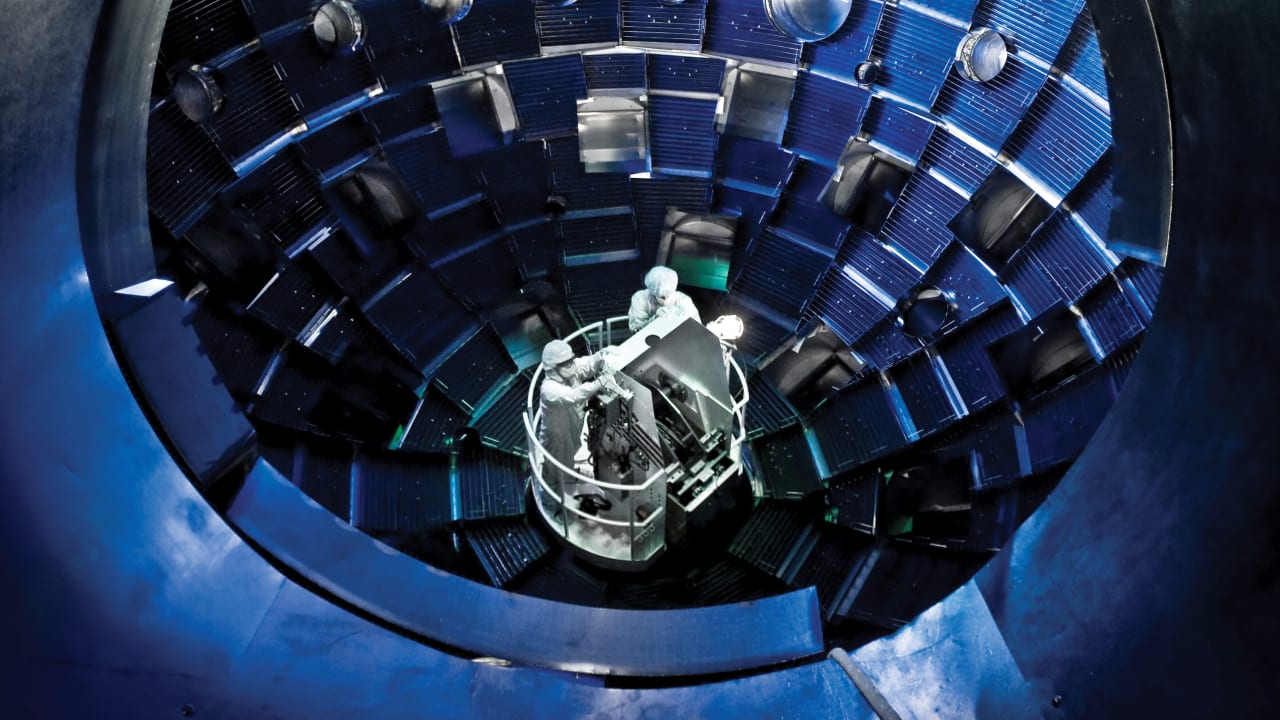
So, in essence, the way we do this is we use all of this laser energy from the world’s largest, most energetic laser—the National Ignition Facility—and we focus it into a very small volume to create a very high energy density. So we have a very small can that’s made of gold or another heavy metal. All that laser energy gets converted into X-rays. So we create a very hot oven. That oven heats up the outside of a capsule. The outside of the capsule blows off. That blows the interior surface in, and it begins to squeeze up that fusion fuel. So this is hot and fast fusion.
There are other approaches to fusion that use different technologies. For example, many people have heard of magnetic fusion approaches. There are devices like a tokamak, which is a large donut-shaped vessel within which you can find a plasma, so a medium of charged particles, using magnetic fields. So it’s a much lower density process. It’s a much longer-burning process, so sort of low and slow fusion. That’s another way that you might create these conditions in the laboratory. And the community over time has been trying to both perfect the machines, perfect modeling and simulation tools to really understand the physics, and then developing ever-more precise technologies both to diagnose these plasma conditions but also to create the kinds of materials and targets and high-precision machines to really get to these very precise and exacting conditions for fusion.
DUFFY: And what is the lab’s relationship to the Department of Energy?
BUDIL: So Lawrence Livermore National Lab is one of the seventeen Department of Energy National Laboratories. We span a wide range of missions. So the missions of the department range from energy and energy technology development, to fundamental science, to national security. So our laboratory is part of the National Nuclear Security Administration, which is the national security part of the Department of Energy. We have about 9,000 employees at our laboratory working in large multidisciplinary teams to apply advanced science and technology to a wide range of national security missions. The core mission centers on sustainment of the U.S. nuclear deterrent, but we work in a huge range of areas—from critical infrastructure protection, to biosecurity, to climate and energy technologies, and anything and everything you can imagine.
DUFFY: So in my space, the end of 2022 is notorious for the public release of ChatGPT. That is how everyone that I know remembers the end of 2022. But in December of 2022, there was another seismic occurrence in science. And, Tammy, I want to ask you—and I want to ask you to not be as modest as you normally are. (Laughter.) I want you to really explain to folks the incredible breakthrough that you and your team led that has been game changing.
MA: Yeah. So December 2022 was when we achieved fusion ignition. This was the first time humans had demonstrated in the laboratory controlled thermonuclear fusion burn giving more energy out than we use to actually drive the reaction. So what this actually did was demonstrate the scientific feasibility of fusion as an energy source. And it was built on over six decades of investment, committed investment by our U.S. government and the Department of Energy, and just tens of thousands of people that had committed their lives to trying to better understand the physics of fusion, understand how to build up the technology, the lasers, the targets, all coming together to make this breakthrough. And, yeah, it was—it was a big deal.
DUFFY: And can you explain what it was about your approach that is distinct? I mean, Kim touched on this a little bit, but going specifically into how did you and your team approach this differently than a lot of the other approaches that was really—that was sort of innovative, and produced these results?
MA: Yeah. So our approach is called inertial confinement fusion. And the name of the game of fusion is you have to achieve what we call the triple product. This means you have to get dense enough, hot enough, and hold your plasma together long enough. And you multiply those three things together, and you can—you can vary each of them a little bit. The way we get there is with lasers to actually compress and heat up that fuel pellet and rely on the inertia of the target itself to hold itself together and make those fusion burns happen, and get the energy out before the whole thing blows itself apart.
Now the pressures, the densities, the temperatures we’re talking about are more extreme than anything in the solar system. They are hotter than the center of the sun, denser than the core of giant planets and the Earth. And so to be able—for humans to be able to do this is just absolutely extraordinary. And it was a confluence of physics, engineering, computer modeling, and just the work of scientists and engineers over decades to actually make this happen.
DUFFY: So there’s been a longstanding sort of joke or phrase in the field that we’re thirty years away, right? We’ve been thirty years away for a long time. So are we—do you still think we’re thirty years away? What I keep hearing from people in the field is that this is truly a different moment. We are in a transformative moment. Kim, can I ask you first? And then, Tammy, I’d love to hear from you as well.
BUDIL: Yeah. The old joke is fusion is thirty years away from whatever day you ask. (Laughter.) And always will be, is the corollary to that. I don’t think that’s true anymore. I think a huge number of things have happened in the last five years that have really made this a very unique moment in the history of fusion research. One is the scientific demonstration. This was an extraordinary accomplishment for the whole community. Independent of what approach to fusion you were pursuing, this was a signature moment where we demonstrated that controlling these conditions in the laboratory was possible. So that was incredibly important and galvanizing for the whole fusion community.
There have been technology advances for some of these other approaches, development of new types of superconducting magnets that will allow you to create different types of magnetic geometries, advances in pulse power technology that will allow those approaches to move forward, new types of lasers, new types of materials, precision engineering and precision manufacture of the targets that we use. So a whole host of things have to come together. And then I think you add into that mix the advent of large language models and AI, particularly AI for science and technology, and you can begin to see why this is a moment to double down on this technology and see where we can go.
Because we can use those AI models to mine all of this data we’ve been taking to really learn at a much higher rate about the physics and engineering of fusion systems. We can use it to design machines. We can use it to control manufacturing processes, either to build very precise or unique target geometries, or to build very complicated fusion machines in a high-precision way. And we can use it to control the—use it to create control systems for these plasmas.
So the trick with a plasma is that it’s a group of charged particles that wants to blow apart. So everything about fusion is trying to work against their natural state, which is exploding. So, you know, thinking about having very fast, very smart control systems that can keep these machines in a stable place for long periods of time is really, really unique. So what I think is it’s now, you know, thirty years and moving toward you. And the timescale at which it moves toward you is sort of a function of dollars invested in the field. There’s a lot of private sector investment right now—$10 billion into the private sector for fusion startups. And, you know, what we need now is to double down in the public sector to really help with all this incredible capability that we’ve built up over many decades, through patient investment of precious taxpayer resources, to help support and enable this industry to move forward.
DUFFY: And, Tammy, from your perspective, it’s—you know, you had this incredible breakthrough. And now, as I understand it, you’ve really seen private sector investment and private sector interest just skyrocket. As a scientist, what to you feels great and exciting about that increased interest? And where, on the other hand, do you sort of have some reservations or think there are other considerations that need to still be in play?
MA: Yeah. So it is—it’s really energizing, really—
DUFFY: No pun intended. (Laughter.)
MA: Thank you. Yeah, yeah. It’s really cool to see all of a sudden a lot of venture capital, private industry interest in fusion. Fusion is kind of—has always been this high risk, long timescale R&D endeavor. And so it has very much sat in the public sector for the past decades. What we’re seeing now is signaling from the private industry that, ah, it might be time. We’re ready to start commercializing. And not just commercializing, you know, the eventual energy on the grid, you know, ultimate holy grail, but a lot of the spinout technologies that might come as we look into fusion.
And so, you know, with all of these new private fusion companies, right now, the Fusion Industry Associates puts out a report every year. There’s been—they report over fifty-five different private fusion companies, mostly startups, all around the world, over $10 billion of investment in just the past couple of years. And with this comes a lot of new creativity, a lot of new agility, because each private fusion company has a slightly different approach to fusion. They’re trying to build different machines, trying out different physics. And so what we’re seeing is a lot of ambitiousness, creativity in the field, that will ultimately help push us forward and accelerate us.
Now at the same time, it’s a whole different ball game for those of us that have been here for a little while. And private sector often has very different incentives than we might in the public sector, right? You know, I personally am a plasma physicist. I’ve been working at the National Labs for nearly sixteen years now. You know, we have this mindset of, you know, how do we develop the science and technology to best serve the U.S. and the public good? You know, we’re publishing papers, going out to conferences, trying to get our knowledge out there.
DUFFY: Peer review—lots and lots of peer review.
MA: Lots of peer review, absolutely. And private sector, they’re really just on a march to, you know, turn this into an application and get energy on the grid as fast as possible. And they also need to monetize, right? They need to continue to keep their companies going. And so very often some of the IP will become proprietary. And what we worry about is having some of that IP get locked up rather than getting it out there to actually serve the public good and the overall field. Because, in all honesty, there is still so much work to do. There’s still so much physics, science that we don’t understand yet, that peer review is incredibly important, and making sure that we can kind of all look over each other’s work and try to figure out what we don’t understand together, and solve it.
And so right now in our field we’re just trying to balance that as best as we can. We’re also launching a lot of public-private partnerships, you know, with the federal government. It’s fantastic because then we can use that to spur the overall industry, but at the same time it is taxpayers dollars, right? So how do we make sure that we are protecting the S&T coming out for the overall public good?
DUFFY: Kim, how do you think about the national security implications? Both of what the private investment can help fuel, in terms of speed and innovation and creativity, but also that dynamic of what happens if something gets bottled into IP or a private sector investment, that could sort of go to anyone or that may not fuel our broader national security interests? How do you think about this as the director of the lab?
BUDIL: Yeah. It’s incredibly important. So the National Ignition Facility, our laser facility, is the centerpiece of our national security programs. So we built this as part of the Stockpile Stewardship Program with the intent of really learning about this science, understanding the physics and engineering of these systems, and applying that knowledge. And this plan was created in the wake of the U.S. decision to stop underground nuclear testing. So this is part of how we do that sustainment of the national—the nation’s nuclear deterrent, without additional underground explosive nuclear testing. So it really is an important centerpiece of our national security program. And our allies and adversaries alike are pursuing this physics, because this thermonuclear burn physics is incredibly important. So there are considerations on that front. And people are watching what we do very closely.
So I need people who are trained and expert in this physics. I need people who have excellent skills and judgment to make very high-consequence national security decisions. I need people to continue to push our understanding and our knowledge base so that we can continue to serve this important range of national security missions over time. And so there are numerous elements of dynamic tension. It’s pretty exciting. Many people got into this business because they wanted to realize the dream of fusion energy. So there has been a pull from the private sector to pull people out of the laboratory. That’s really not in the long-term best interest of our national security programs, but it’s very hard to argue with the opportunity to do this once-in-a-generation technology development adventure.
So we’re trying to find new ways to allow people to participate with industry and stay a part of our core national security programs. You know, energy is a very strategic resource. So we really want to ensure that we advance U.S. industry in this arena and give them the best chance of success. We also think it’s important to work with our allies and partners. You know, we have longstanding collaborations with the U.K., with Europe, with Japan, South Korea, other countries. We want to foster this ecosystem. Fusion is very difficult, so there’s plenty of room for more than one winner in this space. And so having the opportunity for the West to set the rules of the road in how this technology is used and deployed and managed, I think is really important.
And then for these companies, you know, I have the keys to the world’s most powerful fusion facility today, but in ten years two or three of the most powerful fusion facilities in the world could be in the private sector. And that really is a very different world, where we have to think about how this public sector mission works with the private sector in a very different way. And this is not a relationship between a provider and a purchaser. This has to be much more of an intimate partnership where we work together as peers to really advance both their commercial interests and these really important national security priorities.
DUFFY: And there’s no guarantee that it sits in the United States. So can you speak a little bit to the strategic competitive advantage that we have, but how that’s now shaping up geopolitically?
BUDIL: Yes. So there’s a lot of competition around the world, as I said, with our partners and allies and our adversaries. So there is a sister laser to our laser, the Laser Mégajoule, which is in Bordeaux, in France. The two projects were started at the same time, which was very helpful to both countries. We were able to derisk the technology and the supply chain by having two massive projects going at the same time. But if you look at what’s happening around the world, you know, Russia has built a large laser facility. China is building a large laser facility, that could be significantly larger than ours. They’re also building an advanced tokamak facility. They’re also building a fission-fusion hybrid facility. They’re also building a pulse power facility. So they’re really doubling down, not just on the national security but the strategic importance of this as a new and emerging energy technology sector, potentially.
And so they’re all watching us. When we had our breakthrough at the National Ignition Facility, that was truly the shot heard ’round the world. And you saw a tremendous uptick, not just in the private sector but in these public sector programs around the world, who could see the strategic import, and this very unique capability that the U.S. had demonstrated. So we’ve created an enormously powerful set of capabilities and tools in the U.S. We have shown really unmatched leadership in this field over many decades. We have built the foremost cadre of people pursuing the science and technology. We have the best innovation ecosystem. We have the most capital investment in this arena. This is ours to lose. So this is definitely a moment for the U.S. to decide to really own this technology.
And I’ll just note, fusion has been a very interesting R&D program for a long time that’s produced many other technologies that are not fusion, in the end. As Tammy said, for companies this is, you know, can I commercialize my accelerator technology for medical applications? Just at our lab, you know, the core technology for extreme ultraviolet lithography came out of the fusion program. Microwave impulse radar, that annoying beeping when you back up your car, that came out of the fusion program. Whee. (Laughter.)
MA: You’re welcome. (Laughter.)
BUDIL: Lasers—yes. You are welcome. (Laughter.) Laser peening. So if you fly on a jet, almost certainly the fan blades and those jet engines were processed by laser peening. That technology came out of Livermore. So there are these huge amounts of innovation and entrepreneurship within the program that have driven all of these ancillary benefits around it. You know, these big investments in the public sector are more than just, you know, a great and interesting science program. It really is the foundation of U.S. economic leadership in these very high-tech industries.
DUFFY: And I feel that I would be remiss if I didn’t point out that while our sister laser is in Bordeaux, Kim informed me—or, Kim informed me earlier today that Livermore has its own burgeoning and excellent wine industry. (Laughter.) So.
BUDIL: Yes. You’re all welcome to come and see.
Q: (Off mic.) (Laughter.)
DUFFY: So, Tammy, I’m going to ask one or—I mean, two more questions, and then turn it over to everyone for their own questions. So, Tammy, let’s say—we’ve talked a little bit about the national security implications and the sort of geopolitical implications. But let’s say we do get to commercialization of this technology in our lifetime. What does that look like? How does the world look and feel different? What is available to us, and to many other countries around the world, that is not currently available?
MA: Yeah. So fusion is a strategic technology. And many governments around the world are realizing this now. Besides the U.S., Japan, Germany, Korea, the U.K., they have also put out strategic roadmaps for how to pursue fusion. And everybody wants to be the first to get there. Why? When fusion is so hard, takes so long, takes so many resources and investment, why is everyone pursuing fusion? Well, because the benefits are real. It’s an entirely clean technology. You don’t produce any carbon. It is abundant. The fuel that we need for fusion comes from seawater, or we can breed tritium in the laboratory. It can meet baseload. It’s envisioned that fusion power plants are hundreds of megawatt, gigawatt-type scale. Similar to coal power plants today. Incredibly reliable, it’s flexible.
It’s not just electricity that fusion can produce. High temperature production, industrial heat, can come from fusion. And there’s no high-level nuclear waste. So it’s not the kind of radioactive waste that fission produces that has to be buried in geological repositories for hundreds of thousands of years. So there’s many benefits to fusion, if eventually we can get there. And fusion is also abundant, if we can make it work. It can be geographically located almost anywhere.
And because it’s so abundant, we can start powering other technologies that are very energy-intensive today—things like desalination, carbon capture, vertical farming—technologies that we know have enormous potential, but we need a lot of energy to run. And not just those technologies, AI, datacenters, right? And we all know that from AI you can do drug discovery, materials discovery, all of these future innovations that will change life on Earth and change standards of living. They all need abundant sources of energy. And if it’s clean, if it’s reliable, like fusion can be, it is game changing. So that’s why we’re going after fusion.
Now besides that, why is fusion strategic? Well, it’s because we also realize we have to bring up the supply chain for all of these different component technologies we need to make fusion work. So things like lasers, or high-temperature superconducting magnets, we need critical minerals. And we realize that the countries that can control that supply chain have a strategic advantage, right? We don’t want to make the mistakes that we have in the past, like we have in the U.S. with the chips industry or with solar panels, for example, right? So we got to be thinking ahead.
And this is why you’re seeing so much government mobilization right now trying to make sure that we stay ahead in fusion. And whoever gets there first gets to set the standards, the rules of the road, like Kim said. You know, if we can make fusion work we want to democratize it, we want it deployed around the world, but we want the U.S. to get there first so that we can deploy it in a way that’s democratic and just.
DUFFY: This will be my last question, then I’ll turn it over to Q&A.
So, you know, because I focus on artificial intelligence, I am always on a mission to remind people that AI is about a lot more than your experience with GPT, or with Claude, or autocomplete on your Google search. So, Kim, can you speak a little bit to how AI transformations could really then play into transformations in fusion? Because it’s clear that the energy generation and considerations that fusion could power would do an immense amount to transform AI, but how do you think about where AI is heading right now? What do we have? What do we not? How is it shaping the field?
BUDIL: So we’re just beginning to understand how AI is going to reshape the way we do science in the world. And it has a number of ways that it impacts the way we normally do science. First, let’s think about this array of large experimental facilities that the Department of Energy stewards. We have neutron facilities, and light sources, and lasers, and other facilities. And they generate enormous amounts of data. So data is the coin of the realm in this environment. And humans are not very efficient at using data. So we’ll often take a very rich dataset or a series of images, and then distill that down to a few numbers or some simple metrics. But with AI tools, we can now ingest that whole body of information and begin to look in that space to learn faster. So this was one of the early lessons as we were pursuing ignition was that we had a lot of data that took us a long time to understand. So there were clues in the data as to why the experiments weren’t working. And it took us quite a while to sort out, looking at many different types of diagnostics, what those clues were telling us. AI can really supercharge our ability to use that data efficiently.
It can help us design and operate these facilities in new ways. So I already mentioned, you know, trying to control plasmas is very hard. Fusion is a great technology. It’s very safe. It’s extremely hard to turn on and it’s very easy to turn off. Pretty much everything will turn your fusion plasma off. (Laughter.) AI control systems can really change that. And it can allow us to design machines that are more complex than the ones we have today. That may be ways to mitigate some of these challenges we have, but it really does take those kind of tools to understand how to do that, coupled with things like advanced manufacturing. It can help us reshape how we think about R&D, because now you can think about some of these advanced models, as we train them to speak the scientific language and not just natural language. It’s like having a coinvestigator working with you so you can explore your hypotheses and have a true peer sitting with you, working through the possibilities, and then going off and doing, you know, thousands of calculations to really help you survey the space, and then helping you look through all that information, summarize what you’re learning, plan your next set of experiments.
You know, Department of Energy has just launched a new effort, the Genesis Mission to really understand how to harness AI for science and technology. And I think we’re going to see extraordinary changes. I’ll just note, Tammy mentioned one of our current killer apps. We’re working on trying to speed the process by which we design drugs and therapeutics. For us, this is to understand what would happen if there was a biothreat that emerged. You would want to have counter measures available very quickly. So with our understanding of biological systems and our understanding of the chemistry of different types of molecules, we now have the computational power to really do this problem in silico. We can design these very complex molecules to interact appropriately with whatever the threat vector is on very fast timescales, because these AI-driven pipelines can survey massive numbers of molecules and spaces very rapidly with modern computing technology.
DUFFY: And you have incredible computing ability.
BUDIL: We do. I am legally obligated to tell you that my lab is home to El Capitan, which is the most powerful supercomputer in the world today. So, you know, we are trying to bring all of these different technologies together to think about an entirely new way of doing science.
DUFFY: I just have this image of a—like, a server stack with a cape.
BUDIL: Exactly. Exactly.
DUFFY: And so with that, I want to turn it over to questions. Oh my gosh, so many. We’ll start here. Oh, let me—sorry, let’s bring you the mic, because that way people online can hear you.
Q: I’m Ivan Selin. I was a long time ago the NRC chair, so this is very interesting.
I, first, would like to congratulate Dr. Budil and Dr. Ma on a terrific presentation. The last part, the last half, could have almost been for AI, or for quantum computing, or for crypto, with one huge difference. We have no idea how to regulate AI because we don’t know what we’re trying to regulate. And the same for quantum computing. But in theory, we know what we’re trying to regulate with fusion. So have we—have you thought about—is it too early to start thinking about what a regulatory regime might look like? I’m sure the answer is no. And so the implication is, if not, what might it look like? Thank you.
BUDIL: Yeah. Do you want to comment? There is a lot of effort on regulatory frameworks, because it is—the goal is to not regulate fusion like fission. They’re different.
Q: The goal is not to regulate fission. (Laughter.)
DUFFY: That’s true.
BUDIL: We all have dreams. But I’d let Tammy—
DUFFY: But so—yeah, can you go into that a little bit? Fusion versus fission, how would you—how would you want to think about regulating this, Tammy?
MA: Yeah. So the NRC has engaged, actually.
DUFFY: Can you say what the NRC is, for those who may not know?
MA: The Nuclear Regulatory Commission. They have engaged on fusion. They realize that we want to start setting standards now that can help the overall industry have surety to actually accelerate the innovation, right? And currently the idea is to regulate fusion experimental facilities more like accelerators than fission machines. And that gives us a little more flexibility in where we site and the oversight there. And so that helps the industry quite a lot. You’ll also see governments around the world engaging here as well, because we want to make sure that there is some kind of standardization worldwide, right?
And the U.S. and the U.K. are certainly in the lead driving the conversation. The IAEA, the International Atomic Energy Agency, IAEA, is also involved because they’re the ones that do nuclear safeguards, right? And so, you know, we want to work with the international community to educate and to demonstrate both the benefits and whatever potential risks there are in fusion too. We just have to be upfront about it and have that conversation going. So everything is still in an early stage right now. That’s the exciting part of it, really. But, yeah, regulation is a big piece of it.
DUFFY: OK. We’ve so many questions, so let’s try to get to more.
Q: Hi. Tao Tan. Thank you for being here tonight. And, full disclosure, about twenty years ago, when I was a lot smarter than I am right now, I did some research at the Princeton Plasma Physics Lab. (Laughter.) Yeah.
And so my question is, if you think about the two primary types of technology today for fusion, historically it’s been the, you know, magnetic confinement, the tokamaks—yay, Princeton. What you have at Lawrence Livermore is the laser pellets. Like, how would you compare the two technologies and their progress? And where do you think that—you know, where are the most promising discoveries along these two paths in the years ahead?
BUDIL: Right. I won’t force Tammy to pick favorites, but since it’s my lab I can pick favorites. (Laughter.) So there have been technology innovations on both fronts. I think it’s important to remember that, as of today, only one approach to fusion has ever produced target gain. So that’s the laser-based approach. The magnetic confinement community has had significant technological advances in superconducting magnets and other technologies. These AI-driven control systems, I mean, very good. And they—actually, the record for the most fusion yield—again, without actually producing more fusion yield than energy required to confine the plasma—is held by a tokamak. So both show great promise and both have very significant private sector investments.
If you think about operating a fusion power plant, then there are some things to consider. One, if you want baseload energy you want it every day, all day, all year round. So you have to think about a system that has very high availability and very straightforward maintainability. So here’s where laser fusion actually has some nice attributes. In a laser fusion system, you have a very small target producing the fusion yields and you can put the target far away from all your high-value lasers and optics and stuff. So the degradation on the plant systems can be managed in a different way. The problem is essentially separable. So that’s a nice feature for laser fusion. On the downside, you have to produce a million targets a day and, you know, you have to show that you can do this process at ten times a second. We can do one fusion experiment a week currently. We typically don’t do more than one per month because of the infrastructure required to do that, and the complexity of the targets, and so on and so forth. So many, many, many, many, many challenges.
In magnetic fusion, you know, you have your fusion generating plasma right in the middle of all your high-value hardware. So the system is very closely coupled. The magnets are snuggled up right around the outside of that confinement vessel. So you have to think about strategies for protecting those systems from the radiation that’s produced in the plasma and making them last as long as possible, or strategies for maintaining—or, taking the facility down in a scheduled way so that you don’t really disturb the production of energy. So I think there are some logistical challenges, and potentially some long-term sustainability challenges. You know, materials don’t like high radiation environments. If you think about what happens to materials in fission reactors, all of that exposure to radiation causes steels to swell, for example, and so eventually you have to replace structural components in many of these systems. Fusion systems will have some of those same challenges.
We’re working on new material systems to try to mitigate those. We don’t have them today, but that’s, you know, a challenge for both approaches to fusion. And I think, you know, in the next ten years it’s very probable—it’s certainly possible, and it’s probably probable—(laughter)—that both approaches in the private sector will build facilities that can demonstrate gain. Now, there’s a big difference between building a big facility and operating a big facility and successfully producing fusion gain. So there are many ifs in my statement. But there are a number of companies that have very credible approaches, very credible teams, really building great machines right now. And I’m very hopeful that, with the right kind of partnerships, we’ll be able to get them over that threshold.
But turning it into a power plant, there’s more to it than just—we always say it’s just—I’m a physicist. We always say it’s just engineering. I mean, but—(laughter)—I’m also an engineer. (Laughter.) So that is just—that really underplays—(laughter)—the degree of difficulty here. There’s, like, the quadruple axle of science. So, you know, people need to be—people need to be serious about that. It’s worth doing. Hard things are worth doing. That’s why we had this fusion ignition moment. We didn’t quit for sixty years, because it matters. And it matters that we can make these things happen and bring people together to solve hard problems. So, man, this is a—this is a good one. So you may want to go back. (Laughter.)
DUFFY: This feels like an evergreen statement around innovation that we could have a spectrum of, like, well, it’s possible. It’s possibly possible. It’s probably—it’s probable—it’s probably probable. Like, these are—these are all little benchmarks that I now think I can use as a spectrum that I like. (Laughs.)
BUDIL: Yes. Well, we spent a decade after we turned our facility on with people telling us—people in the field—telling us that it was literally impossible for us to get to that ignition threshold achievement. They told us we needed a laser that was five to ten times bigger than the one we had.
DUFFY: And now you’re at 4X, or you were, right?
BUDIL: And now we have gains of over four with our system. So it isn’t—I mean, do not challenge us. We are—we’re going to do it. (Laughter.)
MA: And I’ll follow on to that. We achieved gains of four on the NIF, so four times more energy out than we put in with the laser. If you can achieve gains of about fifteen, that is kind of a demonstration you would need for a self-sustaining power plant. It would be a demo. You wouldn’t actually feed energy out to the grid, but you also wouldn’t need to draw any energy from the grid. A gain of fifteen is what you need. And, you know, we have good hopes that we can get there in the next couple of years.
DUFFY: I think we have some questions from our members joining online.
OPERATOR: We will take the next question from Krishen Sud.
Q: Yes. Hi. Thank you for taking my question.
From my perspective, can you just estimate how much investment has been made in this area at your lab over the many decades? And then, in terms of access by the private sector, do they pay you for a royalty or a license fee? Or is there any return on investment from this? Or basically you’re providing, you know, the technology for anyone who wants to come and use it for free? Just curious what the model is. Thank you.
BUDIL: Yeah. So, on the first question, that is probably a very big number, if you did inflation-adjusted investment. (Laughs.) I’ll just talk about this last period. So we started building the National Ignition Facility in 1999. We turned the laser on in 2009. It cost about $3 ½ billion all-in to build the facility and make it operational. Standard benchmark is it costs about 10 percent of total project costs per year to operate a big high-tech facility. So it’s about $350-$400 million a year. We do about 300 to 400 experiments a year. We’re coming up on our—getting close to 5,000 experiments over the life of the facility. So it’s about $10 billion all-in, if you look over that—the whole life cycle of the facility. Which—oh, that’s a lot of money. Certainly I don’t have $10 billion. (Laughter.) But in terms of investment in major scientific infrastructure, it’s actually, you know, sort of a standard issue, large-scale scientific project.
In the private sector, as Tammy said, there’s about $10 billion in private capital right now, spread over many, many fusion companies. The best capitalized have a few billion dollars each. So there are some big players in magnetic fusion, in pulse power, in laser fusion. There are probably three to five, I would say. really major dominant players across that space, and a couple of other approaches that are different. So lots of money in the field. The fusion energy sciences budget, which is what funds the basic science fusion program—so the tokamaks at Princeton Plasma Physics Lab, or at General Atomics in San Diego, that program overall is about $800 or $900 million a year. And that funds a huge number of academic participants, university labs, scientific researchers, you know, really laying the foundations for the field.
So the way the private sector works with us, there are different mechanisms. If we have a technology they can license that technology out. So we have put a huge amount of technology out into the field that, you know, represents a very significant market capitalization. We get royalties on those licenses. The inventor gets a share from that, so there are incentives for our people to really bring patents forward. We can do cooperative research and development. That’s where companies come in and they pay us to work on a specific problem for them. So if they have a very specific systems issue, or they want us to help them develop some specific technology, they can pay for that service. Or we can do strategic partnership projects, which are really more R&D contracts, where they will have a set of questions.
You know, we might work together, we might write a paper together, we might create a technology together, there might be IP sharing in those arrangements. Each arrangement is unique. I think what we’re exploring right now is with the speed with which industry is moving and the emergence of new types of industries, the AI industry is very different, for example, in character. We need to figure out ways to work more fluidly with industry. So we’re looking at ways where we can have our folks out working with industry partners in their environment, and where we can have industry folks working in our environment, so that we can really find a different type of mutual benefit. We learn from them. They learn from us. And it’s less about IP and about money changing hands. But early days.
DUFFY: And, Tammy, asking you to follow up on that. What would be the most, sort of, exciting or compelling innovation you could see in what private-public partnership looks like, to unlock some of the potential of this moment?
MA: Yeah. So what we see in the public sector is our role is to grow the overall industry, and the overall ecosystem. So what we’re trying to do is really bring together the National Labs and those of us in the public sector to answer the questions that are precompetitive and that every fusion company needs and can benefit from. So things like tritium fuel cycle, which the companies, you know, aren’t too excited to actually touch themselves, materials discovery, which takes a lot of resources and takes a lot of time, things like robotics or hardened diagnostics, that everybody can kind of grab from. And so we’re trying to build up the infrastructure so that we can have that kind of exchange, the private sector can tell us what they need, and then we can bring solutions back to them.
And the other thing we’re trying to do is actually try to push everybody towards common solutions. So maybe, you know, a first wall material, we can find something that works for almost everybody. And maybe it’s not the most optimal solution for this one particular approach, and companies might want to, like, you know, play around with the solution a little bit later. But for now, let’s try to, like, push everybody, find the common solutions that can really accelerate overall progress, things that can really bring all of these technologies together. So that—we’re trying to build the structures around there. And right now it’s a really exciting time, because I think there’s a mood for change, there’s a mood for acceleration. Let’s try to break down those barriers and make that happen. And there’s a willingness on both the public and private side. And so we’re trying—and policy side as well, right—to kind of make that happen.
DUFFY: So, Kim, to your point, a little more than engineering. (Laughter.)
BUDIL: It is. And I—you know, so Tammy’s institute is Livermore Institute for Fusion Technology, LIFT. That acronym was chosen quite deliberately. We’re so clever. (Laughter.) The goal is to create a platform that will lift the industry. We want to accelerate everybody in this race. Not all these technology pathways will win, but it’s plenty hard enough for more than one shot on goal.
DUFFY: All right. Let’s go to the next question. Yes. Why don’t we get your question and your question, and then we’ll—
Q: OK. I’m Aaron Mertz from the Aspen Institute Science and Society Program.
Last year saw a lot of upheavals for NSF and NIH supported scientists, with delayed and canceled grants, changes in training programs, a lot of offers to go abroad. What did you see within the National Lab environment, changes in your mandate? And how you stayed true to carry out the best science possible?
DUFFY: And then we’ll go to your neighbor there as well. We’ll get both questions.
Q: So I’m Adam Falk with the Wildlife Conservation Society. Hi, Kim.
My question is often when you work really hard on one aspect of a problem and you make a breakthrough, one of the things you discover is that there were other really interesting problems that are now suddenly the new hardest problem you have to solve. And I’m curious about what—like, the one or two hardest problems to solve that you see now for getting this technology into a commercial application, besides continuing along the path that you’re on now.
DUFFY: So can we start with you on the labs, and then, Tammy, maybe move to you on the commercialization?
BUDIL: I get the easy question. (Laughter.) So it’s been a time of great upheaval and change and uncertainty, I would say. So for us, we’re part of the national security community. The investments in foundational capabilities for national security have been very strong and stable. And we have had great support from the administration and from the Congress to really sustain and advance the capabilities that we have for these critical missions. I think in the science realm what we’re seeing right now within the Department of Energy is a reprioritization and a focusing of resources. So there’s an attempt to really galvanize, for example, all of the offices in the Office of Science, and the energy technology realm, and the national security around this AI opportunity for science and technology. So that’s not a statement to roll back scientific research, but it will necessarily mean that resources move from one set of activities to another set of activities. And we’re still working our way through that.
Of course, budgets are proposed. And then Congress makes decisions. And what we’ve seen are more consistent budgets ultimately being enacted by Congress over time. And so what has been a particular challenge for us and for many institutions is the level of uncertainty, right? So I’ve been in this business for a long time. Exactly one time in the last twenty years have we had a budget on the first day of the fiscal year. So it could be a continuing resolution. This year it was a, what, forty-nine day shutdown. Could be a short shutdown. We’ve had every variant on this. In the end, cooler heads prevail, people come together around important priorities, a budget gets enacted, and we move forward.
We have a lot of young, early-career professionals in our environment. And so I’ve had to devote a huge amount of energy to really talking to them about what the environment is like and what the long-term commitment in the U.S. to science and technology really looks like. And I think there is a broad and general understanding that one of the foundations of U.S. national security, economic security leadership, is this foundational investment in science and technology. And it’s my sincere hope that we can get to good conversation and a more stable approach. And, you know, maybe for the second time in twenty years we could have a budget on October 1. (Laughter.) That would be—that would be really great.
DUFFY: We might get to fusion faster. (Laughter.)
MA: Yeah, absolutely. That is actually one of the biggest challenges, having kind of robust, reliable funding for what you know is kind of a long-term problem. But on the technical side, what are the biggest challenges? Or, to actually just pick a few. One is certainly materials, right? So for these reactors that are very extreme environments, there actually is no existing material for tokamaks, these magnetic confinement devices, where you have plasma-facing components that get very close to these very hot plasmas, particles whizzing around, lots of radiation. On the inertial laser fusion side, we have some solutions in hand because your target is about this big, and then your chamber is actually quite large, and your lasers are quite far away. So there are existing materials today. But they wouldn’t last for the thirty, forty years you might need for a power plant to actually run consistently. So still a lot of R&D there. That’s one big challenge.
Another big challenge is actually the systems integration. There are many, many complex components that we have to bring together. And we have to scale up. So, for example, you know, we’ve gotten ignition on the NIF. We’ve gotten ignition ten times now. But that—you know, that is not a fusion reactor yet. How do you actually capture the energy, right? How do you bring more tritium? How do you slow down your neutrons? So many different pieces that you have to bring together. And, like Kim said, it has to be reliable, maintainable, inspectable. So all of these other requirements that we put on top of the engineering. We haven’t, you know, really been able to quite tackle yet, because we’re not that mature in many of the senses.
And then finally—I’m biased, because I’m a plasma physicist, right—getting those plasmas up to the fusion conditions that we need reliably. We’re still not there yet. Again, we’ve achieved ignition ten times on the NIF. But we don’t achieve ignition every single time. So we don’t have a full grasp of the physics yet. And certainly as we bring more facilities online, do more experimentation, we bring in AI, that will certainly help. But you have to keep in mind with fusion that we are getting to conditions that have never existed before on Earth, right? So no data exists. You can’t train up your AI models yet. You are extrapolating outside the box that AI is comfortable in. So it will absolutely help us, accelerate us, but it won’t give us the answer.
And so, you know, through—we need this convergence of policy and will as well, because we have to build the experimental facilities. And they’re big. We need the funding to make sure that our researchers train up and build up the workforce that we need over time. We need the supply chain. I can go on and on. There’s a lot of challenges. But, like Kim said, you know, anything worth doing is hard, right? So.
BUDIL: Very good.
DUFFY: Well, and that is—that is perhaps the perfect way to wrap things up, because we’re almost at time. I think the whole goal of Science Fair is to bring technical expertise to an audience of CFR members, in particular, all of whom have their own expertise in policy, all of whom have their own expertise in exerting political will. And so it is my hope that, for example, when we have members who are thinking about wildlife conservation, that a conversation around fusion starts to spark a lot of—again, no pun intended—starts to spark a lot of ideas around what that could mean.
And so with that, I want to ask you both a rapid lightning question to close out. For our membership, for the general public, they’re seeing a new story on fusion. They’re seeing some big thing come out. What are the—for each of you, what is the question you want someone to ask when they see that headline or engage with the topic? What is the sort of key area of critical thought that you want them to exert as they engage with it? Kim, can I start with you?
BUDIL: Sure. Well, Tammy, you mentioned one of the most important ones. And we put a lot of time and thought into this. If you see a claim, a bold claim, of something new that’s never been done before, you should look to see if anyone else has verified it. (Laughter.) So that doesn’t mean they repeated it, but they at least, you know, had a chance to look at the data. When we had our ignition announcement, we had the secretary of energy announce this. And we had a press conference afterwards.
And the first question was, well, you had this ignition breakthrough on December 5. And now it’s the 12th. So what have you been doing? (Laughter.) And I—the secretary just, like, pushed me up to the mic. And I said, well, we were checking the—we were checking our work. We did a peer review. I mean, we invited people in to look at the data. No one wants to stand up and say, breakthrough, and then find out we had a decimal point in the wrong place. (Laughter.) So, you know, I’ve talked to many of the leaders of these fusion companies. And the really credible ones are committed to that. They’re committed to showing their work. And I think you should expect that.
DUFFY: And, Tammy, how about you?
MA: Kim stole my answer. (Laughter.) I think the other thing is, if somebody is promising energy on the grid, and, you know, we certainly hope that, you know, they’re for real. That’d be great, right? Kind of look at it in the context of the integrated solution, right? Just producing gain is not the same as building an integrated reactor that has all of these different problems solved. And see who they’re partnering with as well. Are they credible institutions that are doing real R&D to actually move things forward?
BUDIL: Or ask yourself, what would Tammy say? I think that’s—(laughter)—my benchmark.
DUFFY: It’s going to be devastating to my children to hear that it actually is important to show your work. They keep praying it’s not. And with that, I want to thank Dr. Budil and Dr. Ma. Please join me in thanking them for this wonderful discussion. (Applause.) I want to thank all of you for joining us today, and all of our members who joined online. Have a great night.
(END)
This is an uncorrected transcript.