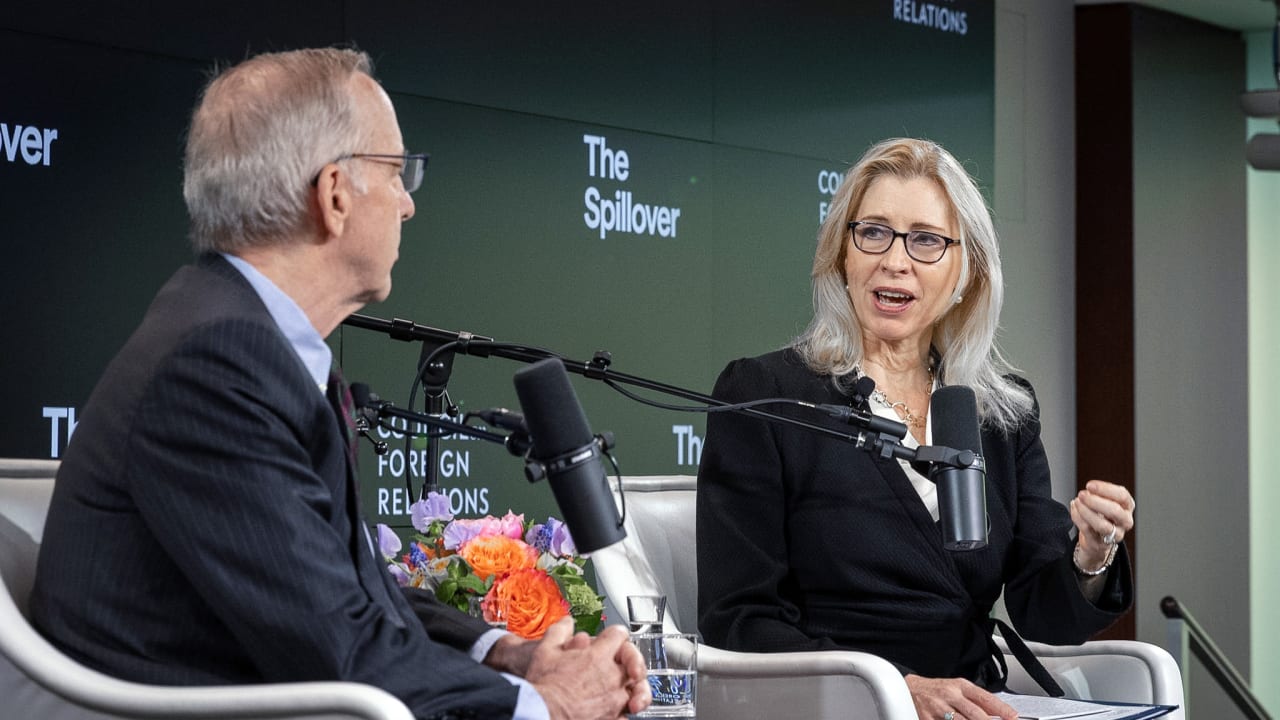
The Spillover: Live Podcast Taping With William Dudley
Event date
Speaker
- Chair, The Bretton Woods Committee; Former President and CEO, Federal Reserve Bank of New York (2009—18); CFR Member
Host
 Rebecca PattersonCFR ExpertCohost, The Spillover, and Senior Fellow, Council on Foreign Relations
PATTERSON: Hi, I’m Rebecca Patterson. Welcome to The Spillover. Our podcast every week looks at the ripple from global events around the world whether we’re talking about economics, finance, technology, or geopolitics. My co-host Sebastian Mallaby is on the road this week with his new book The Infinity Machine, and I’m happy to say it’s now a New York Times bestseller.
But I am absolutely delighted today to have as a special co-host guest Bill Dudley. Bill is the chairman of the Bretton Woods Committee but he is also, importantly, a former New York Fed president, and we have lots to talk about, whether it’s multinationals, whether it is the global economy, the U.S. economy, monetary policy, and we’re going to go into all of that today.
So, Bill, thank you so much for joining.
DUDLEY: Thank you for having me.
PATTERSON: It’s IMF-World Bank week, and for those of our listeners and viewers, I just want to explain a minute what that means. So twice a year you get finance ministers and central bank governors from all over the world descending on Washington most of the time, and an ecosystem has been created around it.
So you have these meetings at the International Monetary Fund, or IMF, and World Bank, but then you have conferences and dinners and breakfasts, and by the end of the week you’ve really taken the pulse of the global economy. You know what’s top of mind for people, what’s keeping them up at night.
So I want to start there. We had an event Tuesday at the IMF headquarters for Bretton Woods Committee and our membership, and you had the chance to interview Christine Lagarde, president of the European Central Bank. I interviewed Ajay Banga, the president of the World Bank. Our colleague John Lipsky interviewed Kristalina Georgieva, head of the IMF.
And what struck me, I think, was the amount of discussion around scenarios when we talk about the global economy, that there’s so much uncertainty right now, especially lately with the beginning of the war in Iran, that no one really wants to have a point forecast.
Everyone’s talking about, well, if this happens, this happens, this happens. But, broadly, the IMF is looking for lower growth and more inflation. So I’m curious, what have been your takeaways from the week and any thoughts you have on the global economy?
DUDLEY: So people are very much focused on the energy shock that’s being created by events in the Persian Gulf. There’s probably 8 million barrels a day shortfall relative to global oil demand, and it hasn’t really shown up very much yet because most of the shortfall up to now has been at sea.
But all the boats that needed to get where they’re supposed to go have gotten there and so the shortage is now going to quickly transition to onshore. Every day this goes on you lose another 8 million barrels a day so the energy shock grows in magnitude.
In my discussions with Christine Lagarde, you know, one thing she said was that they have three scenarios, base, adverse, and severe, and she noted that every day that goes by and we don’t resolve the situation in the Strait of Hormuz we march a little bit farther away from the base scenario towards the adverse one.
So I think right now uncertainty is probably the main aspect of how people are trying to cope with it. They know that the energy shock is going to be bad for growth—it’s going to push growth down—and they know it’s bad for inflation. It’s going to push inflation up, and this creates quite a bit of a quandary for central banks because they’re going to be missing on both sides of their objectives if you’re the Federal Reserve, or if you’re the European Central Bank, which only has the single mandate of inflation, inflation is going to be above their objective.
It’s particularly frustrating—Christine Lagarde noted it’s particularly frustrating for the ECB because prior to the war everything was almost in perfect shape. They were at their 2 percent inflation objective. The unemployment rate in Europe was very low. The economy was sort of humming along, and then we got this.
PATTERSON: Yeah. I think a lot of countries are feeling that way right now, Japan included, that, you know, the Bank of Japan was starting to normalize interest rate policy. The economy was doing well. Their stock market was one of the best in the world over the recent years, and then this.
And the question is how long does it last? How bad is the shock? We don’t know. I think the IMF’s—they also have severe adverse scenarios and their worst case scenario has inflation going up—global inflation going up potentially above 6 percent.
So it’s not as bad as post-pandemic but it’s still really bad and it’s coming on top of all the price increases that we’ve had over the last five years. So really going to hurt purchasing power for consumers.
DUDLEY: Yeah, and it’s a tough—it puts the Federal Reserve and the U.S. in a tough position because, you know, they thought that, you know, inflation was going to normalize. It was going to decline to 2 percent after five years of being above the inflation target and now we’re hit with a shock.
And, you know, typically, the Federal Reserve would like to look through that shock. You know, it’s a temporary price increase so the prices—oil prices will go up, and then a year from now, presumably, or sooner oil prices will come back down.
But it’s hard to—harder to look through a shock when the—you’ve been missing your target to the upside for five years in a row.
PATTERSON: Yeah.
DUDLEY: And it’s also harder to look through the shock when your independence is under attack and people are going to be wondering if you—you know, if you were to cut rates are you cutting rates because it’s appropriate or you’re cutting rates because you’re under pressure from President Trump.
PATTERSON: And I want to get there. We’re going to get into that because our next Federal Reserve policy meeting is coming up on April 29, in theory. Kevin Warsh, the nominee to be the next Fed chair, his Senate hearing is going to start next week, again, in theory. He would take over from current chairman Jerome Powell on May 15.
So we’re going to—we’re going to spend a little time in the weeds there because I think there’s some elements, honestly, about some of these processes within the Fed that are underappreciated.
But before we go there, Bill, let’s talk for a minute about the U.S. economy. So, you know, the U.S. is a large energy exporter but we do still import quite a bit, and the last ship from the Strait of Hormuz arriving to the U.S. should arrive at some point within the next week and then there’s no more.
So we’re going to be feeling it more as well in different ways—fertilizer, helium, et cetera, et cetera. I mean, we’ve talked about this a lot on The Spillover. But the U.S. economy, you know, forget the shock. It’s just really interesting right now. There are so many contrasting signals that if you’re an economist or, frankly, a policymaker, you can write your own story depending on the data and it will be factually correct.
I mean, right now we have a stock market that hit a new all-time high last night, which is great if you own stocks, which isn’t everyone. We have a job market that’s slow but it’s not deteriorating. People have jobs. Generally, they have incomes. The unemployment rate is low. So there’s some good news there, and manufacturing just in the last few months seems to have been picking up.
At the same time, you have consumer confidence, if you look at the University of Michigan last week, at a record low, tons of worries over illiquid instruments like private credit. So where are you landing on the U.S. economy right now?
DUDLEY: So let’s talk about the economy pre the war—
PATTERSON: Pre-war.
DUDLEY: —because then we can sort of talk about how the war sort of—
PATTERSON: Sure.
DUDLEY: —affects that outlook. I would say before the war the U.S. economy looked in really good shape and, if anything, the risk was that the economy was going to be probably a little bit too strong rather than a little bit too weak, and there were really sort of three things that were pushing the U.S. economy ahead.
The first is that fiscal policies actually turned stimulative over the last few months because a lot of the tax cuts that were enacted as part of the Big Beautiful Bill the withholding schedules weren’t changed, and so when people are filing their tax returns this spring, they’re finding they’re getting bigger refunds as a consequence. So that’s a positive for growth.
The second positive for growth was the AI investment spending boom to build out this whole infrastructure is continuing unabated. The increase in spending in 2026 relative to ’25 is quite significant. It’s actually bigger than the increase from ’25 to ’24.
It’s not the level that matters. It’s the rate of change, and so that’s still ratcheting upward. So the AI investment boom is also adding to growth. And the last thing, to your point about the stock market, financial conditions are really accommodative. You know, it’s really amazing how well U.S. financial markets have held up.
So I would say prior to the war it was like there was no reason for the Fed to do anything over the very near term and wait and see what happens to the labor market, what happens to inflation, does inflation come down as the Fed Reserve was expecting, and they were going to just sit and wait.
Now, the war makes things even more—you know, makes it—you know, it puts them in the same place. They’re still going to wait but now they’re missing by more on the inflation side of the mandate. They’re worried a little bit more about what’s going to happen to the labor market.
So they’re more nervous, especially given the fact that they can’t really tell yet how long—how high are energy prices going to go and how long are they going to stay elevated. The U.S. is better positioned than other countries.
For example, we don’t have a natural gas price shock here because we basically export all the natural gas we can in terms of the facilities that we have in place and everything else stays in the U.S. So natural gas prices in the U.S. are, you know, $3/a thousand cubic feet. It’s probably like, you know, a tenth of the price that you might see in Asia right now.
But oil prices, obviously, and gasoline prices definitely are going up. It’s probably about, you know, a hundred-billion-dollar shock to the economy, you know, if you ran this ahead for a whole year.
But, you know, it’s going to take time to show up. I mean, it’s really the low-income households that are going to really feel squeezed. They don’t have the resources to sort of paper this over. They don’t have the holdings of the stock market to sort of make them feel that they can afford the higher gasoline prices so it’s really the low and moderate-income households that are going to suffer.
The consumer confidence numbers, you know, obviously, people are very unhappy. You know, if you ask people in polls what the single most issue that they care about, it’s affordability.
What’s the worst thing that possibly could happen that could make people more aware of the affordability question? Higher gasoline prices. Because you see the gas price every day as you walk, drive, through your neighborhood. It’s even worse than grocery prices because it’s a single price, it’s out there, and you just see it every day.
And so people are very aware of the fact that gasoline prices are, you know, $4 a gallon in a lot of places. In California, they’re much higher than that, and this is really, you know, I think affecting consumer confidence.
PATTERSON: Yeah. No, I would agree with that. It’s—and it reminds me—I know there’s a lot of differences between the pandemic and today, but there are some things that rhyme to me and one of those is just kind of the rolling contagion, that it literally starts in one part of the world and travels.
So we already see in countries in Asia, for example, there’s rationing of different energy products like jet fuel. Countries are offering subsidies to consumers to try to help mitigate the price shock a little bit. Now we’re starting, just starting to see that in Europe. I read earlier this week that there were four different airports in Italy that are now rationing jet fuel.
I mean, this is complete speculation on my part, but I could imagine if this continues for another month or two months, there could be a lot of people who suddenly have surcharges or very different flight situations on their summer vacations.
DUDLEY: Yeah. I mean, you basically have to bring—I mean, if this persists you’re going to have to bring down the demand for oil by 8 million barrels a day on a base of a hundred million, and we know that the demand for oil is very inelastic. In other words, you know, people aren’t that sensitive to the price. So to essentially bring down demand by 8 million barrels a day that’s a big lift.
PATTERSON: Yeah. One of the other things I think is very different this time from the pandemic is the room for governments to respond with fiscal policy. I mean, with the pandemic there were all these fiscal programs as well as monetary easing to help soften the economic blow.
But now here we are six years later and deficits are higher. Debts are higher. When we met at the IMF earlier this week, you know, both the head of the IMF and World Bank were talking about emergency facilities they have ready. They’re already starting to provide emergency liquidity to countries that are getting particularly hard hit by the crisis.
But they’re worried that there could be—and they said this in our event—that there could be national political reasons that the governments don’t use the money the right way.
DUDLEY: I mean, the—I mean, the risk is that the governments are going to overdo it and then there’s going to be a fiscal overhang on the other side. I mean, it’s, you know, understandable as a politician you want to sort of shield your population from the worst effects of the shock. But then the question is how much and then what’s the consequences for your finances, going forward.
PATTERSON: And do you think—you know, one of the things that’s really struck me about the last month or so is that U.S. government bond yields, like the ten-year Treasury yield, they’re off their high but overall they’ve gone higher during this event, and I am assuming part of that is investors see this more as an inflation shock than a growth shock.
But I have to imagine part of it as well just the term premium in there is an expectation that this is going to require the U.S. to have an even bigger deficit to pay for the war. That means more bond supply and questions of whether that supply will be absorbed well by an equally large increase in demand.
But the bottom line is it hasn’t worked to diversify a typical person’s portfolio the way it normally does when you see this sort of event. I’m curious if you have any thoughts on the bond market and how it’s acting.
DUDLEY: I think the bond market is mostly reflecting the fact that the outlook for Fed monetary policy has changed. So we went into the year people were thinking that we’re going to—in the markets they were thinking we’re going to get about two cuts, fifty basis points, and the Fed Reserve in their summary of economic projections wrote down a median of one cut.
But now the market is basically no cuts for 2026. So if you change the path of short-term rates, then you’re going to change what people are going to pay for short-term instruments versus long-term instruments and so that gets reflected in the bond market.
I think the bond market is behaving pretty well, frankly, given the U.S. fiscal outlook. We have a deficit of 6 percent of GDP as far as the eye can see. No political, really, hope in the near term of resolving it because the Democrats and Republicans are so split in terms of how you would go about dealing with it.
We have President Trump coming to the—with a proposal to raise defense spending by $500 billion for fiscal ’27. And what’s interesting it is the Congressional Budget Office that makes these official estimates. They have penciled in for 2027 the deficit—the defense spending will be up 1 percent compared to 2025 because they can’t make assumptions unless the thing has actually happened yet.
So we know that defense spending is going to be much higher than the CBO assumed so the fiscal outlook is probably going to be worse than anticipated.
PATTERSON: Great. OK.
Before we get into what the Fed’s going to do with all this, let’s just—you mentioned AI before and you talked about the CAPEX, and I know the estimate this year, just for kind of four of the big guys—Meta, Microsoft, Alphabet, Amazon—is 650 billion (dollars), which is almost as big as Sweden’s whole economy. So it’s a lot of money.
But one of the discussions, I think, within the Fed and other circles is how much is AI in the United States going to transform the economy? Is it going to be this productivity boom nirvana that lifts growth but in a disinflationary way, and we all work four days a week and have long weekends, and it’s great?
Or are we going to go through a transition period where there’s more automating of jobs than augmentation of jobs and we have a job displacement and that slows growth, and it could have even political backlash.
Thoughts on AI? Personally, I think anyone who tells you they know where it’s going to go you just want to, like, excuse yourself from the conversation because they don’t know what they’re talking about.
DUDLEY: I’m definitely—I’m definitely in that school. I think we don’t know.
I mean, typically, when you get major innovations like this, they do ultimately turn out to be really important. But typically people overestimate how fast the world can change, how businesses can adjust their business practices, invent new lines of business, new products to respond to this.
You know, it took forty years from electricity being able to be generated for it actually to lead to mass production—you know, assembly lines that we sort of are familiar with today. I think this is going to go a lot faster than that, but I think it’s going to be a bit slower than people anticipate.
I think the biggest impulse from AI today is the investment spending.
PATTERSON: Yeah.
DUDLEY: So I think it’s actually more pushing up interest rates today because it’s increasing investment spending and that’s, obviously, depleting the pool of savings. So interest rates probably have to be a little higher today.
Now, over the medium term, if AI generates a huge productivity benefit, then presumably that’s going to be good for the inflation outlook. That’s going to be good for GDP growth and that’s actually going to help you on the fiscal side as well because if you can grow faster, then you can actually bear the burden of a lot of debt a lot more easily. But I think that’s going to play itself out over time.
Now, there are some people, Kevin Warsh and Scott Bessent are among them, who’ve argued that this is going to be great and we should get ahead of it by cutting rates now, and I think that’s a really risky way to go because I think we just don’t know how big, how far, how fast this is going to go.
PATTERSON: OK. So with that in mind, let’s go to the next Fed meeting.
So Jerome Powell will still be chair and he, at the last policy meeting—the last FOMC—actually said he doesn’t think productivity evidence is here yet. He thinks there’s a risk it could be inflationary, so agreeing with the point you just made, Bill.
So we just assume they’re doing nothing? What else—what else would you be watching for maybe from the press conference or the statement? You know, you—you know, the journalists will ask as long as they can until the press conference has ended.
DUDLEY: Yeah, I think that clearly they’re going to be on hold unless something just really dramatic takes place in the next couple weeks, which I’m not expecting.
PATTERSON: I hope not.
DUDLEY: I think it’s highly unlikely that they’re going to do anything because basically the level of uncertainty is really, really high. The risk of a policy mistake, if you make a bet and it turns out to be the wrong bet, is substantial, especially given the misses on inflation over the last five years.
So I think the press conference is really going to be more about how are you assessing the energy price shock, how are you thinking it’s going to affect the economy, where do you think monetary policy might go over the medium to longer term in response to this, and I’m sure he’ll get some questions about AI and productivity and I’m sure he’ll get a lot of questions about, so are you planning to stay on at the Fed.
And I think what he’ll do as he’s done at most press conferences he’ll try to answer that very definitively, very quickly, and then move it off the table for further conversation.
PATTERSON: All right. So let’s pivot to that.
So, process. So we know over history there have been a number of cases where the new Fed chair did not come in exactly on the date. I think it’s five times since the 1930s, and one time in the ’70s there was some legal brouhaha around it, so it hasn’t always been clean. So it’s not—it’s not crazy to think that Powell could be in the seat on a pro temp basis for some time.
DUDLEY: That’s the most likely default if they don’t confirm Kevin Warsh on time. I mean, there’s precedent for that. Chair Powell was pro temp for a little while because they sort of dawdled in terms of getting—in terms of his own reappointment. So that seems to be the precedent.
But there are some—there are some legal cases going back to the Carter years which suggests maybe it’s possible that the president could have the authority to say, no, I want to name my own temporary chair of the Federal Reserve.
And so this could be adjudicated. It could go to the Supreme Court, although most people—most lawyers, I think, think that Powell would be able to stay on as the acting chair.
PATTERSON: OK. And then there’s two—so remember, the Federal Reserve, we have the Board of Governors and then we have the regional president. So the main issue right now is with the Board of Governors.
DUDLEY: Right.
PATTERSON: And you have seven, and if you have four Board of Governors who lean one way or the other—in theory, they shouldn’t lean at all. But let’s just say possibly there’s some leaning.
What’s the issue if you have four people more amenable to President Trump’s political priorities, let’s say?
DUDLEY: I don’t think having four people on the Board of Governors necessarily means that President Trump can—you know, will have, you know, control of monetary policy because it’s twelve—it’s a twelve-member committee. So you need more than four votes. You need seven votes to do anything on the committee.
I think where the issue of the four people on the Board of Governors comes in is more about how they can influence the choices of people that run the Federal Reserve banks who are also on the Federal Open Market Committee.
So there are—there’s a little bit of anxiety that, gee, if the—if you had a Board of Governors that was controlled by Trump loyalists could they start to replace presidents of the Federal Reserve banks.
I don’t think that’s going to happen. You know, one thing that was really noteworthy was a couple months ago the Board of Governors voted to reappoint all the Federal Reserve presidents to new five-year terms on time on schedule, and so that seems to have been settled.
And I think also the fact that people like Chris Waller and Miki Bowman, just because they were appointed by President Trump I don’t think they’re necessarily going to go out and do something sort of pretty radical.
You know, I think, you know, Chris Waller has spent almost all of his—his whole career at the Federal Reserve and the idea that he would sort of do what President Trump wants, no, I think he’s going to do what he thinks right for the Federal Reserve as an institution and for the country.
The independence of the Federal Reserve is really important because it basically makes monetary policy more credible. The reason why we give independence to central banks in terms of their—how they set monetary policy is because we think that allows them to take a longer-term time frame in terms of thinking about their decisions.
If you don’t have independence, then monetary policy can be sort of captured by the political cycle. And so then you have a very easy policy going into the election, the economy booms, then the inflation happens after the election, then the Federal Reserve or another central bank has to slam on the brakes. We don’t want that.
It’s been pretty clearly established by a huge amount of literature over the last fifteen, twenty, thirty years that independence of central banks with respect of how they conduct monetary policy, that’s what independence is. It doesn’t mean they get to do whatever they want. It’s whether they—how they conduct monetary policy results in better outcomes in terms of inflation and economic prosperity.
PATTERSON: Yeah. I think it was last year I did some research and I published a column in the New York Times just looking at other countries that—where the central banks had lost independence, and the U.S., obviously, is unique in many ways so it’s not a perfect comparison by any stretch.
But I looked at Hungary and Turkey as two examples where recently there has been some loss of independence, and directionally you could imagine that the U.S. directionally could go in the same direction if there was a perception of loss of independence or actual loss.
So higher inflation expectations, higher inflation, higher borrowing costs, and that eventually bled into lower growth, because if you have interest rates going—even if you’re cutting interest rates for political reasons, the inflation expectations is going to mean you have a steeper yield curve and higher long-term interest rates, which in the U.S. means mortgages, auto loans, et cetera, get more expensive.
DUDLEY: Yeah, it’s really counterproductive, frankly, for President Trump to attack the Fed in some ways because, you know, when you’re putting the Fed’s independence at question, you actually make the central bank a little bit more reluctant to cut rates because the Fed is in sort of a quandary.
If I cut rates are people going to understand that I’m doing this because I think this is appropriate for the economic outlook or am I cutting rates because I’m being pressured by the president?
PATTERSON: Right.
DUDLEY: So if it’s a really close call, you’re probably going to be more inclined to keep rates unchanged.
PATTERSON: So I want to tie this together and have one more quick question on Bretton Woods institutions.
But I just—just to get out there, it’s also important to know that there’s the Fed chair of the board and then there’s the chair of the FOMC policy committee. That person is chosen once a year and that—so it’s different.
So you could have a new chair of the Board of Governors and that person isn’t necessarily going to be the same as the head of the FOMC, correct?
DUDLEY: Correct. I mean, historically—
PATTERSON: Right.
DUDLEY: —it’s always been the same person but—
PATTERSON: In theory.
DUDLEY: But in theory, you know, how the Federal Reserve operates every January they basically have a vote where the FOMC—as part of their first meeting in January they vote who’s going to be the chairman of the FOMC, who’s going to be the vice chairman, et cetera, et cetera, and, you know, they could—I mean, you can imagine an outcome. It’s possible, not likely—possible outcome where someone was the chair of the Board of Governors but Jay Powell was still the chair of the FOMC.
But this would be a very radical step by the Federal Open Market Committee. I mean, it’d be sort of like declaring all-out war on the administration. So I think this is—you know, it’s possible, theoretically possible, but I think it’s actually quite unlikely.
PATTERSON: I agree with you. I just think it’s important for people to understand some of the nuances for the process.
DUDLEY: These things are different. Yeah, absolutely.
PATTERSON: Yeah. OK.
Real quick, so kind of coming back to where we started, IMF-World Bank week, with all this uncertainty going on, to me it feels like these institutions, which in the media it feels like they’re somewhat under attack, or depending on the institution, very much under attack.
I think about the World Trade Organization in particular. They’re fighting against some pretty negative press after their last ministerial, which they didn’t have a full communiqué. It didn’t work out as well as they would have liked.
But in general, when I look at the World Bank IMF, they are reforming. The World Bank now has twenty-two different goals on its website and you can click on those and actually see if they’re meeting their annual targets, their metrics.
But the fact that these organizations have those liquidity lines, they’re out there trying to help the countries in need, kind of a first line of defense for the global economy, it feels to me like they’re pretty darn important, maybe more important than ever.
DUDLEY: Yeah. I would say, I mean, certainly the IMF in this current set of circumstances is extremely important, especially for small, poorer countries that depended on foreign oil imports are hit with a big shock that they really can’t afford.
And the other thing that happens is, obviously, if you’re hit with a big shock like this, foreign investors may actually start to pull back in terms of their willingness to supply funding to those countries and that’s why—where the IMF comes in. Very, very important.
World Bank, obviously, has a separate mission. It’s really about project finance, about how to, you know, build, you know, infrastructure to develop your, you know, digital finance networks. So it’s a different sort of thing but very, very, very important because, you know, sharing best practices around the world, sharing access to technology, hugely important role that the World Bank plays.
So I think that, you know, my personal opinion is we need international cooperation and coordination more than ever, and when you think of all the global public goods that are outstanding right now—you know, health security, climate, financial stability, you know, energy security—there’s just so many things where individual countries just going their own—if everyone just goes their own way in an uncoordinated fashion, you’re going to end up with a lot less good outcomes than if you actually have some coordination and cooperation.
PATTERSON: Yeah, well said. And I give them a lot of credit, too. During the war, the World Bank, IMF leadership, they’re now having regular meetings every other week with the International Energy Agency as well. So they’re acting very quickly on this, as they should.
DUDLEY: People never ask the question so what would the world look like without these institutions, and I’m absolutely convinced the world would be quite a bit worse.
PATTERSON: I think that’s the hardest thing with these institutions because, you know, after the pandemic people literally got checks in the mail and so they felt the stimulus. They felt better.
But when you’re talking about what is the benefit of a stable, growing, healthy global economy, it’s indirect. It’s not a check in the mail. You can’t touch it and feel it, and so I think it tends just to structurally get underappreciated.
But if we didn’t have it we would know it.
DUDLEY: Absolutely.
PATTERSON: Well, I’m going to say thank you so much for joining us today, Bill, for this episode—
DUDLEY: Thank you.
PATTERSON: —of The Spillover, and we’re going to look forward to having you back, hopefully, again in the future sometime.
DUDLEY: That’s great.
PATTERSON: All right. Thank you. (Applause.)
(END)
This is an uncorrected transcript.