U.S.-China Relations and the Global Economy
Event date
Speakers
- Chairman and Chief Executive Officer, Pfizer, Inc.; CFR Member (speaking in New York)
- Chairman and Chief Executive Officer, Medtronic, Inc. (speaking virtually)
- Gina M. RaimondoCFR ExpertDistinguished Fellow, Council on Foreign Relations (speaking in Washington)
- President and Chief Operating Officer, The Goldman Sachs Group, Inc.; CFR Member (speaking in New York)
Presider
- Michael FromanCFR ExpertPresident, Council on Foreign Relations (speaking in Washington)
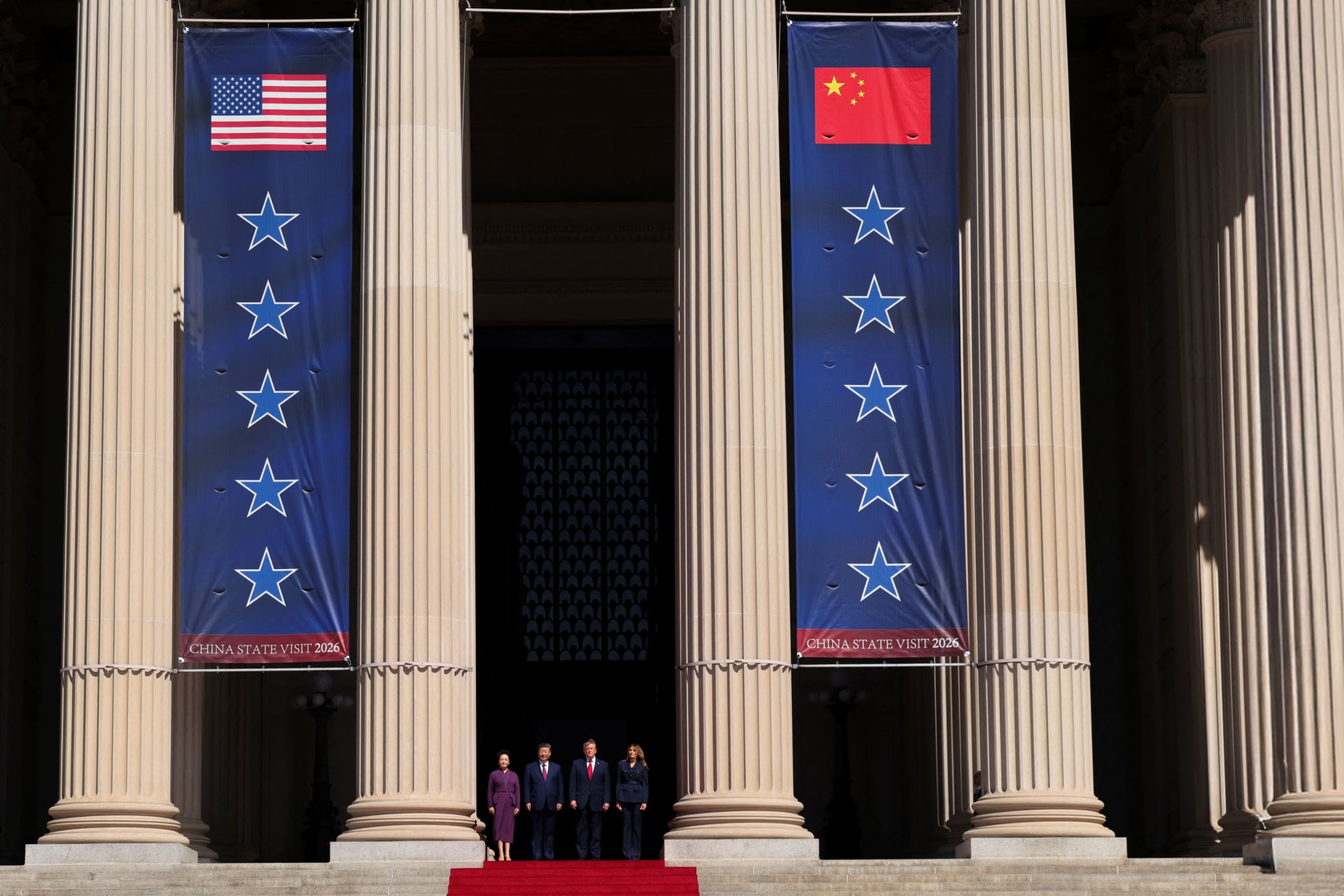
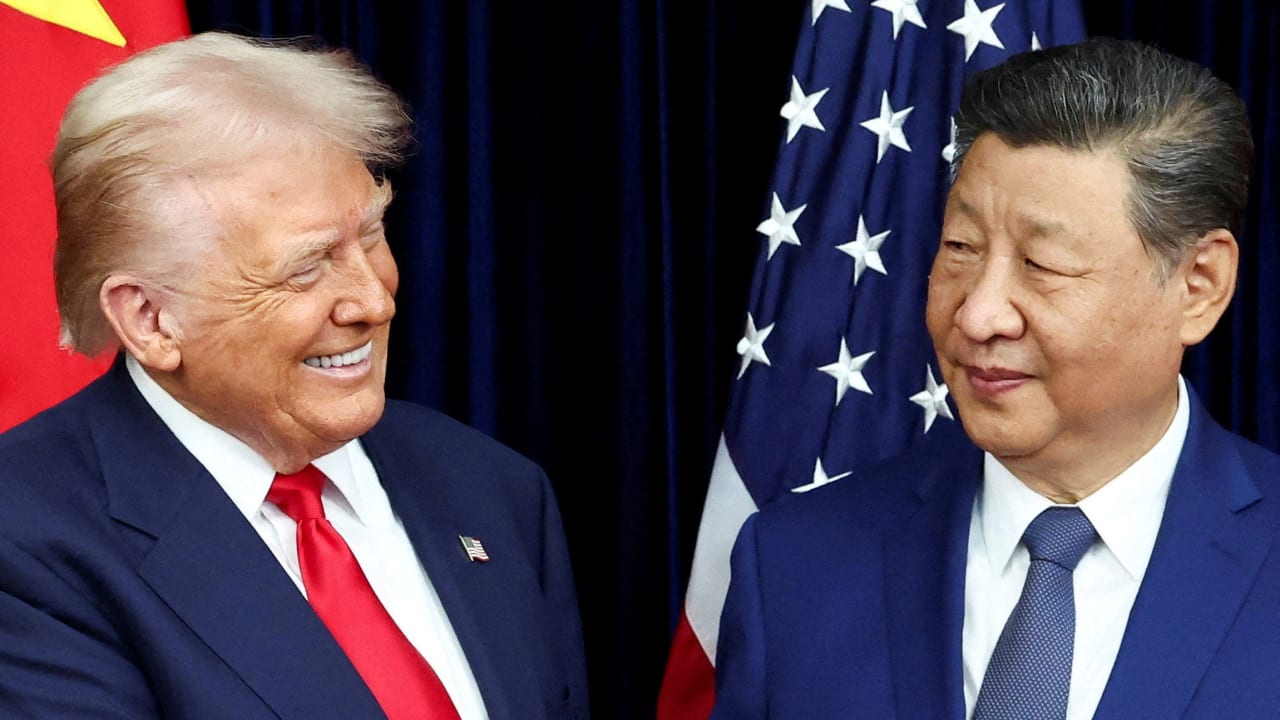
Panelists discuss the implications of U.S.-China relations on the international economy, including how tariff negotiations, supply chain restructuring, and technological competition impact global business. President Donald Trump’s meeting with Chinese President Xi Jinping in Beijing, originally scheduled for March 31, was postponed and will now take place on May 14 and 15.
This meeting is presented in partnership with CFR’s China Strategy Initiative.
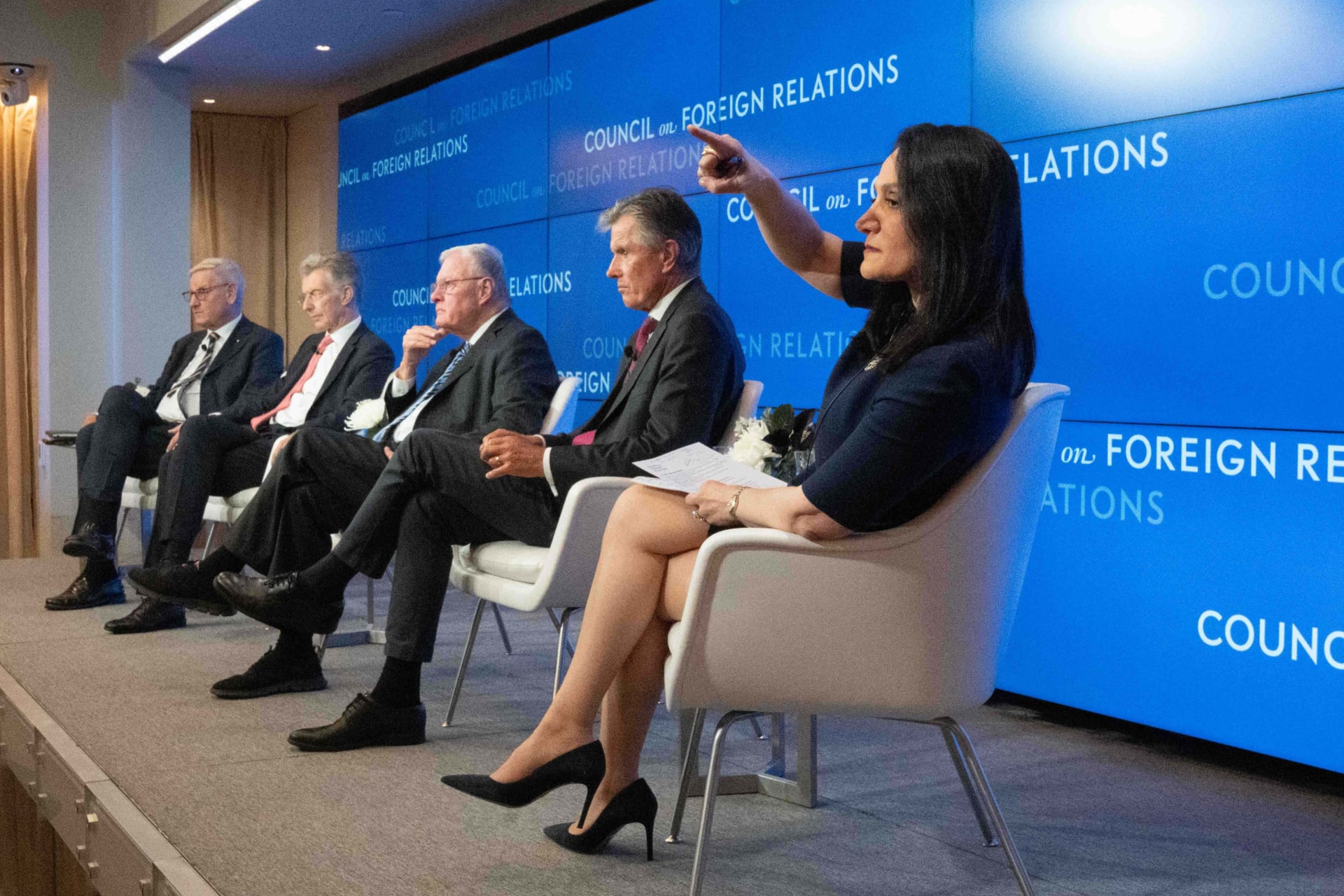
FROMAN: Well, good afternoon, everybody. It’s great to see everybody here, and in New York, and, Geoff, wherever you are. Thank you all for joining us. I’m not sure we’ve ever done an event quite like this, with three locations at the same time. So thank you all for being here. We’ve got a full room here in Washington. I understand we have the same in New York. And we have 450 people who registered to be online. So this is a very popular—very popular event. This event is put together both by the Council generally, and particularly our China Strategy Initiative. The original motivation for this event was, as you may recall, tomorrow was supposed to be a summit meeting between President Trump and President Xi.
RAIMONDO: Instead, you have us.
FROMAN: (Laughs.) But between Greenland, Venezuela, Iran, maybe Cuba, things have gotten slightly delayed until mid-May. But we thought it would be very useful to take a moment, and particularly with a range of private sector representatives, and talk about the state of U.S.-China relations, expectations for summitry this year—there could be up to four summits this year between President Trump and President Xi—and where we see things going overall. And we’ve got a great group to lead that discussion really representing manufacturing, services, the intellectual property, innovation sector, and, of course, Gina, who represents government and the private sector and the Council on Foreign Relations—a woman with many hats. So great to have you all here.
In New York we’ve got John Waldron, president and chief operating officer of Goldman Sachs, and Albert Bourla, chairman and chief executive officer of Pfizer. Online remotely we have Geoff Martha, the chairman and chief executive of Medtronic, a major medical equipment manufacturing company, and here in Washington we have Secretary Raimondo, and myself. Thank you all for being here. We’re going to talk for about thirty minutes and then open it up to questions. And this is all on the record.
So perhaps let me start with Geoff, if I can, representing the entire U.S. manufacturing sector. Geoff. (Laughter.) We’re about a year from—or, we’re about to celebrate the one-year anniversary of liberation day, and the imposition of tariffs on the world. Of course, increasing tariffs on China. A lot of companies, I think, had hoped to kind of wait it out and see whether this would be a passing phase. As you look at your own company and others in the manufacturing sector, how are companies thinking about the tariffs and the regime—the trading regime they’re likely to face, in the U.S.-China in particular? And how is it affecting your business model, your decision about where to put plants, where to source your supply chain?
MARTHA: Well, thanks, Michael, for having me. Thanks for the question. Yeah, it has had a big effect. I mean, you know, for us, China—for med tech and for Medtronic, China, it’s all about the end market, historically. It’s less about, for our industry and our company, getting product out of China. It’s more we’re an exporter into China historically, and still are. And the tariffs have had a material impact on that. And so for us, what we’ve done is, one, reroute—short term, is making—reroute some of our products, so that it optimizes the tariffs, right? So you don’t—so that’s been one opportunity for us. But it has—it has impacted—you know, I don’t think this is going to be a short-term thing, because you’ve got tariffs, but you’ve also got other geopolitical factors.
And so for years we’ve been, you know, really minimizing our reliance on China’s supply chain, but continue to focus—supply China of products. So this just adds to that focus, I’d say. So we are, you know, moving—you know, making sure—there’s some factories in China. And it’s primarily China for China. And if we’re getting product, technology, out of China, we even moved those manufacturing plants outside of the—outside of the country. So tariffs are just one more thing on a broader, I think, geopolitical landscape that has really altered the way I think manufacturing companies look at the country.
FROMAN: And what does market access look like for you in China? Are you getting your products in there in the way that you’d like to? Or is this an issue that you would want to see covered in a U.S.-China summit?
MARTHA: Well, look, ideally, there are some—you know, the tariffs—the reciprocal tariffs that China added just is one more barrier, right? It adds to our costs. And I think, look, there are—over time, the Chinese—so there’s 1.3-1.4 billion people there. And right now, for the high-end medical devices, high-end medical technology that we provide, I’d say 300-400 million people have access. And so, you know, the Chinese government, I give them this, they are committed to expanding that access. But they’re also really focused on developing less of a reliance on the U.S. for those products, because those products tend to come from the U.S., and build out their local competition. And so policy has tilted the playing field towards local competition.
So as time goes on, our ability to import products into China gets more difficult, and China’s pushing for more of a local strategy. But then you get back to some of these other geopolitical issues, make that local strategy challenging. So, you know, if we can maybe wave a magic wand, it would be helpful to mitigate some of these, you know, market access barriers.
FROMAN: Albert, maybe turn to you next. On market access, are you getting your drugs onto the formularies, the lists of approved U.S. drugs for sale in China?
BOURLA: Not to the degree that we want, but I don’t think there is a significant issue of discrimination Chinese versus us. It is more of an issue of pricing, that they are requiring very, very low prices. Which we are having the difficulty to provide. So we would like to see a bit more of valuing innovation in price and policy. But I think it is pretty much not discriminatory compared to local players.
FROMAN: And China’s played a pretty big role in your corporate strategy. You’ve got—it’s part of your five-year plan. You’ve got major investment plans there. As well as China’s been a partner of U.S. companies in doing clinical trials and sharing data, scientists going back and forth. How does the current state of China-U.S. relations affect the manner in which Pfizer is developing drugs and thinking about innovation going forward?
BOURLA: First of all, I need to say that there is nothing more important right now that will shape the biopharmaceutical industry, other than AI, than China. China is extremely important. And when I said about China, I’m talking about a meteoric rise of their scientific capabilities. Right now, there is, for the first time in history or in the recent decades, that the U.S. dominance in biotech technology is challenged by a competitor. And that’s China. It’s challenged because they have done all the right things over decades in a long-term strategic plan.
From cover from a reliable regulator, they transformed their regulator, protecting IP, in our world IP is very well protected. And for a reason, because they filed more patents than U.S. companies last year. So they are so, so good. They have a lot of interest to invest. They are giving subsidies. They repatriated talent. And, you know, our visa policies here made it even easier to do that. So right now I think they are not at the same level like the U.S., but they are very close. And the rate with which they go up predicts that they will be better than us within the end of this decade. So it’s amazing what is happening over there.
For us, that’s the biggest component of our strategy. It’s not how to utilize the Chinese market so that we can sell our products. That’s 5, 6, 7 percent of our revenue. It is how to tap into Chinese innovation that it is created right now in a very rapid and unique way, and do that in the middle of this crisis. I mean, the geopolitical complication makes it very, very complicated. Both countries, they take measures. In the U.S., and they speak about the restrained transfer of data, both countries, transfer of samples. And so—and there is uncertainty. If investments that you do there, suddenly a new rule will make them obsolete or will make them difficult to get your return.
FROMAN: And so when President Trump and President Xi sit down and talk about trade issues or economic issues, when it comes to pharmaceuticals what would you want them to come out with, ideally?
MARTHA: Actually, I think that the biggest impediment right now, it is obstacles that one country is setting on the other in data, scientific knowledge transfer, samples. This is the issue right now. Tariffs are not affecting us, but they are affecting the generic industry. It is a significant number of generics are produced in China. We don’t export anything from China into the U.S. And we are not unique in that. Many pharmaceutical companies there have innovative products. They do not have a supply issue from China. We have from Europe, we have from Japan, but not from China. So that will not affect much.
FROMAN: Are you concerned more generally about our dependence on China for active pharmaceutical ingredients that go into other drugs?
MARTHA: I think that’s a different topic. And that, it is a national security issue. And I agree with that. I think that a lot of the market of producing the ingredients moved to China. And it was not in China before. It was local in the U.S., or it was in Puerto Rico. But policies that have to do with taxes and, more importantly, a very brutal generic system in the U.S., that the prices really go to bare minimum. It’s very efficient, the U.S. pricing system in generics, made a lot of that to be produced in China. So suddenly now you have a very big part of the medicines that your hospital needs to operate, but they are dependent on China. That, I think, needs to change, and bring it here. None of the ingredients of innovative products, let me put it, products that they are new, they are on patent, are produced in China. So I don’t think that will affect it.
FROMAN: John, you see through all of your clients’ eyes a pretty broad perspective on the global economy, as the countries have more tension between them, more friction in the global economy. How are they adapting? And how are people viewing the likely trajectory of global growth, of productivity, of development? All the things that we sort of benefited from during the period of hyper globalization, as we move away from that, particularly vis-à-vis China, and see some decoupling, fragmentation, how are your clients viewing the prospects for global economic growth?
WALDRON: Well, I would just say, to pick up on Albert and Geoff’s comments, I think you see more multinational companies running China for China. So it’s a different strategy than would have been the strategy, you know, five, ten, fifteen-plus years ago, where it was China for the world. I do think the fragmentation is having some impact on the growth. I do think that most people now think China is going to grow slower. And China itself is actually declaring it’s going to grow slower. So now we’re talking about less than 5 percent growth in China, which is materially down from what would have been historic growth rates, you know, the last ten-plus years at 6, 7, 8 percent.
And I think if you looked under the covers and tried to discern the real growth rate, most people would say it’s materially less than 4 ½ percent, even though that’s the stated growth rate. If you actually look at where final demand lies, it’s probably growing slower than that. Having said that, most companies we talked to are focused kind of along the lines of what Albert and Geoff just talked about, which is around the innovation. And I think if you look at where the growth in China is coming, most of it is coming from sources we would think of as nontraditional domestic consumption kind of growth, more investment in innovation, technology, industries of the future.
So if you read the Chinese literature on the plenum, you know, five-year plans and otherwise, you see that where most of the focus is going, from a capital deployment standpoint, would be in places like life sciences, pharmaceutical drug development, robotics, quantum, AI, of course. Electrification would be another area where they’re clearly big leaders. And so I think that increasingly that fragmentation is becoming problematic for companies to try to figure out how to get access to it and deal with the geopolitics around it. But all under the umbrella of, frankly, slower domestic demand and slower domestic growth, certainly relative to the United States. So that’s why you see more capital actually flowing into the United States. Because if you look at relative growth rates United States is actually growing pretty—in a pretty healthy fashion, with much less geopolitical risk.
FROMAN: Goldman’s been in China for a long time. And now you’re 100 percent, I think, owner of your of your subsidiary there, as of the last few years. When you look back at the global financial crisis, U.S. and China actually work quite well and closely together to help manage that crisis. How healthy do you assess the Chinese financial system to be? And could you envisage that kind of cooperation happening today if there was some kind of new financial crisis?
WALDRON: Yeah. I mean, first of all, I think one of the strongest relationships between the two countries lies in the central banks. You know, today I think there’s quite a lot of engagement between the two central banks, and a healthy amount of respect between the PBOC and the Federal Reserve. And I would expect that would continue. You know, if we were to have a financial crisis of sorts, I would expect that that coordination would be significant. And I think is a helpful thing, to the extent we have to go through another crisis of that magnitude.
I do think that the markets are—there’s been much more opening of the Chinese markets, which is good. There’s more capital flowing both ways. But it’s definitely—China, to me right now from an international standpoint, is viewed more as a trade in terms of capital markets activity. So the trade has worked quite well in 2025 and into 2026, up until the Iran war. The Chinese markets have had phenomenal performance, probably the best-performing markets broadly globally from the start of ’25 until the Iran war. Obviously, retracing now. More liquidity is flowing in. Allocations have been rising. And so all that is healthy, but I think it would come back out if we had a geopolitical event.
And one of the things that we often tell our Chinese friends, whether we’re in Beijing or Guangzhou or Shanghai or otherwise, is to make clear that that money is hot money. And if we had an event in the world that made investors feel like they wanted more safety and security, a lot of that money would come back out. Which I think is not a good thing for the Chinese banking system and the Chinese system more broadly. So I would say I think the Chinese banking system is fine, but not as healthy as one would like it to be. Particularly if we have a, you know, more negative economic event around the world.
FROMAN: Gina, when you were Secretary of Commerce you were really at the center of the U.S.-China competition, both in terms of the CHIPS and Science Act and investing in domestic production of critical technologies, but also the export control system to keep out of the hands of China some of our most advanced technologies. As you look back now, with a year-plus of retrospective hindsight, how do you feel it’s done? How do you feel the CHIPS and Science Act has been implemented? What would you have done differently? And can we—can export controls be an effective way of keeping technology out of the hands of Chinese, or enhancing U.S. competition? Or is there value in creating some dependence in China on our technology?
RAIMONDO: Yeah. All good questions. Good afternoon, everyone. And thank you all for joining us in New York or on Zoom. It’s nice to see you all.
So I would say, if you could only do one thing—which, of course, we should do all of the above—investing in American capability is much more impactful and important than denying China what we have. Now, you do need to do both. And I did both robustly. But I just want to emphasize, when I listen to Geoff and Albert talk, what I hear is a desperate need on behalf of America to invest more significantly in our own capability—research, science, innovation, development, AI, et cetera. And we did that in the CHIPS Act. And I would say, you know, nothing’s perfect, hardly. But net-net, I think the CHIPS Act is doing what it was intended to do.
I mean, when I started, zero leading-edge chips by way of the chips in AI data centers were made in America. And now in Arizona TSMC is producing sophisticated NVIDIA Blackwell chips in Arizona at the same yield they do in Taipei. And, you know, the same is true for memory and packaging, and, you know, the rest of the chip ecosystem. And this administration has continued with the implementation. And so I think it was a good thing. History will judge it, you know, favorably. And I hope it becomes a model for other ways to stimulate investment in the key areas—like AI, like quantum, like biotech—where we need to compete and outcompete with China.
The one thing I think that is a—I think is a bit of a tragedy, is that this administration pulled back the research and development money. So the bulk of the CHIPS Act, $39 billion, went to big companies, you know, TSMC, Micron, SK Hynix, et cetera. A smaller amount, 6 or 7 billion (dollars) was to be invested in startups, future innovation, research and development, work with universities. And this administration has decided to stop that. I think that’s a mistake. You know, that’s where the next round of innovation will come from. And, by the way, that’s where China is investing.
The whole point—you know, you say what would you do right, what did you do wrong? The same thing, insofar as I tried to design the program to really crowd in private sector money. You know, so we had a goal of every private—every public—every taxpayer dollar we put in we wanted, you know, $10 of private sector money. We did achieve that, ten to one. I think we should have, and could have been even more aggressive, because at the end of the day, and on the market system in the U.S., we want to use our taxpayer money most strategically as possible as a way to really stimulate private sector investment. And we did do that. But I think we could have done more, and I think we should do that in the future.
With respect to export controls, that’s really hard. I’ll be the first to admit. I’m sure I made plenty of mistakes. You do the best you can with the information that you have. Knowing where the cut line is, it’s hard to know. And I always felt, you know, the key thing was deny China what it can’t otherwise get in the global market. So if the U.S. has a technology that’s so advanced that no other country can make it, including China, in our critical areas, we should use export controls to deny China that technology. But that changes constantly. You know, innovation changes constantly. I will say—so it’s important to do it. It’s important to do it. It’s a speed bump. It slows China down somewhat. Like I used to tell my team, it’s sand in the gears. But it is by no means a substitute for running faster and innovating faster.
And just a couple quick points. I think—I do think it’s a problem. This is not a political statement. I don’t think the U.S. government should be in the business of any kind of rent-seeking and saying you can sell this chip to China if the U.S. government gets X percent of your revenue. It’s, like, it’s either a national security threat or it’s not. So figure it out. If it’s a national security threat, ban it. If it’s not a national security threat, sell it. I think that’s a bad precedent, and we should probably not do that again. And I also—the other thing I would say is we have to work with our allies in this respect. And that’s not always easy, you know? I would say, my own time in government, sometimes our closest allies, i.e., Europe, is very difficult to deal with, right? (Laughs.)
FROMAN: I’m shocked.
RAIMONDO: (Laughs.) So, but what is the—or Japan. You know, Tokyo Electron is the cutting edge. ASML is at the cutting edge. What good is it to deny U.S. companies revenue if China can buy whatever they want to buy from a Japanese or European company? So I do. I worry that pushing Europe away so much makes it harder to have effective export controls.
FROMAN: This issue, the export control issue, is always—excuse me—at the top of China’s list that they want to talk about.
RAIMONDO: Always. Guaranteed. Yes.
FROMAN: So President Trump, President Xi, sit down. President Xi pulls out his talking points on export controls. What would you hope would come out of a summit on this, if anything? Or would you hope that they somehow manage to get through the summit without talking about export controls?
RAIMONDO: Yeah, zero chance. I’m not a betting person. If I were, I bet everything on the fact that this issue will come up. You can—in my experience, I met with President Xi several times. I met with my counterpart many times. I met with He Lifeng and Premier Li. Every time you meet with them they will ask for us to relax our export controls and to define, refine, and limit what is in the national security bucket. You know, they want to know—they want us to say: This is the bucket of technology that we view to be critical to national security, and it won’t change. And so I’d be shocked if they didn’t try to make that ask. And it’s hard to predict what will happen. I really hope the answer is, national security is nonnegotiable. We are not putting a price on our national security. And I hope—I hope that, like you said before, we don’t see some kind of graying of the lines in exchange for some sort of payment, because to me, what I’ve already said.
I mean, I have had to look President Xi in the eye and say: President, America’s national security is not for sale, period, full stop. And I think that’s the right—you know, China, it’s a fascinating thing. Like, in general I don’t expect much to come out of this summit. It’ll be a continuation of the detente truce that we’re in. And I’m—I think engagement is a good thing. More engagement, more predictability, lack of escalation. I think the fact of a summit is a good thing. I don’t—there’s no evidence that there’s going to be—that there’s been a lot of work done to produce any kind of big announcements. And I would expect that in export controls, as well as all these other areas. Because the truth of it is, their interests are opposed to ours, right? (Laughs.) Like, they want to control the supply chain. You know, they want to control their supply chain. They want to use critical minerals as leverage over us. They want and will take Taiwan. We want the opposite.
So at some level, you know, we’re going to go over there and say, hey, please buy the Boeing planes that were built eight years ago that you promised to buy eight years ago. And maybe they’ll buy one. OK, that’s progress.
FROMAN: But that seems to be the direction we’re heading in, right? The administration is talking about moving towards a managed trade system, where we’ll sit down. They’re talking about a board of trade that talks about what it is China should import from us and what it is we should import from them. Last time the president and President Xi got together, they talked about soybeans, fentanyl, and TikTok. You know, not Taiwan, North Korea, nonproliferation, South China Sea, economic and—not the major issues in the relationship, but, you know, a bean, a drug, and a social media platform. What does it look like if we move from what has been this notion of a rules-based trading system to one where we basically agree on how much of which commodity each of us are going to sell each other? And I’ll ask Geoff and Albert too, in their sectors do they want to be on the list of what is bought and sold? How do they think about managed trade when it comes to U.S.-China? Geoff.
MARTHA: Well, look, in our space I would love to see just equitable access to each other’s markets. I don’t think med tech is considered—you can ask Gina, like, national security issues, you know? I don’t think it is. It’s healthcare. It’s humanity. And equitable access to each other’s markets, I think, would be—you know, that’s what we would look for here, from a med tech perspective.
FROMAN: Albert.
BOURLA: As I explained before, we are not that affected because our trade doesn’t involve that we send goods or we import from them goods. I couldn’t agree more than what Gina said, but our biggest problem, it is that we are watching a superpower developing super scientific capabilities, and our whole effort is how to slow them down rather than how to become better than them. And the only way to be able not to lose the edge that we have, it is if we do changes inside our American ecosystem of biotech, of science, of academia, of pharmaceuticals, of capital markets, venture capital, that they are. So to create the incentives here they will accelerate the investments. Which is exactly what Chinese did. So for me, during those discussions I hope we stay out of that because we are not that much affected. And if there is something that I would like to see more it is a better environment so that some hokey, some, let’s say, more extreme views will not be applied to scientific exchanges between the two countries.
MARTHA: Michael, if you don’t mind if I add onto that, just back to Albert’s comments, like, I think biopharma capabilities in China, I think, like, he’s the expert on it. It’s very advanced. We’re seeing that start to happen in med tech. You know, the Chinese said—they laid out their five-year plan a couple of years ago. They put med tech as a priority because they’re reliant on the U.S. They want to develop self-sufficiency. And every year since then, you know, we’ve seen improvements. And so I think inside the United States we need to take the same approach. Whatever we’re prioritizing, we need to invest in it and stick with it. One interesting thing that came out of last week is one thing they’ve added to their list is something that does impact med tech a bit. It’s something called the brain-computer interface. They’re very focused on that. It has all kinds of healthcare applications, but as applications beyond. So they’ve added that specifically to their technology priorities.
FROMAN: Hmm.
RAIMONDO: That’s interesting.
WALDRON: One of the reasons—Mike, one of the reasons why the capital markets and the, you know, pricing has been so dynamic and strong in China is because the capital is flowing towards the innovation. And I think that, you know, that’s one of the great things about capital, is it kind of goes where the value proposition is most attractive. And to the points that are being made by Geoff and Albert, you know, particularly in healthcare, you’re seeing enormous innovation, enormous progress being made. Same in other areas, as I talked about earlier, in those key sectors. And the capital is flowing in. Now, the capital can flow out quickly, as I said, if there is an event, because people—there’s still a big geopolitical premium, if you will, on Chinese valuations, as there should be because of all the things we’re talking about. But the capital is telling you that there’s a lot of attractive value creation happening in China. And I think I wholeheartedly agree with the comments have been made. We have to compete. And I think we’re spending too much time worrying about how to stop them, and not enough time thinking about how we compete.
RAIMONDO: To answer your question, look, the best scenario in my view would be rules-based free trade. You know, trade is a good thing. But that’s not in the cards. (Laughs.) China does not play by the rules. And I don’t think that they ever will in our life—well, unlikely that they will. You know, we all know what they do—subsidize, dump—subsidized goods into the global market, distort the price, et cetera. So I suppose the next-best thing may be some kind of managed trade. I will say I don’t love that, for a few reasons. One, you know, who’s to decide what are the goods? And it inserts a great deal of politics and potential for all kinds of nefarious potential goals.
But the other thing is, I just always—I think, in general, we don’t get—we don’t push hard enough. You know, I made the joke about Boeing. Let’s say they take a plane. Soybeans. They’re not actually buying more soybeans. So in general, we—you know, Visa—you were at MasterCard. How long has Visa been looking for their license to operate there? How long has Bank of America been looking for their license to operate there? Geoff could find out tomorrow that they’re paying, you know, instead of X for a pacemaker, half-X for a pacemaker. So it’s—you know, it’s just a—it’s a totally different system that they have. And I think we really need to work with our allies to push back on it more effectively.
FROMAN: All right, let’s open it up to questions. I’ll take questions from people here in Washington and online. John has agreed to take questions from people in—to recognize people in New York. I see one way in the back. This looks like Demetri, no?
Q: Thank you. I apologize for—
FROMAN: If you could stand, identify yourself, on the record.
Q: Demetri from the Financial Times. And I apologize for the European accent. (Laughter.)
I’d like to ask Mr. Bourla if we can talk a bit more about APIs. Do you think the Congress and the U.S. administration is doing enough to tackle this potential chokepoint down the road? And if you were advising the White House, what do you think they should be doing that they’re not doing right now? Thank you.
BOURLA: On the APIs, the problem is the cost of manufacturing. That’s why APIs moved there. It is also environmental rules that in Europe are very strict, in the U.S. not as in Europe but certainly more relaxed in China. Which makes their production cheaper. And then you have a system in the U.S. that it is driving prices extremely low. And as a result, you had all this deindustrialization of the U.S., in terms of moving production over there. But also a lot of stock outs. The U.S. is notorious, famous, for having stock outs in important medicines that they are existing for seventy years. I mean, this is the reality. So it is a combination of things that needs to be done. Incentives to resort manufacturing.
And those incentives should involve better ability, for those that they are manufacturing the API’s, to—better ability to extract a return by having prices that they are more sustainable. I think that will be the number-one that I would do. Keep in mind, everything was manufactured in the U.S. in the past. Everything. And particularly in Puerto Rico, but also in the U.S. And nothing in the last twenty, twenty-five years. So they need to bring back by creating market incentives that creates the environment to invest in local manufacturing of APIs.
FROMAN: John, you want to take a question in New York?
WALDRON: Yeah. Right in the back. Yeah. If you still have your hand up, go ahead.
Q: Hi. My name is Hall Wang. I’m a healthcare founder and investor.
Secretary Raimondo, I would love to talk to you about trapping in Cranston, but my question’s to Mr. Bourla. Cranston, Rhode Island, for those who don’t know.
RAIMONDO: Love it.
Q: Yeah. I’d like to get a sense from you where is the U.S. venture ecosystem letting you down, to the point that you have to resort to Chinese innovation? You know, I was always told that U.S. biopharma and healthcare innovation is the best in the world, and the venture system keeps it great. Is it a matter of issues with the scale, the regulatory, lack of talent, or something more fundamental? But what’s causing you to resort to Chinese innovation?
BOURLA: Yeah. Let’s first start with what created this unique U.S. biotech ecosystem? Because it was not always here. In ’80s and ’90s, it was all in Europe. Pfizer’s main research center was in U.K., not in—not in the U.S. Here, we had development but not basic research. Everything moved into the U.S. because, one, the NIH budget in early 2000 was doubled. And that created a situation that they were giving a lot of grants to universities. Those universities will discover something new and interesting. They will spin it off into a separate company. There was here venture capital, very highly developed, that didn’t exist in Europe. So they created this funding of this type of highly risky opportunities. Then they were developing up to a certain level, and then big pharmaceuticals will acquire many of them. And then eventually they will close by manufacturing them and selling them. So this is what created the whole thing.
All of that was reinforced by stellar regulator. FDA was the golden standard of regulation. So people would feel confident to put their money into science when they know that the only name of the game it is if the science is good. China was the opposite in the past. And they did methodically all of the above. So they modernized their regulator. They strengthened their IP system. They created a lot of incentives for local capital to invest. They increased their financing of their local institutes. If you see the Nature Index, which is a way of ranking universities in STEM, in research, right, five years ago in the top ten would be eight U.S. universities, one from, let’s say, France, and one from Germany, and/or U.K., depending on the kind. Right now, if you see the same index, in 2025, eight of the top are Chinese, and only one—Harvard—remain into that.
So they built their science. So this is where we need to become better. They operate it very differently. Everything in China in research it is three times the speed, half the cost. Regulations play a key role in that. The ability to utilize, in a much less bureaucratic way, their hospitals to run studies, for example, is creating that. Their ability to allow the use of AI in the design of the studies and in the execution of the studies, it’s playing a very significant role. So these are—there are a lot of things that we should do here to become more competitive with them. But basically, we should be half the cost, triple the speed, if we want to compete with them.
FROMAN: Let’s go to a question from the online audience.
OPERATOR: We’ll take our next question from Itai Grinberg.
Q: Hi. So Itai Grinberg from Georgetown Law, and previously an official at the Treasury Department in tax, in the Biden administration.
This question is for Geoff Martha. So, Geoff, I was really struck by your comments about the continuing importance of China as a market for Medtronic, and your remark about changing supply chains to avoid tariff issues. I wonder if you might say more about that, especially as Medtronic is an interesting case, right, because it’s not technically a U.S. company even though it does have its main operational headquarters in the U.S. In other words, Medtronic moved itself to Ireland. Does your tax resident status make it easier for you to export into and do business in China? And I ask that honestly, worrying about whether what is happening here with the tariff war is going to encourage other companies to potentially, for that and other reasons, redomicile out of the U.S., and whether we should worry about that as a country. Thanks.
MARTHA: Yeah, thanks for the question, Itai. No, it doesn’t matter at all, the Ireland domicile. So it’s a legal domicile, but our—look, all our innovation, like, 90-some percent, is done in the U.S. Med tech’s a uniquely U.S. business, where the innovation happens here and we export. And having our legal domicile in Ireland doesn’t impact that. So, again, it comes back to China is a huge market, end market, a lot of people. And they don’t have, many of them—like I said earlier—like, a billion people don’t have access to the products that we provide. And the Chinese government is really committed to, in a very systematic way, driving up that access. And we want to be part of it. Because the economics we make on those sales of those products find their—from a U.S. perspective, they find their way back to the U.S., the profits, where we reinvest in the innovation.
So most of our innovation is happening here. It’s a little different than what Albert described in the pharma space, where it used to be in Europe and moved to the U.S. Here it’s always been in the U.S. And, yeah, there’s a little bit of innovation happening in Israel, but the lion’s share of it’s here in the U.S. And in the point that—I think one point of this conversation is China is starting to innovate. They used to be kind of a fast follower, but now they’re actually starting to innovate on both vectors—both technology but also clinical, like clinical trials and things like that as well. And so I could see—so something we’ve got to watch, we’ve got to be close to, but we’ve—you know, we’ve got to—but the U.S. and med tech still has the innovation edge. But China’s rising quickly.
FROMAN: Gina.
RAIMONDO: Albert, just a quick follow on, I understand all that you said about regulatory burden, and expense, and investing in basic R&D. To what extent is the fact that it’s just hard and expensive to manufacture at the mid-level in the U.S.? In other words, there’s a long way to go between the bench and Pfizer. A lot of people say that we’ve hollowed out that mid-scale manufacturing and, in fact, done it all in China. How important is that in China’s competitive advantage now?
MARTHA: There are two markets, Gina. One it is the generic market. The other is the innovative market. The generic market, the cost to manufacture is the most important thing. And the cost to manufacture is related to multiple things, including environmental, including labor, including the ability to have robotics there, et cetera, et cetera. The second market, which is the innovative markets like us, manufacturing is very, very small part of the equation. Everything over there is about research. The cost of our medicine, it is the R&D. Otherwise, the cost to manufacture could be 10-20 percent of the selling price. There’s very, very high demand. So doesn’t make any difference for us to transfer manufacturing in low-cost location.
We want to transfer manufacturing in locations where there is scientific—there is expertise so you can find skillful labor, so that they can make the products, and low tax location. The U.S. over the years increased dramatically the taxes in corporation. And this is what drove everything to be manufactured outside the U.S. For example, most of the manufacturing of innovative products moved to places that they are not low-cost locations, like Ireland or like Singapore. Why? Because they are low tax locations. And so these are the two different dynamics. In the Midwest, where we have—we operate eleven manufacturing sites in the U.S. Most of them are in Midwest. And we are very happy with them. But they are not making products that are innovative right now, although we are transferring. They are making products that are generic.
FROMAN: John, is there a question there in New York?
WALDRON: Yeah, there are plenty. Let’s go here.
Q: Mark Rosen, formerly the U.S. representative of the IMF.
For Gina, I wanted to ask you about rare earths and how you compare your policies on making the U.S. less reliant upon China’s rare earths and what the Trump administration has been doing? And what is your estimate of when we can truly put this behind us and say that we’re not concerned about being held ransom by China on rare earths?
RAIMONDO: Yeah, thank you for the question. I don’t have the number off the top of my head exactly how dependent we are on China. Certainly for the hard rare earths, we’re utterly dependent on China. I think we’re a long way off, is what I think. We don’t have to be, but the political reality is I think we’re a good way off. I will say it was interesting to me when liberation day happened, and this administration, you know, put the very high tariff on China, or the threat of it, China did what I thought they would do, is play the rare earth card. And I think this administration was genuinely surprised that China would do that, you know? I think they think the rare earth is a—you know, what’s that phrase—you don’t bring a gun to a knife fight. I think this administration thought they’re going to play the rare earth card when we were just threatening a tariff.
I wasn’t at all surprised. It is a huge leverage point that China has over the United States. The supply chain with which I am most familiar is the AI supply chain. And China, because of its leverage over critical minerals, rare earths, printed circuit boards, chemicals, substrates that go into semiconductors or other AI components that are in an AI datacenter, the vast majority of all of those inputs come from China. If you were to do a national security scan, for example, of a typical AI datacenter in the U.S., and go through those components I said, I think most Americans would be alarmed at the dependency we have on China. And China is very aware of that. And they’re going to do everything they can to maintain that advantage.
Albert was just talking about the expense associated with some of this. I mean, we did once have chemical companies in the United States. We did have printed circuit boards in the United States. The environmental regulations make it very difficult to have that in the United States. And the pure economics, like the economics of manufacturing commodity goods in the United States, is hard. So—and we don’t have a fantastic track record of working with our allies. You know, I don’t know why we’re not spending more time developing economic relationships in the Indo-Pacific with places like the Philippines and Indonesia, that are critical mineral rich, or more time in Africa. This is hard work. It’s economic security work. It’s diplomatic work. It’s work that has to be done. Quite frankly, if it’s not done we won’t—we will fundamentally continue to be very reliant on China. And they will—they will take advantage of that every single time.
FROMAN: Yes, in the back there. Next to Anya. There you go.
Q: Hi. I’m Ana Swanson with the New York Times. Thank you for this panel.
I also wanted to ask about rare earth, specifically how China’s rare earth export restrictions are affecting businesses now. I think that might be relevant for Geoff. And then, more generally, are there other sort of chokepoints or vulnerabilities that companies are focused on? We saw China find a powerful one this year with rare earths. We’ve seen Iran find one with the Strait of Hormuz. It just seems like that’s a very relevant word this year, if there are others to highlight. Thanks.
FROMAN: Geoff, want to take that one?
MARTHA: Yeah, so on the rare earths, again, Medtronic, is medical devices and surgical tools. And we touch the imaging space a little bit, but the large imaging players have felt, you know, the impact of the rare earths. Think MRI machines, CT machines, things like that. And then through our industry association, AdvaMed, I’ve had exposure to that. And so on those things it has impacted the industry a bit. And we’ve engaged the administration and the Chinese government, and are working through licenses on those things. And there appears to be a path forward. And there’s been some movement there. But that’s where it’s impacted us. And, again, on things like our products, that are not really tied up in national security, what we’re finding—it takes work, it creates supply chain disruption, it’s a distraction—but we’re seeing an ability to work through these so far.
RAIMONDO: One thing, just to add on to that—and, John, or anyone could pipe in on this—but, you know, the market doesn’t price in national security. The market doesn’t price in supply chain resilience, insurance. And so if you’re the CEO of a U.S. company, it’s not that you’re not patriotic and therefore you’re not willing to pay more for a U.S.-manufactured printed circuit board, chemical, rack, wire, cable. It’s that the market will punish you if you focus on things other than price. And unfortunately, we don’t have any incentive system. You know, I—and I have some experience with this, because I was forever asking, you know, Apple, NVIDIA, all the big chip buyers to pay a little bit more for a TSMC-manufactured chip in America. And it’s a tough discussion.
Again, not because they don’t want to do it. But their boards would be against it. The market would punish them. My view is paying somewhat more for a U.S.-made printed circuit board or critical mental or whatever, it’s like—it’s like insurance. It’s supply chain resilience insurance. It’s national security. It’s in the longer-term interest of every company to be less reliant upon China for these chokepoint technologies. But it’s—I think it’s a challenge, given our, you know, capital markets and the incentive system we have. So you could argue that’s a place for the government to put a thumb on the scale to incentivize this, which I think is the only way we’re going to get out of this extreme reliance on China. Which is why I said we could do it, but it requires, like, the political will to get it done. I don’t know if you disagree, John. You’re the capital markets expert.
WALDRON: I agree. I agree, of course. At the margin I think that’s absolutely the way the marginal economics work. But we wrote an op-ed, I guess, six, nine months ago called “Strategic Interdependence,” where we laid out a thesis, which I firmly believe is true, which is we are shifting from just-in-time, fully efficient inventory management and cost focus, to more resilience. And I think that the supply chains are recognizing more of a need for an insurance premium to have capacity to actually have what you need. And, you know, things like the Iran war only further exacerbate that mentality.
And so I think you’re right in terms of the marginal economic decision. But I think more holistically, vis-à-vis China, I do think this notion of more interdependence and the need to actually shift from just-in-time efficiency to resiliency, scalability, availability is there. And, you know, the markets—I mean, I think what’s going to go on is the markets are really not pricing that supply chain decision. They’re pricing the marginal profit decision. So you may make a decision to buy insurance and supply chain and take it out of your cost structure elsewhere, and still meet your profit margin expectations and so forth. So I think it’s more complex and nuanced. And I do think the direction of travel is for more resiliency over cost at the margin on supply chain.
RAIMONDO: I agree with that. I think that’s well said.
FROMAN: Let’s take a last question from our audience online.
OPERATOR: We’ll take the next question from Alejandro Manzanares.
Q: Thank you. Alejandro Manzanares, JP Morgan. Also Puerto Rican, or, as I said, Hogwarts, to you folks who are there but we’re not there.
But question for Geoff is, I think not talked about that much but areas of opportunity to better cooperate with China. I think, beyond just sort of the fentanyl-related kind of, you know, issue, what are some areas that we could—or creative areas that we could think about in the future in terms of cooperation with them?
MARTHA: Well, you know, Albert mentioned the rising technology. And I was just there last week and met with a lot of startup companies. I think we can be an enabler to that innovation and coinvest with the Chinese government. They’ve proposed different—you know, the Shanghai government, different governments in China would like to invest alongside us in different local technologies. And the hope, you know, the expectation would be that if those technologies, you know, are successful and get to market, that that we’re able to have access to the Chinese healthcare market with that technology, and also use it in other parts of the world.
So I think there is an opportunity to innovate, to be an enabler to innovation that helps Chinese patients, but also helps patients in other parts of the world. That’s one area that we’re starting to navigate, now that they have, you know, such good innovation. And the other just accessing the rest of their market, working with them, the Chinese government, to access the rest of their patients. I mean, it’s a real innovation challenge in terms of not just technology, but business model. How do you access all these people in rural parts of China with meaningful healthcare solutions? So those are opportunities, I would say, for us in the med tech space.
The other—the last one, I’d say, is training physicians. You know, one of the unique value propositions that the med tech industry does is we train physicians. Just think about it. You graduate med school. You go onto your residency, fellowship. But innovation still happens. And so we are constantly training physicians around the world. And the Chinese, you know, medical education system is not as advanced for surgery and things like that as other parts of the world. So we provide a real valuable service in terms of training their physicians. We have two massive training centers in China. And we train hundreds of thousands of physicians every year.
FROMAN: Terrific. Well, first of all, I want to thank Gina Raimondo for coming up with the idea for this program, and for recruiting three excellent CEOs to join us here. And please join me in thanking all of them for being with us today. (Applause.)
(END)
This is an uncorrected transcript.