Will Student Debt Add to America’s Fiscal Woes?
By experts and staff
- Published
Experts
![]() By Benn SteilSenior Fellow and Director of International Economics
By Benn SteilSenior Fellow and Director of International Economics

By
- Neil BouhanAnalyst, Center for Geoeconomic Studies
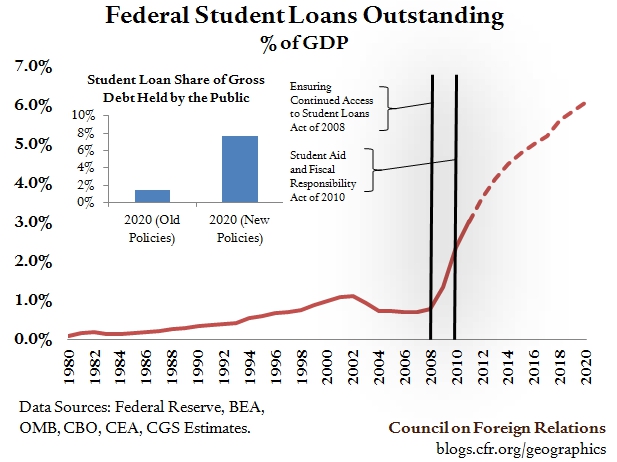
With a pair of new laws in 2008 and 2010, Congress fundamentally changed the student loan market, making the U.S. government the sole supplier of Federal student loans, rather than just the ultimate guarantor. In itself, this does not affect the government’s net debt, because it acquires assets—student loans—which carry a market value. This new direct lending does, however, add to the gross debt held by the public. The $1.4 trillion in direct federal student loans that will be outstanding by 2020 will amount to roughly 7.7% of gross debt. This is 6.3 percentage points higher than it would have been had the scheme not been nationalized. To the extent that one worries about debt from the perspective of a “fiscal crisis,” in which government borrowing costs soar without warning, gross debt is more important than net debt, as student loans are not assets that can be readily sold to reduce borrowing requirements.