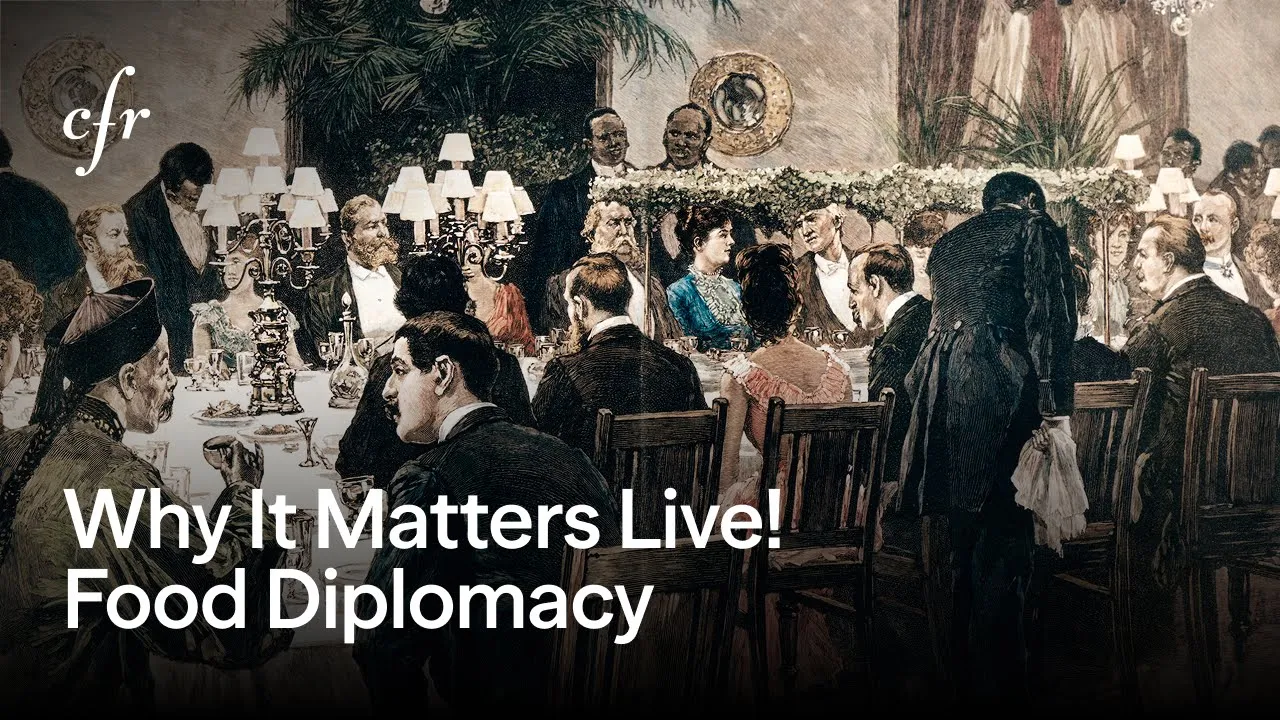
Why It Matters Live!: Food Diplomacy
This live episode unpacks the soft power of culinary diplomacy and how food has helped to create lasting international partnerships.

Published
Host
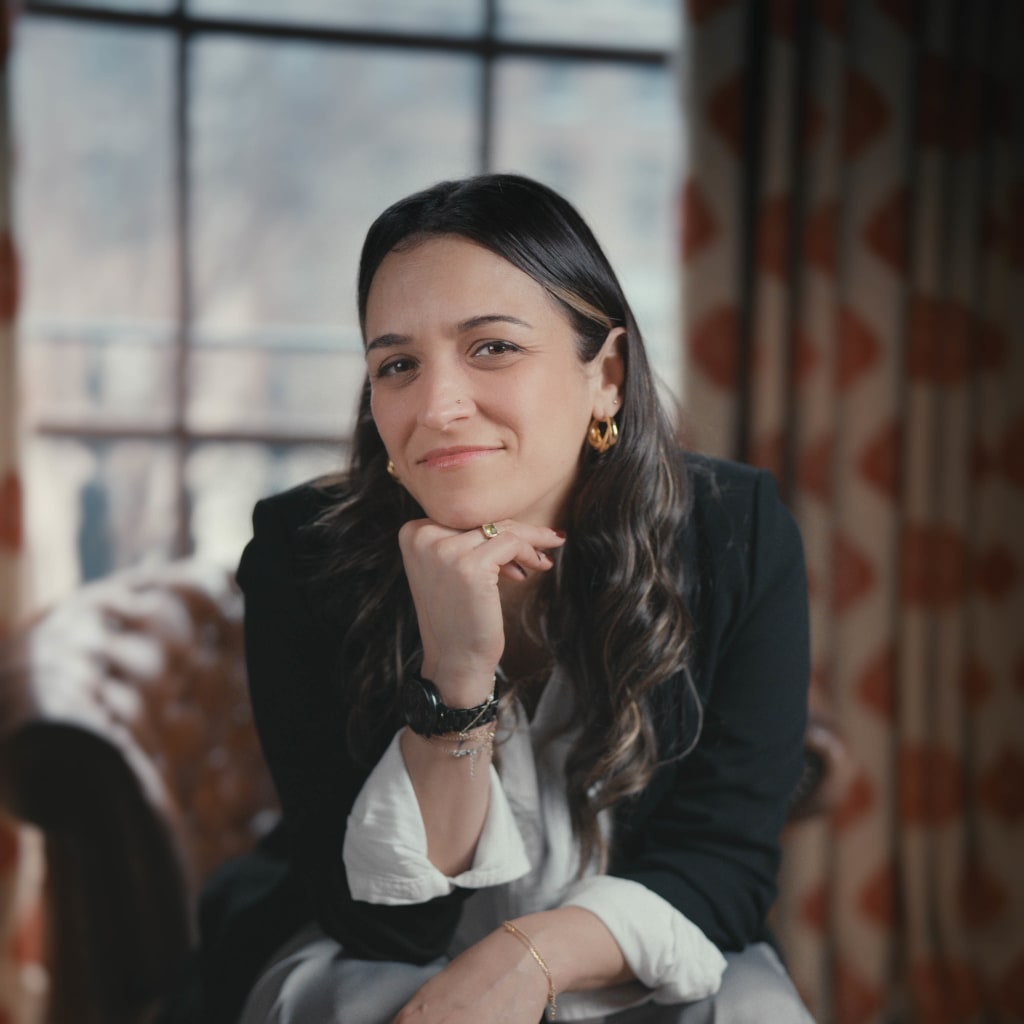 Director, Podcasting
Guests
- Johanna Mendelson FormanDistinguished Fellow at the Stimson Center, Adjunct Professor at American University’s School of International Service
- Matthew CostelloChief Education Officer and Director of the David M. Rubenstein National Center for White House History at the White House Historical Association
[Video: https://youtu.be/dU1GTNcvWmE]
Transcript
SIERRA: Everyone’s got to eat. Food is, of course, something we need to consume in order to survive. But eating also brings people together. After all, as famed Chef James Beard once said, food is our common ground, a universal experience. Hosting someone for a meal can indicate friendship or a celebration. And when it comes to international relations, sharing a meal can also be an opportunity to build trust between leaders, even at the highest level. As chef and author Anthony Bourdain said, with No Reservations, nothing is more political than food. I’m Gabrielle Sierra. And this is Why It Matters, live. Today—yeah. (Cheers, applause.) Yeah! Today, for this special live taping, we’re talking about Food Diplomacy, the power it has to facilitate connection and relationships, and even bridge cultural divides in times of conflict.
(Music ends.)
Thank you to everyone for joining us, live, and also to those of you joining us virtually. So while we will be joined on stage by our guest in a few minutes, we also had the chance to sit down with Matthew Costello before this live taping. Matt is the senior historian at the White House Historical Association. And we got to hear some of his favorite state dinner stories and gain some insight into the role food has played in U.S. foreign policy. So we have those recorded. And here he is to kick us off.
(A video presentation begins.)
SIERRA: So today we just want to narrow in on one topic, even though I have a million questions for you. So, the topic is something near and dear to everyone’s heart, food. So what is food diplomacy? And why does it matter, historically?
COSTELLO: I feel like it’s probably closer to your stomach than your heart. But yes, that’s a great question. You know, I think at its core it really is a very human thing. You know, this idea of people—on the surface, or on paper you may have very little in common with that person, right? You may—you may speak a different language, grew up in a different part of the world, different educations, different traditions, all these things that are so different. But one shared human trait that we have is I think there is sort of this general inclination to want to sit down and share a meal with someone else.
And really, you know, presidents have historically, you know, used these opportunities to try to get a better sense of really the leader that they are primarily dealing with, but also as an opportunity to reveal what they want to reveal about themselves, or about what really matters to them. I think it’s a way that our leaders can get to know each other a little bit better, know exactly where the other person is coming from. And there’s something to be said about sitting at a table and breaking bread. And sometimes even depending on what they’re drinking that can be helpful too.
SIERRA: I was going to say booze helps too. Yeah. (Laughs.)
COSTELLO: Yes, the old Roman, in wine there’s truth, in vino veritas. I think it’s a very human thing to want to sit down with someone else, converse, share a meal, and talk about things like hopes, dreams, goals, aspirations. I think that’s just—that’s something that transcends cultures.
(Video presentation ends.)
SIERRA: In wine, there is truth, but also in beer. Here’s a fun story that we learned while doing research for this episode. It’s actually sourced by my producer, Molly. And she brought it to me. Not too long ago, in 2019, Belgium had a parliamentary election that failed to produce a majority. Politicians from Belgium’s two big regions, Dutch-speaking Flanders and French-speaking Wallonia, were split and they refused to cooperate. So executives at Anheuser-Busch took it upon themselves to try to bridge the language divide. The Belgian beer company set up yellow lawn furniture along a 250-mile virtual border between Flemish and French Belgium, and invited locals to sit and chat with one another. The bait? Free glasses of beer. All right, the beer was not alcoholic, but still, people showed up. Conversation flowed. And it proved that one drink can bring people on opposite sides of the aisle together. And there are many more stories just like this.
So we’re going to get into all of that now. I’d like to bring up our very special guest here with us tonight, Johanna Mendelson-Forman. (Applause.) Hello.
MENDELSON-FORMAN: Thank you for the introduction.
SIERRA: Oh, thank you. So Johanna is a distinguished fellow at the Stimson Center, where she heads the Food Security Program. She’s also a CFR life member. Welcome to Why It Matters, Johanna.
MENDELSON-FORMAN: Well, thank you, Gabrielle. It’s so much fun to be here, both live and with people on Zoom.
SIERRA: So to start, I must ask you, what is your favorite meal and/or drink to share with someone?
MENDELSON-FORMAN: You know, I thought about that question because a lot of people who do interviews on the radio say, what do you eat for breakfast? (Laughter.) And I think I don’t have a favorite meal, because we are a country of such abundance that I would love a Monte for dinner one night, and I’d love a pastrami sandwich in New York for another day. And there really isn’t a favorite. But I think it’s the privilege of living in a place of plenty where you can pick. And for someone like myself, who goes between the diplomacy and the security parts of the food, I always feel we’re very fortunate to be even able to ask that question.
SIERRA: Well, now you’re making me want pastrami. So—
MENDELSON-FORMAN: Well, that’s after the show.
SIERRA: That’s after the show. So it’s unusual for us to be sitting here talking about food on stage at CFR. Maybe behind the scenes, you know, for the meetings. But it feels like food is being recognized more and more as a form of soft power around the world. So we heard from Matt, but what does food diplomacy mean to you?
MENDELSON-FORMAN: Well, do we have a couple of hours? (Laughter.) It’s interesting that you use the term “food diplomacy” in IR, because there are some particular terms of art, like food diplomacy, which refer to humanitarian aid, the use of food as a way to assist other countries, particularly, for example, you all remember the Marshall Plan, or the humanitarian assistance we give and support the World Food Program with. But culinary diplomacy, and its sister gastrodiplomacy, are another character. So culinary diplomacy is what Matt described and showed you on those beautiful slides, of coming around the table—and, by the way, he mentioned breaking bread. You know what—you all use the word company, don’t you? You know what that means, when you say I want company? You want to come together around bread, co-pan. So all the time when we have company we are coming together around bread, which implies more than one person.
But culinary diplomacy, just for our simple definitions, is really an act of a state where food is used as a tool for persuasion or coercion. It could be both. But it isn’t forceful, in the sense that it’s not kinetic. And you’re all IR students, you understand. It’s not bombs. It’s the butter. Gastrodiplomacy, which is become a term which is more popular since 2002 when the government of Thailand started promoting its cuisine, is the role of the government, or state, or non-state actors, to promote cuisines to stand out in a crowd. And we’ll get to that later. I know you’ll have some questions. But I just like to distinguish that and the difference, because since you’re asking about IR we have to be specific.
And then historically—I mean, I’m sure you all are aware of all these various dinners that you’ve seen in television programs of the kings and queens who hold these sumptuous meals, because food is power. Just the way I said we have abundance here, we have power through our kitchen. So when someone had feasts for days and days, and even in ancient times feasts were given when the Romans conquered an area. They made a feast as a way to get the leadership of that country to come together around the table. So there is this ancient background of culinary diplomacy. And then, of course, the modern that we just saw Matt describe in our own country and abroad.
SIERRA: So, I mean, do you feel like it’s gaining legitimacy as a tool in the foreign policy space?
MENDELSON-FORMAN: Well, I believe that food is the new internet. We communicate with food. And that’s a very important thing. I mean, just the way we had email and internet before, we use food to connect. And food is also entertainment. How many of you watch Food TV? You can admit it, even though you’re at the Council. Yeah, OK. So the point is, food is a new form of entertainment because it shows people competing, but it also shows the power that food has to connect each other. It’s our culinary DNA. And when you watch these competitions, you’re also being entertained by how people use their background, their history, their personal stories to connect with another person.
SIERRA: I know before the show in our pre-interview you had actually brought up something that I thought was so interesting, which was that even during COVID people were having virtual drinks, virtual dinner parties, that they were still drawn to this idea of sharing food even when we were far away from each other.
MENDELSON-FORMAN: Well, I think the Council still has virtual happy hours.
SIERRA: Oh yes.
MENDELSON-FORMAN: In Washington, at least. I don’t know, here in New York. But, yes, I feel part of people being alone is countermanded by having a meal with someone. And I was just reading an article about someone who likes to dine alone but the prejudice they feel when they go to a restaurant, because it’s normal for human beings to connect around the table. So that’s the other term I want to use, because I happen to be an academic, is commensality, which means coming around a table. And this term goes back to ancient Greece, when the family unit was very important and coming around a table for an occasion was not only sharing a meal, but it was about having a forum in which to discuss problems. So we are looking at something both very ancient and very modern.
SIERRA: I want to talk a little bit about tradition, because food is often a way to share culture. And while food may be gaining more legitimacy as a soft power tool, sharing a meal as an act of goodwill, as you say, is certainly not a new tactic. Which is why I asked Matt about White House state dinners, the top diplomatic dinner that you can be invited to in the U.S. And here he is to tell some stories.
(A video presentation begins.)
COSTELLO: (In progress)—very different from if you were to go back and look at the historical record. You’ll see references to things like state dinners in the nineteenth century, but they’re not talking about the state dinners as we think of today. Sometimes they use the same language to talk about dinners that they were having for members of Congress, or Supreme Court justices. There were receptions that were held every year as part of the Washington winter social season. So we identify today state dinners as really sort of one of the highest honors a visiting leader can get when they come to the United States. The first state dinner that we believe is sort of the first one in this modern form dates back to 1874.
And it’s when King Kalakaua, who at that time is the monarch—he is the king of the independent kingdom of Hawaii. And he comes to the White House and Grant hosts him, actually, over several days, about a week or so, in Washington. When he has this state dinner for a visiting head of state, that’s really sort of the first time that we acknowledge. There are other visitors that come to the White House prior to that. It seems like it’s more, like, princes, and cousins, and nephews of people who are affluent, well connected. But when we’re talking about a visiting head of state or a visiting head of government, that’s really the first time that the president hosts someone at that level.
SIERRA: So it’s a celebration. It’s not necessarily something you’re negotiating over a table. You’re celebrating something that’s already been achieved.
COSTELLO: Hopefully. It’s not—it doesn’t always go that way. Obviously, whatever’s happening in the world will also shape these decisions, right? Who are you trying to pull closer to you? Who are you maybe trying to help thaw relations with? Or who are you really trying to solidify and firm up support of somebody who maybe was a more traditional ally, and maybe they’re not quite on the same page with the new administration? So there’s a lot of different angles and perspectives to consider when you extend this invitation.
SIERRA: I love these state dinner stories. Are there any that stand out to you as significant?
COSTELLO: Well, I mean, the one that I’ve always found really fascinating is Nikita Khrushchev’s visit to the United States in 1959. And the reason that I’m so interested in it was because, you know, this is really sort of in the height of the Cold War. You know, Stalin is dying, and now the Soviet Union has a new leader in Khrushchev. And so, again, it’s sort of a feeling-out phase of will the Soviet Union continue to be sort of on the same path that Stalin had it? Will Khrushchev be more open or more receptive to changing some of those things, to working with the United States, to finding some type of shared, common ground, or shared goals? It’s Vice President Nixon who goes over and is part of the kitchen debates in Moscow. And I think Khrushchev sort of puts it on tilt a little bit. He’s sort of grilling him about the excesses of capitalism and all these other things.
And so when they make the decision to invite Khrushchev to Washington, it becomes part of a larger multi-week visit to the United States, so that Khrushchev can go and see different parts of the United States. He can see different cities, different places, meet different people. Of course, you know, Eisenhower has him at the White House, as is customary, but they also do a reciprocal dinner for the Eisenhowers at the Soviet Embassy. And in both of those dinners, they are featuring sort of classical or traditional cuisines from their homelands. So Eisenhower has much more Americana-type style food, which, you know, Eisenhower, growing up in Kansas, spent most of his life in the military, he wasn’t somebody who had very opulent taste buds. And, you know, the Khruschevs, very, very similar.
When they had the Eisenhowers the embassy, they have things like stuffed partridge, borscht, macaroons, you know, something—it’s a lot of very Eastern European delicacies. So, again, it is sort of a way to sample the culture, the taste, the cuisine, of whoever you’re meeting with. And this visit is also particularly important because it’s the first state visit of a Soviet head of state. Stalin had never been to the United States. There had been Soviet foreign ministers, but this was the first time that we had an American president on American soil meeting with the leader of the Soviet Union. And it went fairly well. In fact, there were plans for a reciprocal visit for Eisenhower to go to Moscow, but then, of course, the U-2 spying incident happens in 1960. And so it’s just as quickly as some progress is made, some inroads are made between those two leaders, it can dissipate just as quickly as that.
(Video presentation ends.)
SIERRA: I’m going to blow up Matt’s spot here and say that he told me he’s never been to a state dinner, neither have I, but he is a professional to his core because I also asked him if he would try to crash on with me, and he said no. (Laughter.) So there’s a long history here. And although state dinners and hosting foreign delegates are part of a longstanding tradition, they’re evolving alongside the geopolitics of the time. Some are more formal. Others have been more impromptu, with meals taking place even on the battlefield. So, Johanna, along with your roles at the Simpson Center and at CFR, you also teach a course at American University called Conflict Cuisine: An Introduction to War and Peace Around the Dinner Table. I would love to know more about this.
MENDELSON-FORMAN: Well, the Conflict Cuisine course started because of the international relations background I had working on countries that were emerging from conflict. And one thing that we know when we have conflict is we always have immigrants and refugees. And I thought, what an interesting thing I could do to teach students about a war, if they were able to talk about people who escaped. And in the city of Washington, or the metropolitan area, we have many diasporas of many conflicts from the Cold War.
We have a large Vietnamese population, especially after 1975 when Saigon fell. We have large population of Afghans who came in 1979 after the Russians invaded Kabul. We have Ethiopians. We have more Ethiopians in Washington than in Addis Ababa, because when the Communists took over the government, with the guerrilla wars that went on there, Ethiopians came to Washington. And of course, we had Central Americans because with the conflicts going on and the proxy wars there, we had the Salvadorians come, and also the Hondurans, the Guatemalans.
And so we have not only people who’ve experienced the sadness of war, but use this experience and their cuisines to start new lives. And that’s what this course is about, that you can become resilient and you can use your cultural background to create a whole new way of living, and food becomes that tool.
SIERRA: So we heard from Matt, but I’d love to know what are your favorite foreign policy stories to teach, where food or a meal was used to bring leaders to the negotiating table?
MENDELSON-FORMAN: Well, there are lots of them. How many of you have seen Hamilton? All right, well, what was one of the main parts of Hamilton? It was the bargain—the dinner table bargain, where Thomas Jefferson brought James Madison, who was a Virginia congressman, together with Alexander Hamilton, who was our, at that time, secretary of the treasury, to create what eventually created this—almost brought down the republic, because it had to do with the assumption of debt. After the American Revolution, states were fighting with the federal government about who would pay for the debt of war. And Jefferson, being a clever diplomat, he had served in France as our ambassador there, decided that he would offer a meal and try and bring these two parties together.
And the ultimate result was the Assumption Bill. What happened is our capital of the United States at that time was in New York City, which is where Jefferson was living, in downtown. And he—the compromise was the following: Hamilton got his bill so that the federal government would become the source of credit for the debt. But Washington, D.C. became the capital to appease Madison, who was a congressman from Virginia. So there’s always compromise. And that’s what I think is important for you to remember. And we can talk about lots of dinners. There is a quid pro quo. While it’s pleasant to be over a meal, while you build trust—and there’s lots of psychological literature which shows that when you break bread with somebody, as opposed to doing it over a Zoom, you create a bond of some sort. And negotiations in business usually go better. There is something about the corporate lunch, without the martinis, that can do something for you.
But also, you do want something. So, for example, it was clear that Jefferson wanted these two gentlemen to solve a crisis. And it was a constitutional crisis, at the time. At the same time, we have, during World War II some very famous dinners where the allied powers—there was Franklin Roosevelt, Churchill from England, and then Stalin, were trying to figure out how they would overcome the threat of Nazism. And there were three famous conferences—one in Tehran, a second one in Yalta, which many of you may have read about, and a final one when Roosevelt had passed in Potsdam. These were culinary feasts. They were of a scale like you would see in the White House.
And what I think is interesting in all of these dinners is in the height of one of the most horrible conflicts in the twentieth century, the logistics of bringing this food to these conferences is in itself a history of the prowess of the military and military chefs, who were able to get things on dangerous supply lines. And also, the smarts of people—for example, it was clear Stalin knew that Churchill loved oranges. Well, there weren’t many oranges or citrus food in World War II, but he would bring oranges to Churchill every time he saw him. Or Franklin Roosevelt, who knew Stalin like bourbon in addition to vodka, and brought bourbon to the conferences. So these events, while they had very high culinary value, had underlying roles of trying to persuade, in very trying times, something that needed to be done. So there is this diplomatic component, which I think is a story that is of great value in the history of international relations.
SIERRA: It’s very intimate, you know, to know that about somebody. It’s also displaying that you were listening, that you’re, you know, trying to please them, and that you remember.
MENDELSON-FORMAN: Well, I have to put a cheer in for the women also, because there’s a wonderful book about—called The Daughters of Yalta. And Roosevelt brought his daughter to the dinner. Harriman, who at that time was the ambassador in Russia, and also Stalin’s daughter. They all came. And they were all instrumental in helping set up meals. And it was they who decided what the menus were, working with the chefs, and were recommending the protocols. So these daughters of Yalta, who were very highly educated women and trained women—Churchill’s daughter as well—were the people creating the backdrop for the diplomacy that was taking place around the table in some very trying times. And almost—you know, certain things almost didn’t happen.
SIERRA: I give them a lot of credit. I find menu planning to be stressful for my friends, so.
MENDELSON-FORMAN: Well, you can use AI now. You can do AI.
SIERRA: That’s true. Yes. So the first World Food Summit was held in 1974. So tell me about that. What sort of lasting relationships came out of—well, what is it? But also, you know, what sort of lasting relationships came out of it?
MENDELSON-FORMAN: Well, in 1974 there was a decision to hold a World Food Summit, because we were recognizing that as the world was developing and growing very quickly there was also a tremendous problem about global hunger. We saw huge population growth in Africa and Asia. And the Green Revolution, which was underway, was still not solving the needs of feeding everybody in society. Henry Kissinger, of whom you all are aware, was, of course, a very active Council member and a great diplomat of this country, was the leader of the U.S. delegation and helped create that event. But he left one lasting political memory, in that he pledged that in ten years no child would be hungry.
Now I say this because in 1974, there have been many food summits since that time, but the promise of no child hungry which he made—and it was probably the most well-known comment of the event—is still a challenge. But you all know about the Millennium Development Goals, the Sustainable Development Goals. All of these different goals have a pledge to end hunger. And the most recent, the Sustainable Development Goals which end in 2030, have as a pledge to end global hunger by 2030. And because of all the things that have happened in our lifetimes in the twenty-first century, from the wars in the Middle East, from Syria, to the COVID pandemic, we will not make that goal. This goal is set by U.N. members, 195 countries, who agree on this. And no child hunger, while we’ve made great progress in certain areas, is still elusive. So I know that’s a long-winded answer to your question, but that’s where it goes.
SIERRA: So, turning back to Matt, I want to play just one final piece of our interview that we thought was fun, and actually turned out to be quite delightful. How food helped shape the relationship between presidents and the American people.
(A video presentation begins.)
SIERRA: Which presidents had the weirdest taste buds or food requests? You know, who ate what?
COSTELLO: As far as quirky culinary tastes, James A. Garfield enjoyed squirrel soup. So that was something that, I mean, not everybody today probably would go for. But in those days, we see these things kind of happen here and there. For example, there was a lot of interest in possum at one point as a delicacy in the United States. In fact, one of the most famous White House pets was a raccoon named Rebecca. And Rebecca was given to the Coolidges by a supporter from Mississippi in 1926. But the intent of the gift was, hey, you should eat this raccoon for Thanksgiving.
And the Coolidges could not—they just could not bring themselves to do it. I don’t know if it’s because they loved the raccoon, or they were like, no thank you, we don’t want to eat a raccoon. But they named her Rebecca. They turned her into a White House pet. And you can find some great photos online of her at the White House Easter egg roll where Grace Coolidge has her on a leash. And she’s walking her around, and the kids get to kind of, like, look at the raccoon. It’s very interesting, though, to see how that relationship between the American people and the presidents through food, and how that has evolved and changed over time.
SIERRA: Which president—
(Video presentation ends.)
SIERRA: We ask again. Would you eat a raccoon?
MENDELSON-FORMAN: No.
SIERRA: OK. (Laughs.)
MENDELSON-FORMAN: But Brunswick stew, which is made with a squirrel, is still very popular. And I know Jimmy Carter liked Brunswick stew. Now, I don’t know if they served it in the White House, but they certainly—it’s a staple in Georgia.
SIERRA: OK, yeah. All right. So we have to expand our minds and palates.
MENDELSON-FORMAN: Exactly.
SIERRA: So I want to talk about something that you spend a lot of time looking at, you even brought it up before, food as a representation of a person’s country and culture, something that you bring with you as you move. A sort of movable feast. So you talked a bit about this, but how have diaspora communities influenced American cuisine? And how are we seeing this pan out in terms of U.S. foreign policy today?
MENDELSON-FORMAN: Well, one thing about diaspora cuisine is we—unless you’re a Native American—we all bring different foods to this country. And people say, well, what is an American cuisine? And if you look at the surveys, I mean, a hamburger always comes up, by the way, as number one. But as different groups came to this country, until the middle of the nineteenth-century American food, as we knew it, was pretty awful. It was really mush if you were poor. I mean, lots of leftovers, ground up, and made into pie. But when we started getting immigration flows really moving, especially after the 1848 wars in Europe, we began to get Germans. We began to get Irish. And then in the beginning of the twentieth century, we had people from southern Mediterranean. We had an Italian migration. And then we had people from Eastern Europe. So we had the people from the Jewish population from Russia.
The cuisines of the United States are so diverse that what it does is it makes it possible, in this melting pot, for everybody to enjoy the different types of foods that we eat. Just walk down a street in New York and look at the diversity of cuisines. But you don’t have to be only in New York. Look at the influence of Mexican cuisine in our culture. We have regional American Mexican food now. And it’s a cuisine. So that’s one part of it. But food can also be used to brand a country. And I think this is the important point. Nation branding, you know what that is? Well, we know about branding. Nation branding is countries like to stand out in the crowd. So if you’re part of the big Group of Twenty, you know who you are. But if you’re a little country like Thailand, and you want to stand out—even though it’s a beautiful kingdom—how do you stand out?
You create a program to promote your cuisine. So why are there so many Thai restaurants around? Have you ever noticed how many Thai restaurants there are? That’s because the government of Thailand actually subsidized its foreign nationals to open restaurants. So starting in 2005, Global Thai became a program of the government of Thailand to promote tourism to Thailand, but also to promote its cuisine. So many countries now do this. This is not unusual. Mexico has Ven a Comer, its own gastrodiplomacy program. There are Japanese programs. There are programs from China that have their own culinary diplomacy, not that China needs more elevation of it is cuisine. But Malaysia has a program. India has the program. In other words, countries see food as part of tourism.
Now, about 65 percent of people who travel, at least in the U.S. and Western Europe surveys, travel to eat. Don’t you like to eat when you travel, and try new cuisines? Food is a very important part of the economy. And for the United States, it’s extremely important. We promote food as part of our exports. A quarter of the U.S. economy is food based. And so when an ambassador goes to represent us, for example, in Norway, our ambassador to Norway, who wrote a book, recently, talked about promoting California wines in Norway, which, by the way, were very popular. He did it because he liked California wines, but he was also promoting a business.
The same with Korea. You know, Korea promotes its cuisine through its food. So it has wonderful food, and there are many great restaurants here in New York in Koreatown, but all over the United States. But it’s also to promote export products like fish and soy. So you have this nexus of economy with the whole use of food, which is something that’s accessible. Food is very accessible. You don’t need to have an IR degree to eat. But you can learn about a country through your palate. And that’s part of the goal.
SIERRA: Well, I was going to ask you, what is the relationship between food security and diplomacy around the world?
MENDELSON-FORMAN: Well, food security is very, very different. And I was just thinking, as we were in the prep room, in 2015, which is a decade ago now, the national intelligence estimate, which is something the CIA does on different issues, declared food security a national security issue. And why is it? Not because we had a lack of abundance of food in this country, but they recognized that as the population grew, as climate change had an impact on growing patterns, that we were going to have a problem globally if we did not address global food security. So I think one, perhaps, of the tragedies happening as we speak is the lack of recognition of how vital food assistance is to stability in other countries. Because, you know, you don’t have to be Bob Marley to say a hungry belly is an angry man. I mean, that’s all about anger. When you’re hungry, you get angry. And so there was this security interest that was very much a part of our own diplomacy and international relations.
SIERRA: So it’s got that soft power element, but it also very much has this security piece.
MENDELSON-FORMAN: Absolutely. Right. And in fact, we did work a few years ago I guess with the State Department and the military training academies to get a course on food security as part of the regular curriculum, because we felt that if you were a soldier, or sailor, or a marine, or an airman, you needed being able to understand the power of food on the ground when you went into a country. Because the lack of it could be a danger.
SIERRA: So looking forward, and this is a big question, but what are your thoughts on how we could and should use food diplomacy to face looming threats?
MENDELSON-FORMAN: Well, we have lots of threats. We have lots of existential threats. Climate is certainly one of the biggest. And also, we still have lots of disease and hunger as a result of that. The good news, and there’s lots of good news in the food space, is that the technology around food has grown so that—I personally feel, with the technology that I understand, and I’m certainly not a scientist, there are great advances in agriculture, great advances in farming that will help feed populations going to midcentury. But there are also many unknowns. And that’s what you all, in your generation, have to solve. We need to figure out migration, because climate migrants are one of the biggest challenges we face. Even when you are a farmer, if you can’t farm because of a drought, you leave your land. Urbanization is a result. And the world is much more urban than it’s rural. So who is going to grow your food going forward, if you don’t have people living in rural areas? How are you going to farm if there’s no water? How are you going to farm if there’s no energy?
So I think the technology and the solutions are there and being developed, but they’re not equally distributed. And that’s the biggest challenge. Africa has the largest population growth projected of any continent in the world, and yet that’s an area which could be potentially very fertile and would grow many lands. But what happens? You have conflict. What do conflicts do? If somebody is coming in and trying to steal your farmland, you’re not going to be able to plant, you’re not going to be able to harvest, you’re not going to be able to conserve seeds. So we have these challenges that keep going and really deeply affect the way we look at the future. And I’m hopeful that the future will have many more positive inventions, but we all are guardians of this little planet that we’re on. And we have to recognize how to protect what’s there, and to address threats when we face them.
SIERRA: Speaking of technology, you said something very interesting to me when we spoke last about how AI can’t taste. I wonder if you could speak a little bit more to that, as we’re all terrified—or maybe I’m projecting—(laughter)—of AI and what’s to come.
MENDELSON-FORMAN: Well, I’m older than you and I’m not terrified of it. (Laughter.) But I’m fascinated by what people are doing in the food space with AI because now people can create menus. And you can tell somebody—you can talk into your ChatGPT and say, OK, I have eggs, and I have butter, and I have a piece of meat, and I have these vegetables. Create a dish that I can cook. And, you know, less than thirty seconds later it will create that dish and tell you how to make it. Similarly, chefs are using these types of techniques to create menus in restaurants.
I recently spoke to a chef who was a chef in the Hiltons in England. And he said, oh, I always do my menus on AI now. So, you know, here you’re paying $300 for a dinner, and a computer is making the menu. But I will say, one thing AI can’t do for us is it can’t taste. Taste is a human skill. And, you know, if it will taste good, I don’t know. But flavor profiles, which are the key to culinary, you know, prowess, require a human taste bud. There’s a whole field of neurogastronomy, which is a very serious field, about how your nerve system tastes. So will we have bots that can taste? I don’t know. Maybe so. But I’m more skeptical of that, that we still need commensality and community in order to be able to taste things.
SIERRA: Well, we’ve reached our time limit. Next time we’re together, it’ll be over a meal. Thank you so much to everyone for being here. We will have fifteen minutes for questions for Johanna, but first let me read us out to our theme in the usual manner.
(Music plays.)
For resources used in this episode and more information, visit CFR.org/WhyItMatters, and take a look at the show notes. If you ever have any questions or suggestions, or just want to chat with us, email [email protected]. Or you can hit us up on X at @CFR_org. Why It Matters is a production of the Council on Foreign Relations. The opinions expressed on the show are solely that of the guests, not of CFR, which takes no institutional positions on matters of policy. This episode was produced by Molly McAnany, Justin Schuster, and me, Gabrielle Sierra. Our theme music is composed by Ceiri Torjussen. Huge special thank you to Liz Lowe, the events team, the AV teams, and meetings teams for letting us do this, putting this together. You can subscribe to the show on Apple podcasts, Spotify, YouTube, or wherever you get your audio. For Why It Matters, this is Gabrielle Sierra signing off. See you soon. (Cheers, applause.)
Host Gabrielle Sierra and podcast guests Johanna Mendelson Forman and Matthew Costello discuss food diplomacy, share stories from White House state dinners, and unpack how food has helped to create lasting international partnerships.
This taping was originally recorded on April 17, 2025.
Featured Guests
Johanna Mendelson Forman, Distinguished Fellow at the Stimson Center, Adjunct Professor at American University’s School of International Service
Matthew Costello, Chief Education Officer and Director of the David M. Rubenstein National Center for White House History at the White House Historical Association
Producer
- Producer, Podcasts
Video Editor
- Associate Producer, Video and Audio
Audio Producer
- Audio Producer & Sound Designer
More Episodes
 29:35Podcast
 26:04Podcast
 38:36Podcast
 31:35Podcast
 37:32Podcast
 32:26Podcast