Autonomous Ukraine: Allies, Partners, or Frenemies?
This episode outlines the global network sustaining both sides of the war in Ukraine, with NATO allies on one side and Russia with backing from China, Iran, and North Korea on the other, and how the limits and tensions within these alliances are shaping the war’s next phase and raising broader global security risks.
Published
Host
 Director, Podcasting
Guests
 Liana FixCFR ExpertSenior Fellow for Europe
 Joseph TorigianCFR ExpertSenior Fellow for Asia Studies
Transcript
These are among the darkest hours, for Europe sees the end of WWII.
(Air Raid Sirens)
ABC7: Breaking news right now. Russia has attacked Ukraine marking the start of a new war in Eastern Europe.
NBC News: We are reporting tonight from a country fighting for its survival against one of the most sophisticated and largest militaries on the planet.
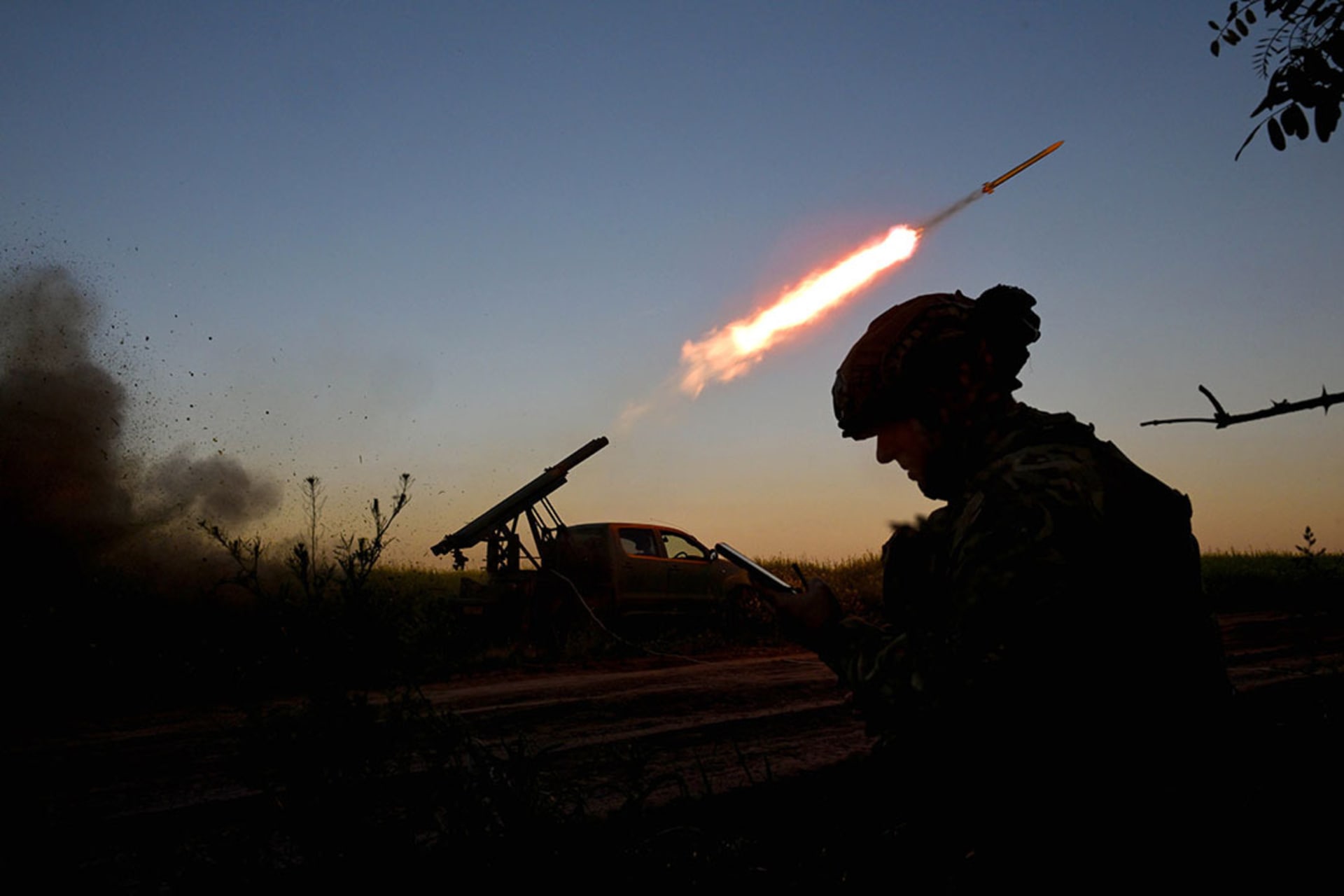
As Europe’s largest conflict since World War II enters its fifth year, Ukrainian and Russian forces remain gripped in a bloody standoff: Russia holds close to 20 percent of what had been Ukrainian territory while taking heavy casualties, and has inflicted massive damage to Ukrainian infrastructure both near and far from the front lines in the eastern Donbas region.
Both sides have demonstrated incredible resilience, and have adeptly embraced the use of advanced technological warfare. But they have also been bolstered by outside support - the Ukrainians from NATO members who have provided weapons and financial assistance, and Russia primarily from extensive economic and logistical help as well as materials that help the Russian military-industrial complex provided by China.
But the nature of support for both warring sides is far from a rock-ribbed alliance.
Ukraine’s most critical partnership, the United States, is facing fresh scrutiny under a second Trump administration. And although China and Russia declared a “partnership without limits” right before the start of the war, Beijing has since demonstrated some limitations around its support of Moscow’s campaign.
So what is the current nature of these partnerships?
My name is Gabrielle Sierra, and this is Why It Matters. Today, in episode two of our Ukraine series, we take a look at the alliances shaping the war, and ask what these modern partnerships mean for the future global order.
Liana FIX: The Ukraine war is really an example of how the world order is changing and how alliances are changing.
My name is Liana Fix. I’m a senior fellow for Europe at the Council on Foreign Relations in Washington D.C., and I have worked on Russia, European security, NATO for many years in Moscow, London, Berlin, Tbilisi, and in Washington D.C.
At the beginning, it was very clear that we had a Western alliance that supported Ukraine, that consisted of NATO members, Europe, Canada, and the United States. The United States took a very clear leadership role in this war from the beginning. That was different from 2014 when Russia first invaded Ukraine where the United States under Obama basically said, “Well, you Europeans, you deal with it. We take a backseat.”
Gabrielle SIERRA: Okay. So, no surprises there. These were expected alliances.
FIX: Yeah, absolutely. I mean, NATO has a longstanding relationship with Ukraine. NATO never wanted Ukraine to be a member, specifically France and Germany never wanted that to happen. The United States under George W. Bush pushed for that, but then, subsequent administrations rather saw Ukraine’s role in NATO as outside of the alliance, but in a close partnership with the alliance. The EU also has put Ukraine on a track of association, which is what actually stoked the protest in 2014.
Liana has mentioned 2014 twice now so let’s quickly explain what happened around that time.
In November of 2013, the Ukrainian government rejected an association agreement with the EU in favor of closer ties with Russia.
Al Jazeera English: Many demonstrators want President Viktor Yanukovych to resign, and talks with Europe to resume immediately.
Hundreds of thousands of Ukrainians began to protest the decision early in 2014.
The movement, which lasted months, sparked a violent confrontation between protesters and state forces in Kyiv’s Independence Square-
EuroNews: Ukraine’s political opposition leaders joined the sea of blue and gold in Kyiv’s main square on Friday. They said that President Viktor Yanukovych had stolen the dream of closer integration with Europe.
...and culminated in the ousting of pro-Russian President Viktor Yanukovych.
CBS Sunday Morning: Ukraine’s anti-government protestors are now in control of Kyiv and celebrating victory.
Following Ukraine’s ‘Revolution of Dignity’ as these protests have been coined, Moscow decided to invade and subsequently annex Crimea.
CBS Mornings: There was chaos and confusion in Crimea this morning after armed gunmen took over regional government buildings and flew the Russian flag.
Bringing the peninsula under Russian rule. These actions, along with the instigation of armed separatist conflict in the Donbas region in April of 2014, marked the start of an ongoing war in the region.
FIX: So, in the Western institutions, the EU and NATO were very clearly in a strong bond with Ukraine, which is exactly the reason why Russia did not want Ukraine to slip even further into this kind of Western camp there.
At the beginning of the war, it was quite clear that what Russia is doing is an unprecedented violation of international law and violation of borders. So, it was actually pretty easy to get many countries, also countries that are not aligned with NATO or the EU from the global south, to get them on board with the argument, well, look, do you want to be invaded by a more powerful neighbor? No, right? We have to uphold that principle.
SIERRA: So, you’re saying, “were.” Where are we now?
FIX: Things have become more complicated. Now, we are seeing that Europeans are still supporting Ukraine, whereas the United States is somewhere in the middle between Ukraine and Russia, seeing itself as a mediator, often with a pro-Russian bias here. Then, we have Russia and at the beginning of the war, China was more of a neutral actor, an actor that was partly surprised by the war and also did not want to see an escalation. And we also see Russia getting support from Iran, from North Korea, what was called a CRINK alliance, which makes many countries from the global south think, well, where do we position ourselves in this messy new world?
Joseph TORIGIAN: Russia is in this situation where they have a kind of à la carte relationship with several different countries that provide different kinds of benefits and also face their own restrictions in what they’re actually willing to do. And so, these are partnerships, but I’m not sure whether ally is exactly the right word. Even though I think that viewing them as crucial facilitators of the Russian war machine is exactly the right way to think about them.
My name is Joseph Torigian. I’m a senior fellow at the Council on Foreign Relations and an Associate Professor at American University School of International Service.
Joseph is a leading expert in his field and studies Russian, Chinese, and North Korean politics and foreign policy.
TORIGIAN: I think the most important thing to think about is of course China.
CBS News: NATO is warning China against supporting Russia’s war effort in Ukraine. The alliance also says Beijing should not do anything to help Russia get around sanctions from the West.
DW News: Evidence is mounting that Russia’s war effort is drawing military assistance from Chinese companies now.
TORIGIAN: And so here we have a country that views the origins of the war in remarkably similar ways as the Russian Federation. They believe essentially that the United States provoked the war and that the U.S. is now using the war to achieve a strategic defeat of the Russian Federation. And using the words of many Chinese, that they’re fighting to the last Ukrainian. And the Russians and the Chinese have been very forthcoming about their vision of a new, more multipolar world. They have the same idea of what history means, that during World War II, they had defeated fascism, but did not eliminate it. And that America’s behavior both in Europe and Asia is something that rhymes with what Nazi Germany and Imperial Japan did. And that the United States is not paying enough respect to the outcome of that war by acknowledging a Russian sphere of influence in Europe or China’s claims against Taiwan. So the language that we’ve seen that characterized the Russia-China relationship in the most dramatic terms was right before the war was launched, where it was described as a partnership without limits.
Once the war started, the Chinese were a little bit careful about helping the Russians in material terms until the Russian forces started suffering in rather dramatic ways on the battlefield. And that’s when we saw the Chinese stepping up in more meaningful ways to help the Russian war machine, even as the way that they’ve characterized the relationship more formally has never reached that level that we saw right before the war was launched.
SIERRA: Do you anticipate this emerging anti-Western block, I know some are calling it CRINK, to evolve into something more?
TORIGIAN: I don’t think so. And the reason for that is the Russians and the Chinese were in an alliance before during the 1950s. And one of the reasons it collapsed was because as formal treaty allies, they were supposed to sacrifice their interests for each other, but they didn’t want to do that. And so that led to a sense in both capitals that they were being betrayed. There was a fear among the Russians that the Chinese would lead them into a war that they didn’t want to fight. And so that created the conditions for the Sino-Soviet split.
History on Maps: The two countries were former allies but by the late-1960s, they had become bitter enemies, and the border conflict in 1969 brought them to the brink of war. This conflict shaped the international political landscape, and had a profound impact on the balance of power between the superpowers.
TORIGIAN: And so what they have now is more flexible, even if it wasn’t as close as they were before. And so the Chinese can decide when and how to support the Russians while still being very careful about not sacrificing their own interests in any fundamental way.
SIERRA: Tell me more about this partnership. What are we talking about here?
TORIGIAN: So the Chinese have been careful not to supply weapons to the Russian Federation. I think that the Chinese have recognized that they would face real economic and reputational costs if they cross that line. But at the same time, what they have sold has been essential for the Russian’s reconstitution of their war machine. So, everything from machine tools, various technologies that have been harder for the Russians to import because of the sanction regime. And so as the war turned from one of maneuver and these really dramatic changes on the battlefield to one of attrition, and one especially that uses drones, which are being built very quickly by the Russians, but inevitably draw upon Chinese materials and technologies, Beijing’s role in those efforts has really been quite essential.
Engines, control systems, operation units — these are just some of the components China provides to Russia, enabling the production of new technologies for battlefield use like the Garpiya-A1 Attack Drone designed to strike deep behind Ukrainian enemy lines. Latest reports estimate that in a single day Russia manufactures 500 Iranian-designed Shahed drones designed to carry explosive warheads at long range.
TORIGIAN: At the same time, China tries to play a double game by positioning itself as a country that’s not a party to the war and that calls for a peaceful solution as quickly as possible. And has been very careful about not taking certain specific steps that would make its economy or reputation vulnerable in ways that aren’t, in their view, strictly necessary. And so there is some daylight within the relationship between Russia and China, which has led to debates within the United States about whether Washington could put pressure to make it even more of a difficult relationship between the two. But I think that that will shape specific decisions, but not the broader trajectory of that partnership.
SIERRA: Well, what does China get in return for their support?
TORIGIAN: The big picture is that the Chinese view the world in very dangerous terms. They see the United States as a declining power, but also one whose strengths remain persistent, and that as it views a rising China will engage in increasingly adventurous and dangerous behavior to stop China’s rise. And so when that is how you view the world, you’re going to look for people with broadly similar ideas. A world in which the West is engaged in what they call peaceful evolution. This idea that they are trying to grow forces within their societies that will rip them apart. That the idea of universalism is a way of turning their countries into appendages of the West. And so they see themselves as creating in their mind a more multipolar world. And in that sense, I think that the Chinese see a real value into having a powerful Russian Federation that can persist and succeed.
Following the collapse of the Soviet Union in 1991, Sino-Russian cooperation emerged as a response to the looming geopolitical vacuum. Long opposed to Western approaches to democracy and human rights, Russia and China’s cooperation strengthened after 2014, when Russia annexed Crimea and faced Washington’s heavy sanctions.
Barack OBAMA: The international community will continue to stand together to oppose any violations of Ukrainian sovereignty and territorial integrity, and continued Russian military intervention in Ukraine will only deepen Russia’s diplomatic isolation and exact a greater toll on the Russian economy.
SIERRA: So would you say they’re friends for now until one pulls too far ahead of the other?
TORIGIAN: So I think what you’re getting at with this question is a real debate that people are having, which is will the power differential between Russia and China grow so great that the Russians decide that they’re vulnerable and need to think more carefully about their grand strategy? And I was reading recently these documents that were just declassified that the National Security Archive posted. And there was this conversation between Vladimir Putin and George W. Bush in which they talk about China. And Russia is, of course, in Putin’s mind at this time, a European country. And Bush warns that in 50 years, the Chinese will be much more powerful and that if Russia is able to create a society with the rule of law, entrepreneurship, freedom of the media, then they would be able to join this European family, which would make them less vulnerable to the Chinese. And Putin said, “I will write that down,” which is a very interesting thing to say. But I think that, right now, because the Russians view everything through the prism of the war, that their increased dependencies on the Chinese are just something that they can’t focus on right now. And so whether that might change after the war is over, we’ll have to look at what the broader U.S.-Russia relationship looks like, but I suspect that it will remain resilient because the Russians don’t really have better options. But I think that the Chinese probably will recognize that it’s not useful to try to take advantage of the Russians too much, and that they don’t really want a vassal anyways because they used to have one in the form of North Korea, and that was very costly. And the North Koreans didn’t listen to the Chinese anyways, and the Russians are much more powerful than the North Koreans will ever be.
SIERRA: In other words, you’re saying China doesn’t want another dependent – North Korea is enough to deal with. So speaking of, a lesser known ally but still in the media recently is North Korea. Tell me about the role they’ve taken on.
TORIGIAN: So North Korea has proven also to be essential to the Russian war effort, both because of the artillery that was provided to the Russian military, but also the sending of North Korean soldiers to help the Russians expel the Ukrainians during their sudden and dramatic attack on the territory of the Russian Federation.
Reuters: Ukrainian troops smashed through the Russian border in August 2024 and held substantial pockets of Russian territory for months. Russian President Vladimir Putin said in April that Moscow had finally pushed them out with the help of North Korean soldiers.
TORIGIAN: And so that has turned into, on paper, a formal alliance. And the North Koreans have described the war essentially as a showdown between the old way of organizing the international system and the birth of another. And so the North Koreans, I think, are viewing this war very carefully as they decide when and how to engage with the United States based on just what kind of power they see Washington as in the future.
You may be thinking - North Korea sent troops? Yep, they sure did! According to estimates by intelligence agencies, at least 14,000 of them, and they have suffered major casualties in the process. Reports suggest that over 6,000 North Korean soldiers were killed in action by early 2026.
And they sent troops for a really interesting reason - North Korea hasn’t fought in a full scale war since the 1950s. So the war in Ukraine is an educational opportunity to train their troops and give them experience in active combat - that way, when the next conflict emerges, Pyongyang knows they have well-trained combat veterans to deploy.
TORIGIAN: So of course, when we talk about North Korea, we always have to be careful because so much remains mysterious about the regime. So often we can only infer what they may be thinking by their actions and also by parsing these public statements, which is always challenging. But I think that there are a few elements here that experts have identified as workable hypotheses. One is that by having a relationship with the Russians makes them less dependent on the Chinese. And the North Koreans have always been worried about Chinese influence within their country and society back from a very long time ago. I think that the North Koreans may also hope that the Russians might play a role in their nuclear program, perhaps by providing technologies, maybe helping them with their satellites. I think that there is this idea that having a relationship with the Russians also helps them break out of a sense of isolation, that they can show to the rest of the world that they have options, including Russia. Russia has stopped referring to the North Korean Nuclear Weapons Program as a problem. We also know that the North Koreans have been getting cash from Moscow, which is always essential for a place like North Korea where cash flow is crucial because of all the sanctions. And then of course, their soldiers are getting experience on the front lines. And so for all of those reasons, you can see that the North Koreans feel like they’re really benefiting from this partnership.
SIERRA: Okay. Now let’s move on to one that I don’t think we’ve brought up, which is Iran. Iran has supplied the Russian military with one of the most precise mass systems in the world. This seems pretty instrumental. So can you tell me more about this and how it’s been strategic to Russia’s campaign?
TORIGIAN: So the Russians started to rely very heavily on this Iranian drone known as the Shahed. And subsequently, the Russians have been very successful about building their own facilities for producing drones. And these have been really quite useful to the Russian war effort because of their ability to use them at scale against the Ukrainians.
Recent U.S. strikes on Iran mean that two out of five countries in the informal ‘CRINK’ alliance – Russia and Iran – are now in active wars. The escalation involving Iran could have indirect effects on Russia’s war in Ukraine - rising oil prices may boost Moscow’s revenue from energy exports, potentially strengthening its ability to fund the war.
At the same time, the Pentagon is reportedly burning through air-defense missiles and precision munitions in the Iran conflict. This could place additional pressure on American weapons stockpiles, raising concerns among some analysts about the pace at which the United States can continue supplying Ukraine.
SIERRA: Do you feel like the West underestimated Russia’s resolve to build alliances?
FIX: Yes. I think the West did underestimate Russia’s resolve to build alliances. First of all, because of China, the way how China and Russia have really come together, how Russia is also selling out the crown jewels of its military technology to China, that is surprising and growing to the West or to Western countries, but we also had other countries pitch in. Iran suddenly came to the help of Russia. North Korea not only sent weapons, North Korea actually sent soldiers to help Russia in the fight. And again, all these countries wanted to see something in return, which is still a little bit of a black box. We don’t know how much of Russia’s quite significant military technology went in return to North Korea and to Iran for that kind of help. India bought a lot of Russian oil. It also depends largely on Russian weapon systems. And the West was surprised by that development. At the beginning, Western countries really thought, “We just have to keep Ukraine in the fight. Over time, Russia is going to be depleted. Russia will have to ask for a ceasefire.” But that didn’t happen. With the help of its friends, Russia stayed in the fight.
SIERRA: So, it seems like even though Russia and China aren’t necessarily allies, they have a strong partnership. Are we seeing the same thing in the Western alliance?
FIX: There’s a very clear rupture in the Western Alliance supporting Ukraine, and that relates to the election of Donald Trump in November 2024. Before that, the United States under Joe Biden, has taken on a really strong leadership role of what we call the Western Alliance plus all the other middle powers, as I would call them. For example, Australia, Japan, South Korea - the United States was basically doing everything. Of course, Europeans also chipped in, but the United States saw this as a fight for the future of international law, for democracy. It really was a revival of almost a Cold War-style alliance system, and a strong U.S. leadership role.
The EU has been an especially dedicated partner to Ukraine throughout the war. They provided significant aid, outpacing Washington in supplying military and economic support to the frontlines. They even stepped up to fill the void that the U.S. left when Washington scaled back its support in the first year of the current Trump administration...
FIX: Now, that has dramatically changed when Donald Trump returned.
Donald TRUMP: Zelenskyy better move fast or he’s not going to have a country left. Gotta move, gotta move fast because that war’s going in the wrong direction.
FIX: Donald Trump made very clear that first of all, he doesn’t see the United States on the side of Ukraine. He sees the United States as a neutral mediator between Ukraine and Russia, and he’s willing to force both sides to make concessions. In practice, he has been much more willing to put pressure on Ukraine than he has been willing to put pressure on Russia. And also, Donald Trump did not want to assume the role of a leader of the Western Alliance of the Ukraine support group anymore. He basically said, “This is the role and the responsibility of the Europeans. We will stop military support for Ukraine. We will stop financial support for Ukraine. We will only sell weapons to Ukraine and provide intelligence. Everything else has to come from Europe. This is not, anymore, our fight. And that means, in essence, that today, it’s very difficult to speak of a Western alliance for Ukraine. We clearly see an alliance between European countries and Ukraine, but the United States is somewhere in between and not the leader of Ukraine’s support group anymore.
SIERRA: I mean, what does this say about Trump’s priorities? Are we seeing signs of a pro-Russia bias in parts of U.S. political decision making?
FIX: So, officially, the Trump administration is portraying itself as this kind of neutral mediator, but in reality, Donald Trump has much more respect when it comes to the big powers like Russia and China, is much more cautiously treating those countries than he is countries that he perceives as weaker. And Ukraine really has felt that from this famous Zelenskyy-Trump meeting in the White House to all the other instances when Donald Trump pressured Ukraine in a way that he would never dare to pressure Russia.
Donald TRUMP: You have to be thankful. You don’t have the cards.
Volodymyr Zelenskyy: I am thankful.
TRUMP: You’re barely there. Your people are dying. You’re running low on soldiers. Listen-
This begs the question – what does this faltering alliance mean for NATO? While the U.S. antagonizes its longtime ally, Denmark, and applies pressure on Greenland, NATO has begun to question the United States’ long-standing commitment to their mutual defense pact.
FIX: And so, in the end, for European countries, this really is a crucial moment. Either they step up for Ukraine or not only the defense of Ukraine, but also the defense of Europe will be at stake because they can’t rely on the United States anymore. And if we think about the history books and how the U.S. role in history books will be portrayed, I would argue that there’s certainly a leadership paradox there. Joe Biden was a great leader of the Western alliance, but the U.S. was almost too successful for its own good. It did not encourage Europeans to step up in the way that they are doing now under pressure from Donald Trump. That is certainly a shift that we see occurring.
SIERRA: Yeah. Can you say more about that? I was going to ask what effect Trump’s withdrawal of political support has had on Europe’s response?
FIX: There were always fears that Europeans will not be able to step up for Ukraine and to step up for their own defense, but we actually see that that is happening. Europeans are providing a lot of both the military capabilities and the financial support that the United States has provided. Previously, there’s some areas where Europeans still rely on the United States, intelligence, certain weapon systems. But even there, they are trying to catch up. So, if challenged, Europeans are actually able to do more and that of course, together with Europeans stepping up in NATO, is a little bit of a blow to the Biden administration who at that time has really pleaded with Europeans, “Do more.” But they could rely on the comfortable cushion of unwavering U.S. support and security guarantees. Now that that has gone away and there’s suddenly doubt about the U.S. commitment to Europe and to Ukraine, Europeans are actually stepping up. So, it’s a brutal and cynical lesson, but for those who are only looking at the results, they would say, “Well, look, it’s working. Europeans are stepping up.”
Council on Foreign Relations/Mike FROMAN: There’s talk about Europe stepping up and bearing more of the burden and taking responsibility. How confident are you that they’re going to be able to make the tough political decisions that they need to face so that not every country has its own air defense system or its own tank. Are they actually spending the money on the right stuff?
Elbridge COLBY: I think it’s happening. Finland, Sweden, Norway, the Netherlands...
SIERRA: So, I mean, I have a memory, a faint memory of Trump portraying himself as this ‘deal-maker’ that was going to end the war very quickly. He vowed to end it in I think 24 hours on the first day of his second term. But a year into his term and as the war approaches its five-year mark, a peace-deal seems as different as ever.
FIX: Yeah, Donald Trump met the reality of negotiating with the Russians. This is something that actually throughout decades, both the United States and Europe have learned the hard way in Soviet times during the Cold War. And also in today’s Russia, those negotiators are really tough. Vladimir Putin is not just out for economic incentives, for business deals the same way as Donald Trump wants to have those. He really is an ideologue. He really is radicalized in his view about Ukraine’s role and Ukraine’s belonging to Russia. So, it’s not that simple as Donald Trump thought. He thought he could basically just offer Vladimir Putin great U.S.-Russian business ties, and that would be enough to incentivize an end to the war. That’s not working. Vladimir Putin remains the hardcore ideologue that he has always been, and that is, for Donald Trump, a real negotiation challenge.
SIERRA: So, I want to dive a little bit deeper into something that we’ve mentioned a few times, which is NATO. So, how important is this alliance in all of this? And how has NATO’s role shifted from the start of the war to now?
FIX: I remember when in 2024, NATO celebrated its historic anniversary here in Washington DC, and back then, the festive events were very nostalgic of Cold War times, of the values that unites NATO. That really felt already back then, like a relic from the past.
The new NATO that we see emerging now is less based on those values. It is much more based on the question of how can we actually defend, how can Europeans actually defend themselves even if the United States draws back? So, it’s still relevant, but the promise of U.S. security guarantees for NATO members is questioned on an almost daily basis, which to be blunt, is freaking Europeans out.
SIERRA: At this point, will Europeans support for Ukraine outlive NATO?
FIX: Yes, I’m pretty sure it will because the alternative for Europeans if they don’t support Ukraine, is that Russia will move closer to their own borders. That’s just a very simple calculus. If Ukraine gives up, Russia will move further west, and that means Russia will be a threat to Poland, and that means Russia will be a threat to the Baltic States, to Germany, and so on. And suddenly, the war comes much closer than it has been so far. So, the defense of Ukraine keeping Russia at arms length away is a top priority for Europeans. Of course, there are worst case scenarios that if the United States does not uphold NATO anymore, Europeans will fall into appeasement of Russia, giving Ukraine to Russia with the hope that Russia will not go further, but that’s not what I see in Europe these days. I just returned from a trip to some European capitals. There’s a lot of resolve, and there’s a lot of resolve, not only when it comes to deterring Russia, but also a lot of resolve to de-risk from a United States under Donald Trump that does not seem as reliable anymore as it has been in the past. The United States is suddenly dealt with, in a similar way as Russia and China are dealt with, or at least the Europeans are taking precautions and are drawing up worst case plans. What if the United States becomes an adversary instead of an ally?
SIERRA: Do you think that this is just a move to, in general, a more transactional style of alliance building? Is this where American foreign policy is headed, or is this just right now, Trump era politics?
FIX: Unfortunately, I think that a more transactional idea of alliances is exactly where we are headed. There’s a worst case scenario of that to me, which is that the United States will in the future, just be the arms dealer for Ukraine and Europe. Instead of coming in with its own troops and with its own resources for the defense, it will just sell weapons and say, “Well, look, you are kind of our proxies here and we support you, but we will not risk our own lives for your defense.” That’s what the United States is doing now with Ukraine, but that might also be the future for NATO at some point. And so, I think this transactional alliance that goes away from this kind of history, values, institutions in the past is where we are headed, but it also makes the world much more unstable. It’s easier and clearer if you have alliances that are set in stone, like blocks in the Cold War and Cold War times. You had two blocks, and it was very clear on which side everyone was. Now, the United States is also using bilateral relationships with European countries. Europeans are always concerned that the United States will work with Hungary to undermine European unity and so on and so on. So, it has become much more complicated. And I think at some point, people will wish that we can go back to Cold War times because the future of geopolitics that we face now is much more complicated than the Cold War times that we had back then with two clear blocks and bilateral confrontation of a bipolar world. The world that we are headed to will be much more complicated.
Alliances only deter adversaries when their promises are believed. Ukraine wants security guarantees from Washington and the Trump administration before any ceasefire — but the real question today is whether those guarantees still carry the credibility they once did.
At the same time, Ukraine is no longer just a security consumer. Over the past four years, it has pioneered cheap but effective ways to defend its skies from Russian strikes. Now other countries are coming to Kyiv for help. The United States and several partners are exploring how Ukraine’s hard-won expertise could help Gulf states under attack from Iran.
For many Ukrainians, the hard truth is that the most reliable defense may not be promises on paper, but a country armed well enough to defend itself and establish itself as a valuable partner.
More on that next time...
Want to keep up with Why It Matters? Sign up to receive an email alert when new episodes drop at cfr.org/newsletters/#podcasts or click the link in our show notes. If you ever have any questions or suggestions or just want to chat with us, email at [email protected] or you can hit us up on X at @CFR_org.
This episode was produced by Molly McAnany, and me, Gabrielle Sierra. Our sound designer is Markus Zakaria. Our intern this semester is Isabel McDermott. Robert McMahon is our Managing Editor. Our theme music is composed by Ceiri Torjussen.
You can subscribe to the show on Apple Podcasts, Spotify, YouTube or wherever you get your audio. For Why It Matters, this is Gabrielle Sierra signing off. See you soon!
We discuss:
- How the war in Ukraine has become a global conflict fueled by competing networks of allies and partners on both sides.
- Why Ukraine’s survival depends on sustained military, financial, and intelligence support from the United States and NATO.
- How Russia has built its own wartime coalition, relying on Iran for drones, North Korea for munitions, and China for economic backing.
- Why the Russian alliance with China is driven more by shared opposition to Western power than true strategic alignment.
- How cracks are emerging within both coalitions, from political fatigue in the West to quiet limits in China’s support for Russia.
- As Liana Fix puts it: “A more transactional idea of alliances is exactly where we are headed.”
- How sanctions, supply chains, and defense production have turned global economics into a second front in the war.
- How shifting alliances could expand the conflict’s risks beyond Ukraine and reshape global security dynamics.
- What this war reveals about the return of bloc politics in a new era of great power competition.
Read More:
Liana Fix, “Defending Europe if Russia Steps Out of the Gray Zone,” CFR.org
Liana Fix, Heidi E. Crebo-Rediker, Thomas Graham, Paul B. Stares, and Sam Vigersky, “Securing Ukraine’s Future: Adapting to New Realities After Four Years of War,” CFR.org
Joseph Torigian, “Xi Jinping’s Russian Lessons,” Foreign Affairs
Clara Fong and Lindsay Maizland, “China and Russia: Exploring Ties Between Two Authoritarian Powers,” CFR.org
Anya Konstantinovsky, “China, Russia, and Ukraine: December 2024”
Molly Carlough and James Kennedy, “How North Korea Has Bolstered Russia’s War in Ukraine”
Why It Matters is a production of the Council on Foreign Relations. The opinions expressed on the show are solely those of the host and guests, not of the Council, which takes no institutional positions on matters of policy.
Producer
- Producer, Podcasts
Audio Producer and Sound Designer
- Audio Producer & Sound Designer
More Episodes
 26:04Podcast
 38:36Podcast
 31:35Podcast
 32:26Podcast
 32:47Podcast
 37:41Podcast