How North Korea Has Bolstered Russia’s War in Ukraine
North Korean troops and weapons have played an unexpectedly crucial role in sustaining Russia’s grinding military campaign in Ukraine. In exchange, Pyongyang has been able to upgrade its outdated Soviet-era military.
By experts and staff
- Published
- Program Coordinator, Center for Preventive Action
- James KennedyProgram Coordinator, Military Fellows and Fellowship Affairs
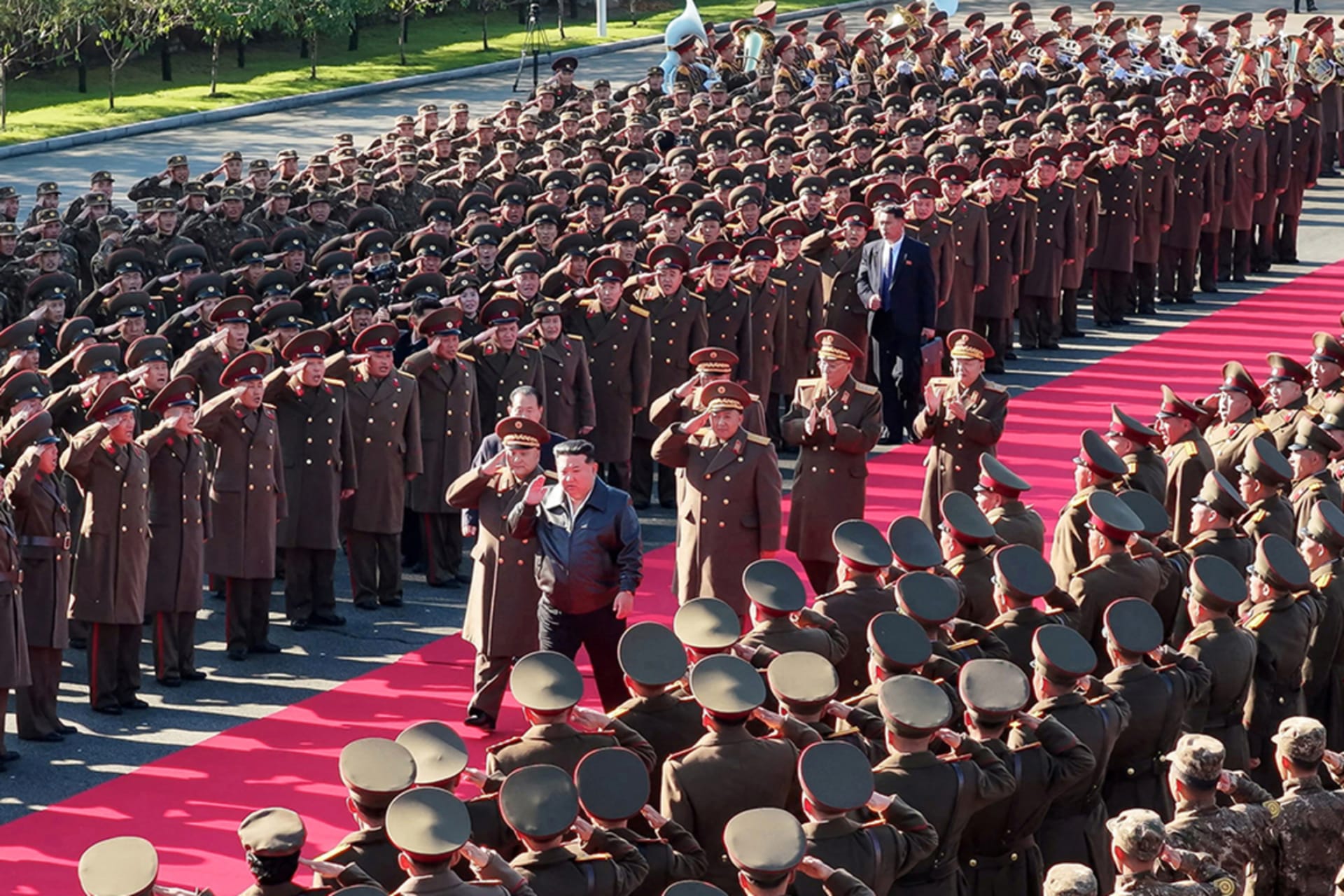
In the more than three years since Russia invaded Ukraine, North Korea has emerged as a significant ally for Moscow. By first providing ammunition and weapons, then sending thousands of its own troops to fight alongside the Russian military, North Korea has become essential to fueling Russia’s war machine. It has reportedly suffered heavy casualties yet also benefited by modernizing its military and anchoring itself more firmly in an anti-Western coalition led by China and Russia.
How many North Korean soldiers are in Ukraine?
Since the fall of 2024, North Korea has sent between fourteen thousand and fifteen thousand soldiers to fight alongside Russian troops, according to Western officials. This estimate combines the roughly eleven thousand to twelve thousand forces originally deployed in October 2024, and the additional three thousand reserve forces sent to the front lines in the months since to replace battlefield losses.
The majority are believed to be from Pyongyang’s elite special forces unit—the 11th Corps of the Korean People’s Army, or Storm Corps—which is trained to infiltrate and sabotage enemy operations and assassinate targets. So far, North Korean forces have only been deployed in the Kursk region in western Russia, where they have helped the Russian military regain control of most of the territory captured by Ukraine in its surprise August 2024 offensive. However, their success has reportedly come at a heavy cost. More than six thousand North Korean soldiers have been killed or wounded, according to the United Kingdom’s Ministry of Defense, though estimates have varied.
In addition to deploying soldiers, North Korea has sent thousands of laborers to support Russia’s war effort. In June 2025, following a meeting between North Korean leader Kim Jong Un and Russian Defense Minister Sergei Shoigu in Pyongyang, Kim reportedly agreed to send some five thousand construction workers and one thousand combat engineers to Kursk to assist with demining the region, among other tasks.
What kinds of weapons and other military equipment has North Korea provided to Russia?
North Korea began assisting Russia’s war effort long before its own troops became involved in the conflict, first shipping weapons in August 2023. At the time, both the Russian and Ukrainian militaries were struggling with ammunition shortages, as their domestic production was unable to keep pace with battlefield expenditures.
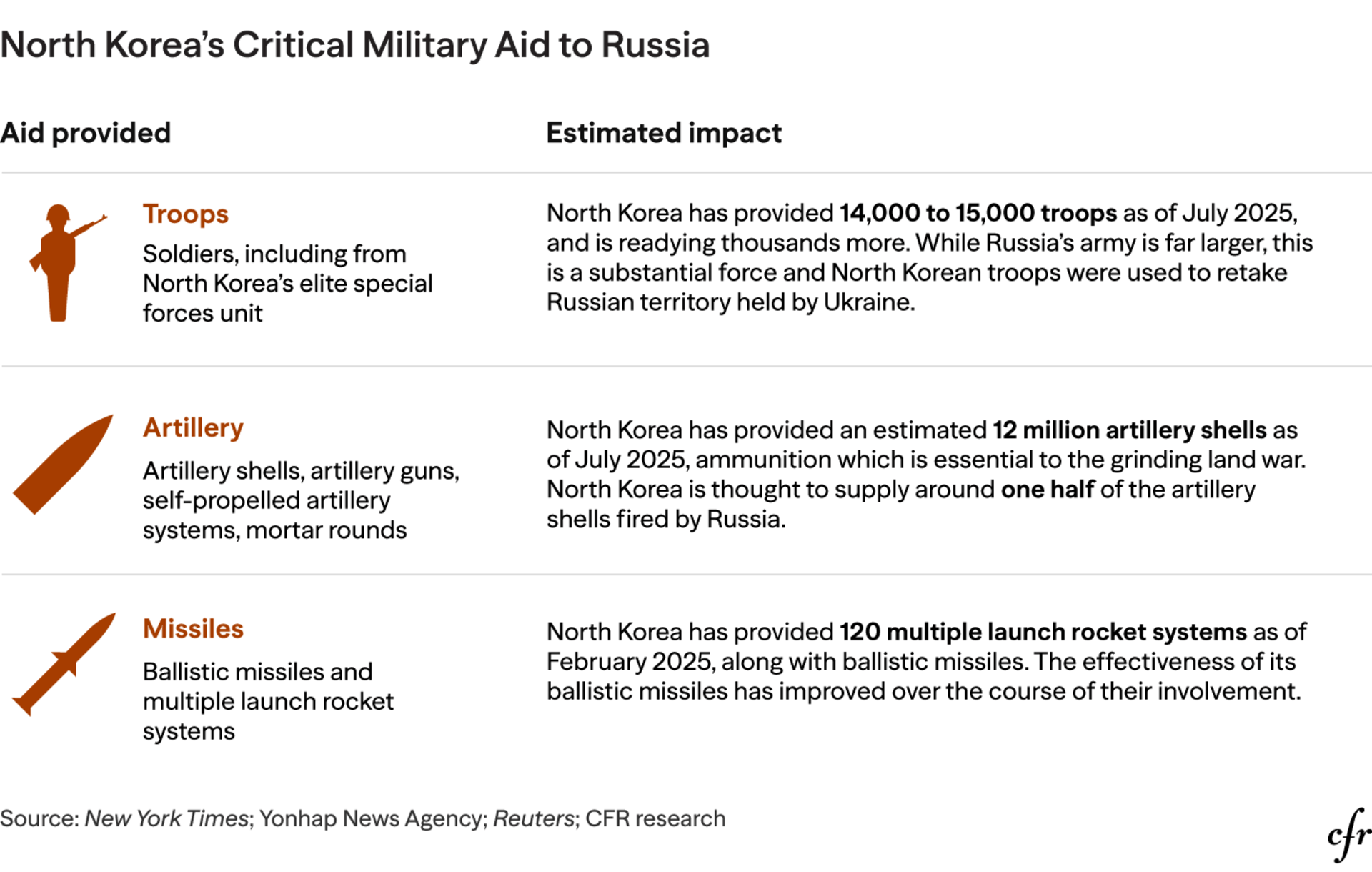
To date, North Korea has reportedly provided Russia with ballistic missiles, long-range artillery, and multiple launch rocket systems, as well as millions of rounds of ammunition and artillery shells. In July 2025, South Korea’s Defense Intelligence Agency estimated that North Korea had sent more than twelve million artillery shells in total, with some Russian units at times coming to rely almost exclusively on North Korean-made artillery. Overall, Ukraine’s military intelligence agency estimates that North Korea is providing roughly half of Russian artillery shells.
North Korea has also provided Russia with a wide range of armaments. According to Lieutenant General Kyrylo Budanov, commander of Ukraine’s Defense Intelligence Directorate, North Korea has delivered everything from KN-23 short-range ballistic missiles—some capable of carrying nuclear payloads—to D-74 howitzers and self-propelled artillery guns. Budanov also indicated that Russia and North Korea recently made several agreements to launch North Korean production of Shahed-style drones, which Russia has used to target population centers to devastating effect.
Though it is difficult to determine the full extent of these weapons’ impact on the battlefield, experts from a UN sanctions monitoring group recently said that North Korean support has significantly contributed [PDF] to Russia’s ability to sustain its military advance in Ukraine.
What has North Korea gained from its alliance with Russia?
North Korea seized an opportunity with the advent of the Russia-Ukraine war. Russia’s assumption that Ukraine’s military would collapse within days proved woefully inaccurate, and it soon became apparent that Russia lacked both the weaponry and manpower to sustain its offensive. North Korea proved to be one of the only countries willing and able to provide Russia with support.
In July 2023, then Defense Minister Shoigu led a delegation to Pyongyang to commemorate the anniversary of the end of the Korean War. There, Kim showcased the country’s military capabilities, and the two officials discussed military cooperation. Less than a month later, North Korea sent its first shipment of munitions to Russia. The countries cemented their alliance in June 2024, when Kim and Russian President Vladimir Putin signed a comprehensive strategic partnership treaty that included a mutual defense clause.
Russia has provided North Korea’s inexperienced military the opportunity to learn on the world’s most technologically advanced battlefield. Multiple reports from Ukrainian military personnel who have fought North Korean soldiers underscore their ability to adapt to the realities of modern warfare. North Korean forces have shifted their tactics over time, from conducting World War II-style light infantry assaults on open ground to employing drone warfare. These tactical advancements have prompted adjustments by the Ukrainian military, which sought to avoid direct engagement with North Korean soldiers in Kursk given the skill and speed with which they advanced. Instead, Ukrainian forces used drones to target North Korean soldiers and began planting anti-personnel land mines increasingly closer together to slow their advance.
More significantly, Russia has provided North Korea with the knowledge and means to modernize its military capabilities. In exchange for its assistance, Russia has financed several North Korean military programs and given the country air defense equipment, anti-aircraft missiles, and advanced electronic warfare systems.
Russia also continues to share battlefield data from its North Korean ballistic missiles, allowing for noticeable improvements to their accuracy and overall effectiveness. Investigations revealed that roughly half of the ballistic missiles in North Korea’s initial shipment deviated from their trajectory and exploded in midair. Since then, their accuracy has improved significantly, according to Budanov. Russia is also reportedly supporting the development of North Korea’s satellite and nuclear programs.
Although the extent of Russia’s support is unknown, Kim’s brandishment of new military technology in recent months suggests that Russia’s funding and knowledge transfer are improving the country’s capabilities. For example, Kim launched the country’s largest naval destroyer in April 2025 and tested various missiles, including a supersonic cruise missile that experts say resembles a nuclear-capable Russian model. This is a far cry from the Soviet-era military capabilities North Korea possessed prior to Russia’s invasion of Ukraine. South Korea has warned that deepening cooperation between North Korea and Russia threatens to disrupt the military balance on the Korean Peninsula.
Beyond military cooperation, Russia has also provided North Korea with economic relief and protection from further international repercussions. Trade between the two countries, of both military and non-military goods, has markedly increased. Russia reportedly supplied North Korea with more than one million barrels of oil in 2024, well above the threshold mandated by UN sanctions. According to South Korea’s central bank, North Korea’s economy grew 3.7 percent in 2024, its fastest annual rate in eight years.
Broadly speaking, North Korea’s support for Russia’s war effort has demonstrated its value as a partner in challenging the Western-led world order. The increasingly close relationship between China, North Korea, and Russia was on display at a military parade commemorating the end of World War II in Beijing in early September. At the event, Kim stood arm-in-arm with Putin and Chinese President Xi Jinping, a tangible symbol of the so-called axis of autocracy’s growing synergy.
What are the prospects for continuing North Korean support for Russia’s military?
North Korea’s provision of arms and personnel to Russia shows no signs of abating. Kim continues to express his unconditional support for Russia. In late August, Kim held an awards ceremony commemorating soldiers who died fighting in Russia, calling them “great heroes and great patriots.” Plans are also underway to construct memorials to fallen North Korean soldiers in Moscow and Pyongyang.
Meanwhile, Ukraine’s military intelligence directorate indicated in July 2025 that North Korea is preparing to send up to thirty thousand additional soldiers to Russia in the coming months. So far, there have been no reports of additional North Korean deployments to Russia or entry into combat operations in Ukraine.
However, there are other signs that North Korea’s role in the war may be advancing. On October 16, Ukraine’s military indicated that North Korean units are operating reconnaissance drones from Kursk in Ukraine’s neighboring Sumy region to locate Ukrainian military positions and strike targets. The military’s statement included a video of suspected North Korean soldiers using the intelligence gathered to modify the trajectory of multiple launch rocket systems to more accurately hit Ukrainian locations. The video represents the first public evidence of North Korean involvement in a direct attack on Ukrainian territory.
There is also evidence that North Korea has diversified the type of weaponry and munitions it is supplying to Russia, resulting in battlefield innovation. A recent New York Times report revealed that Russia retrofitted first-person-view drones with North Korean-made cluster munitions, which scatter small explosives across a wide area when detonated. According to experts, this new adaptation of weaponry is the first of its kind to be reported. It demonstrates a more sophisticated effort to integrate North Korean munitions into Russian military equipment and provides further material evidence of the link between North Korea’s defense industry and the Russian war machine in Ukraine.