ICE and Deportations: How Trump Is Reshaping Immigration Enforcement
The second Trump administration has significantly ramped up immigration enforcement to meet deportation goals. But the widespread deployment of ICE, in addition to a series of high-profile lethal incidents, has led to widespread backlash and protests in some targeted cities.
By experts and staff
- Updated
- Kaleah HaddockEditorial Assistant
- Senior Writer/Editor, Latin America
Since returning to office in 2025, U.S. President Donald Trump has taken major steps to reshape immigration policy and enforcement in pursuit of his campaign promise to execute “the largest domestic deportation operation” in U.S. history. As part of this effort, his administration has carried out deportation flights, sometimes to third countries where migrants have no existing ties; ramped up nationwide immigration raids; and granted expanded or new powers to various federal, state, and local officials to enforce domestic immigration laws.
However, the administration’s whole-of-government approach has raised concerns. In January 2026, the administration’s enforcement push reached a controversial new phase after federal agents fatally shot two U.S. citizens, Renee Good and Alex Pretti, in separate incidents in Minneapolis. The shootings triggered widespread protests and criticism from members of both political parties, leading some Republican lawmakers to call for an investigation into federal immigration enforcement tactics.
In implementing his immigration agenda, some legal experts say Trump is pushing the limits of presidential power, including by invoking centuries-old statutes and expediting deportations, while immigrant rights activists warn that the administration’s aggressive tactics have eroded migrants’ due process protections. Growing criticism of the administration’s immigration policy comes after the July 2025 passage of the One Big Beautiful Bill Act (OBBBA), which allocates nearly $170 billion to enforcement over the next four years.
What is the Trump administration’s approach to immigration enforcement?
Immigration enforcement has been recognized as a federal responsibility since 1876, when the Supreme Court ruled in Chy Lung v. Freeman that the federal government—not states—has sole authority to regulate immigration and manage foreign relations. Later, the 1891 Immigration Act officially centralized federal immigration enforcement authority. Since January, the Trump administration has taken that mandate much further, adopting an approach that reassigns multiple federal agencies to take on enforcement responsibilities. “What we’re seeing is essentially a realignment of the entire federal government to support this mass deportation agenda,” said Nayna Gupta, policy director at the American Immigration Council.
As part of this approach, the Trump administration has, among other actions:
- declared an emergency at the southern U.S. border, enabling military action there;
- expanded expedited removals, which allow immigration officials to deport undocumented immigrants without a court hearing;
- initiated a mass deportation campaign involving hundreds of removal flights;
- broadened the authority of several agencies to enforce immigration laws;
- directed the creation of Homeland Security Task Forces in all fifty states to combat cross-border crime; and
- allocated tens of billions of dollars in additional funding to Immigration and Customs Enforcement (ICE) and other agencies for detention and deportation operations.
Trump has also widened the scope of immigration enforcement, targeting all undocumented immigrants for potential deportation—a shift from recent previous administrations. Under President Barack Obama, individuals with criminal records, recent unauthorized entrants, and those deemed a threat to national security were targeted [PDF] for removal. Likewise, the Joe Biden administration focused on individuals considered threats to public safety, border security, or national security, and introduced new rules to expedite the removal of asylum seekers with serious criminal histories or terrorism ties.
Legal experts like Gupta, however, warn that Trump’s recent efforts to reshape U.S. immigration policy are “pushing the boundaries” of presidential powers. Invoking centuries-old laws such as the 1798 Alien Enemies Act, she said, is “a way for the president to flex his authority, and the White House’s authority, over the Constitution and the other branches of government.” The administration’s attempts to use seldom-used statutes have faced significant legal pushback—sometimes requiring the Supreme Court to weigh in—with human rights advocates arguing the use of such statutes may violate immigrants’ due process rights.
In February 2026, a federal judge ruled that the administration’s policy of deporting immigrants to third countries—places other than their countries of origin—was unlawful, saying it violated federal immigration law and migrants’ due process rights. According to a report from Senate Democrats, the Trump administration spent some $40 million last year to send hundreds of migrants to third countries. The administration has said it will likely appeal the ruling.
What is the role of ICE?
As the largest investigative arm of the Department of Homeland Security, ICE is responsible for enforcing a wide range of federal laws within the interior of the United States, primarily those related to U.S. customs, immigration, and trade. Since taking office, the Trump administration has expanded ICE’s domestic operations by shifting enforcement priorities, increasing resources, and incorporating other federal agencies into immigration enforcement efforts.
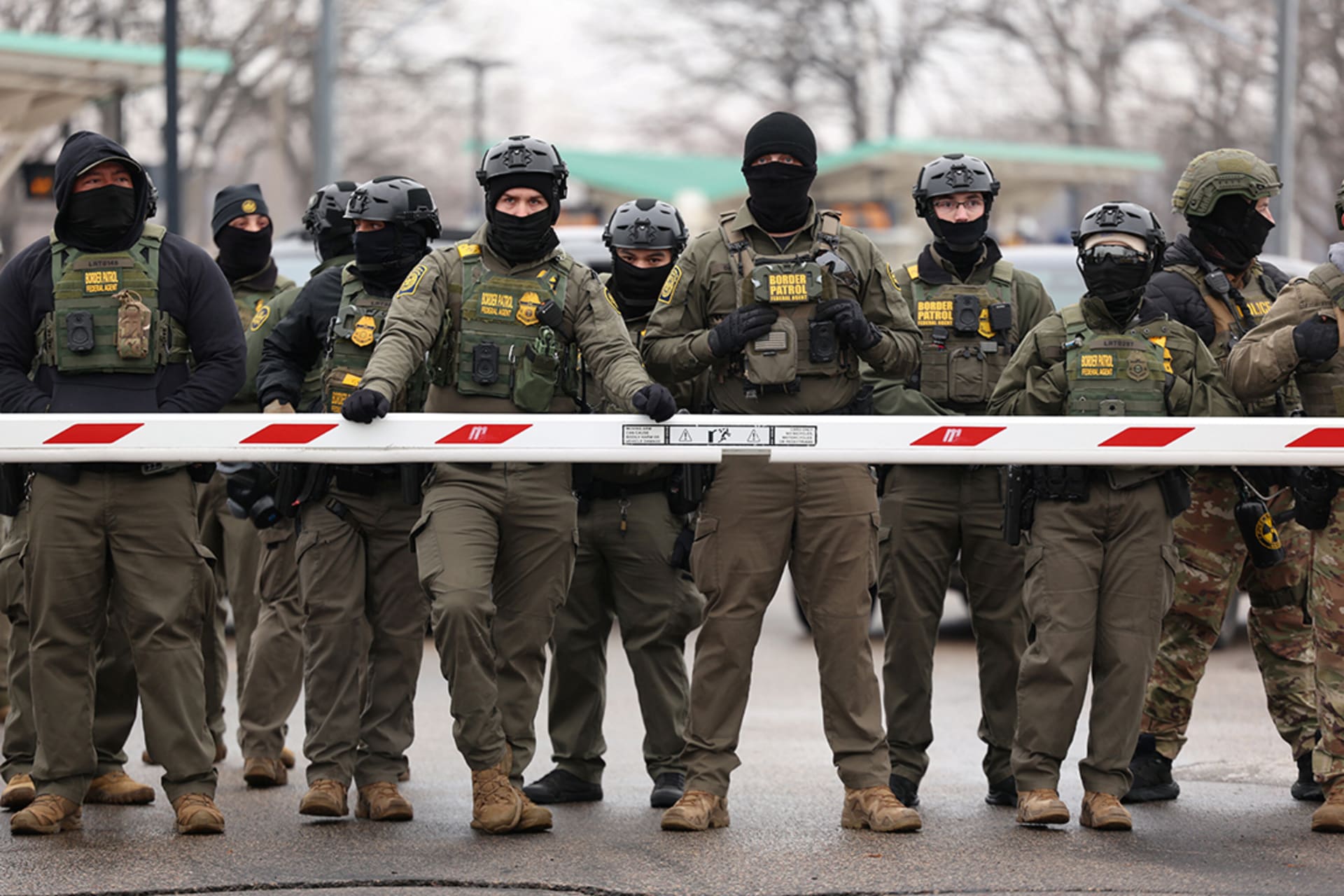
Experts say this is part of a larger shift away from a previous border-centric strategy. “It’s not just ICE conducting immigration enforcement—you also have Customs and Border Protection working in the interior of the United States,” said Kathleen Bush-Joseph, a lawyer and policy analyst at the Migration Policy Institute. “They have widened the net of enforcement.”
Bush-Joseph added that the Trump administration is now bringing both border policies and personnel into the interior of the United States, essentially reversing some of what happened under the Biden administration, when immigration officials were so overwhelmed at the border that they were releasing noncitizens into the country.
In May 2025, Homeland Security Advisor Stephen Miller confirmed that the administration has set a daily arrest quota of three thousand undocumented immigrants. (DHS later said that no such quota existed.) Nearly sixty-nine thousand people were in ICE detention as of early January 2026, according to the agency.
Immigration authorities have targeted workplaces, farms, university campuses, and private homes. One high-profile raid occurred in September, when nearly five hundred workers—most of whom were South Korean nationals—were detained at a Hyundai electric vehicle plant in Savannah, Georgia. The raid sparked protests from labor unions and rattled the U.S.-South Korean alliance.
In some cases, ICE has bolstered its operations by cooperating with state and local officials via the use of 287(g) agreements—authorized under Section 287(g) of the Immigration and Nationality Act—which deputize state and local law enforcement officers to perform federal immigration functions. January 2026, ICE has signed more than 1,300 such agreements covering forty states, a sharp increase from the 135 agreements it had in December 2024, prior to Trump taking office.
When it comes to enforcement, ICE has considerable authority to arrest and detain individuals in public spaces for civil immigration violations without a judge’s warrant. This warrantless arrest authority applies only to civil immigration enforcement; ICE’s separate criminal arrest powers follow standard criminal procedures.
Still, experts say ICE is increasingly pushing the boundaries of its enforcement operations. According to Jason Houser, former ICE chief of staff under Biden, the issue is not necessarily the agency’s legal authority but how that authority is being exercised. “What they’re doing—I believe that they have the authority, currently under law, to do,” Houser said. But “how they’re doing it… shows that they don’t care about the implications.” In recent months, there have been multiple news reports accusing ICE agents of using excessive force against protesters and detainees; ICE has denied that characterization.
Two incidents that drew widespread attention are the fatal shootings of Renee Good and Alex Pretti by federal immigration agents in Minneapolis in January. Pretti’s death was the third shooting involving ICE agents in the city in three weeks, prompting mass widespread protests and criticism from elected officials and local authorities over ICE’s enforcement practices. In the days following Pretti’s killing, a growing number of Republican lawmakers in the House of Representatives have called for a deeper investigation into his death, while Senate Democrats had threatened to block DHS funding unless new limits on immigration enforcement were imposed. Federal officials also told news outlets that Border Patrol chief Greg Bovino had been removed from his position and reassigned. On January 29, Senate Democrats struck a deal with Republicans and the White House to pass five spending bills funding most of the government, along with a two-week stopgap for DHS. The short-term measure gives Democrats time to negotiate limits on immigration enforcement while averting an immediate government shutdown.
What other major agencies are involved in immigration enforcement?
Customs and Border Protection (CBP). The agency is primarily responsible for inspection and admission of travelers, cargo, and conveyances at the more than three hundred U.S. land, sea, and air ports of entry. Border Patrol, an agency within CBP, is responsible for enforcement of immigration, customs, and other laws between ports of entry along the land and sea borders of the United States. However, under the second Trump administration, CBP has played an increasingly active role in domestic immigration enforcement operations.
In late October 2025, multiple news outlets reported that CBP officials would replace several field office directors at ICE as authorities faced pressure to meet the administration’s daily arrest quota. Critics say the move signals a more militarized approach to domestic enforcement on the part of the Trump administration, both because Border Patrol agents employ more aggressive tactics and because their deployment in U.S. cities blurs the boundary between agencies.
U.S. Citizenship and Immigration Services (USCIS). Typically, USCIS oversees lawful immigration to the United States, including by processing applications for asylum, naturalization, and humanitarian programs. In September, USCIS was granted authorization to hire special agents with enhanced law enforcement abilities, including to “investigate, arrest, and present for prosecution” individuals who violate U.S. immigration laws.
In November 2025, USCIS announced that it would pause processing asylum requests after two National Guard members were killed in Washington, DC; the accused shooter has Afghan nationality and was granted asylum earlier this year. DHS Secretary Kristi Noem said on social media that all immigration requests for Afghan nationals would be “stopped indefinitely pending further review of security and vetting protocols,” while USCIS’s director posted that the agency would reexamine green cards issued to individuals from nineteen countries deemed “of concern,” including Afghanistan. USCIS said in a further statement that new guidance permitted consideration of “negative, country-specific factors” when vetting the immigration requests of people from those countries.
FBI. According to personnel data obtained by Senator Mark Warner (D-VA) and shared with the Guardian, 23 percent of the FBI’s approximately thirteen thousand-strong agent pool nationwide are now assigned to immigration enforcement. That number climbs close to 50 percent in the agency’s twenty-five largest field offices across the country.
The Trump administration has also granted immigration enforcement authorities and responsibilities to several other federal law enforcement agencies, including the Drug Enforcement Administration, Federal Bureau of Prisons, U.S. Marshals Service, U.S. Postal Inspection Service, and the Bureau of Alcohol, Tobacco, Firearms and Explosives. This “blending” of federal law enforcement, Houser said, is “going to have long-term implications for public safety and trust in federal law enforcement.”
How will Trump’s One Big Beautiful Bill Act change immigration enforcement?
In July 2025, Trump signed into law the OBBBA, a comprehensive reconciliation bill that provides approximately $170 billion for immigration enforcement and border security over the next four years. This includes $45 billion for ICE to expand its detention capacity, roughly $30 billion for ICE to hire new agents—with the goal of hiring ten thousand more enforcement officers by the end of 2025—and more than $46 billion for border wall construction. It also caps the number of immigration judges at eight hundred, despite increased need and a growing backlog that stood at nearly 3.8 million cases [PDF] as of June 2025.
“All of this could really result in the [immigration] system itself growing to a completely different scale,” said Bush-Joseph.
Experts say some provisions in the OBBBA offload the costs of enforcement onto immigrants. For example, the bill imposes new or increased fees for Temporary Protected Status—a program that allows migrants whose home countries are considered unsafe to temporarily live and work in the United States—asylum claims, and humanitarian parole. The increased costs could deter people from seeking protection in the United States.
Critics, meanwhile, argue that the bill only emphasizes the administration’s singular focus on enforcement over reform. “Nowhere has this administration talked about how they’re going to fix the immigration system,” Houser said.
Austin Steinhart created the graphics for this article.