The Lend-Lease Act
One of the most bitter political debates in U.S. history produced one of the United States’ greatest foreign policy accomplishments.
By experts and staff
- Published
 James M. LindsayCFR ExpertMary and David Boies Distinguished Senior Fellow in U.S. Foreign Policy
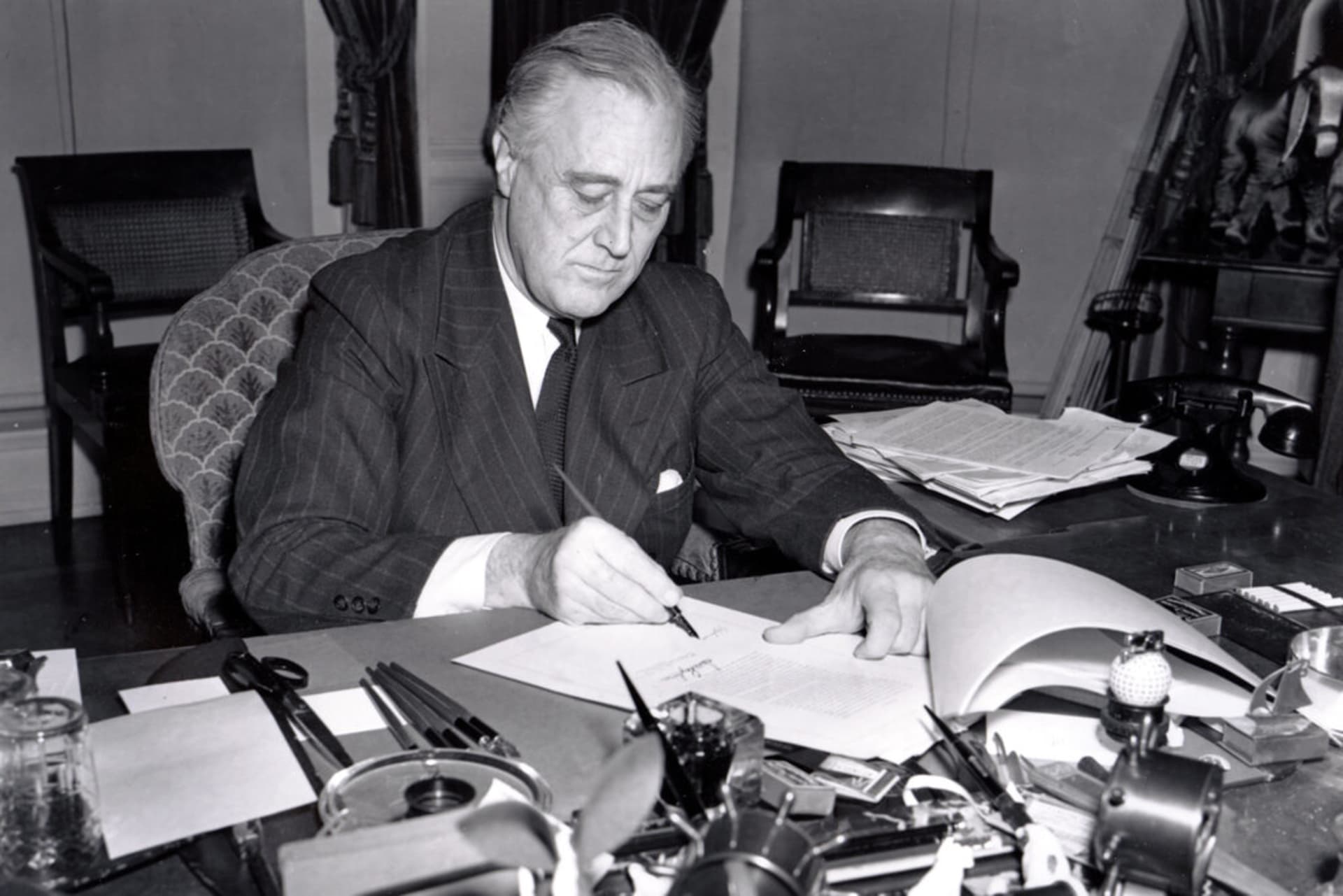
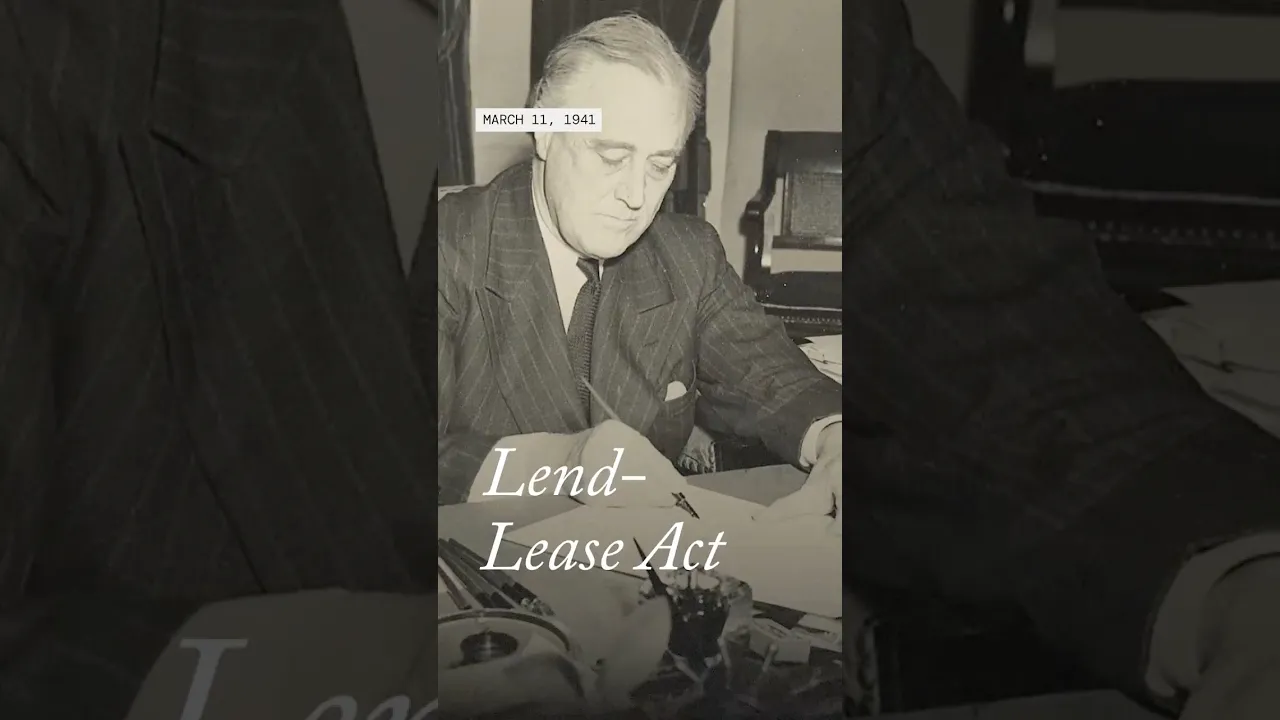
Americans like to imagine that in days long past politics stopped at the water’s edge and the United States spoke with one voice to the world. More often than not, however, U.S. foreign policy debates have been rough-and-tumble affairs, more a cacophony of angry voices than a harmony of sweet ones. Nowhere was this more true than in the pitched battle over one of the most important pieces of foreign policy legislation in U.S. history, the Lend–Lease Act, which President Franklin Delano Roosevelt signed into law on March 11, 1941. Churchill would later call Lend-Lease “the most unsordid act in history.”
The Council on Foreign Relations recently surveyed members of the Society for Historians of American Foreign Relations (SHAFR) on the best and worst foreign policy decisions in U.S. history. SHAFR historians ranked the passing of the Lend-Lease Act as the fifth best.
[Video: https://www.youtube.com/shorts/2UvjGZyoeQg]
War in Europe
The seeds for the Lend-Lease Act were planted in the late fall of 1940. FDR had just been elected to an unprecedented third term, a race he won at least in part by pledging to an American public worried about war with Germany: “Your boys are not going to be sent into any foreign wars.”
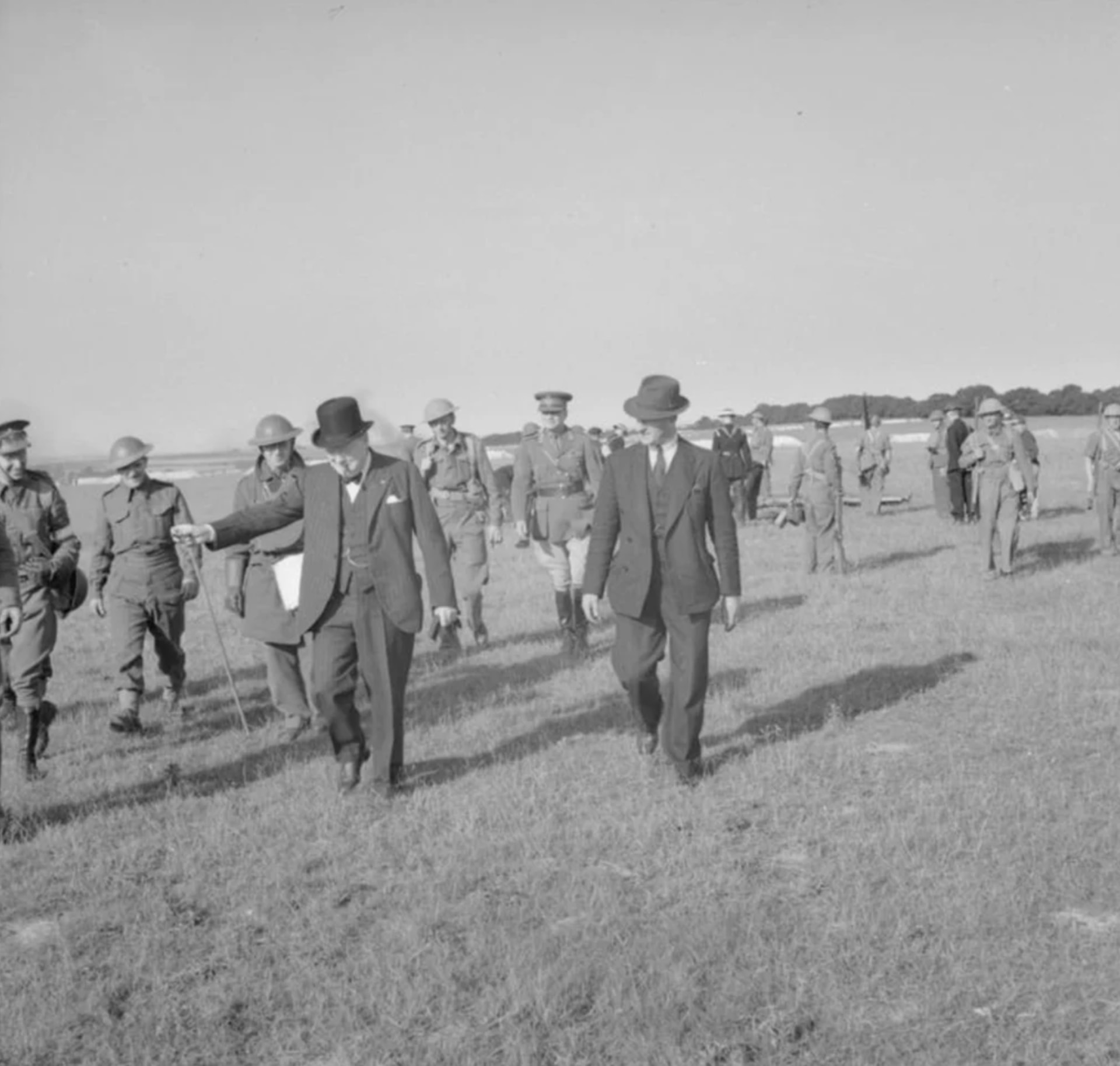
In December 1940, British Prime Minister Winston Churchill wrote to FDR with the chilling news that Britain was verging on bankruptcy. The “Battle of Britain” over the previous summer and fall had taken a heavy toll. Churchill confessed that: “The moment approaches when we shall no longer be able to pay cash for shipping and other supplies.” Without supplies from the United States, Britain would likely not be able to hold out against the German onslaught.
The Arsenal of Democracy
FDR wanted to come to Britain’s aid. However, considerable domestic political obstacles stood in the way of providing more support to Britain and other countries fighting the Axis powers. Most Americans opposed German aggression, but they also wanted to stay out of the war ravaging Europe. That fear constrained what FDR could do and how fast he could do it. So he sought to build public support for aiding Britain.
Ten days after Churchill’s message arrived, FDR used a press conference to float the idea of lending supplies to Britain. He equated it with lending a garden hose to a neighbor whose house was burning, with the expectation that when the fire is out the neighbor “gives it back to me and thanks me very much for the use of it.”
At the end of December, FDR went further. He used one of his famed fireside chats to argue that “never before since Jamestown and Plymouth Rock has our American civilization been in such danger as now.” The best way for the United States to protect its security, and keep from being dragged into war, was to become “the great arsenal of democracy” that would equip friendly democratic nations with “the implements of war, the planes, the tanks, the guns, the freighters which will enable them to fight for their liberty and for our security.”
The Lend-Lease Act
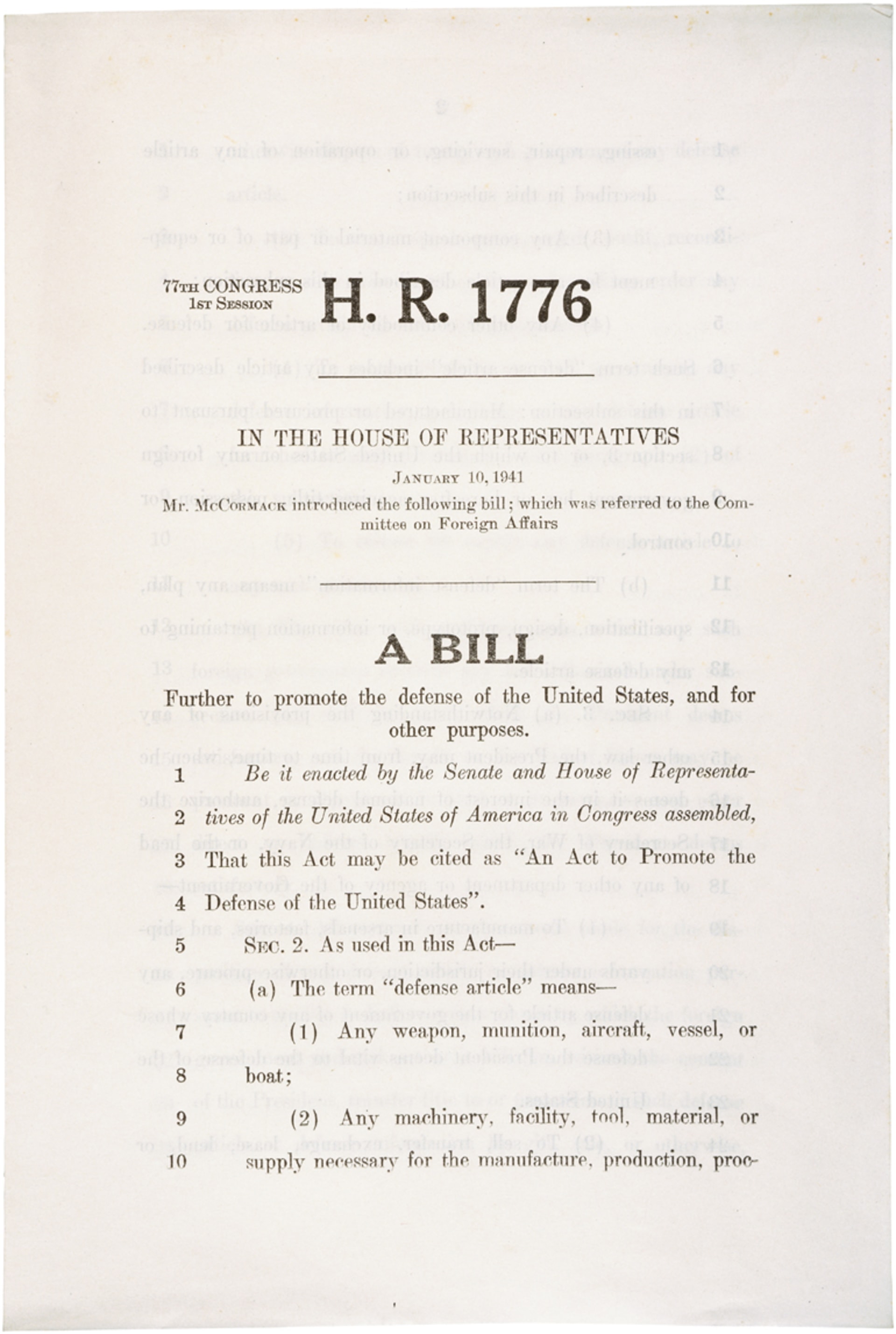
Within days of his Arsenal of Democracy speech, FDR unveiled his proposal for a Lend-Lease Act. It was sweeping in scope. The draft language authorized him, “when he deems it in the interest of national defense…to sell, transfer title to, exchange, lease, lend, or otherwise dispose of” war materiel to the “government of any country whose defense the president deems vital to the defense of the United States.” Such a grant of authority to the president had no precedent in U.S. history. It would be a bitter point of contention in the legislative fight to come.
The administration and its supporters on Capitol Hill went out of their way to make the proposed legislation sound as American as apple pie. The proposal was titled: “Bill to Promote the Defense of the United States.” That title was not enough to satisfy Democratic Majority Leader John McCormack of Boston, who introduced the bill in the House. He worried that any legislation to help the British would anger his heavily Irish-American constituency. So he arranged for the bill to be designated as House Resolution 1776, giving it an extra whiff of patriotism.
These cosmetic touches did not mollify McCormack’s Irish Catholic constituents. After one of them lambasted the bill, he responded: “Madam, do you realize that the Vatican is surrounded on all sides by totalitarianism? Madam, this is not a bill to save the English, this is a bill to save Catholicism.”
The Battle on Capitol Hill
McCormack’s wit did little to defuse tempers back in Washington. Some critics objected that the bill had been drafted by the White House rather than by a member of Congress. Congressman Karl Mundt (R-S.D.) grumbled:
We find this piece of legislation—surreptitiously conceived, individually disclaimed, of unknown parentage—placed before us, like a baby in a basket on our doorstep, and we are asked to adopt it.
Rep. Dewey Short (R-Mo.), who once cracked that “Mr. Jefferson founded the Democratic Party and President Roosevelt dumbfounded it,” went further:
You can dress this measure up all you please, you can sprinkle it with perfume and pour powder on it, masquerade it in any form you please . . . . but it is still foul and it stinks to high heaven. It does not need a doctor, it needs an undertaker.
Other critics denounced the bill for implicitly allying the United States with Britain and thereby making war with Germany inevitable. Sen. Hiram Johnson (R-Calif.) complained: “Like the dog gone back to his vomit, the country has become English again.” Sen. Burton K. Wheeler (D-Mont.) dismissed the idea that helping Britain was the best way to keep the United States out of war: “You can’t put your shirt tail into a clothes wringer and pull it out suddenly when the wringer keeps turning.” The so-called Mothers’ Movement protested Lend-Lease with signs reading: “Kill Bill 1776, Not Our Boys.”
One of Senator Wheeler’s comments in particular offended FDR. In a biting allusion to one of the New Deal’s initial pieces of legislation, the Agricultural Adjustment Act of 1933, Wheeler declared:
The lend-lease-give program is the New Deal’s triple-A foreign policy: it will plow under every fourth American boy.
FDR was unsparing in his public response. He called Wheeler’s remark “the most untruthful, the most dastardly, unpatriotic thing that has ever been said. Quote me on that. That really is the rottenest thing that has been said in public life in my generation.”
Congress Decides
For two months the Lend-Lease Act was, as FDR put it, “argued in every newspaper, on every wavelength, over every cracker barrel in all the land.” In the end, the votes broke his way. Lopsided majorities in both the House and Senate passed the bill.
FDR carried the day in good part because he presented Lend-Lease to Americans as a peace measure, and he adroitly finessed the question of how the United States could help Britain without antagonizing Germany. FDR was helped by the fact that Democrats held lopsided majorities in the House and Senate. He also benefited from receiving the support of the man he had defeated for the presidency just four months earlier: Wendell Wilkie. He urged Americans to support the bill because it gave Americans their only “chance to defend liberty without themselves going to war.”
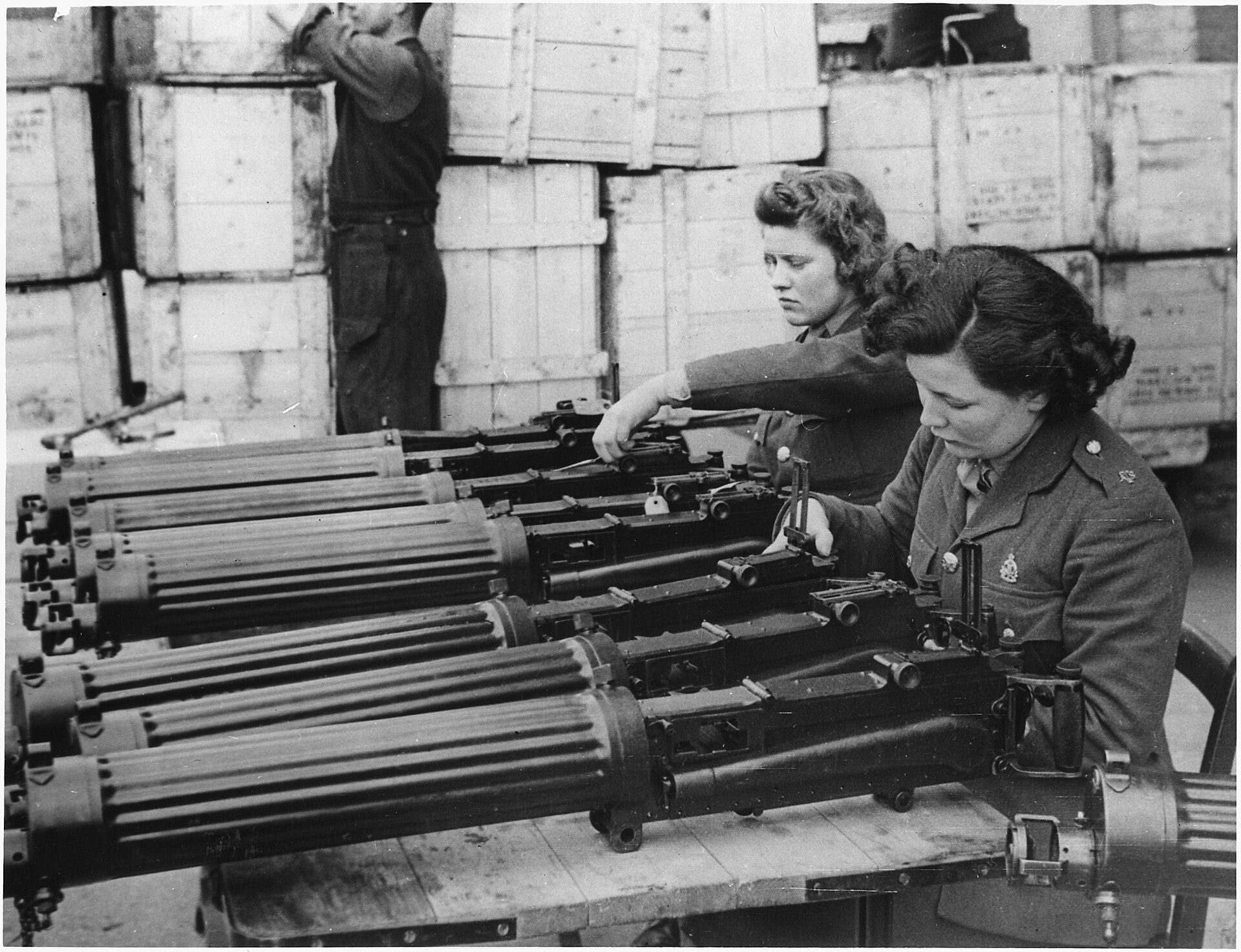
Congress eventually appropriated more than $50 billion in lend-lease funds. The aid did not, however, keep the United States out of the war as Roosevelt and his supporters had hoped. The Japanese attack on Pearl Harbor nine months after the act ended U.S. neutrality. Lend-Lease nonetheless helped sustain Britain when it stood nearly alone in resisting Germany, and it became a critical source of support for the Soviet Union after Germany turned on it in June 1941.
The United States celebrates its 250th anniversary in 2026. To mark that milestone, I am resurfacing essays I have written over the years about major events in U.S. foreign policy. A version of this essay was published on March 11, 2011.
Oscar Berry assisted in the preparation of this article.