Nepal’s Protest-Fueled Transition
By experts and staff
- Published
- CFR Editors
Top of the Agenda
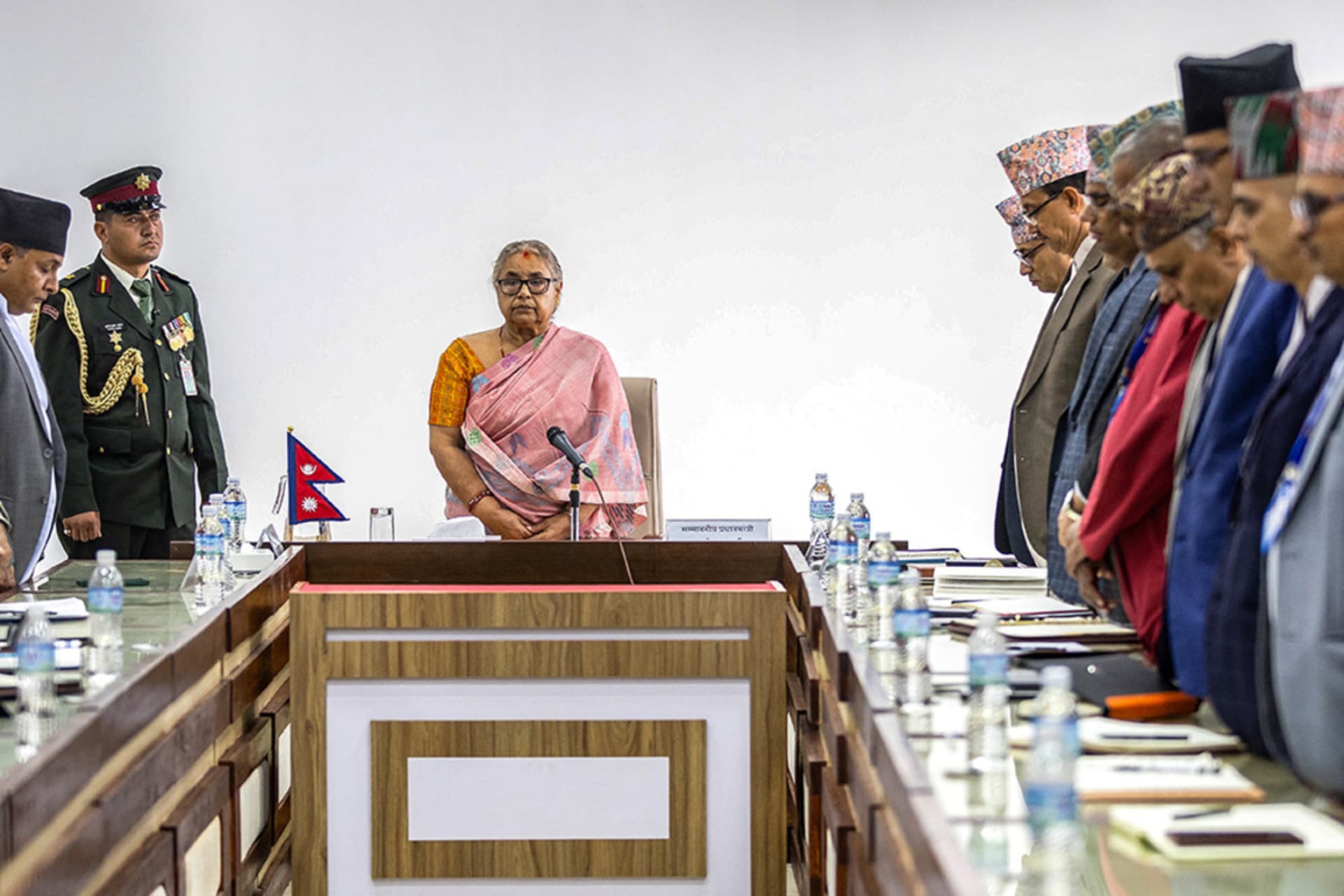
Nepal’s first female prime minister pledged to hold elections in March after being swept into office by a major protest movement. Prime Minister Sushila Karki is the former first female chief justice. Protest leaders endorsed Karki as the country’s interim ruler via coordination on the internet platform Discord—a testament to how badly the previous government’s ban on several social media companies backfired last week. The ban sparked Nepal’s biggest demonstrations in decades, which were youth-led and encompassed grievances about inequality.
The transitional government.
- Karki said that she did not seek out the position but was “compelled” to serve after protest leaders called on her to take up the mantle. They praised Karki for her record of combating corruption.
- Today, Karki named leaders of the finance, energy, and home ministries who are known for their reformist and anti-graft stances.
- Less than two days after her inauguration, she announced that she would hand over the post within six months.
Regional and foreign policy implications.
- Representatives of China, India, and the United States publicly welcomed Karki’s government and were present at Karki’s swearing-in ceremony on Friday. Few of Nepal’s top elected officials attended.
- Karki did not immediately make statements about Nepal’s foreign policy in the wake of the leadership change. Deposed Prime Minister K.P. Sharma Oli’s administration drew Nepal closer to China.
“With Nepal’s uprising after the ones in Sri Lanka and then Bangladesh, it’s tempting to think of a South Asian Spring, something like the Arab Spring. You can see the parallels—rotten governments, young people fed up, one uprising after another…But we also have to remember how the Arab Spring ended up. Democracy did not end up winning out.”
—Himal Southasian’s Roman Gautam tells the Financial Time
Across the Globe
Diplomacy in Israel and Qatar. U.S. Secretary of State Marco Rubio is visiting Israel today, where he is discussing the aftermath of Israel’s deadly strike in Doha last week. Rubio said ahead of the trip that Washington is “not happy” about the strike, which risked undermining Gaza truce talks. Separately, the Arab League and the Organization of Islamic Cooperation are meeting today in Doha for an emergency summit about their response to the strike.
Second NATO Nation Reports Russian Drone. Romania summoned Russia’s ambassador yesterday to protest a Russian drone entering its airspace. Moscow did not immediately comment on the incursion, which European Union foreign policy chief Kaja Kallas called a “reckless escalation.” It comes after NATO forces shot down Russian drones that violated Polish airspace last week.
U.S.-China trade talks. Senior officials from both countries kicked off multiday trade talks yesterday in Madrid. The negotiations will cover an ongoing tariff truce as well as TikTok’s impending deadline to divest from its Chinese owner or face a ban. Ahead of the talks, the United States announced it was adding certain Chinese chip companies to a trade blacklist, while China said it was opening an anti-dumping probe into some U.S. chips; today, China said it found U.S. chipmaker Nvidia violated its antitrust laws.
Call for a Sudan truce. The United States, Egypt, Saudi Arabia, and the United Arab Emirates (UAE) jointly called Friday for a three-month truce that could pave the way to ending the war in Sudan. The four countries said they would “exert all efforts” to reach a negotiated solution to the conflict. They comprise a complex web of allegiances in Sudan’s war: the Sudanese army accuses the UAE of backing its opponent, while Egypt and Saudi Arabia have backed the army. Neither warring party immediately commented.
Australian climate report. Australia’s government today presented its first ever climate risk report, which details the human and economic costs for the country of different global warming scenarios. The direct costs of floods, fires, and storms could reach more than $26 billion per year by 2050, even if global warming is limited to 1.5℃ (2.7℉), the study found. The government is using the report to guide its upcoming 2035 emissions target.
Venezuelan boat boarded. Venezuela’s foreign minister accused U.S. forces of boarding a Venezuelan fishing boat in its territorial waters and blocking communication from the vessel for eight hours. The White House did not immediately comment. The United States has a naval deployment off Venezuela’s coast that it says is aimed at countering drug trafficking.
China-Pakistan defense ties. Pakistani President Asif Ali Zardari became the first foreign head of state yesterday to visit the campus of Chinese defense firm Aviation Industry Corporation of China (AVIC). Pakistan used AVIC fighter jets in a border conflict with India earlier this year. Zardari said the countries would continue to boost defense industrial cooperation; Chinese weaponry already makes up four-fifths of Pakistan’s stockpile.
Gang violence in Haiti. UN Secretary-General António Guterres on Saturday condemned a gang massacre that killed more than forty people in a village near the Haitian capital. Guterres has called for UN member states to strengthen a Kenyan-led multinational security force in Haiti. Washington and Latin American countries are calling for that force to expand from under one thousand to over five thousand personnel and to broaden its authorities.
What’s Next
- Today, the UN Security Council discusses Yemen.
- Tomorrow, Malawi holds presidential and parliamentary elections.
- Tomorrow, Trump begins a state visit to the United Kingdom.
- Tomorrow, Africa Oil Week begins in Ghana.