The 1871 U.S. Expedition to Korea and the Battle of Ganghwa (Shinmiyangyo)
A U.S. naval expedition sent to open relations with Korea went awry after U.S. forces fired on overmatched Korean troops.
By experts and staff
- Published
 James M. LindsayCFR ExpertMary and David Boies Distinguished Senior Fellow in U.S. Foreign Policy
Sometimes good relationships get off to a bad start. The United States and South Korea are a case in point. Today, Seoul is a valued U.S. ally. But the first official U.S. encounter with Korea did not go well. On June 10, 1871, the U.S. Navy expedition sent to open diplomatic relations with Korea instead waged the Battle of Ganghwa (or Shinmiyangyo).
The Search for Trade Partners
Commercial expansion was a major focus of U.S. foreign policy in the nineteenth century. U.S. merchants wanted markets for their goods, and the U.S. government was willing to help. Asia held a particular appeal. The region offered large potential markets for U.S. products and exotic goods that could fetch high prices back home.
The problem was that some Asian countries did not want commercial or diplomatic relations with the United States or anyone else. Japan signed a commercial treaty with the United States in 1854 only at the point of a gun after a fleet headed by Commodore Matthew Perry appeared in Tokyo Bay.
U.S. merchants hoped that the opening with Japan would lead to an opening with Korea. Like Japan, Korea in the mid-nineteenth century disdained the outside world. For more than two centuries it had shunned ties to other countries, other than China, its nominal overlord, and to Japan. That isolation had earned Korea the nickname “the Hermit Kingdom.” The outbreak of the Civil War paused U.S. interest in Korea for a time. But after the war ended, U.S. merchants again turned their eyes to the peninsula.
The Korea Expedition Sets Sail
The “Korean Expedition” steamed out Nagasaki, Japan, in May 1871. Led by Admiral John Rogers, the force of five U.S. warships with 1,230 men had two objectives. The first was to persuade Korea to allow U.S. ships to call on Korean ports and engage in trade.
The second objective was to determine the fate of the U.S. merchant ship, the General Sherman. It disappeared in August 1866 after sailing up the Taedong River, which leads to modern day Pyongyang. The ship disregarded warnings to stop, ran aground upriver when the tide receded, and then sent out raiding parties. The Koreans eventually attacked the ship and killed its crew.
The United States knew none of this. Two U.S. missions to learn about the crew’s fate got nowhere because the Koreans refused to say what had become of the ship. So when the Korean Expedition began, the New York Times assured its readers that the effort would produce a “Detailed Account of the Treacherous Attack of the Coreans on Our Launches” and deliver “Speedy and Effective Punishment of the Barbarians.”
The Battle of Ganghwa
On June 1, the U.S. ships entered the Ganghwa Straits on the west coast of Korea. Their goal was to steam up the Han River, which led to the capital city of Hanyang (modern day Seoul). The Korean king, however, had barred foreign ships from entering the Han. So when the U.S. ships entered the river, the Korean garrison onshore fired. Their outdated weapons did no damage. That did not matter, however, to Rogers. He gave the Koreans ten days to apologize for what he regarded as an unprovoked assault.

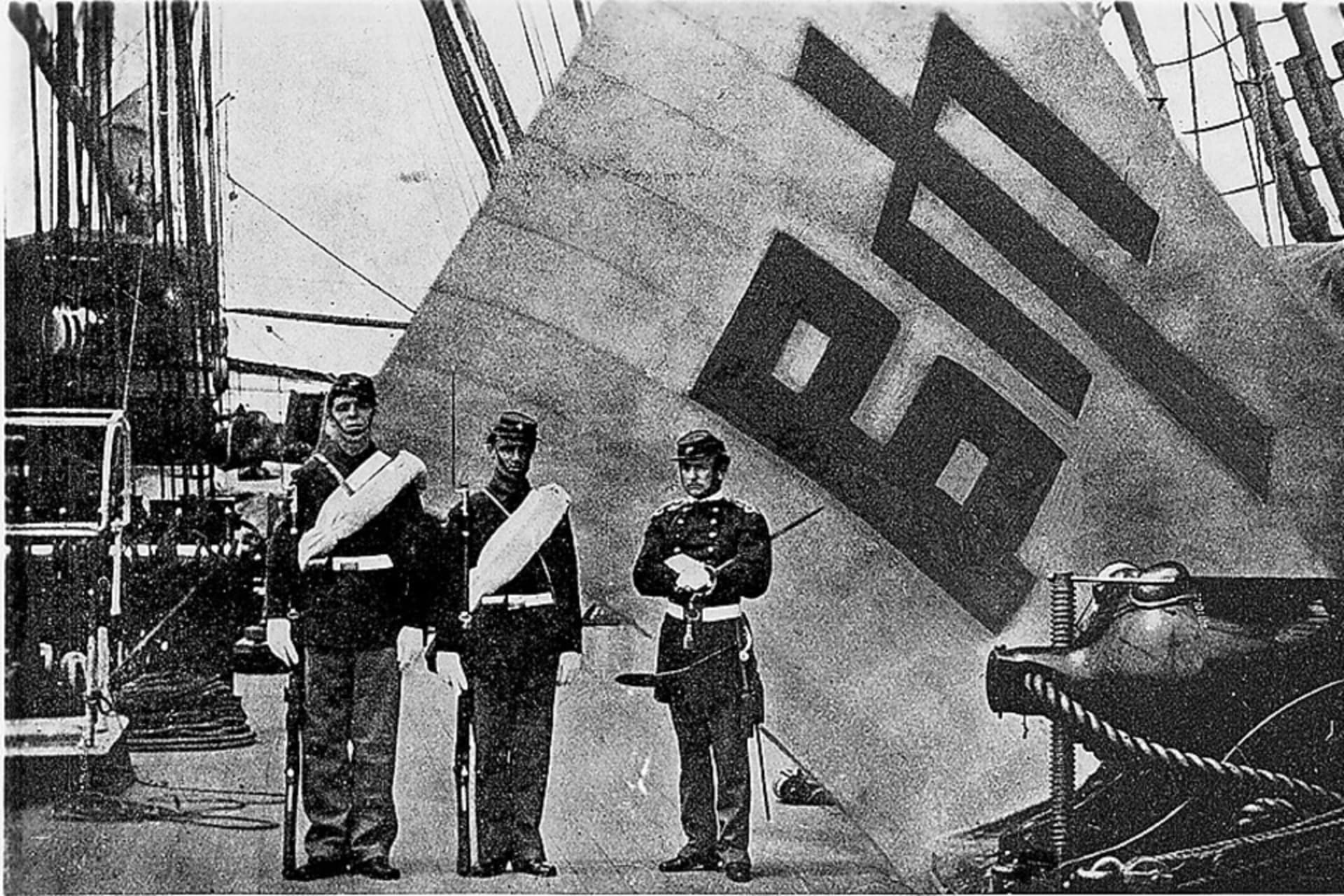
The Koreans refused to comply. So Rogers carried out his threat. On June 10, the U.S. ships attacked the Choji Garrison on the island of Ganghwa-do. It was a mismatch from the start. The garrison was lightly defended and poorly equipped. U.S. marines and sailors made quick work of it and then overran several other posts on the island. When the smoke cleared at the end of the day, the Americans controlled Ganghwa-do at the cost of three dead. The Koreans were not as fortunate. They lost more than two-hundred-and-forty men.
Koreans call the fighting on Ganghwa-do “Shinmiyangyo,” which literally means “Western Disturbance in the Shinmi Year.” The U.S. victory marked the first time that the stars and stripes were raised over Asian territory by force. Nine sailors and six marines were awarded Medals of Honor for their bravery during the campaign, making them the first Medal of Honor recipients to be honored for fighting on foreign soil. As the historian Gordon Chang has noted, the battle “was one of the largest, if not the largest, and bloodiest uses of military force overseas by the United States in the fifty years between the Mexican-American War of 1846-1848 and the Spanish-American War of 1898.”
Rogers hoped that his decisive victory would persuade the Koreans to negotiate. It didn’t. They instead sent reinforcements armed with modern weapons. The odds had shifted. On July 3, Rogers ordered the U.S. squadron to pull up anchor and set sail for China.
Time Heals All Wounds
It would be another eleven years before the United States established diplomatic and trade relations with Korea. In May 1882, the United States and Korea signed the Treaty of Peace, Amity, Commerce and Navigation. It is also known as the Joseon-United States Treaty. Joseon (or Chosun) was the name of the Korean kingdom.
The agreement was the first that Korea signed with any Western country. It came about in good part because Korea’s king hoped that U.S. ties would help preserve Korea’s independence from China, its nominal overlord. To that end, the treaty’s first article stated that “if other powers deal unjustly or oppressively with either Government, the other will exert their good offices on being informed of the case to bring about an amicable arrangement.”
The treaty also pledged “perpetual peace and friendship” between the United States and Korea. Amity with South Korea continues to this day. But most Americans don’t know that, as the historian Robert Kagan put it, “the self-proclaimed disinterested and peace-loving Americans had introduced themselves to Korea by killing its people.”
The United States celebrates its 250th anniversary in 2026. To mark that milestone, I am resurfacing essays I have written over the years about major events in U.S. foreign policy. A version of this essay was published on June 10, 2013.
Oscar Berry assisted in the preparation of this article.