The 1916 Black Tom Explosion in Jersey City
Before the United States entered World War I, U.S. officials mistook German sabotage for an industrial accident.
By experts and staff
- Published
 James M. LindsayCFR ExpertMary and David Boies Distinguished Senior Fellow in U.S. Foreign Policy
History is filled with “what ifs?” We usually ask that question about world famous historical events. How would history have changed if Julius Caesar had avoided assassination? If Napoleon had decided not to invade Russia? Or if Adolf Hitler had been killed rather than merely wounded during World War I?
But “what if?” can also be asked about events that have faded from historical memory. One example is the explosion at the Black Tom munitions depot in Jersey City, New Jersey, on July 30, 1916. Authorities at the time blamed the explosion on lax safety procedures by the depot’s owner, the Lehigh Valley Railroad, and its operator, the National Dock and Storage Company. Had officials known the actual cause, the United States might have entered World War I eight months sooner than it did. That might have changed the outcome of the 1916 presidential election and with it, what happened after the war ended.
A Booming Business at Black Tom
Black Tom was a busy place in the summer of 1916. The Great War in Europe was in its second year. The United States was officially neutral, but U.S. law allowed American weapons manufacturers to sell their products to anyone who would buy. Business was brisk. Britain, France, and Russia were the main customers. Germany would have been as well, if not for the British blockade that kept German ships in their home ports.
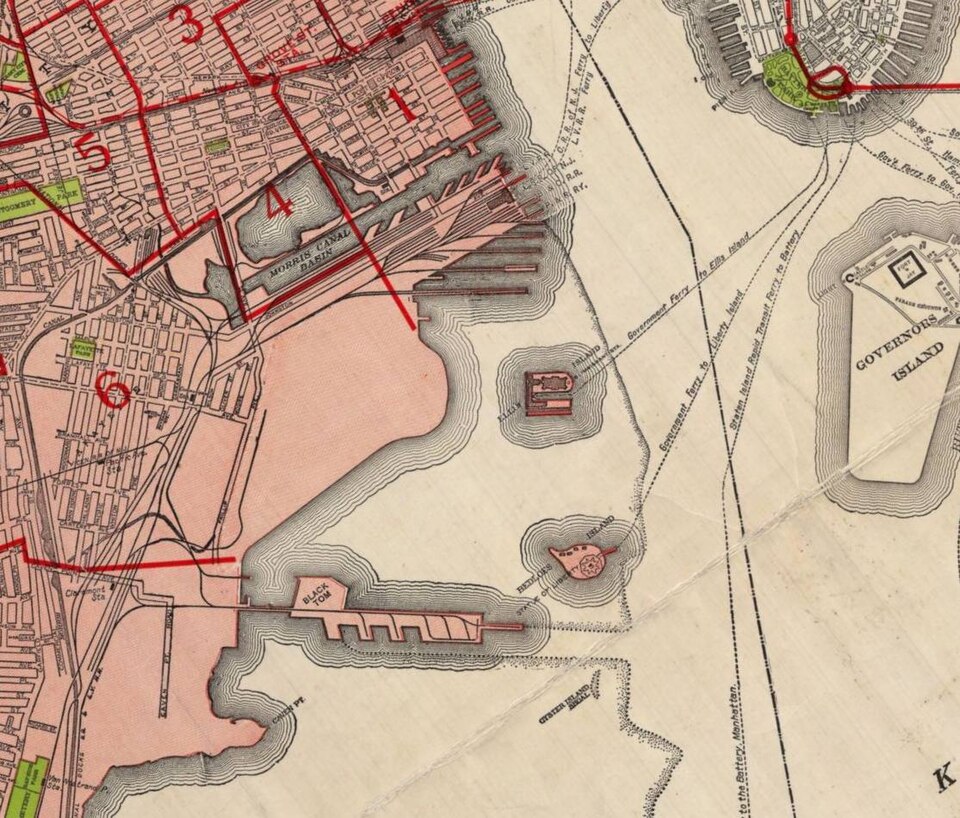
While profitable, the munitions business in the early twentieth century was dangerous. Explosions were a constant risk. Black Tom had already experienced three of them, though they had all been relatively small. Locals thought that the depot was “hoodooed”—or cursed. It didn’t help that safety regulations were routinely ignored in the bid to ship as many munitions as possible as fast as possible. Security was even worse. The depot was not fenced off, no pass or identification was required to enter the property, and fewer than ten security guards patrolled the sprawling complex.
Black Tom Explodes
The lax safety and security protocols became an issue in the early morning hours of Sunday, July 30. Guards patrolling the warren of warehouses, railroad cars, and vessels spotted several fires, including one aboard Johnson Barge No. 17. It was loaded with 100,000 pounds of TNT destined for Russia. Safety regulations called for the barge to be moored offshore. However, the ship’s owner had it tied to the Black Tom pier to save a twenty-five-dollar moorage fee.
Some guards fled upon spotting the fires; others stayed to fight them. They were soon joined by local firefighters equipped with “a horse-drawn pumper, a gasoline-driven ‘hook-and-ladder’ bearing several short lengths of ladder, and a reel of hose.”
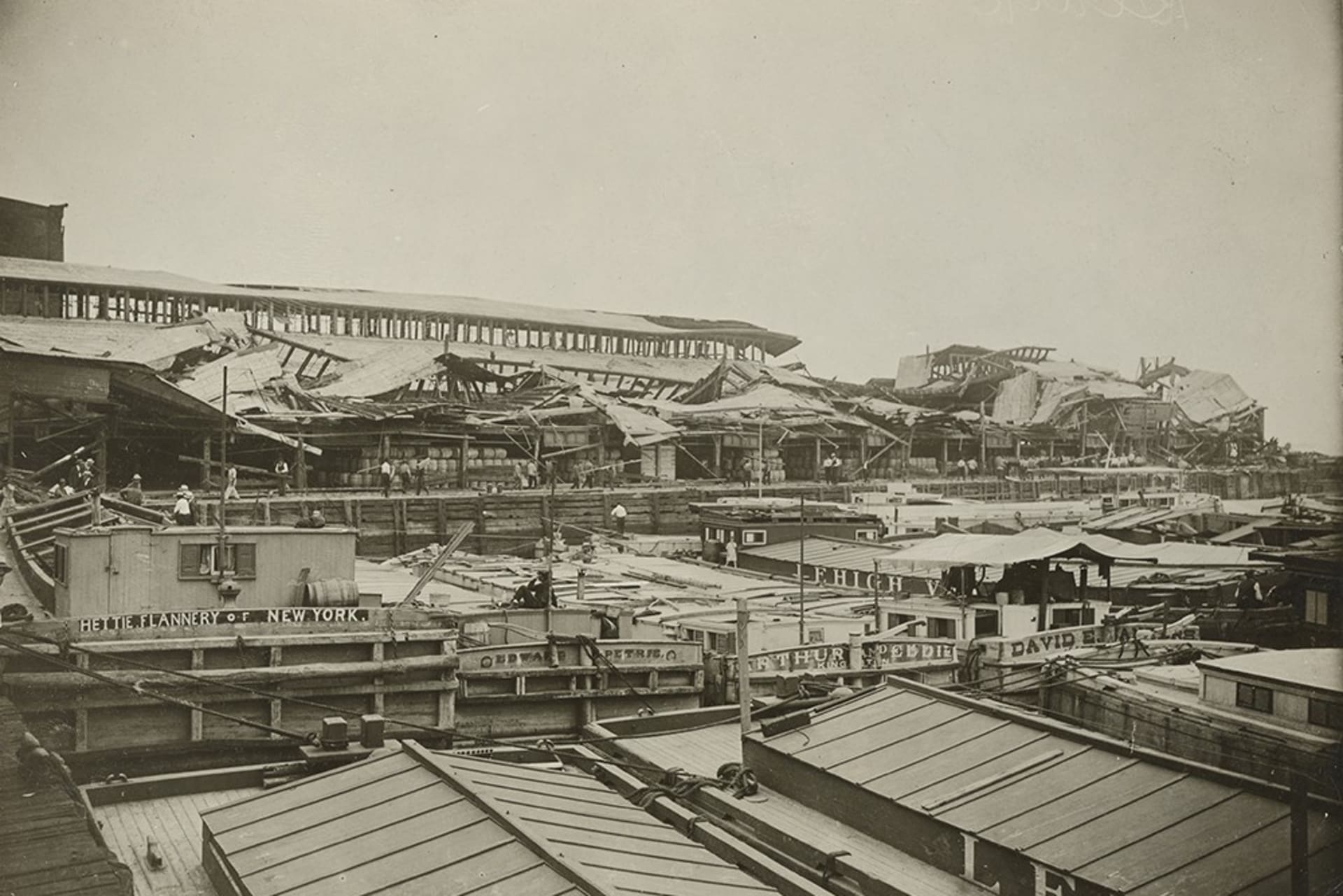
Their efforts were futile. At 2:08 a.m., a massive explosion rocked Black Tom. The night sky lit up as the blast blew out tens of thousands of windows in Jersey City and across the harbor in Manhattan. People as far away as Maryland were jolted awake by the explosion, which scientists later estimated unleashed a force equivalent to a 5.5-magnitude earthquake. To put that number in perspective, the collapse of the North Tower of the World Trade Center on September 11, 2001, generated a force equivalent to a 2.3-magnitude earthquake.
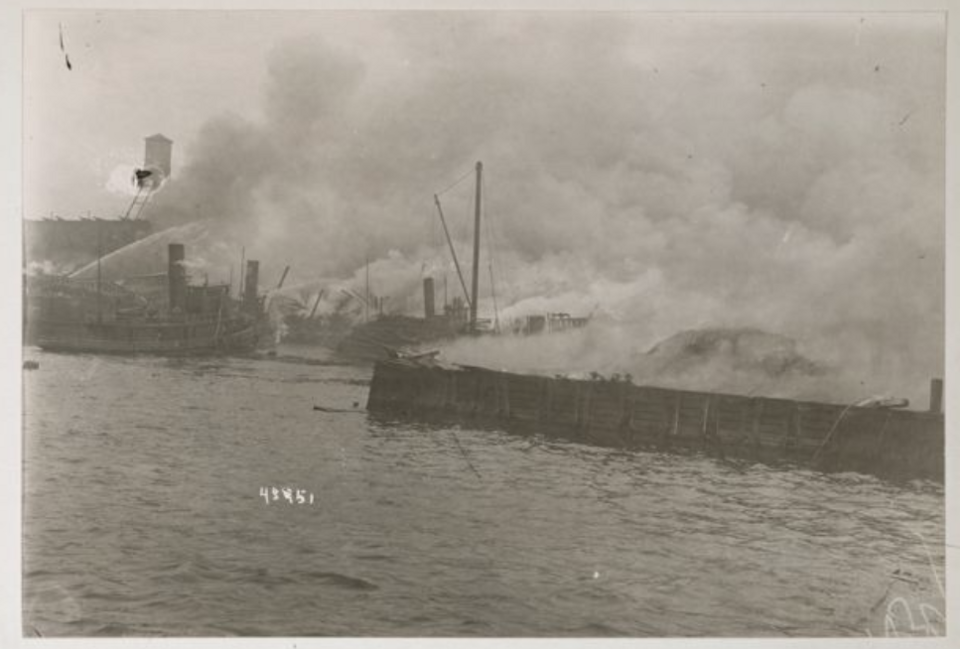
Despite the immensity of the explosion, the death toll was astonishingly low. Just seven people are believed to have been killed. Many more people no doubt would have died if the explosion had occurred during the daytime.
A Quick Conclusion
The history of accidents at Black Tom shaped how the Jersey City police responded to the explosion. They immediately blamed Black Tom’s lax safety protocols. Within twenty-four hours, the police had arrested senior officials at the Lehigh Valley Railroad and the National Dock and Storage Company.
Sabotage was quickly dismissed as a possible cause of the explosion. The chief of the Bureau of Investigation, the forerunner to the FBI, filed a preliminary report noting “our investigator seems to think that the explosion was an accident.” Based on what he heard from his advisors, President Woodrow Wilson concluded that the explosion was “a regrettable incident at a private railroad terminal.”
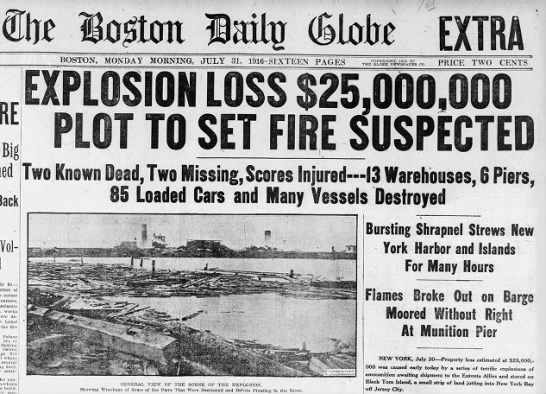
While some newspapers speculated about possible sabotage, the New York Times reported the official consensus in its July 31 edition: “On one point the various investigating bodies agree, and that is that the fire and subsequent explosions cannot be charged to the account of alien plotters against the neutrality of the United States.”
On Second Thought
But the Black Tom explosion had in fact been the work of German saboteurs. They had slipped into the depot after midnight, lit several small fires, and placed time bombs and incendiary devices around the pier. Their actions were part of a larger operation that sought to disrupt the ability of the United States to supply Britain, France, and Russia with weapons and supplies.
Many of these facts did not come to light until the 1930s, when a New York lawyer, John McCloy amassed enough evidence to sue Germany at the Mixed Claims Commission in The Hague. In 1939, he won his case, though Adolf Hitler’s government reneged on its pledge to pay. Payment eventually began after World War II, with the final installment being made in 1979. (McCloy went on to become president of the World Bank, the American High Commissioner for Germany after World War II, and chairman of the Council on Foreign Relations.)
A Historical Puzzle
Why did investigators dismiss the possibility of German sabotage at Black Tom so quickly? After all, Germany had a clear motive. The munitions that left U.S. ports were arming its enemies. Moreover, U.S. officials suspected Berlin was plotting sabotage operations in the United States. A year earlier, Werner Horn, a German army reserve lieutenant, had been arrested for trying to blow up the international railway bridge at Vanceboro, Maine, which he thought carried Canadian munitions to U.S. ports. Meanwhile, Robert Fay, another German national, had been arrested in New Jersey for building bombs to blow up U.S. and neutral ships headed to Europe. Even more puzzling, a month after the explosion, police from nearby Bayonne, New Jersey, arrested one of the saboteurs after receiving a tip. They eventually released him for lack of evidence and dropped the investigation.
The prior explosions at Black Tom were one reason for the premature dismissal of sabotage as a possibility. As the adage has it, “when you hear the sound of hoofbeats, think horses, not zebras.” Everyone knew that the munitions depot at Black Tom skirted safety protocols. So it was hardly surprising that munitions exploded.
The United States was also poorly organized to investigate the cause of the Black Tom explosion. The country had no dedicated intelligence service at the time, and the laws governing spying and sabotage were either vague or non-existent. The federal law enforcement agencies that did exist, such as the Bureau of Investigation and the Secret Service, had little experience ferreting out foreign plots. Responsibility for investigating the explosion was spread among local, state, and federal agencies, with no clear mechanism to share and coordinate what they knew or learned.
A third reason is that most Americans, and most political leaders, wanted to avoid war with Germany. They were not looking for reasons to begin one. Nineteen sixteen was an election year. Wilson, a former governor of New Jersey, was running for reelection on the slogan that “he kept us out of war.” Blaming Berlin for the Black Tom explosion would have undercut that pitch. Wilson’s focus in the summer of 1916 was instead on persuading Britain to relax its blacklist of U.S. firms suspected of trading with Germany and keeping tensions with Mexico from escalating to war.
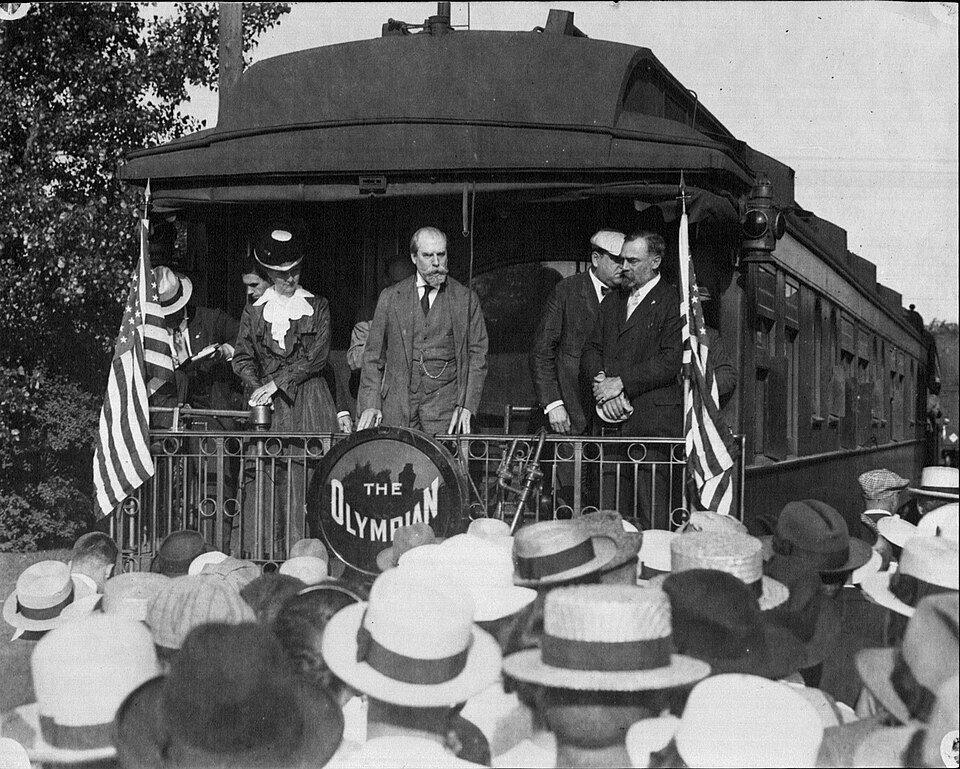
Meanwhile, Charles Evans Hughes, Wilson’s opponent, preferred not to play up the German threat. Many Americans associated Hughes with his fellows Republican, former President Theodore Roosevelt, who was an avowed interventionist. As a result, Hughes spent that summer and fall trying to reassure voters that he too favored staying out of Europe’s war. Ironically, Hughes formally accepted the Republican presidential nomination the day after the Black Tom explosion with a speech across New York Harbor at Carnegie Hall. He did not mention sabotage.
The Legacy of Black Tom
The Black Tom explosion soon faded from the headlines. War with Germany eventually came, but not until April 1917, after Berlin launched unrestricted submarine warfare and the American public learned of the Zimmermann Telegram and Germany’s effort to persuade Mexico to attack the United States.
What would have happened had Germany’s complicity been uncovered in the summer of 1916? The United States may have joined World War I eight months sooner than it did, which could have changed the course of the fighting in unpredictable ways. And had the United States gone to war in response to an unprovoked German attack on U.S. soil, the surge in isolationist sentiment that gripped the United States in the 1930s might never have materialized. That movement rested on the conviction that the United States had not faced a real threat from Germany but had entered the war to enrich the “Merchants of Death,” that is, U.S. munitions manufacturers like the ones operating out of Black Tom.
Uncovering German complicity might also have changed the outcome of the 1916 election, which was one of the closest in U.S. history. Had Hughes won just 4,000 more votes in California, he would have beaten Wilson. Had Wilson lost reelection, the negotiations at the Paris Peace Conference in 1919 might have unfolded differently and his vision of a League of Nations and the broader cause of Wilsonian internationalism might never have gained traction.
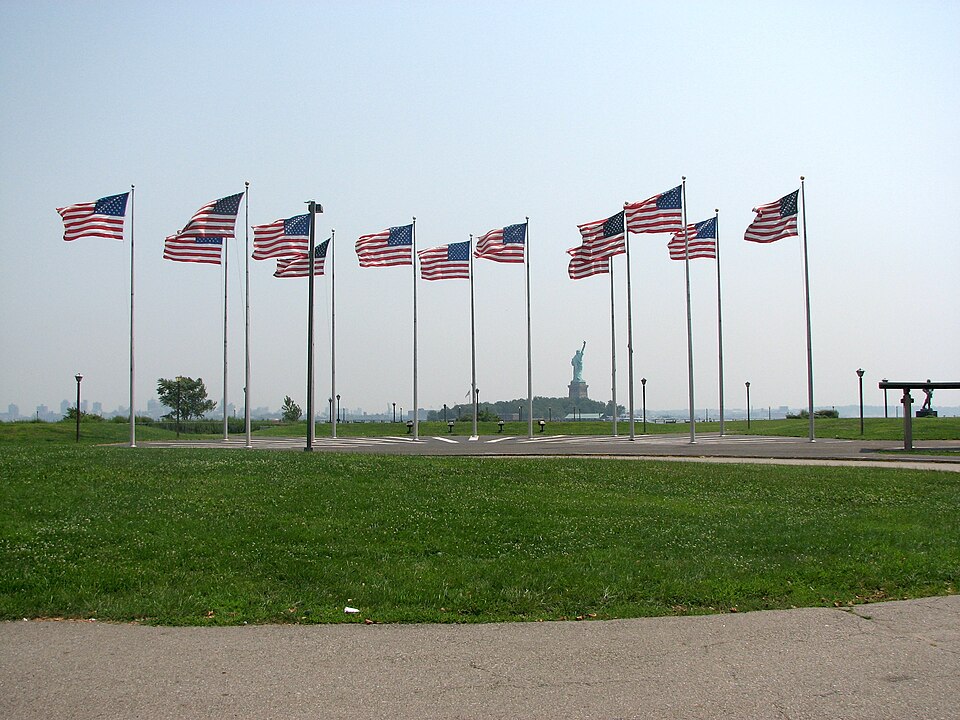
How differently history might have unfolded is always an unanswerable question. But Black Tom did have one lasting consequence. Shrapnel from the explosion hit the nearby Statue of Liberty. The damage required ending public access to Lady Liberty’s torch and its spectacular view of New York harbor. The torch has never reopened.
The United States celebrates its 250th anniversary in 2026. To mark that milestone, I am resurfacing essays I have written over the years about major events in U.S. foreign policy. A version of this essay was published on July 30, 2014.
Oscar Berry and Jack Patton assisted in the preparation of this article.
This work represents the views solely of the author(s). The Council on Foreign Relations is an independent, nonpartisan membership organization, think tank, and publisher, and takes no institutional positions on matters of policy.