Trump’s South Korea Social Post Poses Risks for the United States
Sowing doubt about the U.S. commitment to alliances in East Asia could upend the military and strategic balance in the region and undermine U.S. interests in the process.
By experts and staff
- Published
 Sheila A. SmithCFR ExpertJohn E. Merow Senior Fellow for Asia-Pacific Studies
Sheila A. Smith is an expert on Japanese politics and foreign policy in Asia. She is the author of Japan Rearmed: The Politics of Military Power, Intimate Rivals: Japanese Domestic Politics and a Rising China.
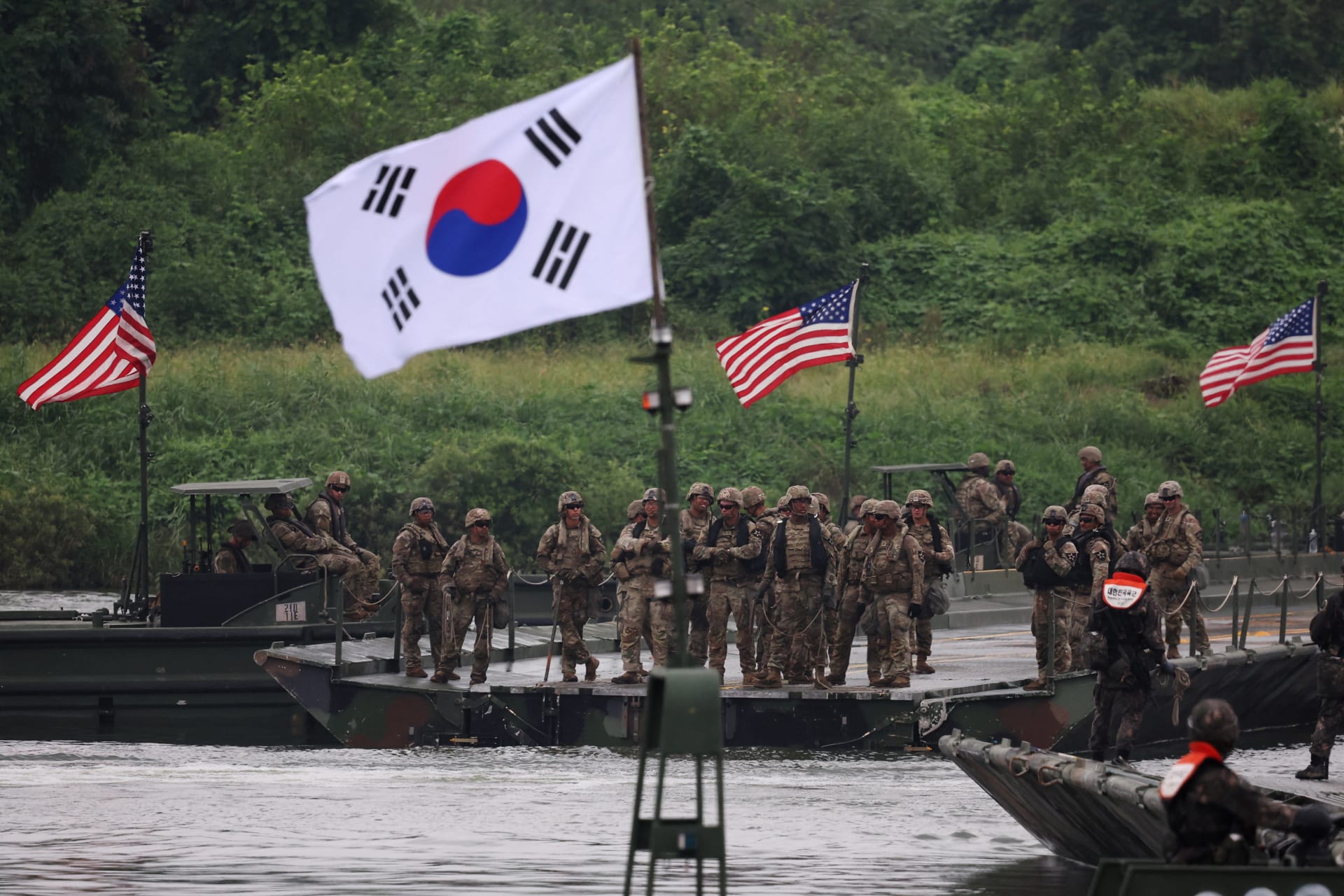
Last week, U.S. President Donald Trump posted that the United States would dramatically scale back joint military exercises with South Korean forces in light of his “very good relationship” with North Korean leader Kim Jong Un. He also expressed frustration with South Korean President Lee Jae Myung’s response to the Iran war, in his latest broadside against U.S. allies in the Asia-Pacific and elsewhere who have not been “helping” enough during the conflict.
The post raises the question of whether this is leverage on a reluctant ally, genuine hope for new diplomatic outreach and peace with North Korea, or simply cost-saving by a U.S. military feeling a spending pinch. Any, or all, of these motivations could be at play. But the United States should not gamble with Northeast Asian security. The stakes are too high not only for U.S. allies, but for the United States, too.
Ongoing Alliance Upgrades
South Korea and Japan are well aware of these stakes—and of the region’s worsening military balance. Both have stepped up their defense efforts in the past decade or more in response. North Korea’s nuclear ambitions and China’s intense military buildup have prompted closer strategic coordination and deeper interoperability with U.S. forces to enhance deterrence.
For Seoul, North Korea is the primary focus of its defense planning, and South Korea’s defense spending has climbed to around $47.8 billion, roughly 2.6 percent of its GDP. Japan, meanwhile, has also upped its defense spending, reaching $62.2 billion, or about 1.4 percent of GDP, in the face of North Korean nuclear and missile capabilities as well as China’s expanding maritime reach. Japan’s order of Tomahawk missiles from the United States and the planned integration of command coordination demonstrate the future trajectory of the alliance, while a new strategic review promises yet another upgrade in Japanese defense investments.
Military commanders in the United States, Japan, and South Korea have all reached the conclusion that it is the combined capabilities and readiness of the three allies that will be decisive in the future. More than eighty thousand U.S. forward-deployed military personnel regularly operate alongside South Korean and Japanese forces from bases in Northeast Asia, and exercise and deploy with forces from Australia across the Western Pacific. Allied forces join U.S. forces to train in Alaska, California, Guam and Hawaii to enhance preparedness. In addition, U.S. treaty allies now have relationships with each other—and in many cases also burgeoning security ties with neighbors across Asia, from India to the Philippines.
Consequences of the Wars in Iran and Ukraine
The strategic activism of U.S. Asian allies is also being felt far beyond the Indo-Pacific region. Ties between U.S. allies in Europe and those in Asia have expanded significantly, and since Russia’s invasion of Ukraine in 2022, U.S. Indo-Pacific allies have joined annual NATO meetings to develop a common response, affirming that the security of the Euro-Atlantic and the Indo-Pacific is inseparable. Similarly, each has devoted resources to help Ukraine in its fight. In 2022, South Korea reportedly sold 100,000 rounds of 155 millimeters artillery ammunition to the United States for delivery to Ukraine. Bilateral defense partnerships with European nations on weapons development and technology innovation have also flourished.
These moves come against the backdrop of strategic tensions that have spilled over to Northeast Asia as a consequence of Russia’s invasion. Broadly speaking, there have been two elements to these tensions.
First, Russia has sanctioned U.S. allies in Asia for their support for Ukraine. Because of its early and comprehensive participation in crafting Group of Seven (G7) sanctions, Japan was designated an “unfriendly” state, and Russia’s sanctions list included individual decisionmakers and civil society groups. Earlier this month, Russian President Vladimir Putin visited the disputed Northern Territories (known as the Southern Kuriles by Russia) in the lead up to the anniversary of the end of World War II. Similarly, Putin has degraded Russia’s ties with South Korea. In 2024, during a visit to Vietnam, he warned South Korea that sending arms to Ukraine would be a “big mistake,” and that Moscow will make decisions “unlikely to please the leadership of South Korea.”
Second, Russia’s struggle to make progress in Ukraine has prompted a new strategic arrangement between Moscow and Pyongyang. Kim visited Russia and various Russian military sites in 2023 ostensibly to discuss Russian technical support for his military ambitions. But a year later, Putin visited Pyongyang to sign a new bilateral defense treaty. Within months, ten thousand North Korean troops were dispatched to Russia’s border with Ukraine. This year, an additional thirty thousand North Korean troops were reportedly promised to Moscow.
The Iran war has also had consequences for East Asia. Publics in Japan and South Korea have not looked favorably upon the U.S. and Israeli attack on Iran. Both these U.S. allies have suffered economically, with cost-of-living pressures putting enormous political strain on each country’s government. According to an August 17 public opinion poll, President Lee’s approval rating has hit a new low of 43 percent. Even Japanese Prime Minister Takaichi Sanae’s approval rating has dipped from historic highs, now sitting in the mid-50 percent range. Neither leader has found any traction domestically in advocating for support for the U.S. position.
Finally, a more practical concern for the governments of Japan and South Korea is whether the United States has sufficient capabilities to conduct a war in the Middle East while still offering protection to its allies in Asia. This question struck home in South Korea in March when media reported that the U.S. Army moved six Terminal High Altitude Area Defense (THAAD) launchers from their home base southeast of Seoul to another facility, ostensibly to ready them for shipping to the Middle East. When asked about this, President Lee stated he could ask for them to stay but, in the end, the decision was not his to make. (The launchers were returned to their original site in June, with the U.S. Forces Korea commander acknowledging the “kerfuffle.”)
Japan’s military is also reportedly feeling the knock-on effects of the Iran war. The Financial Times reported in May that U.S. Secretary of Defense Pete Hegseth told his Japanese counterpart, Defense Minister Koizumi Shinjiro, that the delivery of Japan’s 400 Tomahawks could be delayed by up to two years due to the need to replenish U.S. stocks in the wake of the Iran war.
A New Diplomatic Opening—and the Stakes
This is the backdrop against which Trump confirmed he is pushing for a meeting with Kim later this year. But the purpose of such talks should be made clear. After all, Kim’s influence over the kind of global problem-solving Trump is seeking will be limited. Kim cannot help the U.S. president solve his biggest strategic challenges—namely developing a better strategic relationship with China, ending Russia’s war in Ukraine, and ending the war with Iran. What Kim can do is wreak havoc on South Korean and Japanese defense planning by creating the impression of diminished U.S. support for its allies. And, without a doubt, a crisis on the Korean Peninsula would only add to the White House’s problems as it tries to end wars in Europe and the Middle East.
What Trump must avoid at all costs is opening up another theater of tension and conflict in Northeast Asia. Strategic planners and publics alike are beginning to worry about the prospects for armed conflict spreading to Asia. Undermining the U.S. alliance with South Korea will only feed the debate there over whether to opt for nuclear weapons. If South Korea does so, it will only be a matter of time before more Japanese begin to worry that their defenses need nuclear bolstering, too. Undermining the alliance with South Korea also risks pushing Seoul to hedge its bets in the region. It is worth noting, for example, that just this week Chinese Foreign Minister Wang Yi visited Seoul and offered reassurance that China would be a predictable partner for peace on the peninsula.
With wars ongoing in Europe and the Middle East, this is not the time to upend the premises of U.S. military posture in Asia. Threatening to punish an ally by withdrawing U.S. strategic protection is unlikely to accelerate investment in capabilities designed to integrate U.S. and allied strategic objectives. Nor will threats produce submission in Seoul or Tokyo—or any Indo-Pacific capital—to policies the publics will not support.
Deliberately weakening a long-standing treaty ally will have far more than bilateral consequences. Beijing, Moscow and Pyongyang will have cause for celebration if Washington plays its good hand badly.
This work represents the views solely of the author(s). The Council on Foreign Relations is an independent, nonpartisan membership organization, think tank, and publisher, and takes no institutional positions on matters of policy.