The Luck of the Irish
Each attempt to tax the massive profits booked by Irish-shored multinationals has only expanded the system that allows them to be booked there in the first place.

Since 2014—the year Apple put on a green jersey and became a tax resident of Ireland—Ireland has had a remarkable string of luck.*
Since then, the OECD countries have agreed to end “double Irish” tax structures, so that an Irish-registered subsidiary could not be a tax resident of Bermuda or the Caymans.
They also agreed to raise the global minimum tax rate to 15 percent—albeit with a carveout for the United States.
The United States also enacted major tax reforms in 2017 (the Tax Cuts and Jobs Act) and 2025 (the One Big Beautiful Bill Act).
The net result has been, well, a steady rise in the profit the world’s multinationals report in Ireland, and a steady march up in Ireland’s corporate tax take. The Irish balance of payments data now shows that foreign multinationals (almost all American headquartered multinationals) report earning over $300 billion in Ireland—a remarkable sum.
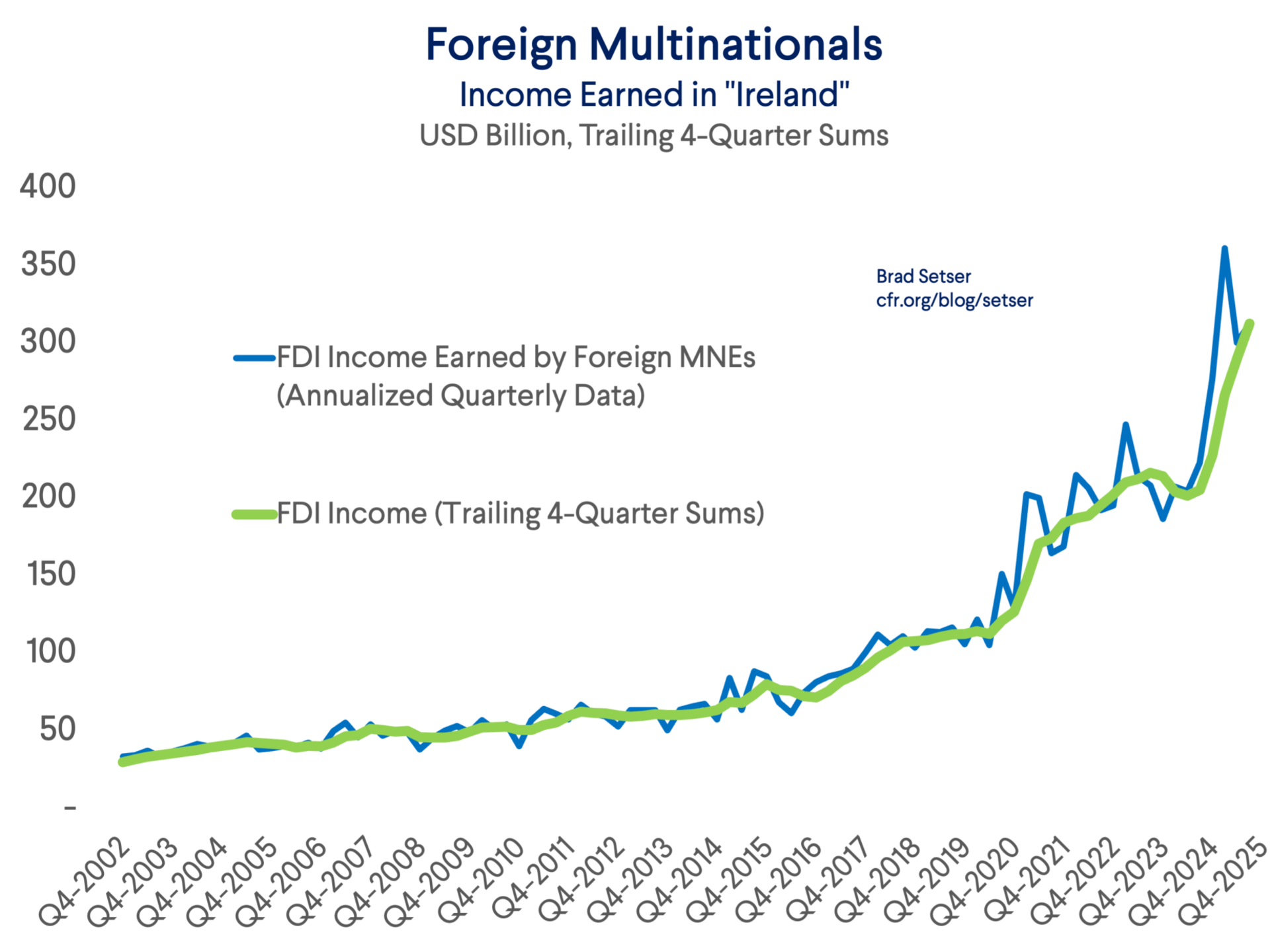
Those “Irish” profits generated close to 35 billion euros ($38-39 billion) or so in Irish corporate tax revenue in 2025—with a little under half likely coming from just three companies (Apple, Microsoft and Eli Lilly, which replaced Pfizer in the top 3 a couple of years back) judging from past patterns.
The first wave of OECD reforms made it impossible for large U.S. multinationals to maintain large subsidiaries in zero tax jurisdictions in the Caribbean—and led many of them to “Irish-shore” their intellectual property. That’s right getting rid of the double Irish was a boon to Ireland.
And the second wave of OECD reforms forced Ireland to raise its headline rate to 15 percent, which led Ireland to collect more revenue on all those “Irish” profits. To be sure most firms don’t pay 15 percent in Ireland—the capital allowances and the like bring down effective tax rates on firms like Apple and Microsoft.
But with close to 30 billion euros in corporate tax revenues, Ireland is now getting a decent chunk of revenue out of some of the world’s most profitable global companies.
The two U.S. tax reforms somehow did not get rid of the incentive to offshore profits. Deferral of offshore profits was replaced by a low 10.5 percent minimum rate, which acted as a further incentive to maintain offshore tax structures in the pharmaceutical industry, and the new law kept the basic structure of this pro-offshoring tax break while raising the minimum rate to around 12.6 percent.
The net result:
Eli Lilly paid $6.6 billion (around €6 billion) in tax to Ireland in 2025. That was an inflated number; Lilly looks to have prepaid tax on drugs produced in Ireland ahead of feared tariffs (which didn’t materialize) and thus incurred an Irish tax liability ahead of getting the profit on actual sales—and the total also includes “a prior year tax payment”). But there is no doubt Eli Lilly is now paying a lot of tax in Ireland—and largely on the profits generated by U.S. sales. It isn’t alone, either—most U.S. pharmaceutical companies still have similar tax structures.** Its cash tax payments to Ireland were twice its U.S. federal tax payments.
Microsoft is thought to have paid €4.8 billion in Irish tax in 2024, and likely a similar amount in 2025. It has disclosed that over 80 percent of its offshore profit—$44.9 billion in 2024, $54.4 in its fiscal 2025—is booked in Ireland (see page 74 in its 10-K.
Apple is thought to have paid €5.8 billion in Irish tax in 2024. It hasn’t disclosed the share of its $77.3 billion in 2024 global profit that is booked in Ireland ($82 billion in 2025), but there is no real doubt that the bulk is in Ireland, as Ireland has long been at the center of its tax operations (Apple’s 2025 10-K mentions both Ireland and Singapore).
That is over €16 billion in Irish tax payments from just three large U.S. multinationals. Call it $17-18 billion.
That’s real money.
Ireland free rides on NATO (It isn’t a member) and has a tiny defense budget even though it is swimming in tax revenues. Given the times, it seems fitting to express the tax revenues the U.S. loses when large American companies pay tax on the global profits in Ireland first in defense terms.
The lost tax revenue from Eli Lilly, Apple, and Microsoft would buy roughly four nuclear attack subs a year.
$17 billion buys a Ford class aircraft carrier and an escorting submarine.
A carrier a year over ten years would easily outpace China—though there is a fair debate over the utility of that kind of carrier fleet now.
The revenue that the U.S. could be collecting would also be enough cover the cost of one week of high intensity military action against Iran.
It is indeed real money, in other words. Enough that the U.S. shouldn’t, in my judgement, maintain a tax code that both allows and incentivizes so much of its tax base to be offshore.
But every attempt at reform so far has only seemed to raise the Irish tax windfall.
So, I raise a glass to Ireland’s skill at navigating through the shoals of global tax reform and emerging untouched on the other side, with more Irish profits and more tax revenue than ever.
* The financial gymnastics included moving Apple’s global intellectual property (the right to profit from sales of Apple-designed goods and software outside the Americas) to a subsidiary in Jersey, which was then notionally purchased by Apple’s main Irish subsidiary—with the notional interest used to finance the purchase deductible against the subsidiaries Irish income and a capital allowance that allowed Apple to net off the notional cost of the purchase over many years—generating a deduction of around €20 billion a year.
** Pfizer disclosed large tax operations in Ireland and Singapore. Merck did the same in Ireland and Switzerland, and AbbVie continues to have an Irish-Caribbean structure.