Trump’s Revamped Food for Peace Bypasses the Countries Closest to Famine
After DOGE dismantled USAID in 2025, the United States’ oldest emergency food aid program—Food for Peace—was moved to USDA, an agency with no crisis-response expertise. Now, Food for Peace is sending U.S.-grown commodities to nonemergency countries, bypassing Somalia, South Sudan, and Sudan—all places in or barreling toward famine.


Sam Vigersky previously served as a senior humanitarian advisor to the U.S. ambassador to the United Nations and has two decades of experience as a field aid worker and policymaker.
Help wanted: the U.S. Department of Agriculture (USDA) is seeking a contract quote for an instruction manual on how to administer Food for Peace, the $1.2 billion program delivering American-grown wheat, rice, and other commodities to victims of disaster worldwide.
Having fed more than four billion people across its seventy-year history, Food for Peace was orphaned last year following the demolition of the U.S. Agency for International Development (USAID). While other USAID humanitarian programs moved to the State Department, a Capitol Hill–supported interagency agreement transferred Food for Peace to USDA in December 2025—quietly, and, evidently, without consideration of a basic operational question: Does USDA have the people to run such a program? The answer, it appears, is no.
And yet experts at the State Department—where one can find several dozen former Food for Peace staffers who have decades of experience managing the money and living in hunger hot spots—were shut out from helping, leaving USDA to spend millions of taxpayer dollars to learn what former staffers already know.
The program’s transfer is the latest ironic twist in the tale of President Donald Trump’s Department of Government Efficiency (DOGE): it destroyed USAID and displaced Food for Peace under a mandate of eliminating waste and inefficiency, only to manufacture significantly more of both.
But beyond the immediate absurdity remains a more consequential question: Why was Food for Peace assigned to an agency without international humanitarian or disaster-response expertise—and what will that mean for millions of hungry people desperate for food aid?
The Case for Food for Peace at USDA
Days after Elon Musk and Trump announced the shuttering of USAID on February 3, 2025, Capitol Hill began its search for Food for Peace’s new home. A February 11 press release from the office of Representative Tracey Mann (R-KS), signed by a half dozen other lawmakers from states with agricultural interests, announced legislation to move Food for Peace to USDA.
“President Trump made a promise to the country to cut wasteful spending, reduce overbearing federal bureaucracy, and ensure every taxpayer dollar is spent wisely and responsibly,” Mann declared, going on to cheer Trump’s promise to review federal spending “line by line to root out waste.”
To proponents, USDA was a logical destination. It already administered two international food security programs that purchase U.S. agricultural commodities: McGovern-Dole and Food for Progress. As a bonus, Food for Peace has USDA roots. It is where President Dwight D. Eisenhower originally created the program in 1954 to offset farm income declines and agricultural stock surpluses driven by productivity gains. President John F. Kennedy’s Foreign Assistance Act later consolidated overseas aid in 1961 under a single agency, a role USAID held for more than six decades.
To opponents, the Trump administration’s decision to move Food for Peace under USDA reeked of Washington rent-seeking—an arrangement where government programs pump money toward the agricultural lobby, farmers, and shipping companies rather than spend that limited funding directly on the hungry. Indeed, the first $452 million tranche of Food for Peace funding under USDA, issued in February, stipulated 100 percent procurement of U.S.-origin commodities, stripping the flexibility to source food overseas or provide cash assistance to support local food markets. That approach undermines its own objective of eliminating aid dependency.
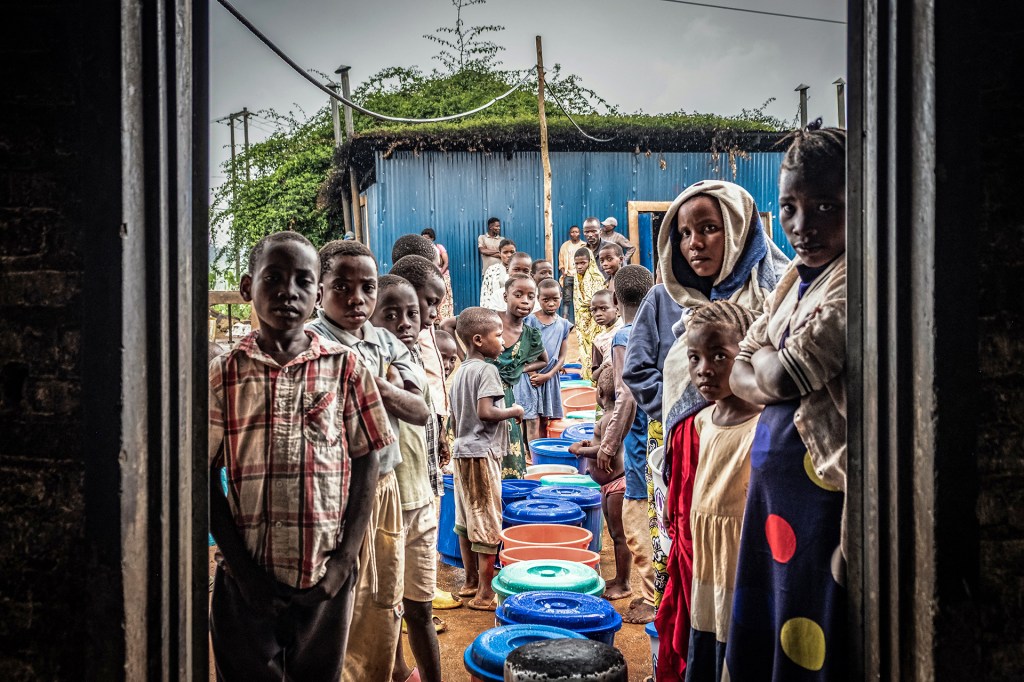
Where U.S. commodities were directed was another cause for concern. Only seven countries were selected by USDA to receive American grain, five of which—the Democratic Republic of Congo (DRC), Ethiopia, Guatemala, Haiti, and Kenya—truly require life-saving assistance. The other two—El Salvador and Rwanda—do not meet an emergency threshold. USDA has not publicly explained why it curated such a short and mismatched list.
Meanwhile, the country facing the largest hunger crisis in the world—Sudan—did not make the list. Now in its third consecutive year of famine, Sudan received nothing. In fact, more than 40 percent of Sudan’s community kitchens, a lifeline for the displaced, have closed in the past six months as funding dried up, according to Islamic Relief.
Afghanistan, Lebanon, and Yemen were also passed over. Millions of people in those countries live one step from famine, according to the Integrated Food Security Phase Classification (IPC), the UN-backed monitoring system that uses a standardized five-point scale (five being famine) to measure the severity of food insecurity.
Food for Peace 3.0
Concerns over Food for Peace’s next chapter have continued to escalate, and quickly.
On May 13, days after USDA posted its help wanted ad, it announced a second tranche of Food for Peace money: a $357 million competitive grant opportunity aimed to “support American Farmers feeding the world’s hungriest.”
Unlike the first tranche, which was solely directed to the World Food Program (WFP), this round is expected to go to more than a dozen implementing partners—raising the possibility of a duplicate system of shipping, warehousing, and programming that would unfold in parallel to WFP’s work in the same seven countries.
Moreover, the program description says Food for Peace should address famine and acute food insecurity resulting from armed conflict, violence, and hazardous environments. The program list, however, remains unchanged since February, despite cascading impacts of Operation Epic Fury, including, according to the WFP, a historic hunger crisis triggered by surging fuel prices and disruptions in fertilizer.
And the gap between the program’s stated mandate and its actual reach is only widening. In late April, more than seventy-thousand people in South Sudan were identified as experiencing famine conditions. A few weeks later, WFP announced that because of funding cuts, it can only reach one in ten people in need of food aid in Somalia, a country with two million people on the brink of famine. And Gaza’s nascent recovery from famine last year has been pushed to the brink as flour and fuel shortages drive up the price of bread.
And yet, none of those locations have been added to the list.
The restricted country list is not the only alarming constraint. In its May 13 solicitation, USDA requires that 50 percent of all grant money be spent on U.S. commodities and freight. The U.S.-flag shipping requirement is a well-documented rent-seeking inefficiency in Food for Peace, costing, on average, $47.5 million annually between 2012 and 2018, according to an American Enterprise Institute study. That means once a U.S.-flagged ship offloads U.S.-grown food, only half of the budget remains for what is often the most expensive part of the operation: inland transport, storage, distribution, and monitoring for fraud, waste, and abuse.
In places like the DRC—an active conflict zone with expensive inland transit routes and a raging Ebola outbreak—nongovernmental organizations (NGOs) could be forced to cut programming costs to offset high operational ones. The people paying the price will be those who can least afford it: mothers who received enough food to avert crisis last year, but who may not get so lucky this year. Even locations with historically lower operational costs, like El Salvador, are now being squeezed by fuel spikes caused by Operation Epic Fury, eroding the margins that once made Food for Peace work.
This new formula leaves the United Nations and NGOs with two options: secure other donors willing to supplement program costs or buy commodities that weigh less but cost the same, reducing shipping costs in country. For a large UN agency like WFP, the former is theoretically possible—even if it is not especially efficient.
The second solution, however, raises other alarm bells. For communities in crisis, WFP calibrates what it calls a food basket: 2,100 calories per person per day, with macronutrient and micronutrient composition set by UN standards. The new Food for Peace thresholds could distort that composition—driven by a shipping formula rather than the science of what starving people need. There is an additional bitter footnote: if Food for Peace needs to buy fewer tons of food to offset in-country costs, U.S. farmers will end up selling less. The policy threatens to shortchange both the people it feeds and the constituency it claims to champion.
Trade over aid
Underlying all of this is a larger Trump administration initiative to prioritize “trade over aid.” Launched by the U.S. Mission to the United Nations in late April, the concept pushes countries toward free market policies and away from reliance on U.S. assistance. Devex has reported that one of two goals for the Food for Peace program at USDA is to create new markets for U.S. farmers through tariff reductions and increased commodities sales in targeted countries.
Put plainly, feeding hungry people is a means, not an end. This pro-business ambition is not entirely unreasonable in the abstract, but countries that have experienced similar policies can speak to their danger.
Haiti is perhaps the most vivid case study: In 1986, the International Monetary Fund provided Haiti with loans in exchange for lowering import tariffs. American rice, subsidized by the U.S. government, flooded Haiti’s market, undercutting local prices and putting farmers out of business.
President Bill Clinton exacerbated the crisis in 1994, reducing import tariffs from 35 percent to 3 percent as a condition of reinstating U.S. assistance—and, as a result, crushing production even further. By 2016, USDA reported that between 80 and 90 percent of Haiti’s rice was imported—a near-total reversal from the early 1980s when almost all of it was grown domestically. In other words, the program meant to reduce dependency only deepened it.
In a 2010 testimony before the Senate, Clinton spoke of his regret, “It may have been good for some of my farmers in Arkansas, but it has not worked. I have to live every day with the consequences of the lost capacity to produce a rice crop in Haiti to feed those people, because of what I did.”
USDA’s May grant posting describes one of Food for Peace’s America First goals as “offboarding and graduating projects”—that is, weaning countries off assistance. If its model repeats past mistakes, however, it will continue to feed the cycle it claims to be breaking.
How to Course Correct Food for Peace
Food for Peace has always faced the same dilemma: not between a perfect program and an imperfect one, but an imperfect program and no program at all. With global hunger at historic levels, the Trump administration has a limited window to ensure Food for Peace can once again save lives at scale. To that end, four practical policy actions should happen in the coming months.
First, USDA needs to expand Food for Peace to additional hunger hot spots. It can start by listening to its own government’s experts; the U.S.-funded Famine Early Warning System Network (FEWS NET) is a four-decade-old, gold-standard forecasting platform used by policymakers to intervene in a crisis before it is too late. Nigeria, Somalia, South Sudan, Sudan, and Yemen are all listed in FEWS NET’s current forecast as IPC 4 emergencies—one step removed from famine—and another fourteen countries are listed as IPC 3 crises. None are currently on Food for Peace’s list; all need to be seriously considered.
Second, the 50 percent floor on U.S. commodities and shipping needs to be revised. If these programs are not financially viable, they risk nutritional harm, hurt U.S. farmers, or both. The first two tranches draw on 2025 funding. That means $1.2 billion in fiscal year 2026 money has not yet been committed. Redirecting ongoing procurements could be challenging, but nothing going forward should come with such burdensome strings attached. Furthermore, given how much money will already be awarded to the first seven countries, the third tranche of money should focus on the IPC 3 and 4 countries not covered to date.
Third, Food for Peace needs a plan to be moved to the State Department. During Secretary of State Marco Rubio’s June 2 congressional testimony, Senator Jerry Moran (R-KS) stated his hope to permanently transfer Food for Peace to USDA, signaling challenge ahead. One reason the program worked so well for so long was its pairing with other U.S. humanitarian initiatives. True efficiency means assessing a crisis holistically—food paired with water, shelter, and medicine, not in a vacuum.
The Trump administration clearly understood that: in 2020, it merged the once-independent Food for Peace and U.S. Office of Foreign Disaster Assistance into a single bureau that could deploy food assistance and disaster response as a unified effort. All the right people were in the same room, collaborating to solve the same problem. Now, the White House is unwinding its own important humanitarian reform. This is a massive mistake. The administration can, and should, correct it.
Finally, feeding the hungry needs to be treated as an equal goal to helping farmers, not a secondary one. The lesson of Haiti is that when commercial interests take priority over humanitarian ones, both ultimately suffer. The architects of Food for Peace 3.0 would do well to remember that—and consider a model of trade and aid, rather than one over the other.
Food for Peace has endured for seven decades on a simple premise: American interests and global ones do not need to be mutually exclusive. At its best, the program has proved they could reinforce each other—feeding the hungry while supporting American farmers, building markets while reducing dependency, projecting soft power while saving lives. That premise has not changed; the current direction at Food for Peace, however, suggests that the will to make it a reality has.
Far more important than finding a contractor who can explain how to operate Food for Peace is ensuring that it develops into what it should be: a renewed lifeline for U.S. farmers and for millions of hungry people who have nowhere else to turn.
This work represents the views and opinions solely of the author. The Council on Foreign Relations is an independent, nonpartisan membership organization, think tank, and publisher, and takes no institutional positions on matters of policy.