UAE Pushback to West Bank Annexation
By experts and staff
- Published
- CFR Editors
Welcome to the Daily News Brief, CFR’s flagship morning newsletter summarizing the top global news and analysis of the day.
Subscribe to the Daily News Brief to receive it every weekday morning.
Top of the Agenda
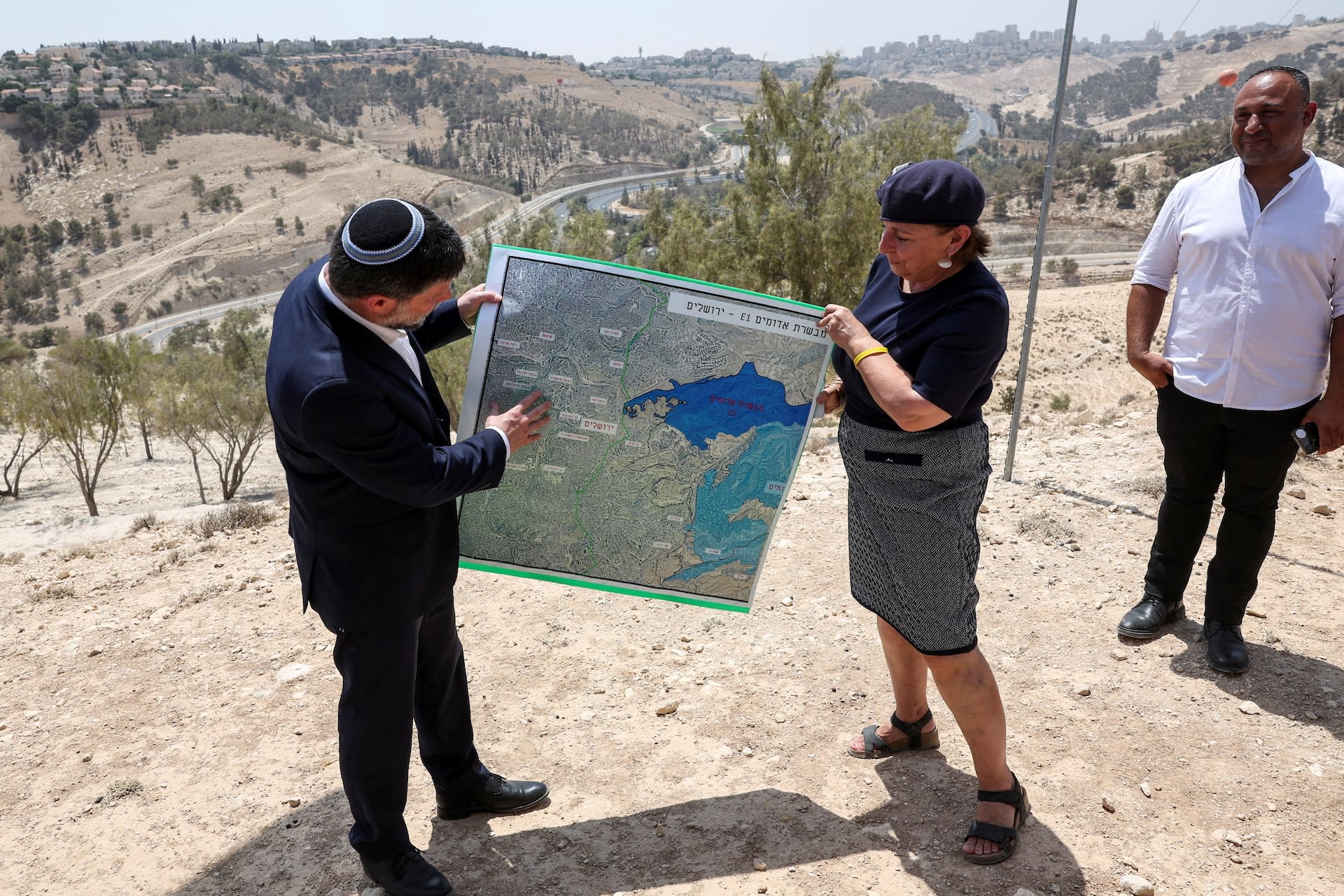
An Israeli official’s call yesterday to annex the West Bank prompted public rebuke from the United Arab Emirates (UAE), which normalized ties with Israel in 2020. Finance Minister Bezalel Smotrich said most of the territory should be annexed in the latest effort to block the possibility of a Palestinian state. His threat came after a string of countries have announced plans to recognize a Palestinian state at this month’s UN General Assembly.
The latest on the West Bank.
- The UAE’s condition for signing the Abraham Accords to normalize ties with Israel was that Israel suspend plans to annex parts of the West Bank. Israeli officials say that commitment has expired.
- Senior Emirati official Lana Nusseibeh said yesterday that annexation was a “red line” that would “severely undermine” the Abraham Accords’ regional integration vision—a hallmark of President Donald Trump’s first-term Middle East policy.
- Israeli Prime Minister Benjamin Netanyahu and the U.S. government did not immediately comment on Smotrich’s proposal.
The latest on Gaza. Many of the countries that pledged to recognize a Palestinian state have done so in an effort to pressure Israel to end the war in Gaza. On that front…
- Hamas said yesterday that it was ready for a comprehensive deal to end the war and release all Israeli hostages.
- Netanyahu called that statement “another spin by Hamas” and said the war would only end if, in addition to the hostage release, Hamas and Gaza were demilitarized, Israel established security control over the enclave, and an alternative civilian administration were established.
- Israel’s military has moved forward with plans to occupy Gaza City, which Netanyahu casts as part of the process of taking over the entirety of the territory.
- A Palestinian-American activist who has been mediating between Hamas and the Trump administration said yesterday that a comprehensive U.S. proposal to end the war in Gaza and free all hostages is on the table.
“[Israel] will either need to make a sincere bid for compromise and peaceful coexistence with the Palestinians or risk losing the international support that its long-term well-being requires. Although the two-state solution has become anathema to many Israelis, it remains the best hope for their prosperity and security.”
—CFR President Emeritus Richard Haass, Foreign Affairs
Across the Globe
Incumbent victory in Guyana… The ruling People’s Progressive Party/Civic more than doubled the vote count of its nearest rival in Monday’s general election, according to preliminary results from yesterday. A party founded by a businessman only three months ago, called We Invest in Nationhood (WIN), came in second place. WIN argued that it would better distribute Guyana’s oil revenues as it experiences an offshore drilling boom.
…and in Jamaica. Prime Minister Andrew Holness declared victory after a partial count of yesterday’s elections showed his Jamaica Labour Party winning thirty-four of the sixty-three parliamentary seats that were up for grabs. It will be the country’s third consecutive Labour government. This year, the government has presided over one of Jamaica’s biggest reductions in homicides in decades.
Cuts to UN peacekeeping. Trump’s announcement last week of plans to trim $800 million from congressional funds destined for UN peacekeeping through 2025 puts operations at risk in areas such as South Sudan and the Democratic Republic of Congo, a UN peacekeeping spokesperson said. The United States currently accounts for nearly 27 percent of the UN peacekeeping budget.
TPS curtailed for Venezuelans. The Trump administration is revoking a deportation shield for almost 270,000 Venezuelans who were granted Temporary Protected Status (TPS) under a program that began in 2021. TPS can apply to people fleeing hardship and political crisis. A U.S. Citizenship and Immigration Services spokesperson said the program acts as an incentive for irregular migration.
Shifting cotton exports. U.S. cotton exports to China fell 90 percent year-on-year during the first six months of 2025, but rose to countries such as Pakistan, Turkey, and Vietnam. Exports to Vietnam nearly tripled. Trump has hiked and then paused tariffs on Chinese goods during that time, leaving trade partners uncertain about where the final rate will land.
Seoul eyes CPTPP. South Korea will consider joining the Comprehensive and Progressive Agreement for Trans-Pacific Partnership (CPTPP) trade agreement in response to U.S. tariffs, government economic officials said. Seoul has weighed joining the twelve-nation group in the past, but it was reluctant to drop its own tariffs and dissuaded by longtime tensions with member state Japan.
Trump on troops in Poland. While the United States is considering pulling back troops stationed in other countries, it will not do so for troops in Poland, Trump told Polish President Karol Nawrocki at the White House yesterday. Poland spends almost 5 percent of GDP on defense, one of the highest levels in NATO. Nawrocki is a nationalist rival of his country’s pro-European prime minister, Donald Tusk; Trump asked for Nawrocki rather than Tusk to represent Poland on a recent call.
India-Singapore ties. The countries signed pledges to cooperate yesterday in shipping, civil aviation, and industrial job training. At a New Delhi meeting, Indian Prime Minister Narendra Modi and Singaporean Prime Minister Lawrence Wong said they aim to jointly boost the artificial intelligence and semiconductor sectors in both countries. Last year, they inked a comprehensive partnership agreement.
What’s Next
- Today, European countries are meeting in Paris about security guarantees for Ukraine.
- Today, the Toronto International Film Festival begins.
- Today, Israeli President Isaac Herzog meets Pope Leo at the Vatican.
- Today, U.S. Secretary of State Marco Rubio visits Ecuador.
- Tomorrow, Australia and Japan hold a meeting of senior security officials in Tokyo.