China and Climate: January 2026
The China and Climate primer series tracks and breaks down China’s engagement with climate and energy issues around the world. January coverage focused on a series of bilateral climate agreements, Chinese oil majors’ response to the U.S. capture of Venezuelan President Nicolás Maduro, and China’s participation in the World Economic Forum’s annual meeting.
By experts and staff
- Published
- Research Associate, Climate and Energy
- Research Associate, Climate Change Policy
China, a Global Clean Energy Partner
Upheaval of the international order carries implications for the global climate and energy landscape. January brought a wave of state visits to China by leaders who sought to not only strengthen trade ties but also deepen cooperation on clean energy.
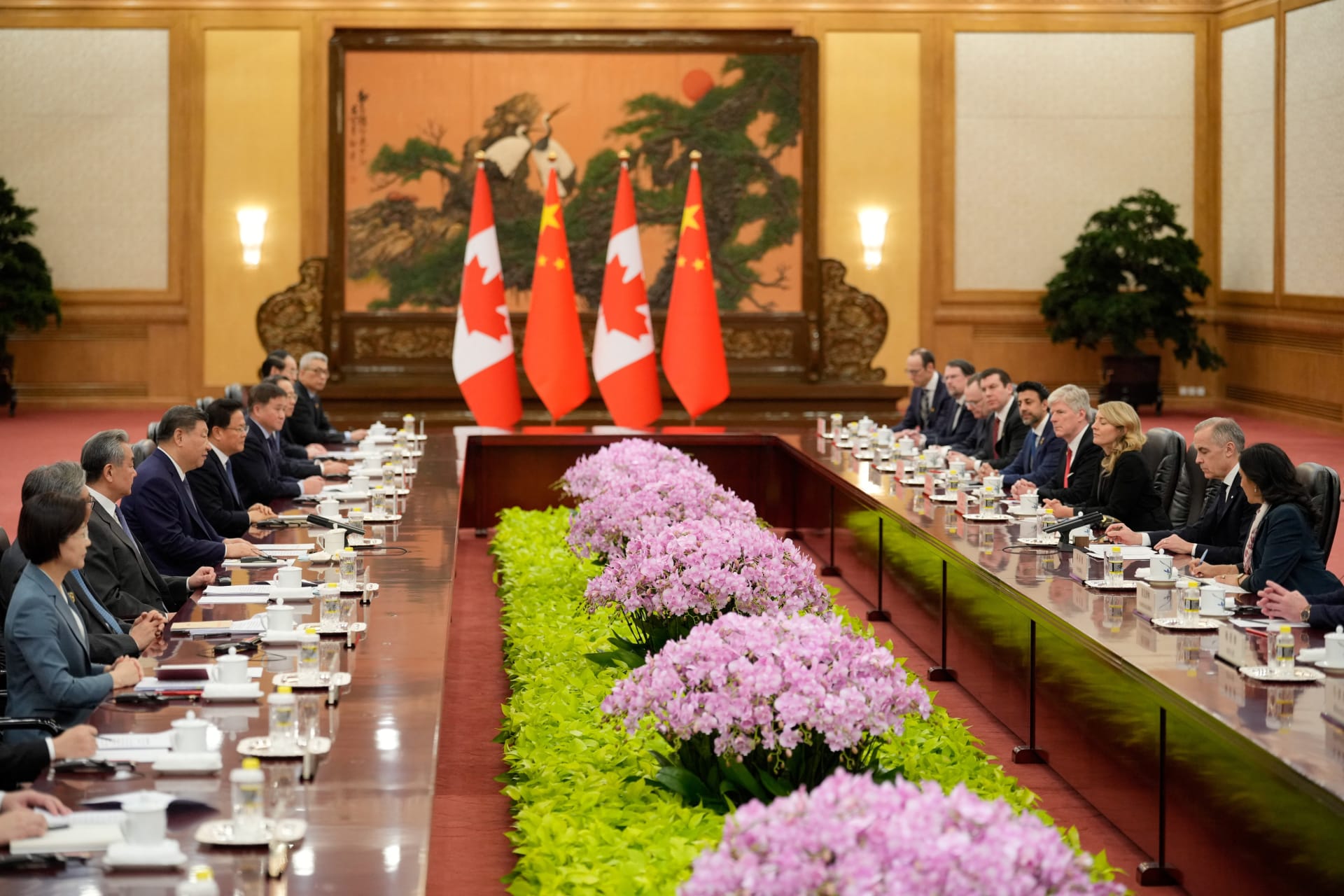
The visit from Canadian Prime Minister Mark Carney, which captured headlines and the ire of U.S. President Donald Trump, resulted in an agreement to allow forty-nine thousand Chinese electric vehicles (EVs) annually into Canada at a significantly marked-down tariff. British Prime Minister Kier Starmer visited later in the month, bringing a thawing of China-UK relations and strengthening cooperation on clean energy. Starmer was the first British prime minister to visit China in eight years, while a Canadian prime minster had not visited the country since 2017. Those gestures signal a seismic shift by two of the United States’ closest allies toward greater involvement with China.
Other American allies made the trip too. South Korean President Lee Jay-myung traveled to China, signing a number of agreements to strengthen areas of cooperation between the two countries, including on climate and energy. Also making the journey to Beijing in January were Irish Taoiseach Micheál Martin and Finnish Prime Minister Petteri Orpo, and both leaders’ visits included their respective countries’ interest in deepening clean energy cooperation. The opportunity for clean energy investment is one element of the diplomatic pull toward China, or wedge driving countries away from the United States, depending on one’s point of view.
Regardless of the framing, underlying China’s diplomatic engagement is its dominant status in the global clean energy market. China’s EV exports surged in 2025, reaching 150 countries and territories with 2.6 million units and generating a record $69.6 billion, according to Reuters. And Chinese clean energy exports, such as solar panel equipment, also hit new records in 2025. Clean energy is increasingly embedded in China’s global engagement, becoming a feature of the country’s strategic position as a ballast against international tumult.
Chinese Oil Firms Show Concerns After U.S. Actions in Venezuela
Following the Trump administration’s removal of Maduro and subsequent seizure of Venezuelan oil assets, public attention turned to China, as its oil firms assessed risks and sought to protect their investments.
China joined other nations in criticizing U.S. intervention, while its oil majors voiced concerns over their investments. The companies sought advice from government agencies on protecting their claims to oil reserves and limiting their investment risks. Although Chinese firms have dramatically reduced their investments in Venezuela since Maduro’s rise to power, their stakes remain significant, with Venezuela still owing billions of dollars.
China became a major partner for Venezuela in 2007 under former Venezuelan President Hugo Chávez. Experts estimate that, between 2007 and 2015, China lent close to $60 billion to Venezuela for infrastructure and energy projects. But trade between the two countries peaked in 2012; by 2025, Chinese imports from Venezuela had fallen to just 8 percent of that level.
Nonetheless, China remains the largest purchaser of Venezuelan crude oil and its biggest creditor. In addition, China is the largest importer of crude oil globally, and 20 percent of those imports come from countries under sanctions from the United States. Although crude oil from Venezuela only accounted for 4 percent of China’s imports in 2025, the U.S. administration’s actions could signal further instability in Chinese crude oil imports moving forward.
Davos 2026
At the 2026 World Economic Forum Annual Meeting in Davos, Switzerland, Trump’s speech questioned whether China uses any of the wind power it builds. In response to a question about the U.S. president’s remarks at a press conference, a Chinese foreign ministry spokesperson defended China’s wind energy use. In calibrated and starkly dissimilar remarks from those of Trump, He Lifeng, Beijing’s representative at Davos, drew attention to the fact that “China has put in place the world’s largest renewable energy system” and emphasized the country’s carbon neutrality goal. Indeed, China added an estimated 119 gigawatts (GW) of wind power in 2025.
China’s and India’s Coal Consumption Fell for the First Time in 2025
For the first time in fifty-two years, coal power generation decreased in both China and India in 2025. Analysis by Carbon Brief found that electricity generation from coal fell in China by 1.6 percent and in India by 3 percent. That simultaneous decline in coal power generation represents a potential shift in electricity generation as both countries continue to build solar and other clean energy sources at rapid rates. Despite the reduction in coal power generation, however, its coal production increased to 4.83 billion tons—a 1.2 percent increase from 2024. Similarly, approvals for new coal projects continued at a steady rate in 2025 [PDF]. That seeming contradiction reflects China’s conflicting priorities: further electrifying its power system without endangering its energy security.
More Nuclear Power on the Way
China announced the commissioning of Unit 2 of the Zhangzhou Nuclear Power Project. A statement by the China National Nuclear Corporation noted that, on completion, the Zhangzhou Nuclear Power Project will comprise six units, with each unit producing around 10 billion kilowatt-hours of electricity per year. According to the World Nuclear Association (WNA), China has 58 operable reactors and 33 reactors currently under construction. China’s fourteenth five-year plan establishes a target of around 150 new nuclear reactors and 200 GW of total capacity by 2035. But the WNA notes that China did not meet its intermediate goal—70 gigawatts of electricity (GWe) of nuclear capacity—by the end of 2025, and currently sits at around 62 GWe.
WTO Backs China’s Complaint on Inflation Reduction Act Tax Credits
On January 30, the World Trade Organization (WTO) supported a complaint by China calling for changes to several clean energy tax credits established under the Inflation Reduction Act (IRA). The WTO panel ruled that several clean energy tax credits violate international trade rules by favoring domestic manufacturing over imports. Though much of the IRA has already been significantly altered by the reconciliation bill the U.S. Congress passed in July 2025—which repealed or accelerated the phaseout of various consumer-facing tax credits—the WTO ruling specifically targets the remaining core manufacturing and investment credits. Although the Trump administration has repeatedly criticized the IRA, U.S. Trade Representative Jamieson Greer refuted the decision, stating that “the WTO report finds that the United States has broken WTO rules by defending industries that China unfairly targeted for global dominance, but does not say a word about the harms caused by China’s industrial policies and massive excess capacity.”