China in Europe: January 2026
In January 2026, several European leaders visited China to deepen ties with the world’s second-largest economy, China and the European Union began to resolve long-standing electric vehicle disputes, the European Commission proposed a new Cybersecurity Act to crack down on Chinese technology firms, and the European Parliament commissioned a report on Chinese transnational repression.
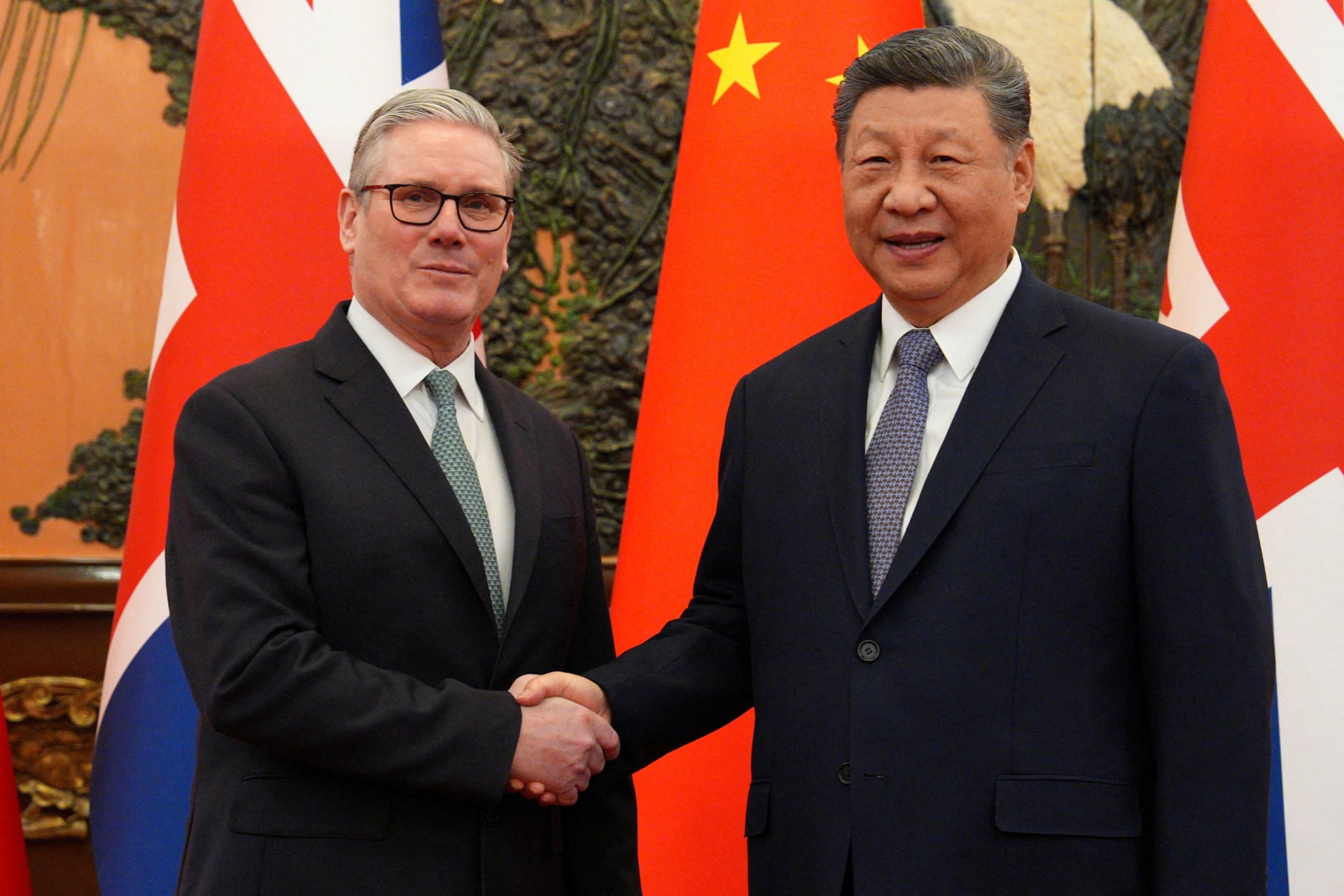
Starmer Visits China
Prime Minister Kier Starmer visited China from January 28 to 31 to reset relations and boost bilateral economic ties. Starmer’s visit to China was the first by a UK prime minister since 2018. He secured a “pragmatic reset,” entailing $2.2 billion in export deals and $2.3 billion in market access deals. Those agreements cover several strategic verticals, including artificial intelligence, car making, clean energy, finance, health care, and pharmaceuticals. Some notable deals include AstraZeneca pledging to invest $15 billion in China over the next four years, partnerships between Chinese and British energy firms to develop a digital platform for trading electricity, agreements to cut tariffs on goods such as whiskey, a deal with Hithium to invest millions into England for energy storage, and an agreement with Chinese automotive manufacturer Chery to open European headquarters in Liverpool, England. China is currently the UK’s third largest trading partner.
After signing the deals, both leaders made remarks on the state of China-UK relations and global trade. Starmer stressed urgency on reaching a visa agreement and further deepening ties in health care, green technology, and other important industries. Chinese President Xi Jinping echoed those points, adding the need to facilitate greater Chinese investment into the UK. Xi also used the opportunity to offer China as an alternative market to the United States and a critical upholder of the global trade order. The warm language used by both leaders is a departure from traditional bilateral relations in which the UK often echoes U.S. talking points on competition with China. U.S. President Donald Trump criticized the deal, to which Starmer replied that the United Kingdom would not “stick its head in the sand.”
Red tape and other bilateral tensions remain. For example, Starmer reportedly did not raise contentious issues such as the imprisonment of the Hong Kong democracy activist Jimmy Lai. The visit occurred against the backdrop of broader geopolitical strains between the two countries. Just a week earlier, Britain and China established a cyber dialogue forum to discuss cyberattacks; the forum aims to manage threats to each other’s national security following a spate of hacking accusations.
Starmer’s visit to China follows his trips to Indo-Pacific countries that are concerned about increased national security threats associated with China’s rise, most notably Japan and South Korea.
Several European Leaders Visit China
In addition to Starmer, several other European heads of state visited China in January. Finnish Prime Minister Petteri Orpo traveled there from January 24 to 29, where he met with Xi, Chinese Premier Li Qiang, and Chairman of the Standing Committee of the National People’s Congress Zhao Le. Orpo called on China to “work towards a lasting peace in Ukraine.” Earlier in the month, Ireland’s Taoiseach Micheál Martin met with Xi in China to expand bilateral economic cooperation in artificial intelligence, the digital economy, health care, and pharmaceuticals. Xi views Ireland as playing a pivotal role in expanding China-EU cooperation, as Ireland will hold EU presidency beginning in July.
Friedrich Mertz is expected to make his first trip to China as Germany’s chancellor in late February, accompanied by a large business delegation. Like the UK, Germany hopes to strike several trade and investment deals rooted in shared interests.
Brussels Introduces Cybersecurity Act
The European Union has introduced a proposal that would phase out Chinese-made telecommunications equipment from critical infrastructure over three years. The move targets some of China’s largest tech giants, including Huawei and ZTE, attempting to bar them from solar energy systems, telecommunications networks, and other critical infrastructure. EU officials cite the collection of sensitive data as the primary motivating factor behind the decision to enact that sweeping proposal and have pointed to the United States’ Huawei telecommunications ban as precedent for such a move.
As it stands, the existing regime restricting high-risk [PDF] vendors from EU networks is voluntary. The EU has an unevenly implemented adoption of Chinese technologies and, therefore, an unevenly implemented regime. Some countries, such as Greece and Spain, rely heavily on Chinese technology companies to deliver basic services. Others, such as Germany, do not. Brussels hopes to solve that asymmetry and unevenness by mandating restrictions across Europe. Regulators have already begun probes into several industries, including wind turbine makers and train manufacturers.
The proposed legislation will phase out telecommunications equipment from high-risk suppliers over the course of three years. While EU leaders have described the law as ensuring products are cyber-secure by design, China’s foreign ministry has criticized the move, calling it “political manipulation” and accusing Europe of dismissing the security and quality of Chinese tech products. China added that it would take “necessary measures” to protect Chinese firms against “blatant protectionism.”
China-EU Resolve EV Dispute
China and the EU took preliminary steps toward resolving disputes over Europe’s imports of Chinese electric vehicles (EVs). European regulators released a “guidance document” to instruct Chinese EV makers on pricing exports and establishing minimum EV import prices. The proposal is designed as an alternative to the existing EU tariffs of up to 35.5 percent on Chinese EV imports following a 2023-24 anti-subsidy investigation. Those tariffs were imposed to counter the rapid influx of Chinese EV models, which were priced well below market thanks to Chinese government subsidies, into European countries. Europe’s top carmakers complained that Chinese EVs were anticompetitive, and EU representatives stated that it was necessary to set minimum import prices to correctly offset the market-altering effect of Chinese subsidies. Chinese EV automakers have captured around 13 percent of Europe’s EV market despite tariff policies.
Both parties have praised the move. The China Chamber of Commerce to the EU said the plan would bring a “soft landing” in the EV standoff, one that has persisted since the takeoff of Chinese EVs in Europe. A statement from China’s Ministry of Commerce added, “This is conducive not only to ensuring the healthy development of China-EU economic and trade relations but also to safeguarding the rules-based international trade order.” For China, minimum prices will still allow brands to export to European markets while avoiding costly import tariffs, meaning that China’s main EV players will retain inroads that have contributed to their success. For Europe, the deal is equally important. The EU relies on Chinese EVs to meet climate goals, which include cutting greenhouse gas emissions by 55 percent by 2030. Moreover, Europe’s manufacturers rely on Chinese-made batteries, rare-earth materials, computer chips, and other imports necessary for clean energy products. EU countries consistently rank in the top ten of Chinese EV importers.
European regulators are also considering policy options on the future of Chinese EV manufacturers’ investments into European car markets.
China at Davos
Chinese Vice Premier He Lifeng gave a special address at the World Economic Forum in Davos, Switzerland, in which he encouraged multilateralism and pitched China as an alternative economic partner to the United States. Though he did not invoke European countries or Europe by name, many of the continent’s leaders echoed He’s speech and China’s pitch for deeper cooperation. French President Emmanuel Macron declared that “China is welcome, but what we need is more Chinese foreign direct investments in Europe, in some key sectors, to contribute to our growth, to transfer some technologies.”
Transnational Repression Report
The European Parliament commissioned a report on transnational repression after the Internation Consortium of Investigative Journalists investigated China’s campaign to silence overseas dissidents. The report proposes several policy recommendations for the European Union to combat cross-border coercion, including improved coordination, increased data collection, and strengthened communication between member states’ law enforcement agencies. It also calls for legal changes to expand and strengthen data protection in EU laws, including through the existing Digital Services Act, as well as countering visa bans and expelling diplomats, among other measures. Among the most aggressive proposals are ways to swiftly mobilize sanctions to punish efforts at transnational repression.
The study comes after Chinese officials attempted to pressure European countries to deny entry to Taiwanese politicians. In January, several Chinese officials reached out to their European counterparts to articulate “red lines” regarding how European leaders can engage with their Taiwanese counterparts.