DeepSeek V4 Signals a New Phase in the U.S.-China AI Rivalry
The latest Chinese model trails U.S. competitors on benchmarks. But it may not have to win the performance race to reshape the geopolitics of artificial intelligence.
By experts and staff
- Published
 Chris McGuireCFR ExpertSenior Fellow for China and Emerging Technologies
 Michael C. HorowitzCFR ExpertSenior Fellow for Technology and Innovation
 Jessica BrandtCFR ExpertSenior Fellow for Technology and National Security
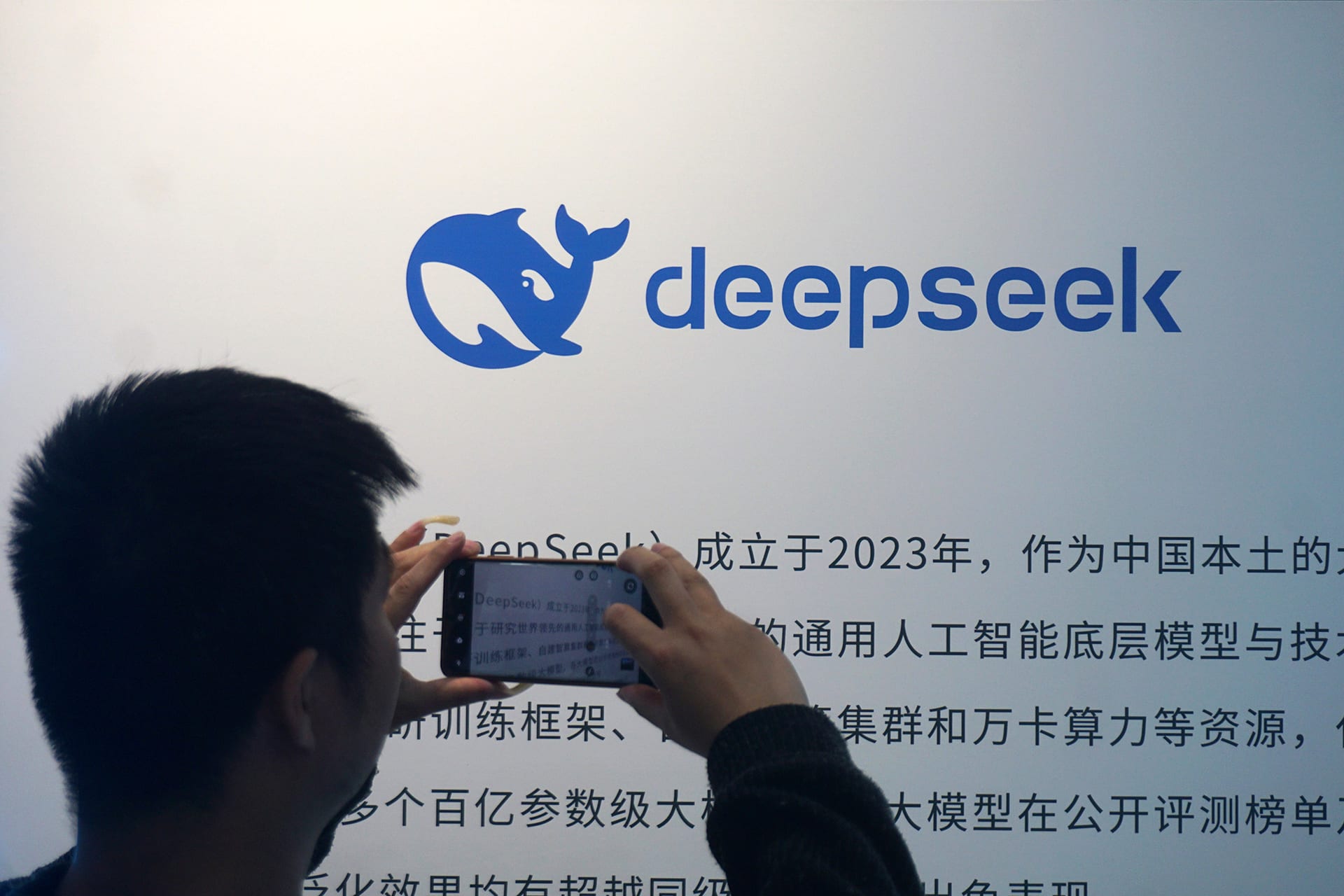
Chinese artificial intelligence (AI) startup DeepSeek released a version of its long-awaited V4 large language model on Friday. It’s the most significant update since the release of the version that rattled global tech markets more than a year ago. Like DeepSeek’s previous models, V4 is open source, meaning it is available for anyone to download, use, and modify. The company claims the new model rivals leading closed-source systems from American firms—like Anthropic’s Claude, OpenAI’s ChatGPT, and Google’s Gemini—on major benchmarks, while outperforming its rival open-source models.
The release has again trained attention on the intensifying U.S.-China AI competition. Adding to the tension, the White House’s science and technology office has accused foreign entities—primarily Chinese ones—of conducting large-scale efforts to extract knowledge from U.S. frontier AI models, a broadside widely seen as directed at DeepSeek.
Three CFR fellows assessed the new DeepSeek model and considered what it could mean for the U.S.-Chinese AI race.
Chris McGuire is a senior fellow for China and emerging technologies at the Council on Foreign Relations.
DeepSeek has released its long-awaited new model, DeepSeek V4—its first new-architecture model since the release of R1 in January 2025. Whereas R1 stoked alarm that China was catching up to the United States in AI, and even briefly tanked U.S. stock markets, V4 has produced a more muted reaction. This new DeepSeek model is not competitive with frontier U.S. models. And while it is likely the best available open-source option, it does not provide evidence that Chinese AI firms are shrinking the gap with the United States.
DeepSeek’s own technical paper concedes that V4’s reasoning and agentic capabilities are comparable to GPT-5.2, Gemini 3.0 Pro, and Claude Opus 4.5—models released roughly half a year ago. DeepSeek even explicitly acknowledges that V4 “trails state-of-the-art frontier models by approximately 3 to 6 months.” That gap is broadly consistent with estimates that the United States has roughly a seven-month lead over China. The actual gap may also be widening, as U.S. AI firms use AI to accelerate next-generation model development. The newest U.S. models announced in April—Anthropic’s Claude Mythos Preview and OpenAI’s GPT-5.5—both show significant performance gains over their predecessors.
DeepSeek V4 is likely the strongest Chinese model, but only narrowly. Moonshot’s Kimi K2.6 and Zhipu’s GLM 5.1 perform comparably on most public benchmarks, and DeepSeek’s pricing of V4 Pro is more expensive than either. The competitive gap within China is now much narrower than the gap between China and the United States.
The most novel feature of V4 is that it is optimized for inference on Huawei’s Ascend chips rather than Nvidia’s, reportedly at Beijing’s direction. But DeepSeek appears to still be extraordinarily dependent on U.S. technology:
- U.S. government officials have asserted that V4was still trained on smuggled Nvidia Blackwell chips, which are banned in China. It is notable that, unlike the V3 paper, the V4 report is silent on what chips it was trained on.
- The White House and all leading U.S. AI labs have accused Chinese AI firms, including DeepSeek, of training their models using data generated by illicit distillation attacks against U.S. models, which enable the replication of some of the capabilities of U.S. models at a fraction of the cost.
- And DeepSeek itself admits that it currently cannot serve its v4 pro model to most customers because it lacks the chips to do so.
The result is a model that is worse than leading U.S. models, more expensive than its Chinese competitors, and not able to be deployed at scale due to compute shortages.
V4 does contain real engineering achievements, particularly a hybrid attention architecture that enables a one-million-token context window at a fraction of V3’s inference compute cost. This indicates that Chinese AI labs are largely keeping pace with advancements in algorithmic efficiency that are also occurring in closed-source U.S. AI labs. And while DeepSeek V4 is more expensive than its Chinese competitors, it remains cheaper than comparable U.S. models.
However, DeepSeek’s low prices are likely also enabled by Chinese government subsidies (particularly given DeepSeek’s direct integration with Huawei), as well as DeepSeek’s aggressive use of distillation attacks against U.S. models, which saves it hundreds of millions or even billions of dollars in R&D costs. And crucially, DeepSeek’s current compute shortages render the pricing moot for the time being. If DeepSeek is unable to serve the model to large numbers of customers, its price is irrelevant.
U.S. strategy to constrain China’s access to AI compute has helped the United States obtain its current seven-month lead, but V4 shows China continues to exploit access to U.S. technology to produce capable, if not directly competitive, AI models. Closing loopholes in controls to fully restrict China’s access to U.S. AI chips, models, and chipmaking tools would allow the United States to open up a lead over China measured in years, not months.
Michael C. Horowitz is senior fellow for technology and innovation at the Council on Foreign Relations. He is also director of Perry World House and Richard Perry professor at the University of Pennsylvania.
When DeepSeek released its V4 model, the headlines predictably focused on whether it had closed the gap with American frontier models. They haven’t: U.S. models remain ahead—but that’s the wrong question. Understanding what V4 reveals about the AI competition requires asking a different one: who is winning the most important U.S.-China competition, the adoption race?
On raw performance, V4 is impressive but still trails the American frontier. DeepSeek claims that V4-Pro beats every other open-weight model, but says it falls short of OpenAI’s GPT-5.4 and Google’s Gemini 3.1-Pro. That gap matters, but it does not tell the whole story.
Here is what does: V4 is open source, large in scale—the Pro version has 1.6 trillion parameters—and priced for mass deployment at least four times cheaper than American competitors. When it comes to converting AI technology into global power, whether economic value for companies or military power for countries over time, success will not just be about having the best-performing models. It requires good-enough solutions that can be deployed quickly and at scale, and organizations need to be able to adapt quickly.
Second-best models carry enormous competitive value when they are cheap and open, which makes them easy to widely diffuse. This is particularly true in the Global South, where countries are not choosing between GPT-5 and Claude Sonnet 4.6 but between accessible tools with different values baked in. Chinese AI models already have more downloads on Hugging Face, the open-source AI platform, than those from the United States. That is the adoption competition in action.
What DeepSeek and others call “open source” also does not mean it comes completely clean and without other potential costs. DeepSeek likely trained V4 on smuggled Nvidia Blackwell chips, still banned from export to China under U.S. Commerce Department rules. Separately, Anthropic and OpenAI have alleged that DeepSeek engaged in “industrial-scale” distillation attacks on its Claude models, creating over twenty-four thousand fake accounts and conducting more than sixteen million interactions to extract capabilities and improve its own systems. This is an enormous Chinese intellectual property theft of American technology that the Trump administration just called out last week and says it intends to address.
The reaction to today’s release will not approach last winter’s DeepSeek moment—when concern grew that China could inexpensively surpass Western models—but it does show that the frontier is not the only front in the AI competition. The country that deploys AI fastest across its economy and government will shape the character of the AI era. The United States is still ahead. It cannot afford to assume that advantage is self-sustaining.
Jessica Brandt is a senior fellow for technology and national security at the Council on Foreign Relations
DeepSeek V4 is undoubtedly a capable model, though it appears to be an incremental advance over other Chinese offerings rather than a competitive challenge to the U.S. frontier. Its performance is consistent with previous expert estimates of the gap between U.S. and Chinese models: the United States remains about seven months ahead.
But China has shown it will go to great lengths to close that gap. The model was released a day after the White House formally accused [PDF] Chinese actors of running industrial-scale campaigns to extract capabilities from U.S. frontier models. Leading U.S. tech companies—Anthropic, Google, and OpenAI—have made the same accusation in recent months. In other words, V4’s capabilities reflect, at least in part, access to illicitly obtained U.S. intellectual property.
The Trump administration said it would explore measures to hold threat actors accountable for industrial-scale distillation campaigns. That’s important, since the entities currently engaging in this behavior face few meaningful consequences for doing so, and the U.S. firms targeted by these attacks can’t go on offense alone.
Some actions to consider:
- Exploring sanctions against firms engaged in distillation attacks. Cutting off their access to U.S. financial markets and dollar transactions would impose real costs on behavior that currently carries none.
- Adding those firms to the Department of Commerce’s trade restriction Entity List, which would put the broader AI supply chain—cloud providers, chip vendors, and equipment suppliers—on notice that doing business with them invites regulatory exposure.
- Multilateralizing pressure on Chinese labs by building consensus that distillation is a form of industrial espionage. Last week, the State Department issued a global directive instructing diplomatic staff to engage foreign counterparts on the threat—a worthwhile first step.
All of this should complement defensive measures, such as sharing threat intelligence with U.S. firms and removing impediments to industry collaboration.
DeepSeek V4 is a reminder that in the race to develop the most advanced capabilities, the United States is ahead, but China is not far behind. As part of its strategy to widen that lead, the United States should go on offense against adversarial distillation. The administration’s announcement suggests there is appetite to do so. Whether that translates into meaningful action is the question worth watching.
This work represents the views and opinions solely of the authors. The Council on Foreign Relations is an independent, nonpartisan membership organization, think tank, and publisher, and takes no institutional positions on matters of policy.