George Kennan and the Long Telegram
A U.S. diplomat’s warning about the Soviet Union’s grand strategy helped produce the strategy of containment that won the Cold War.
By experts and staff
- Published
 James M. LindsayCFR ExpertMary and David Boies Distinguished Senior Fellow in U.S. Foreign Policy
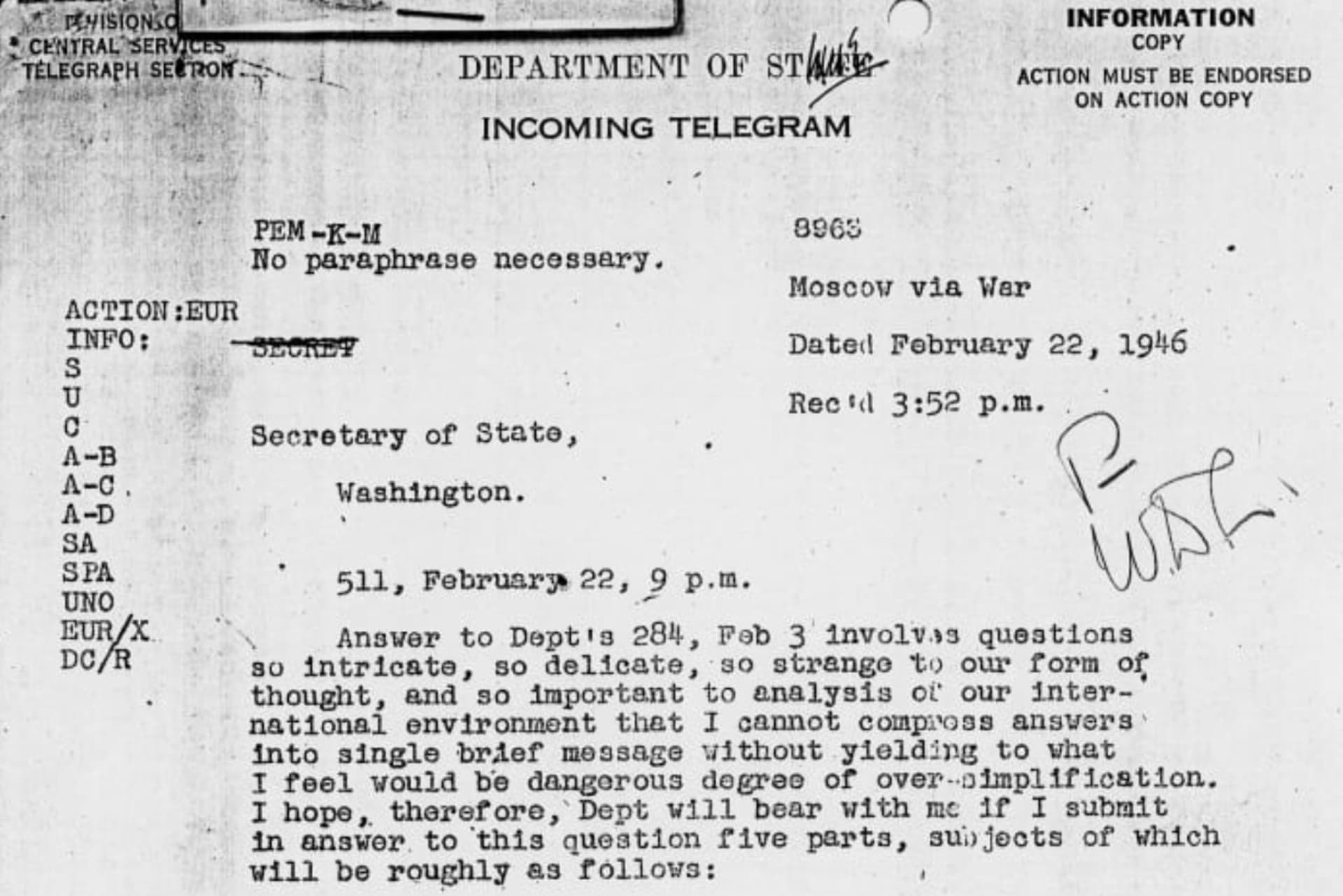
U.S. Foreign service officers posted to embassies and consulates around the world send cables to Washington every day. Much of what they write is forgotten even before it reaches the State Department. Some cables gain notoriety when they are leaked to the public. Very few change the course of history. But the cable that George F. Kennan sent from Moscow to his State Department superiors on February 22, 1946, did just that.
The Question
Hopes in the United States for a lasting peace were high during the winter of 1945-46. World War II had ended with the defeat of Japan and Nazi Germany. Many Americans expected that Washington would build on the relationship with its wartime ally, the Soviet Union. They shared the conclusion that Gen. Dwight D. Eisenhower reached visiting Moscow in 1945: “Nothing guides Russian policy so much as a desire for friendship with the United States.” But by late fall 1945, the alliance began to unravel as Moscow pushed to carve out a sphere of influence in the Balkans, a prelude to what would become Soviet domination of Eastern Europe. Then on February 9, 1946, Soviet leader Joseph Stalin gave a fiery speech in which he spoke of the wartime alliance as a thing of the past and called for the Soviet Union to begin a rapid military-industrial buildup.
Coming as it did just six months after World War II ended, Stalin’s speech alarmed U.S. officials. The State Department turned to Kennan, its foremost Soviet expert and chargé d’affaires at the U.S. embassy in Moscow, for an explanation. The then-forty-two-year-old Kennan, a career foreign service officer, wired back a 5,000-word reply—the Long Telegram.
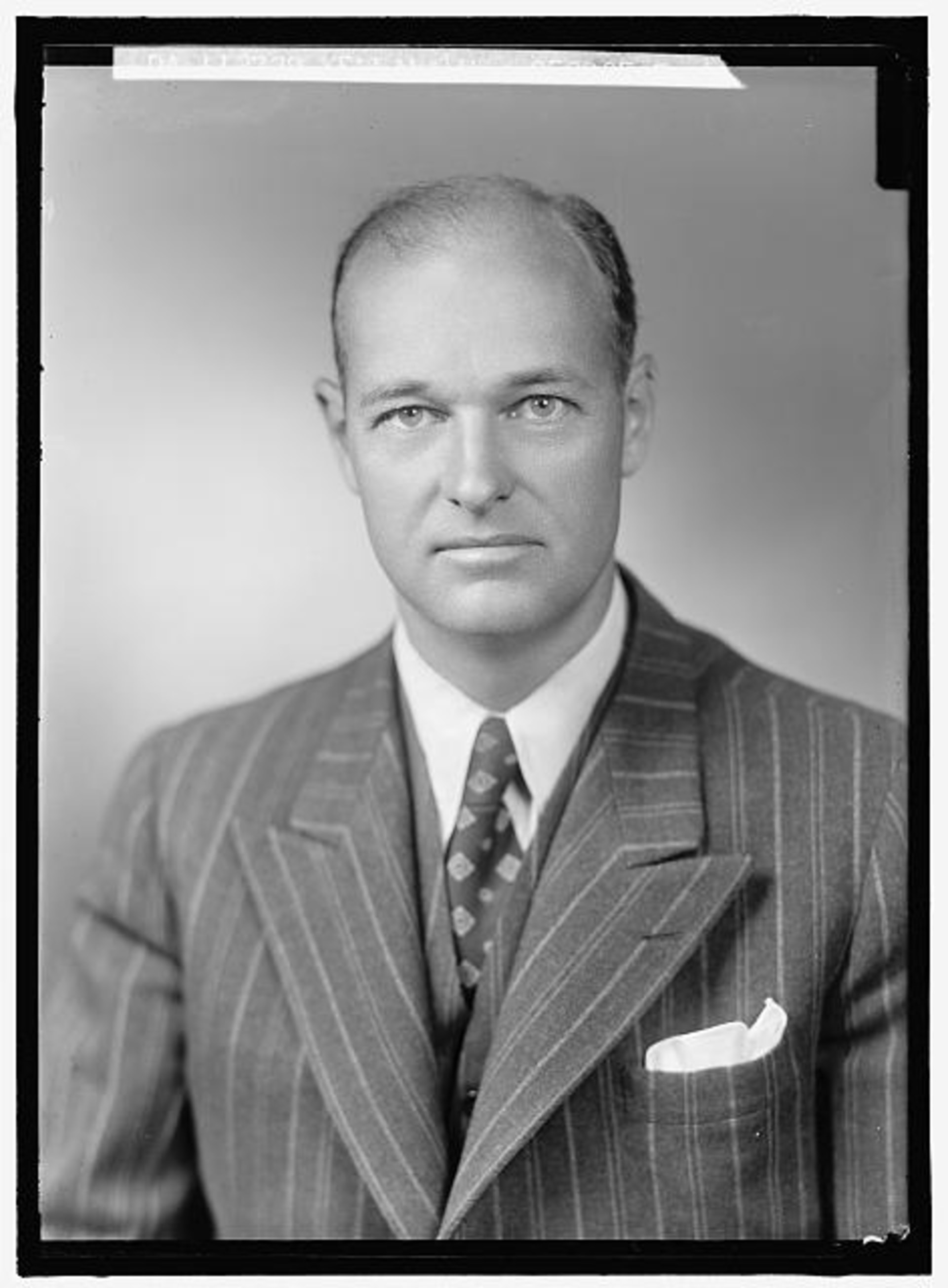
Kennan argued that U.S. policy toward the Soviet Union rested on an erroneous assumption: that Washington could influence Soviet actions by offering economic and diplomatic incentives to encourage better behavior. To the contrary, powerful and irresistible internal dynamics drove Moscow’s behavior. The Soviets were:
committed fanatically to the belief that with US there can be no permanent modus vivendi, that it is desirable and necessary that the internal harmony of our society be disrupted, our traditional way of life be destroyed, the international authority of our state be broken, if Soviet power is to be secure.
As a result, Soviet power was:
impervious to logic of reason, and it is highly sensitive to logic of force. For this reason it can easily withdraw—and usually does when strong resistance is encountered at any point. Thus, if the adversary has sufficient force and makes clear his readiness to use it, he rarely has to do so.
The good news, if it can be called that, in Kennan’s cable was that “gauged against the Western World as a whole, Soviets are still by far the weaker force.”
The “X” Article
Kennan’s argument may never have reached the broader world if not for his decision to speak at a private meeting at the Council on Foreign Relations (CFR) in January 1947 after his return to the United States. One of the attendees was impressed by his remarks and urged the editor of Foreign Affairs, which then as now was published by CFR, to commission Kennan to write an article.
“The Sources of Soviet Conduct” was published in the July 1947 issue of Foreign Affairs. Authorship was attributed to “X” because Kennan remained a State Department employee, and it was deemed unwise that he should write under his own name. The “X article” ran even longer than the Long Telegram, but Kennan’s argument remained the same even as he now introduced a single word—containment—to summarize it:
the main element of any United States policy toward the Soviet Union must be that of a long-term, patient but firm and vigilant containment of Russian expansive tendencies.
Kennan remained confident that “Russia, as opposed to the western world in general, is still by far the weaker party.” For that reason, he was confident that the United States could pursue “with reasonable confidence . . . a policy of firm containment, designed to confront the Russians with unalterable counterforce at every point where they show signs of encroaching upon the interest of a peaceful and stable world.”
Kennan cautioned, however, that U.S. policy should be “by no means limited to holding the line and hoping for the best.” Rather, U.S. success in its geopolitical competition with the Soviet Union would also depend on:
the degree to which the United States can create among the peoples of the world generally the impression of a country which knows what it wants, which is coping successfully with the problems of its internal life and with the responsibilities of a world power, and which has a spiritual vitality capable of holding its own among the major ideological currents of the time. To the extent that such an impression can be created and maintained, the aims of Russian Communism must appear sterile and quixotic, the hopes and enthusiasm of Moscow’s supporters must wane, and added strain must be imposed on the Kremlin’s foreign policies.
In short, maximizing the chances of successfully containing the Soviet Union required more than just amassing military might.
A Lasting Impact
Kennan’s argument that the United States should seek to contain rather than either appease or roll back the Soviet Union got noticed. As an official CFR history, later summarized it:
Perhaps no single essay of the twentieth century can match the X article for its impact upon the intellectual curiosity of a confused nation, upon the mindset of equally confused policymakers and scholars, upon national policy in at least seven presidential administrations to come. It ran only 17 pages; its tone was scholarly, elegant but practical; only three sentences used the magic word that came to define American policy for half a century.
The doctrine of containment would guide U.S. foreign policy for the next four decades. When the Soviet Union landed on the ash heap of history in 1991, foreign policy scholars across the ideological spectrum vied to win the Kennan sweepstakes and name the foreign policy era that succeeded containment. So far no one has claimed the crown.
Kennan, however, was never enamored with how his intellectual handiwork was implemented. He believed that the Truman administration gave containment a more belligerent and militaristic twist than he had intended. He found himself increasingly marginalized within the State Department, and he left the Foreign Service in 1950. He spent most of the rest of his life at the Institute for Advanced Study at Princeton, writing elegantly though critically about U.S. foreign policy. He died in 2005 at the age of 101. He had provided the defining term of his era. But he always thought he was out of place, once describing himself as a “guest of one’s time and not a member of its household.”
The United States celebrates its 250th anniversary in 2026. To mark that milestone, I am resurfacing essays I have written over the years about major events in U.S. foreign policy. A version of this essay was published on February 22, 2012.
Oscar Berry assisted in the preparation of this post.