How I Got My Career in Foreign Policy: Liana Fix
Liana Fix has always been fascinated by history. She took that intellectual curiosity and turned it into a career that has since influenced European politics—from both sides of the Atlantic.
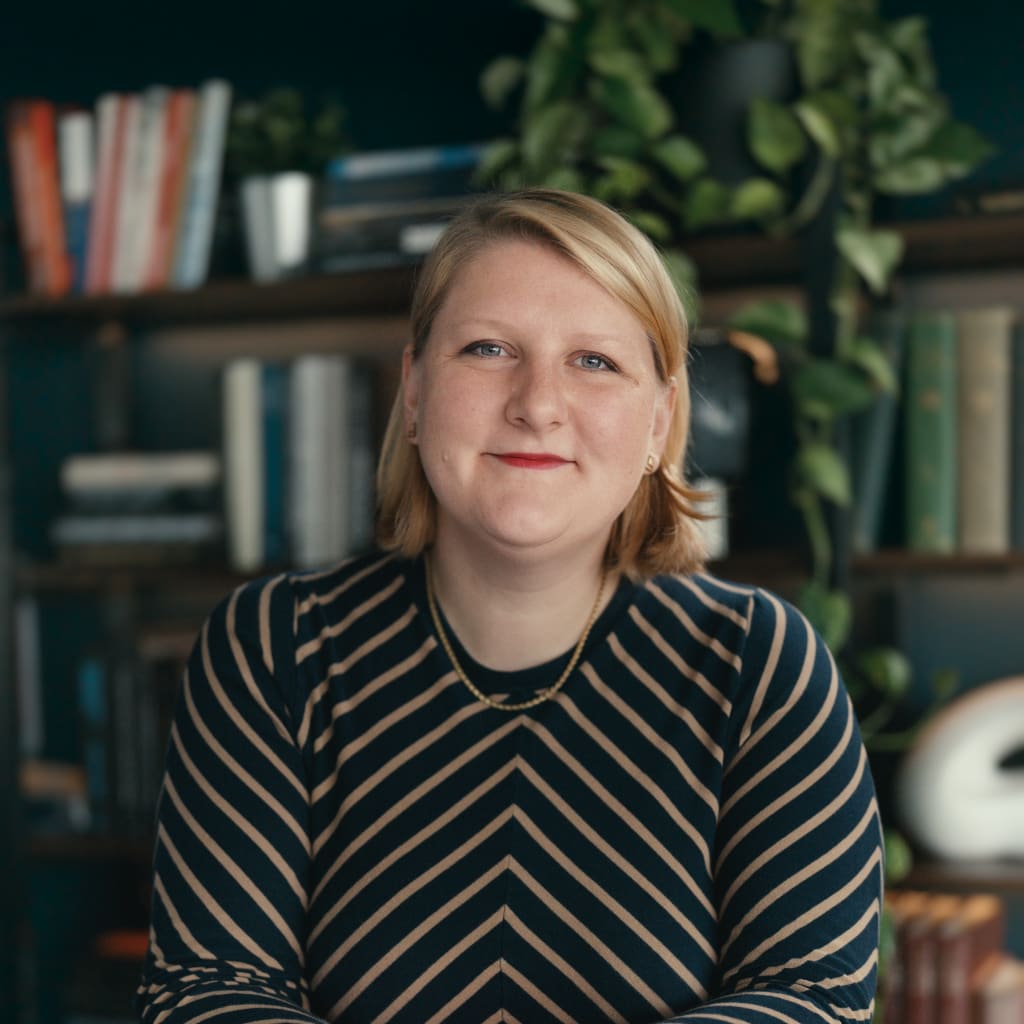
For much of her life, people tried to dissuade Liana Fix from focusing on the things she was most interested in. Scholars in her native Germany maintained that understanding war was not a worthwhile endeavor in a pacifist country, while others told her that specializing in Russia would be impractical. As Fix’s career took her all over Eastern Europe, and then to the United States at the outbreak of the Russia-Ukraine war, she found that the narratives she was told back home couldn’t be further from reality. Now a senior fellow for Europe at CFR, read about how Fix’s days in Moscow shape her work today, why she thinks believing in yourself is the most important foundation for success, and how one of her articles earned her a seat at the dinner table with Germany’s leader.
Here’s how Liana Fix got her career in foreign policy. If you’re interested in this series, check out more editions here.
What did you want to be when you were little?
I didn’t have a clear idea what I wanted to be, but I loved reading books. I would go to the local library and get ten, twelve books per week. As I grew older, I began to love reading history books, which gave me a little direction of what I wanted to study.
My family is also heavily influenced by history. My father’s side are Germans who immigrated to Russia under Catherine the Great in the eighteenth century, and my mother’s side was Ukrainian, Polish, and had a long history of deportation in the Soviet Union. That history was always something that my family, especially my father, was interested in. I continued down that path and studied history later in university.
You stayed in academia after university, too. How did your master’s and PhD inform what you wanted to do after that?
I was initially studying history, and I quickly realized that, although it’s super fascinating, there was not a lot of real-world application to history. History is always part of the context, but it is not where politics is being made, and I was growing more and more interested in political science.
At that time, Germany was actually a difficult place to study what I was interested in. I wanted to explore questions about war and grand strategy, and these were topics that Germany, because of its history, did not study in the way other countries were. In Germany, you could study peace and conflict studies or global governance studies, but not war.
That’s why I went to London, because the British tradition of thinking about war, strategy, and history is just different. I did some internships and knew I wanted to be somewhere between history and political science, but I still had no idea what that would be. I knew what a journalist was, I knew what a professor was, and I knew what a diplomat was. Those were the three models that I had in mind, but I didn’t know what a think tanker was, which is exactly the in-between role that I was looking for at that time.
As you progressed in your studies, was there a particular topic or moment that solidified your interest in Eastern Europe aside from your family background?
I was always drawn to the study of the Soviet Union. In 2010 or 2011, I distinctly remember being asked, “Why would you want to study Russia? You should focus on the relevant issues of foreign policy.”
Oh, little did they know.
Exactly. The takeaway from that conversation now is that you just have to follow your passion, because the advice that people give you and the topics that are of interest today might not be the topics that will be of interest in ten years. So I just continued, because I was really not interested in other areas. As we all know, Russia did become more influential in world politics later. Then I was happy that I was not dissuaded from studying and working on the topics that I actually loved and cared about.
Being from Germany, and having a fascination with Russia, why did you decide to come to the United States?
I was always fascinated by the United States. During my PhD, I had the chance to do a fellowship in Washington, DC, in 2015, and since then, I’d always been drawn back to the United States because I felt that the intellectual debate and expertise here on the topics I was interested in was unrivaled.
The U.S. approach to studying questions of war and peace was a very actionable approach. The question was always, “What can you do about the problem that you have at hand?” Whereas my experience working and studying in Europe reflected the perspective in European research institutes—a little bit more academically asking, “What is the problem? How can we understand it?” I liked the actionable approach and the revolving-door policy in Washington that had administration officials coming out from the government, going to think tanks, and back again.
From then on, I always came back for visits to the United States, especially to Washington, DC, and I even flirted with the idea of becoming a diplomat. It’s such a fantastic job, you can actually affect policy because you get to negotiate at the table. But you have less freedom to say what you want, because you always have to present your government’s positions. You can’t be as outspoken as you can at a think tank. That made the difference for me.
Aside from DC, where you’ve landed today, you’ve lived and worked all around Europe, including in Berlin, London, Moscow, Tbilisi, and Tours. How has spending a significant amount of time in these places shaped your view of global issues?
Whenever I lived somewhere, I always tried to learn the language, at least a little bit. The most challenging was probably in Georgia and the South Caucasus, because Georgian is a very old, unique language, almost incomparable to any other language in the world. But I felt this gave me a connection to whatever country I was in. Being able to glance over a newspaper article and understand the broad strokes of what was on the page, for example, really helped to connect deeply with a place and see the world from the perspective of its people.
Later, when many of these places, especially Moscow, became difficult to access after the war in Ukraine started, it helped tremendously to understand what life is like in these cities, and to know people on a personal level who have nothing to do with foreign policy and understand how world politics, war, and peace affect their personal lives. Being able to immerse yourself in a different country’s day-to-day life and language really helps get a better understanding of the ideas that a country has about itself and its role in the world.
Beyond working in different countries, you worked in the German Federal Foreign Office, in the European Union (EU) delegation, and various nonprofit institutes, so you’ve had multiple working lenses to think about these issues.
Yeah, exactly. The EU delegation in Georgia and German Federal Foreign Office roles were both part of a fellowship that I did. It was incredibly helpful to get to know both institutions, how the people function and how they work, and how the logic is different from the think tank world, academia, or journalism. I always admire the dedication and patience of diplomats in these institutions. They always told us: “You need to prepare for the marathon. Nothing is a sprint in diplomacy and international relations.” That was such a good lesson; diplomatic relations and diplomacy work in a slow, grinding way. I never had enough patience for that.
Sometimes, in this field, you have these rare opportunities where you feel like history is being made in the moment. For example, when I was in Moscow in 2013, there were protests against the imprisonment of Russian activist Alexei Navalny. Thousands of people were walking by the street of my office in Moscow. And sometimes, you were part of a historic moment that you didn’t realize was significant until later. I once took part in a meeting between German Chancellor Angela Merkel, Russian President Vladimir Putin, and former Soviet leader Mikhail Gorbachev. This kind of moment, where these leaders would sit together and talk, is unimaginable these days. In hindsight, I appreciate that a lot about the opportunities that I had.
Wow, there must be many formative stories from your time in Europe. How does being here at CFR, based in DC, affect your view of working on issues close to your other home?
I have had an immense learning curve since I started working in the United States and for the Council, in large part because my move here coincided with Russia’s invasion of Ukraine. The war ushered everyone into a new era where security played a much bigger role. I was thrown into the deep end on everything security-related, from nuclear blackmailing to conventional warfare—which again, are not topics that you could study in much depth in Germany; even now, it is still very much wedded to a pacifist identity.
The United States always had a stronger tradition in strategy, defense, and warfare studies, and an incredible culture of academic research. That’s certainly something that I have benefited from. In my first book, based on my PhD, I was still very much focused on strategy documents being developed within the EU. In my second book, which will come out this year, I’m much more heavily leaning on the security and defense side, and I think that is the influence of being here in the United States, but also of world politics having changed in the last few years.
Can you give us a sneak peek at what the new book is going to be focused on?
The book is called Germany Rearmed: The Return of War and the End of Illusions. The idea of this book is to look at Germany’s post-1945 history and its relationship with military power. The argument that I make is that Germany has never been really pacifist, but it just loves to think about itself as a pacifist country.
Russia’s invasion of Ukraine and the election of U.S. President Donald Trump has led Germany to question this pacifist identity and to return to military power—this time, not to threaten Europe, but to defend it. That, I think, is such a fascinating transformation of the country that really shows, in a nutshell, how the world and geopolitics have changed. Even Germany, the country embedded in the heart of Europe that wanted to leave military power behind, now feels it is necessary to rearm and reinvest in defense.
What advice would you give students hoping to enter foreign policy or think-tank work?
There’s a specific German saying, “courage before king’s thrones.” That is a German idiom that basically says, don’t be afraid to speak out about your thoughts and your ideas. I think that is such good advice for young professionals too, because sometimes you might think, “How can I write or think of something original?” Or even, “My ideas can just not compete with senior people.”
My experience so far has always been to trust in your own ideas. Ask for advice, but trust in your own ideas, trust in your own originality. You don’t need to have had a fifty-year career before you can say something that is courageous, criticize someone else’s position, or look at things in a new way. This way of thinking is important—especially in an era of artificial intelligence, where thoughts that are already out there and the internet can easily be reproduced. It is all the more essential to have confidence in your voice.
What’s one story that stands out from all your work trips and meetings around the world?
Well, the Financial Times has scooped you on that question, because they just published a big read on Germany’s rearmament opening with a story that involves me. I’d written a piece for Foreign Affairs magazine earlier this year about the perils of German power, looking at what kind of risks and downsides are associated with Germany’s rearmament, and why Germany needs to embed its power in Europe.
That piece was read by German Chancellor Friedrich Merz. A month after I published it, I got an invitation in DC to meet Merz for dinner and discuss that piece with him. That was quite an event, which led the Financial Times to use it as an intro to discuss the questions of German rearmament.
Well, they certainly know a good scoop when they see one, I can’t be mad at them for beating me to it! I’m sure the Foreign Affairs team was thrilled your piece fell into the right hands to lead to such a dinner invitation.
This conversation has been edited for length and clarity. This work represents the views and opinions solely of the author. The Council on Foreign Relations is an independent, nonpartisan membership organization, think tank, and publisher, and takes no institutional positions on matters of policy.