A Human Rights Envoy to Assess North Korea’s Food Situation
By experts and staff
- Published
- Scott A. SnyderSenior Fellow for Korea Studies and Director of the Program on U.S.-Korea Policy
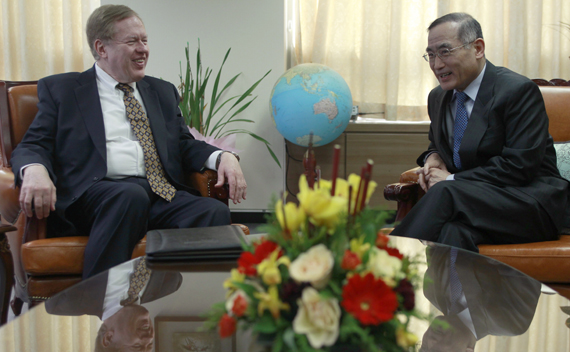
At a State Department briefing earlier this week, the spokesman stated that U.S. Special Envoy for Human Rights in North Korea Ambassador Robert King may be tasked to lead a food assessment mission to North Korea. This announcement comes following a round of consultations led by Ambassador Stephen Bosworth last week in South Korea to manage differences on the issue, since United States sees food assistance as an issue separate from politics while the South Korean government sees food assistance as a form of leverage by which to bring North Korea back to the negotiating table. The consultations resulted in begrudging South Korean government support (or at least the absence of objections to) the U.S. decision to send an assessment team to North Korea.
The decision to send a U.S. food assessment mission itself does not mean that the United States will actually decide to give food aid to North Korea, but it does open the door to that possibility. A major obstacle remains the outstanding issues between the United States and North Korea that must be addressed if food assistance is to be approved, including the unmonitored disposition of food aid that was disbursed in North Korea after the departure of monitors at the time of North Korea’s decision to prematurely end provision of food assistance in March of 2009.
The most interesting aspect of the announcement is the possibility that U.S. Special Envoy for Human Rights in North Korea, Ambassador Robert King, will lead the mission. This new wrinkle is intriguing for a variety of reasons:
As mentioned in my previous post, a substantive issue that has emerged on the basis of previous assessments by U.S. NGOs and the UN World Food Programme is the role of the markets versus North Korea’s public distribution system, through which North Korean government authorizes preferred institutions eligible to receive international aid. To address this issue, the WFP and others have discussed the possibility of “monitoring the markets” as part of the regime that North Korea would have to accept as part of a new round of food assistance.
However, North Korean agreements to monitor the markets will not go far enough as elements of any new program for distributing food aid to North Korea. In the absence of inability to independently determine greatest need, the best option for saving lives in North Korea is to stabilize grain prices through the market mechanism through subsidies that lower market prices. The introduction of external assistance through the market mechanism would influence existing suppliers of grain, who currently have a monopoly on supply and the capacity to influence market availability and perceptions of supply and demand to maximize their own profits. The problem is that such a program would require a greater level of intrusiveness into North Korean markets than North Korea is likely to be willing to accept at this time. Monitoring the markets will provide more detailed information regarding domestic prices inside North Korea, but will not fundamentally decrease the dependence of the entire aid monitoring project on the North Korean government’s listing of priorities.