Nigeria’s Islamist Reckoning
The most recent abductions and executions in southwestern Nigeria have brought home the religious character of the threat to peace and security in the country.
By experts and staff
- Published
 Ebenezer ObadareCFR ExpertDouglas Dillon Senior Fellow for Africa Studies
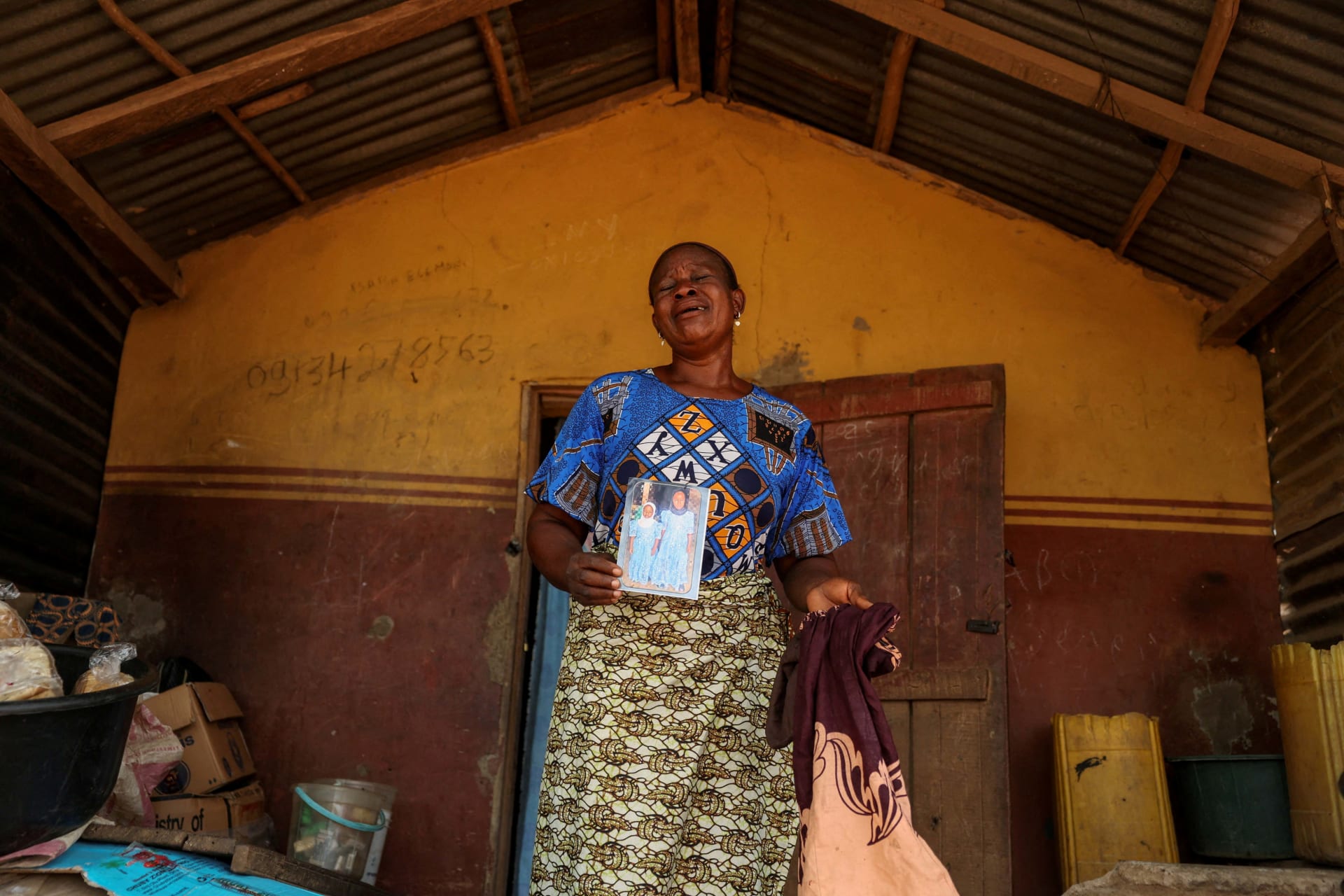
Days after their coordinated attacks on schools across three communities in the southwestern state of Oyo during which they abducted thirty-nine pupils and seven teachers, the gunmen behind last month’s dastardly incident went one step further by decapitating fifty-seven-year-old Michael Oyedokun, a mathematics teacher. The father of two was the second teacher to die at the hands of the yet to be apprehended marauders, sharing the unfortunate fate of Joel Adegboye Adesiyan, forty-eight, who was reportedly executed as he tried to shield his pupils.
Measured on a historical scale, the most recent attacks were far from the worst. Boko Haram and its affiliates’ decades-long campaign to impose a Shariarist theocracy on the country has entailed infinitely more abductions and gorier killings.
The outsized reaction to the latest attacks arguably owes to a combination of factors. One is the location of the attacks. While, in general, the latest incident appeared to strengthen the case of critics who insist that the Bola Tinubu administration has lost control of the country’s security architecture; in the Yoruba heartland, it has heightened fears about the steady incursion of various militant groups into the region. Given the social composition of civil society in the southwestern part of the country, where the combination of a tradition of social activism and media saturation has historically ensured a state of hypervigilance, wall-to-wall media coverage of the attacks and its aftermath has come as no surprise.
Furthermore, any hope among government officials that the incident could be written off as yet another attack by anonymous “bandits” quickly ended with the circulation of footage showing the gratuitous beheading of Michael Oyedokun. The sheer gruesomeness of the beheading was one thing—its symbolism as a tool of psychological warfare long used by Islamist extremist groups to instill fear and induce political concessions was unmistakable. The message from the gunmen was clear enough: if we can decapitate one teacher, imagine what we can do with the other teachers and students in our custody.
Subsequently, several news sources across the country have reported that, in addition to money and the release of detained comrades, the assailants are also demanding “concessions of future laws of this land.” Whether this means Sharia law as many in the media have understandably surmised (to be clear, spokespersons for the Muslim community in Oyo state have condemned the terrorists’ action as “criminal and contrary to Islamic teachings”), the notion that the perpetrators are “some random bandits doing kidnapping” rather than “a terror group” with explicit religious aims, as a Nigerian commentator puts it, is becoming increasingly difficult to sustain.
To the extent, therefore, that they help focus attention on the theological roots of the insurgency in northern Nigeria, the latest abductions and executions amount to a significant breakthrough in the often-polarizing conversation about the origins of the breakdown of law and order in Nigeria.
For the past two decades, a section of the Western media and not a few scholars have doubled down on the theory that insecurity in northern Nigeria is a function of “farmer-herder clashes” whose connection to religion, if any, is tenuous at best. In recent years and as deadly attacks by various jihadist groups on state and civilian targets in Nigeria and different Sahelian countries have mounted, this theory has become less and less persuasive. In Nigeria, the fact that the bulk of such attacks have occurred in places with no history of farmer-herder contention, and on targets with no connection whatsoever to farming or herding (think Messrs. Adesiyan and Oyedokun), has exposed the singular absurdity of the “farmer-herder” theory. Not only that, the overlap between the essential religious element (a theme I have striven to draw attention to) and Fulani ethnicity (“During attacks, assailants sometimes utter slogans with religious connotations, such as ‘Allahu Akbar’”) is one of the key observations of the latest report by the United States Commission on International Religious Freedom [PDF].
In fairness, the incumbent has done more than most of his predecessors to tackle the problem. For one thing, the Nigerian president has increased spending on defense significantly (allocation to the sector almost doubled between 2024 and 2025); has shown courage in declaring “bandits, militias, armed gangs, armed robbers, violent cults, forest-based armed groups, and foreign-linked mercenaries” as terrorists; and has shown more willingness than his predecessors to move pieces around within the defense and security establishment. For another, he deserves enormous credit for accepting offers of assistance from the U.S. military despite opposition from a cross section of the elite to such collaboration, and despite the fact that it instantly put him on a collision path with powerful religious leaders in the northern region.
The clearest demonstration of the growing success of that collaboration is the killing last month of Abu-Bilal al-Minuki, the ISIS second-in-command who was eliminated after a contingent of troops from both countries attacked his compound in the Lake Chad Basin. The collaboration has also led to increased strikes on various terrorist targets across the northern region and successful hostage recovery operations. As a matter of fact, the notable surge of extremist groups toward the southern region of the country may well be due to the fact that U.S.-Nigeria intelligence sharing and joint operations are beginning to have the desired effect in the northern half of the country.
In all likelihood, the crisis will get worse before it gets better. Increase in defense spending notwithstanding, containing a foe in pursuit of an eschatological mission, and one whose definition of victory is the abolition of the secular state rather than inclusion within it, was always going to be a difficult task. Nor is the situation helped by the fact that this is for all practical purposes an international foe, embedded within multiple transnational networks, and assisted in its nefarious missions by a combination of porous borders and decrepit state infrastructure.
A crucial first step is recognizing it for what it is. Neutralizing it will require the sinews and resources of the Nigerian state in collaboration with its Sahelian neighbors and other international actors. That, and a lot of time and patience.