The Gulf of Tonkin Incident
The attack on a U.S. destroyer off the coast of North Vietnam that deepened U.S. involvement in Vietnam never happened and opened up a credibility gap in U.S. foreign policy.
By experts and staff
- Published
 James M. LindsayCFR ExpertMary and David Boies Distinguished Senior Fellow in U.S. Foreign Policy
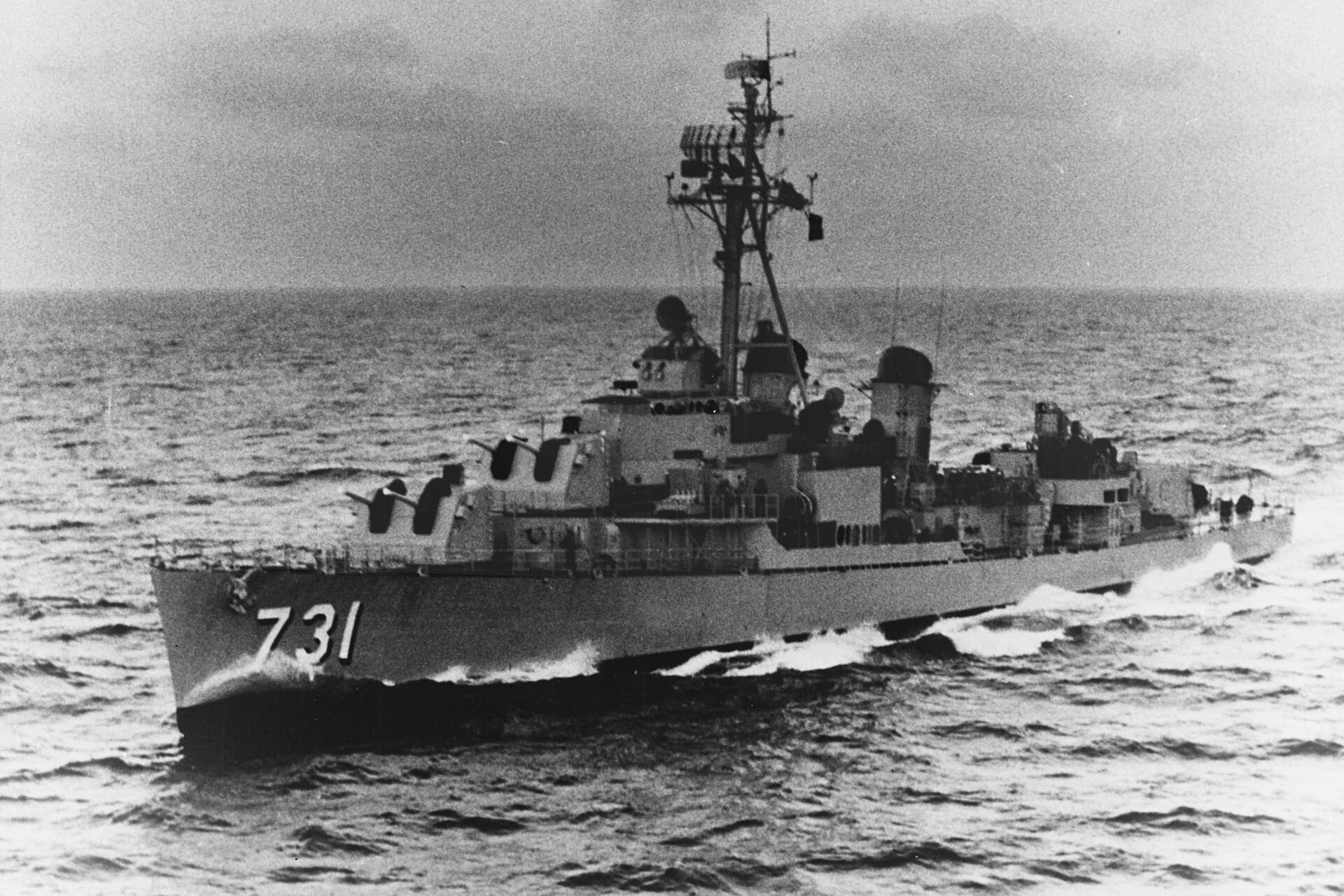
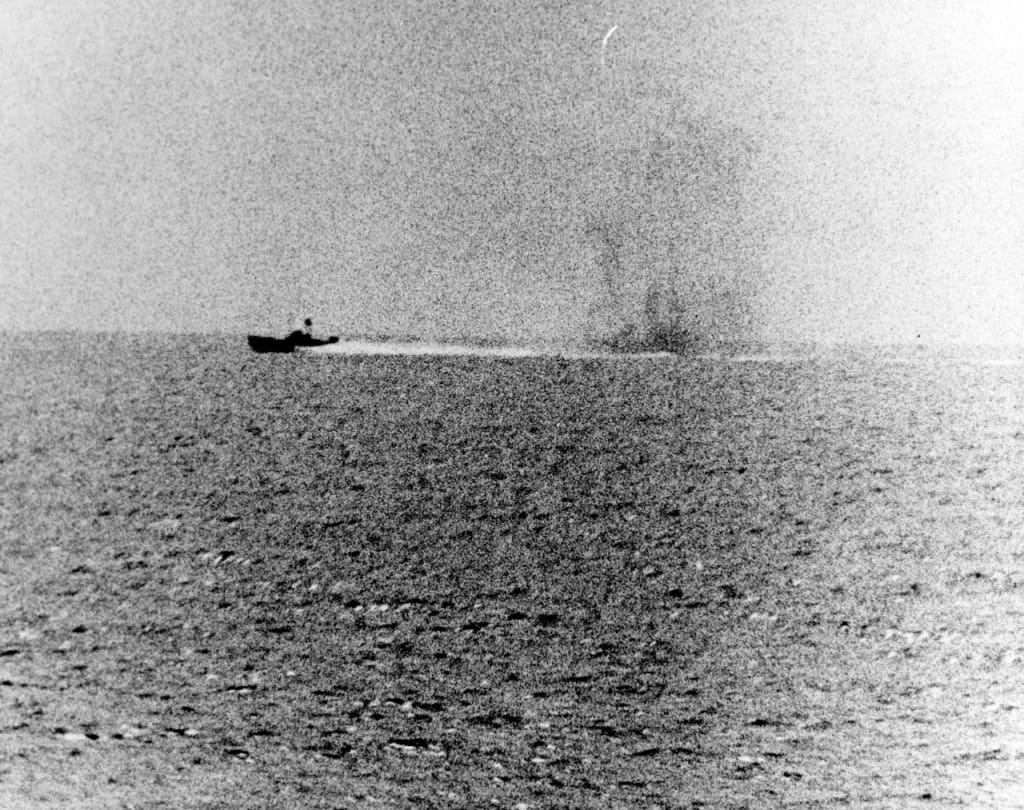
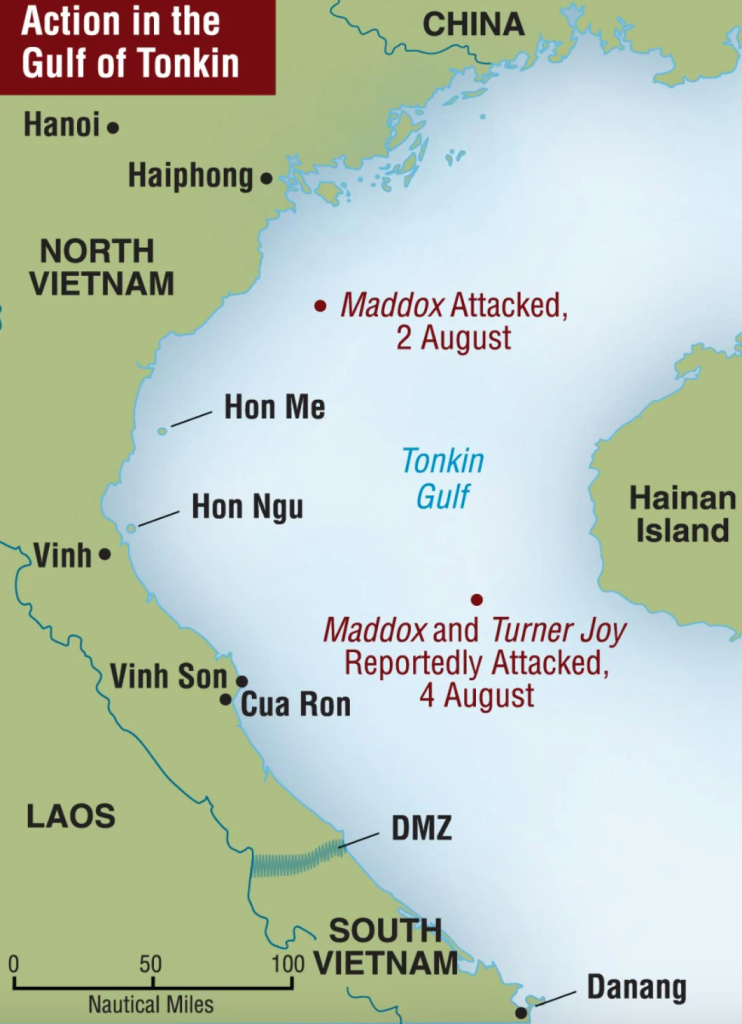
On the evening of August 4, 1964, the destroyer USS Maddox was on patrol in the Gulf of Tonkin. Two nights earlier, North Vietnamese torpedo boats had attacked it without warning. The Maddox had driven them off. The only damage it suffered was a single bullet hole. Now, amidst driving rain and rough seas, it came under fire once again—or more accurately, its crew thought it had come under attack again.
Congress responded to the news of the attack on the Maddox by passing the Gulf of Tonkin Resolution, which deepened U.S. involvement in Vietnam. A survey I conducted on behalf of the Council on Foreign Relations with members of the Society for Historians of American Foreign Relations ranked that resolution as the ninth-worst foreign policy decision in U.S. history.
OPLAN 34A
By the summer of 1964, United States had some twenty thousand military personnel in South Vietnam. They were ostensibly acting as military trainers and advisers rather than leading and participating in combat operations. In practice, however, the role of the U.S. military had grown well beyond providing support. The United States was directing South Vietnam’s war against the National Liberation Front—better known to Americans at the time by its derogatory nickname, the Viet Cong—and North Vietnam.
The U.S. Navy was actively involved in supporting military operations in Vietnam. On July 31, the Maddox arrived in the Gulf of Tonkin to collect signals intelligence on North Vietnam. The night before, South Vietnamese commandos attacked two North Vietnamese islands near where the Maddox was patrolling in international waters. The South Vietnamese attacks were part of Operation Plan (OPLAN) 34A. Conceived by the U.S. military and carried out by the South Vietnamese Navy, OPLAN 34A sought to harass the North Vietnamese coast, test the government’s response, and learn about North Vietnam’s military readiness and operations.
Shots Fired
On August 3, a second destroyer, the USS C. Turner Joy, joined the Maddox on patrol. Ironically and perhaps significantly, the radar systems on both ships were not fully working.
The joint patrol was initially unremarkable. Then, at 8:40 p.m. local time on August4, the Maddox reported that unidentified ships were approaching:
Over the next three hours, the two ships repeatedly maneuvered at high speeds to evade perceived enemy boat attacks. The destroyers reported automatic-weapons fire; more than 20 torpedo attacks; sightings of torpedo wakes, enemy cockpit lights, and searchlight illumination; and numerous radar and surface contacts. By the time the destroyers broke off their “counterattack,” they had fired 249 5-inch shells, 123 3-inch shells, and four or five depth charges.
As the fighting proceeded, neither the Maddox nor the C. Turner Joy saw the North Vietnamese vessels attacking them.
Or Maybe Not
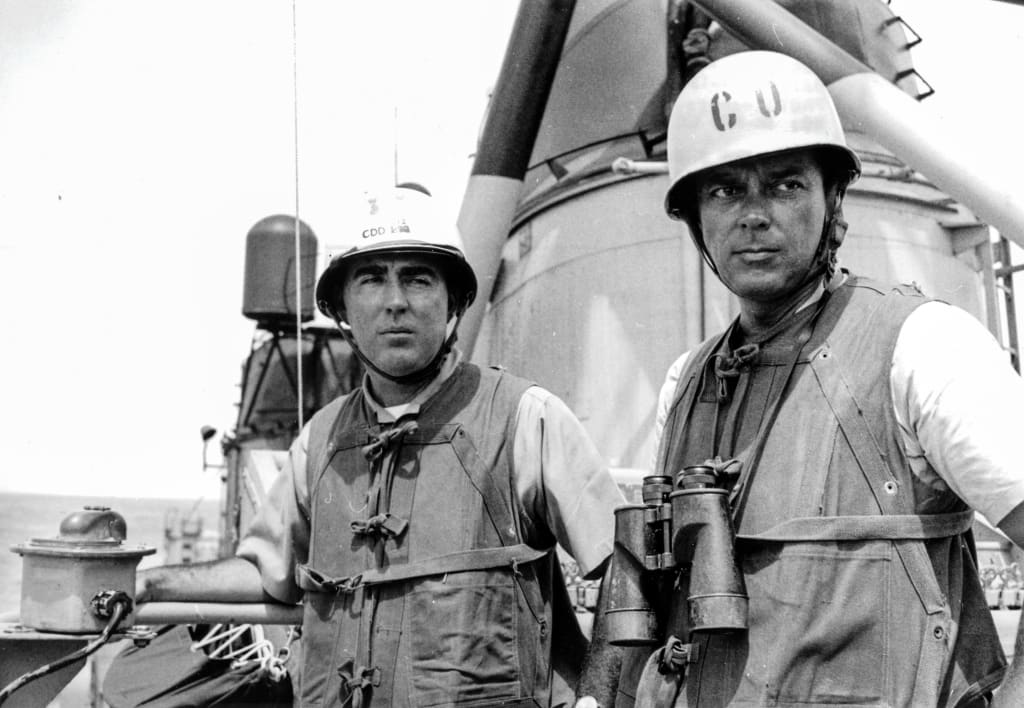
Even as the firefight was underway, the Maddox’s captain, John J. Herrick, began to doubt his ship was being attacked. Enemy vessels would appear on sonar, vanish, and then materialize in a different position, suggesting either that the equipment was malfunctioning or that the sonar operators were misreading the signals they were receiving.
At the same time, a U.S. Navy F8 Crusader launched from the aircraft carrier USS Ticonderoga flew overhead for ninety minutes and failed to identify any North Vietnamese ships. The plane’s pilot, Commander James B. Stockdale, later wrote: “I had the best seat in the house to watch” and I saw “no boats, no boat wakes, no boat gunfire, no torpedo wakes—nothing but black sea and American firepower.”
(Stockdale was shot down a year later over Hanoi and captured by the North Vietnamese. He spent seven-and-half years as a prisoner of war and finally returned to the United States in 1973. He eventually retired from the navy as a vice admiral. In 1992, he ran as vice president on Ross Perot’s third-party ticket. Stockdale’s opening line at the 1992 vice presidential debate—“Who Am I? Why I Am Here?”—constitutes one of the most memorable moments in vice-presidential debate history.)
Two Retractions
At 1:27 a.m. on August 5, Herrick sent an urgent message to U.S. Pacific Command in Honolulu. He retracted his earlier claim that the Maddox and C. Turner Joy had been attacked:
Review of action makes many reported contacts and torpedoes fired appear doubtful. Freak weather effects on radar and overeager sonarmen may have accounted for many reports. No actual visual sightings by MADDOX. Suggest complete evaluation before any further action taken.
Ninety minutes later, however, Herrick retracted his retraction:
Certain that original ambush was bonafide. Details of action following present a confusing picture. Have interviewed witnesses who made positive visual sightings of cockpit lights or similar passing near Maddox. Several reported torpedoes were probably boats themselves which were observed to make several close passes on Maddox. Own ship screw noises on rudders may have accounted for some. At present cannot even estimate number of boats involved. Turner Joy reports two torpedoes passed near her.
Herrick subsequently sent another cable stating: “The first boat to close the Maddox probably launched a torpedo at the Maddox which was heard but not seen. All subsequent Maddox torpedo reports are doubtful in that it is suspected that sonarman was hearing the ship’s own propeller beat.“
Washington Reacts
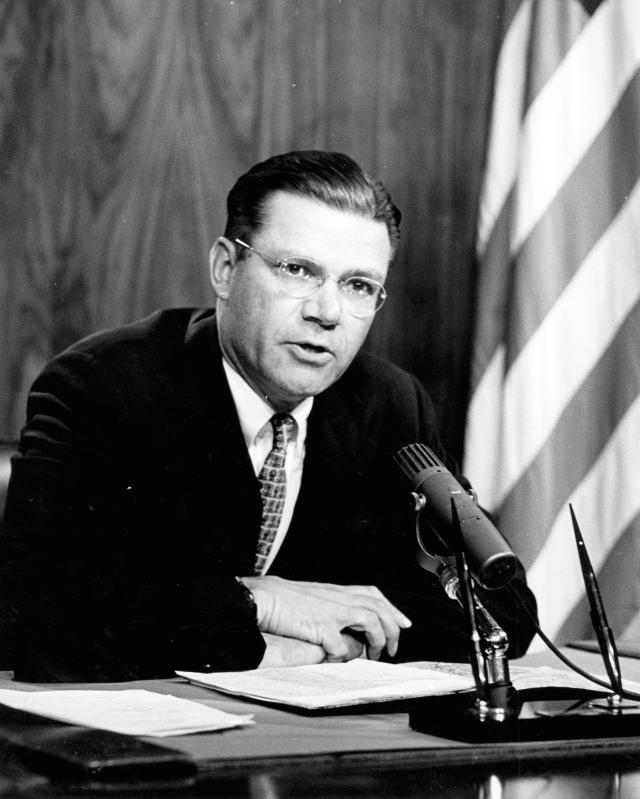
Back in Washington, DC, which was eleven hours behind Vietnam, what had begun as an ordinary Tuesday morning quickly saw Defense Department officials shift to crisis mode. They scrambled to make sense of Herrick’s conflicting reports. Secretary of Defense Robert McNamara ultimately concluded that the Maddox had come under fire when an intelligence intercept arrived purporting to show that one of the North Vietnamese patrol boats had reported the attack to its superiors.
President Lyndon B. Johnson learned of the attack at a National Security Council meeting that had been called to discuss an unrelated situation in Cyprus. The Gulf of Tonkin incident was also not the only momentous news Johnson received that day. A little after 8 p.m., he was told that the bodies of James Chaney, Andrew Goodman, and Michael Schwerner, three civil rights activists who had been missing since June, had been found near Philadelphia, Mississippi.
Johnson was determined to respond to what was now the second North Vietnamese attack on U.S. forces. He worried that doing nothing might embolden the North Vietnamese, undermine South Vietnamese faith in the United States, and expose himself to politically damaging charges at home that he was failing to defend the U.S. national interest. Johnson spent much of the day consulting with his advisors and conferring with congressional leaders. One of those he called was Senator Barry Goldwater of Arizona, his Republican opponent in the upcoming presidential election.
An Address to the Nation
At 11:30 p.m. Washington time, Johnson went on national television. He described the attack and announced that he had ordered air strikes “against gunboats and certain supporting facilities in North Vietnam which have been used in these hostile operations.” He added that he would “immediately request the Congress to pass a resolution making it clear that our Government is united in its determination to take all necessary measures in support of freedom and in defense of peace in southeast Asia.”
[Video: https://youtu.be/Dx8-ffiYyzA?si=wAIibS2rxXqDeYYW]

Stockdale led the retaliatory strike. It was the first overt attack by U.S. forces against North Vietnam. (U.S. military advisers had been directing South Vietnamese attacks for years.) Although the mission succeeded—thirty-three of thirty-five targeted North Vietnamese vessels were destroyed—one U.S. pilot was killed. Another pilot, Lt. Everett Alvarez was shot down and captured, making him the first U.S. naval aviator to become a prisoner of war in Vietnam.
Congress Acts
Less than seventy-two hours after Johnson’s speech to the nation, Congress passed the Gulf of Tonkin Resolution. It stated: “Congress approves and supports the determination of the President, as Commander in Chief, to take all necessary measures to repel any armed attack against the forces of the United States and to prevent further aggression.”
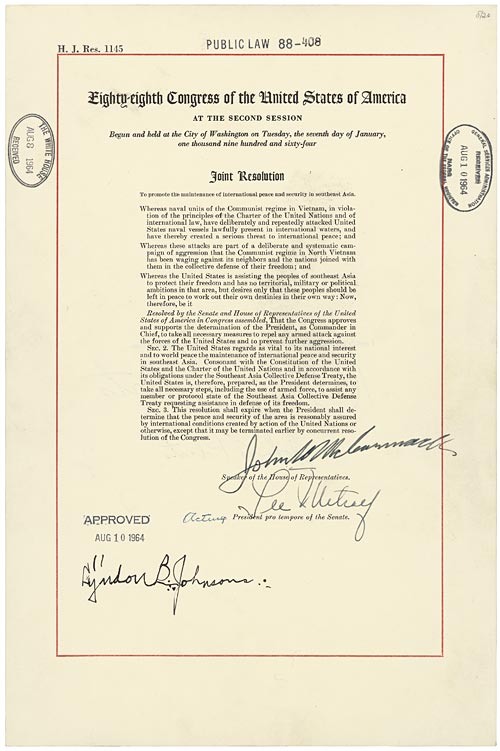
The resolution’s expansive language, which administration lawyers had largely drafted, delighted Johnson. He now had what he took to be Congress’s firm backing if he chose to escalate U.S. involvement in Vietnam. As was his wont, he put the point more colorfully to his aides. The resolution was, he said, like “a grandmother’s nightshirt: It covers everything.”
Who Knew What When
Six decades later, Stockdale’s assessment of the events on the night of August 4, war looks to have been correct: the Maddox and the C. Turner Joy had shot at phantoms. The Maddox and the C. Turner Joy searched the next day for the wreckage of the North Vietnamese vessels they believed they had sunk or damaged and found nothing. The critical intelligence intercept that showed a North Vietnamese boat confirming the attack actually came from the fighting on August 2.
The question of what Johnson and his advisers knew about the attack and when they knew it is less clear cut. McNamara clearly misrepresented the facts in his Senate testimony on August 6 and at a press conference later that day. He made no mention of Herrick’s doubts about the attack, and he denied knowing of any South Vietnamese operations that might have provoked the North Vietnamese. Not only did McNamara know all the details about OPLAN 34A, he had already told Johnson that “there’s no question but what that had bearing” on the attacks on the Maddox.
Whether Johnson believed at the time Congress voted on the Gulf of Tonkin Resolution that the crew of the Maddox had been attacked a second time is impossible to say. The president might have knowingly lied to the public, as his harshest critics insist, because a retaliatory strike enabled him to rebut Goldwater’s charges that he had been “soft” on North Vietnam. Or Johnson might have genuinely believed initially that the attack had occurred.
If the latter is the case, Johnson quickly came to doubt what he had said publicly. Shortly after the Gulf of Tonkin Resolution passed, he told Under Secretary of State George W. Ball: “Hell, those damn, stupid sailors were just shooting at flying fish.” But Johnson never shared his doubts about the events on the night of August 4 with the American public. This gap between what Johnson thought privately and said publicly would characterize much of his decision-making on Vietnam.
The Legacy of the Gulf of Tonkin Incident
Would the United States have avoided the Vietnam War if Johnson and his advisors had investigated whether the second attack on the Maddox had occurred? In all likelihood, no. The United States and North Vietnam were on a collision course in 1964 because South Vietnam was faltering under pressure from the north and Washington was bent on keeping Saigon from falling. If the Gulf of Tonkin incident had not occurred, some other incident likely would have triggered a U.S. escalation.
As it was, Johnson did not dispatch the first U.S. combat troops to South Vietnam for another seven months. Even then, they arrived only after attacks on two U.S. bases in South Vietnam killed thirty-one Americans. In short, Johnson had ample time after the Gulf of Tonkin incident to find an off-ramp from Vietnam if he had wanted one.
But the Gulf of Tonkin incident would come back to haunt Johnson and his administration. With time, details about the supposed attack slowly became public. The gap between what Johnson and his advisors said at the time and what they knew to be true fueled the rise of a “credibility gap” that in many ways continues to haunt U.S. foreign policy to this day.
The United States celebrates its 250th anniversary in 2026. To mark that milestone, I am resurfacing essays I have written over the years about major events in U.S. foreign policy. A version of this essay was published on August 4, 2014.
Oscar Berry and Jack Patton assisted in the preparation of this article.
This work represents the views solely of the author(s). The Council on Foreign Relations is an independent, nonpartisan membership organization, think tank, and publisher, and takes no institutional positions on matters of policy.