President Obama’s UN Speech: Defending World Order
By experts and staff
- Published
- Stewart M. PatrickJames H. Binger Senior Fellow in Global Governance and Director of the International Institutions and Global Governance Program
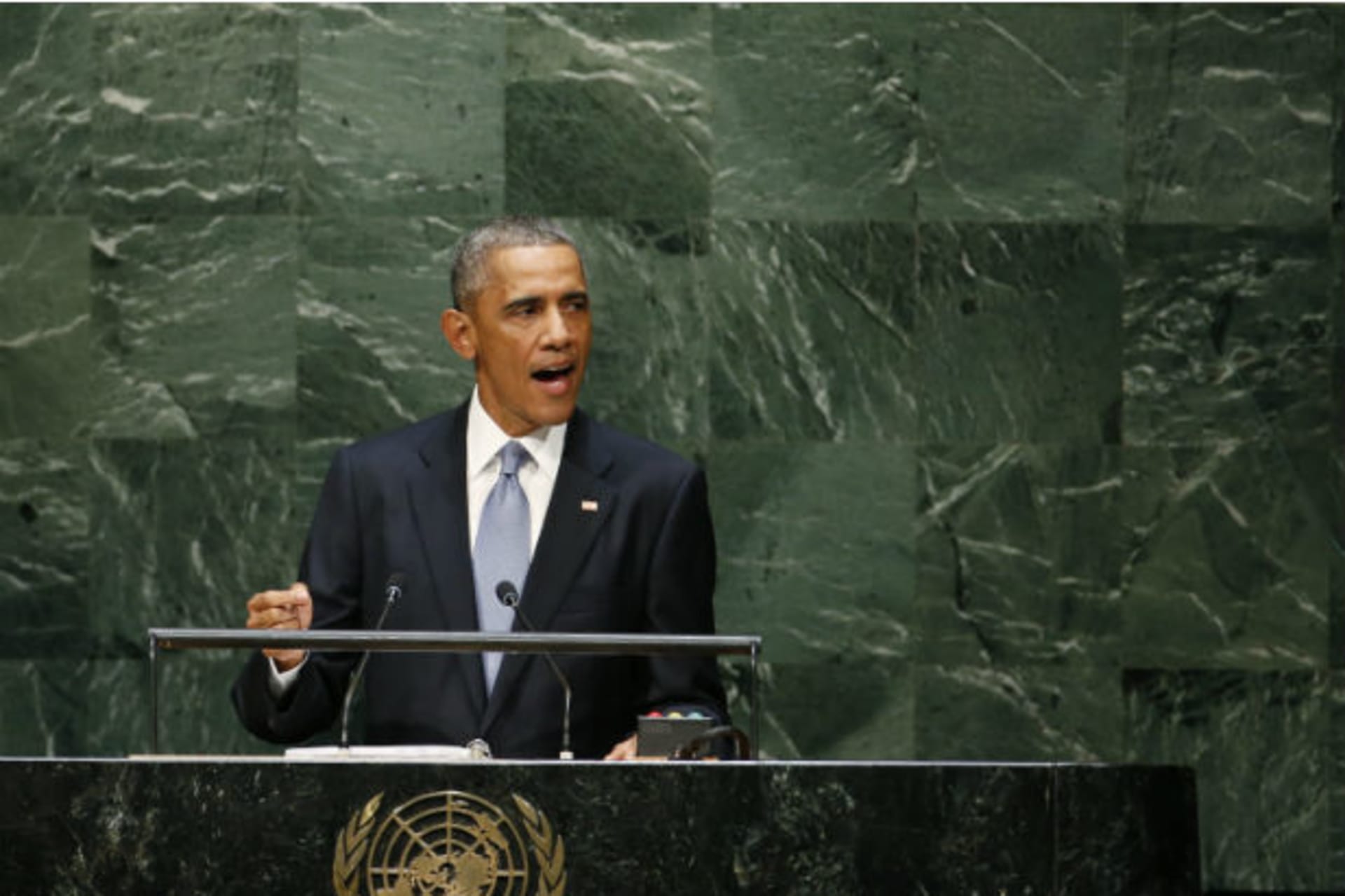
In one of the most impressive speeches of his presidency, Barack Obama this morning challenged UN member states to join the United States in confronting two “defining challenges”: the return of imperialist aggression and the spread of violent extremism.
The president began by acknowledging a widespread feeling that the world is going off the rails. On one level, such pessimism was ironic. For on virtually every dimension of well-being—from wealth to health and from education to security—“this is the best time in human history to be born.” Whether you live in Manhattan or Kenya, “you are more likely than ever before to be literate, to be healthy, and to be free to pursue your dreams,” he noted. “And yet there is a pervasive unease in our world,” he conceded, “a sense that the very forces that have brought us together have created new dangers, and made it difficult for any single nation to insulate itself from global forces.”
The world faces a slew of problems demanding urgent attention, from terrorism to aggression, climate change to Ebola. “But they are also symptoms of a broader problem—the failure of our international system to keep pace with an interconnected world.” The United Nations, he declared, has a choice to make. “We can renew the international system that has enabled so much progress, or allow ourselves to be pulled back by an undertow of instability.”
Rather than cover the entire global agenda, the president wisely focused on the two biggest threats to a stable world order.
The first was a resurgence of great power aggression. Departing from his normal diplomacy, the president launched a frontal assault on Russia’s intervention in Ukraine as a blatant violation of the international rule of law and the very principles upon which the United Nations was founded. “No nation can subjugate its neighbors and claim their territory,” he proclaimed. This was the doctrine of “might makes right,” and the United States rejected it, standing for the principle that “right makes might.” Warning that “the cause of empire leads to the graveyard,” he pledged U.S. support for Ukraine, the strengthening of collective defense within NATO, and continued economic sanctions. President Obama plainly stated that Russia has a choice to make: to continue on its disastrous course, or return to the path of peace and diplomacy. Moscow’s decision would help answer “a central question of our global age”: whether the world will work to solve problems together, or instead “descend into destructive rivalries of the past.”
Second, alongside the throwback threat of Russian imperialism, the world confronts “the cancer of violent extremism” in the Muslim world. Terror itself is nothing new, the president reminded us.As John F. Kennedy noted at the same podium five decades ago, terrorism has long been employed “by those who could not prevail by persuasion or example.” What is novel today is the massive destruction terrorists can inflict with accessto lethal technologies. And the epicenter of the terrorist threat today is the Middle East, where extremists seek to pervert one of the world’s great religions to divide the world into “adherents and infidels.” President Obama proposed a four-point plan to combat this scourge:
Unlike many of Obama’s speeches, which have a professorial tendency to pull their punches, today’s address showed steely determination and a refreshing willingness to offend in delivering uncomfortable truths. Some questions remained unanswered, to be sure. In the case of Russia, how far is the United States prepared to go to reverse its aggression in Ukraine? And how hard can the United States push when it requires Russian support, or at least acquiescence, in other matters ranging from Iran’s nuclear program to the fight against Islamic extremism?
Obama’s four-point plan also raises critical questions. The president promised that the United States “will neither tolerate safe havens nor act as an occupying power” in its campaign against ISIS. But he offered little insight into how the U.S. combat role might evolve, such as by bolstering Special Forces in the region. Nor was he persuasive in suggesting that the United States could thread the needle—attacking ISIS without empowering Syrian strongman Bashar al-Assad, while arming the “moderate” Syrian opposition. Finally, how realistic, really, is the vision of a broad multilateral conference among regional powers (presumably including Russia and Iran as well as Turkey, Saudi Arabia, the Gulf States, and Israel) to resolve differences over Syria? The administration, of course, is already grappling with these questions—and hopefully will deliver convincing answers to them after the bilateral meetings this week.
For now, however, Obama has delivered the right –and crucial—message to his fellow delegates at the United Nations. Under his watch, the United States will not meekly watch Russia, Ebola, or ISIS trample on the post-war order. For a president who prides himself on “hitting singles,” it looks like he got a runner home today.