Reflections on the Foreign Policy Debate
By experts and staff
- Published
- Stewart M. PatrickJames H. Binger Senior Fellow in Global Governance and Director of the International Institutions and Global Governance Program
The final presidential debate last night shed some light on the two foreign policy paths that the United States might walk for the next four years. For all the sturm and drang of campaign rhetoric, on the biggest issues discussed—the U.S. role in the world, relations with China, Syria, Iran, Afghanistan, Pakistan, and how to deal with terrorism—there is not too much daylight between these men. But even so, as I’ve written before, there are sources of disagreement—including national defense budgets, democracy promotion, foreign aid, and U.S.-Russian relations that are evidence of their divergent outlooks.
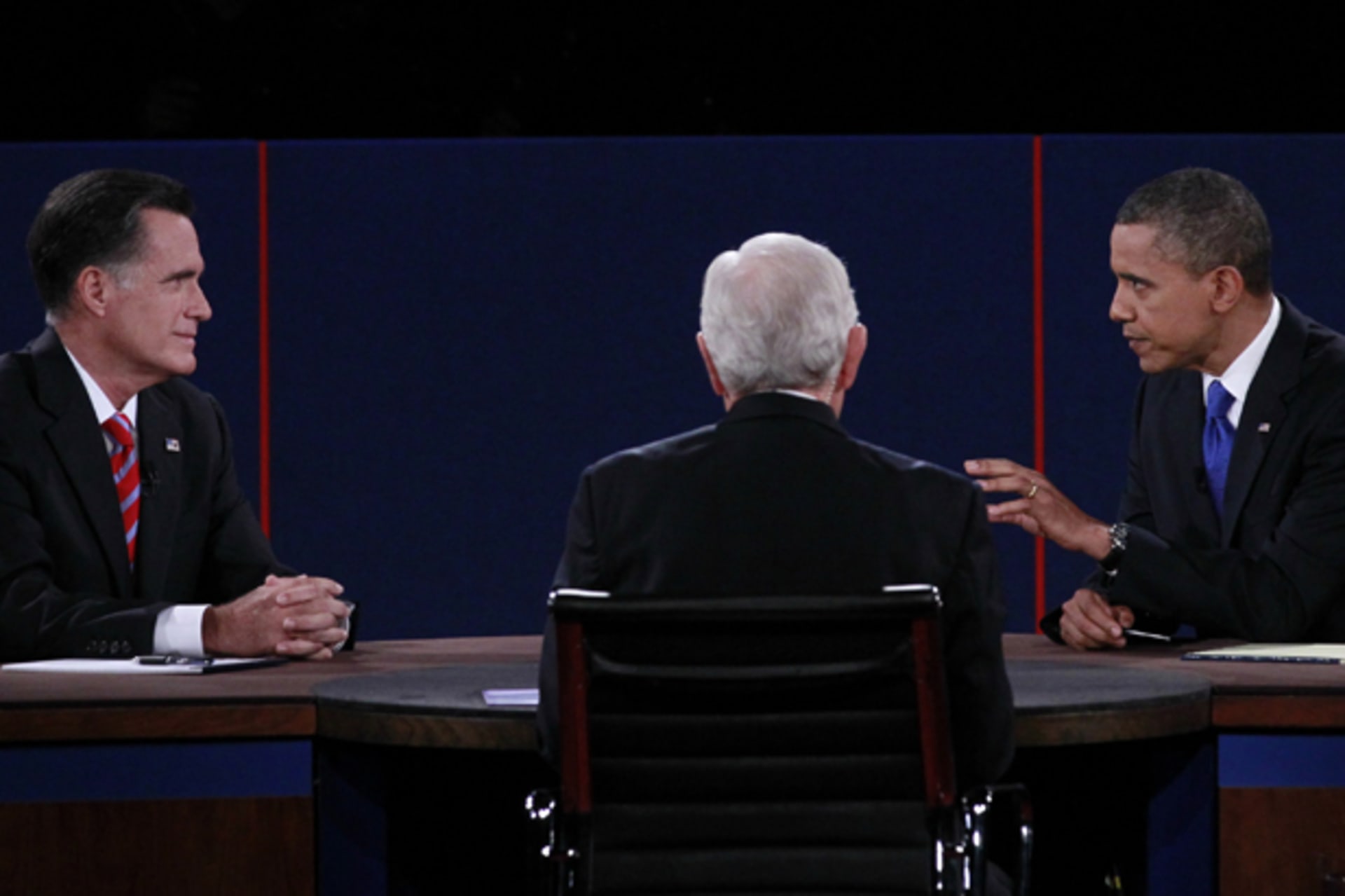
First, to recap, neither President Obama nor Governor Romney emerged as an absolute winner Monday night. On points, one might award a higher score to Obama for substance, and for rebutting Governor Romney enthusiastically. On the other hand, the governor may have won on style given that his main task for the campaign was to look presidential alongside the commander in chief—and he easily cleared that bar. He was reassuring and communicated a reasonable outlook that did not recall the neoconservative stance of George W. Bush, whose foreign policy disillusioned many voters. President Obama sought to paint Romney as an inconsistent amateur, but the governor did not bite and stayed cool.
The major source of disagreement was over Romney’s characterization of a Middle East—and indeed a world—“unraveling before our eyes” in a rising tide of tumult and chaos, a trend he attributed to failed U.S. leadership. He described a Middle East ablaze—with over thirty thousand civilian casualties in Syria, with Egypt in the dangerous hands of Islamists, with Libya at the mercy of armed gangs, with Mali controlled by al-Qaeda, with Iran “four years closer to the bomb,” and with Israel alienated from the United States. President Obama repeatedly challenged this portrayal, arguing vehemently that the Middle East and the world were better off than four years ago as Iran stands more isolated than ever under crippling sanctions, as Libyan and Egyptian civilians live in new democracies, as al-Qaeda’s core leadership remains decimated, and as Israel and the United States are joined at the hip on security.
Beyond this rhetoric, neither politician addressed the question of what, in practical terms, the United States can do to steer events in the turbulent Middle East or how much leverage over internal developments in these countries the United States truly possesses. Even where the candidates concretely disagreed, it was not always clear what a new President Romney would do differently if elected. This reflects in part the particular topics chosen. (It was not exactly wide-ranging—there was virtually no mention of Africa, Europe, Latin America, Asia outside of China, or the challenge of global development, much less climate change). But it also reflects the innate pragmatism of both candidates, and the fact that the differences are subtle (but sometimes important).
But on four issues, President Obama and Governor Romney offered starkly different visions:
Outside of those four issues, striking similarities emerged: