What Trump’s Executive Order Means for Childhood Vaccinations
The order reduces the number of childhood vaccines recommendations and separates measles, mumps, and rubella into different shots.

Stephanie Psaki is a leading expert on health security and the intersection of global health, U.S. foreign policy, and national security. She has two decades of experience spanning the White House, federal agencies, and international research and program management.
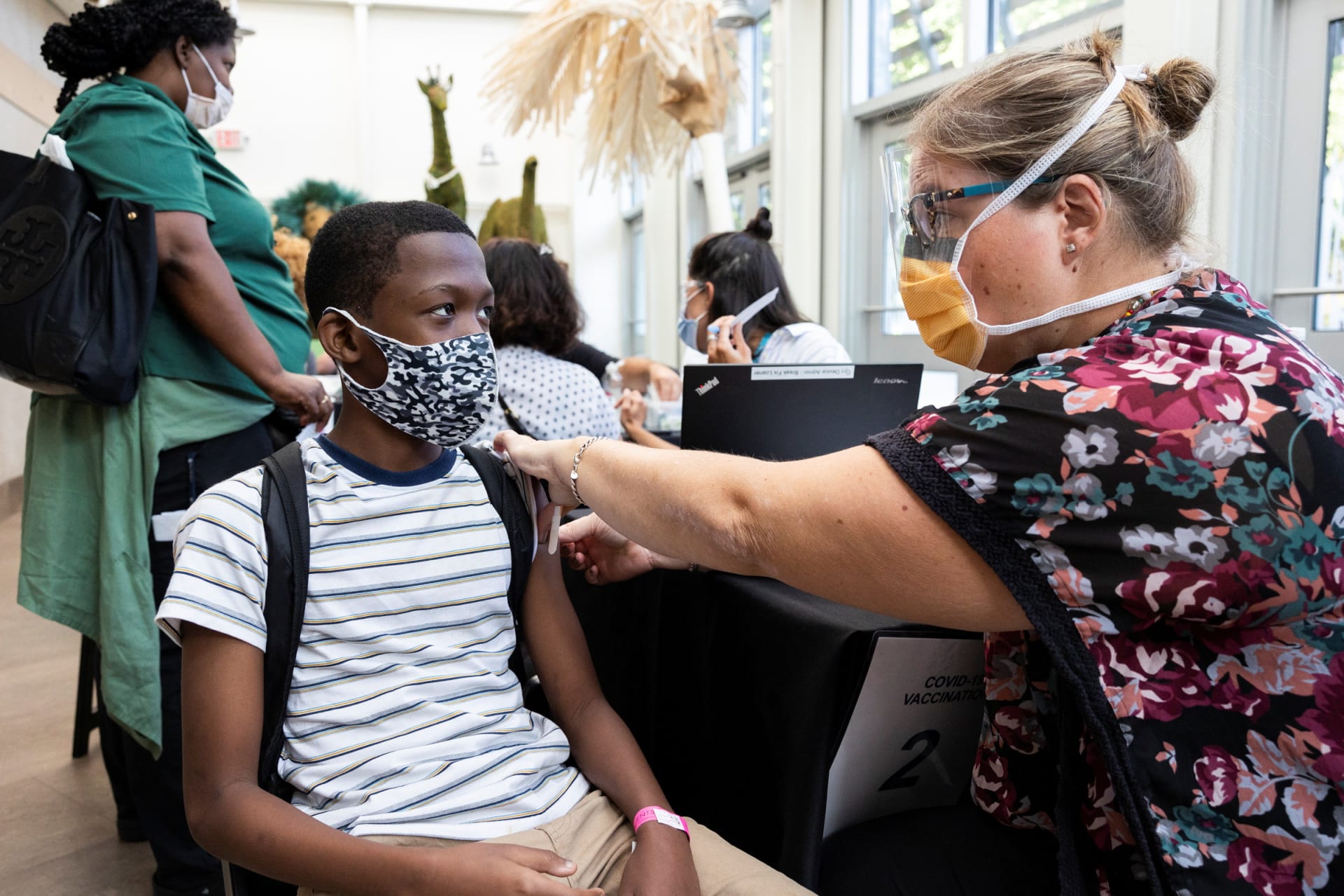
President Donald Trump signed an executive order (EO) Monday that calls for changes to childhood vaccine recommendations. This is the latest in a series of actions aiming to change the vaccine schedule through political directives rather than scientific processes.
If put into effect, which would require action by the Centers of Disease Control and Prevention (CDC) and the Advisory Committee on Immunization Practices (ACIP), the United States government would recommend that children be immunized against eleven diseases, a significant drop from the current seventeen.
The EO also advises splitting up the Measles, mumps, and rubella (MMR) vaccines so they would be delivered in three separate shots, rather than the current combined shot. The order designates additional immunizations for high-risk groups, or at the discretion of parents and doctors.
CFR’s Stephanie Psaki explains the order’s significance and how it compares to vaccine regimens in other developed countries.
Trump’s executive order states it aims to align the United States with peer countries. Does it?
The current vaccination schedule, which is still in place despite this EO, is roughly on par with peer countries: many in Europe recommend vaccines for fifteen or more diseases. The exception often cited is Denmark, which recommends vaccines against ten diseases. In each case, recommendations are based on demographic and epidemiological differences between countries, as well as differences in the structures of our health-care systems. The core vaccine recommendations are largely the same: measles, mumps, rubella, polio, etc. The differences, such as Hepatitis A, reflect different patterns of outbreaks of those diseases. For example, children in the United States don’t get vaccinated for Japanese encephalitis because it’s not a common threat, even though children in Japan get vaccinated against it.
The United States also has a larger and more diverse population than many of the countries people tend to compare our vaccine schedule to: the entire population of Denmark is smaller than that of New York City. And many of those countries have government-run health systems, wherein targeted vaccination of high-risk groups is more feasible.
The order also recommends spacing out shots and splitting the measles, mumps, and rubella vaccine. What will be the effect of that?
It depends. Right now, there are no separate vaccines approved for use in the United States, so this would not be an immediate change, even if the CDC and ACIP were to adopt these recommendations.
Standalone vaccines, made by U.S. pharmaceutical company Merck, existed decades ago and were used in the United States, but they were discontinued in 2009-2010 because the combined MMR vaccine was so widely used. One possibility is that Merck decides to bring those single-antigen vaccines back to the U.S. market, although it would likely take years to do. In addition to driving up costs to families because of multiple visits, this could lead to a further decline in vaccination rates overall, and more cases of measles, mumps, and rubella. Japan tested a similar approach of separating out these vaccine doses in the 1990s and they saw a clear increase in outbreaks of all three diseases.
Another possibility is that vaccine manufacturers look at the political landscape and strong public support for routine childhood vaccinations and decide that it is not worth investing in separating out these doses again—or at least slow-walk the process, waiting to see how the political winds might change in the United States.
Does this order affect U.S. credibility in the realm of public health globally?
Absolutely. The United States has long been a leader in public health expertise—from research and development to regulatory systems and manufacturing. If we are no longer making decisions domestically based on evidence, then we both discourage investments in innovation here at home and we risk losing our standing in the world as a global leader in health innovation.
Many countries also continue to trust and even defer to U.S. expertise, and could take these shifts as a sign that they should revisit their own vaccine guidance—it could set back decades of progress on reducing child mortality around the world. It could also undermine our credibility in a future health emergency, when we may need to work with global partners to counter new threats.
The world used to look to us for expertise and guidance. Actions like this erode our scientific leadership and make American children—and children around the world—less safe.
This work represents the views solely of the author(s). The Council on Foreign Relations is an independent, nonpartisan membership organization, think tank, and publisher, and takes no institutional positions on matters of policy.