South Africa’s “Other” Problem
South Africa cannot hope to confront its xenophobia problem until it owns it.
By experts and staff
- Published
 Ebenezer ObadareCFR ExpertDouglas Dillon Senior Fellow for Africa Studies
It is not every day that the investiture of a traditional ruler becomes a cause célèbre, but that is precisely what happened last week in the South African port city of KuGompo (formerly East London) after the local Nigerian Igbo community installed one Solomon Ogbonna Eziko as “Eze Ndi Igbo East London,” translation: “King of the Igbo People in East London.” In reaction to what is in fact a common practice among Igbos outside their southeast Nigerian heartland (there is practically no Igbo community anywhere in the world without its own “King”), outraged locals took out their anger on Nigerian businesses and individuals of Nigerian descent. By the time the dust had settled on what was initially billed as a peaceful protest, including a demonstration outside the Nigerian High Commission in Pretoria by members of the Progressive Forces of South Africa and other civic groups, at least twenty-six Nigerians had been reportedly injured and hospitalized, with property worth millions of rands similarly destroyed.
Why would a harmless practice whose value is symbolic at best trigger such a violent reaction? (After all, king or no king, Igbos in South Africa—which is the same for Igbos anywhere in the world—remain subject to the laws of the land.)
If the protesters are to be believed, Mr. Eziko’s installation as “King” offends their “traditional values” and disrespects “the sovereignty of their country.” For traditional leader Prince Xhanti Sigcawu, who was present at the protest, the installation ceremony was “a direct violation of South Africa’s sovereignty and legal framework.” Mr. Sigcawu also urged the South African authorities “to see to it that whoever participated in this illegal coronation of the so-called king is removed from the borders of this country with immediate effect, whether that person came legal or not.” Nor would Mr. Sigcawu stop there if he had his way, given his further appeal to the same authorities to “look at all spaza [small street corner grocery] shops, including businesses that are run by foreigners, to see whether these foreigners are documented or not.”
Judging by Mr. Sigcawu’s appeal to the South African government, it is not unreasonable to deduce that his (and his fellow protesters’) anger at the purported disrespect of “traditional values” is an excuse for a barely disguised unease with the presence of foreigners in the country. This is the only explanation for the presence of members of March and March, the self-described “grassroots citizen movement addressing growing concerns about undocumented immigration in South Africa” at the aforementioned demonstration at the Nigerian High Commission. The March and March movement is one of a growing number of “South Africa First” populist quasi-vigilante anti-immigrant groups currently operating in South Africa. Others are Operation Dudula, the MK (Umkhonto weSizwe) Party, and ActionSA. In recent times, Operation Dudula has been implicated in incidents of attacks on immigrants, including raids on businesses belonging to foreign nationals.
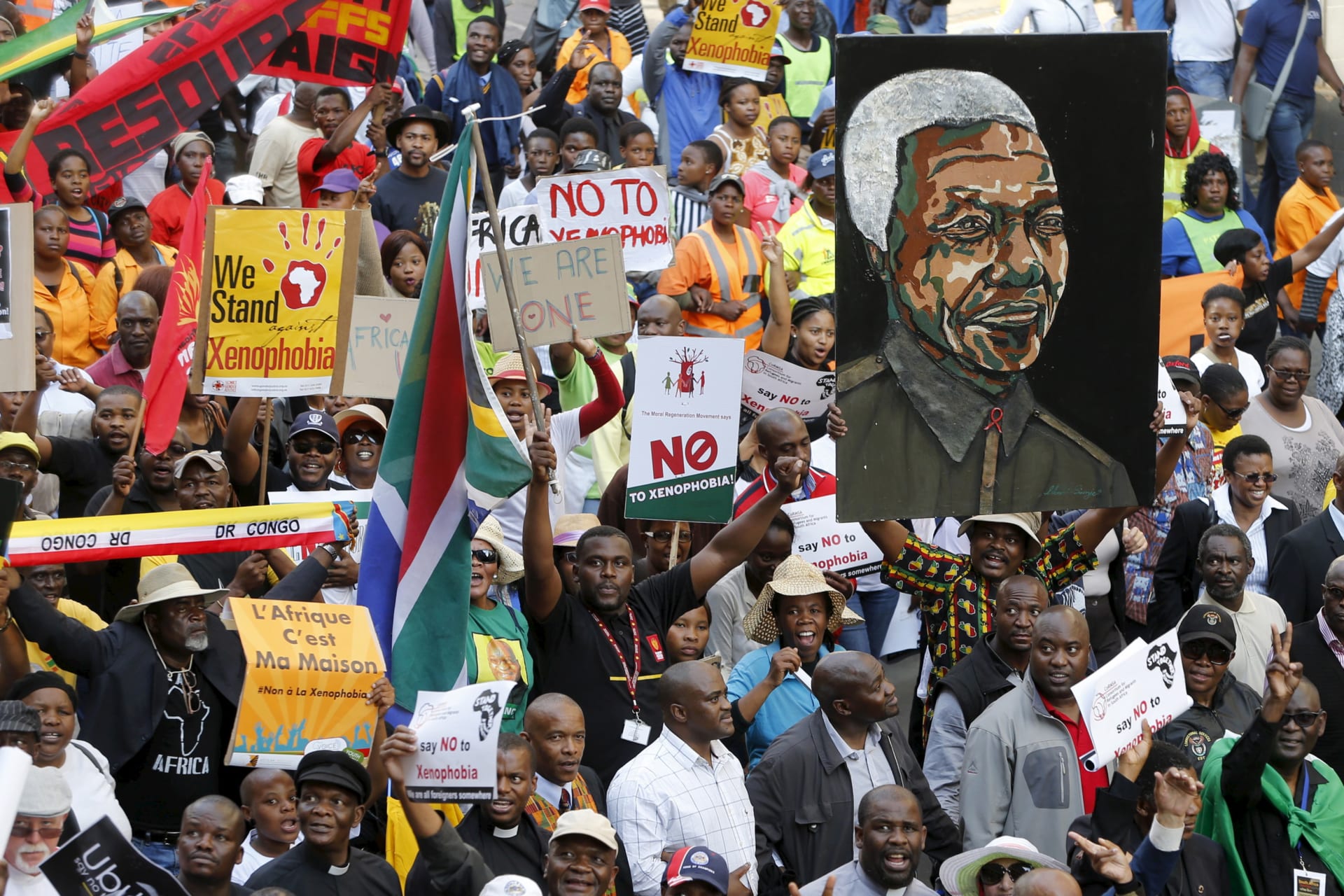
While these groups are relatively of recent vintage (Operation Dudula was established in Soweto in 2021, the MK Party in 2023, ActionSA in 2020), the sentiment they articulate and appear to galvanize is as old as post-apartheid South Africa. The earliest recorded xenophobic attacks in the new “rainbow nation” go as far back as December 1994 and January 1995 (South Africa became a democracy in April 1994) when immigrants from Malawi, Mozambique, and Zimbabwe were reportedly ambushed in Alexandria township by armed gangs who destroyed their homes and demanded their deportation. Since then, South Africa has experienced sporadic waves of violence against foreign nationals and individuals and groups deemed to be living in the country illegally, including in 1998, 2000, 2005, 2006, thrice in 2008, 2015, and 2019, when attacks on foreign-owned businesses in the Johannesburg Central Business District led to at least a dozen deaths and widespread looting.
So serious were the 2019 riots that they prompted retaliatory attacks against South African interests in other African countries, mainly Zimbabwe and Nigeria. In the latter, South African-owned businesses operating in the country, including supermarket chain Shoprite and telecommunications giant MTN came under attack in various cities. AIthough South African President Cyril Ramaphosa promptly condemned the violence which had threatened to overshadow the 28th World Economic Forum on Africa being hosted by the country at the time, insisting that “South Africa must be a country where everyone feels safe, including women and foreign nationals,” it was hardly enough to dispel the belief that the authorities may have laid the groundwork for such attacks with language that seemed to suggest that foreigners were to blame for the country’s economic woes. For instance, in the wake of the riots, and mobilizing rhetoric not all that different from Xhanti Sigcawu’s, the South African Minister of International Relations and Cooperation Naledi Pandor urged the Nigerian government to “help us address the belief that our people have and the reality that there are many persons from Nigeria, who are dealing in drugs in our country, and who are harming our young people by making drugs easily available to them.”
Nigerian involvement in organized crime in South Africa is not up for debate. Over the years, South African police have gone toe to toe with Nigerian criminal groups believed to be involved in illegal activities varying from drug and human trafficking to fraud and cybercrime. Speaking in August 2019, a month before the Johannesburg riots, Nigeria’s High Commissioner to South Africa at the time, Ambassador Kabir Bala, disclosed that more than six thousand Nigerians were either in prison or under police investigation for various crimes in South Africa.
If this goes to show that Ms. Pandor was right to refer to “the belief that our people have and the reality that there are many persons from Nigeria, who are dealing in drugs in our country,” nonetheless, it hardly justifies increasingly coordinated attacks against Nigerians and Nigerian businesses, never mind xenophobic attacks on persons suspected to be of foreign origin.
Substantively, two issues are at stake here. The first is a problem that, unfortunately, is not limited to South Africa. This is the nagging failure of many African countries to embrace the idea of modern citizenship, which uncouples “belonging” from “place” (including circumstances) of origin. In the majority of postcolonial Africa, not only does this portability of citizenship continue to be refuted in law and practice by a misguided valorization of “indigeneity,” but individuals’ opportunities continue to be shaped and defined by something as accidental as where they hail from (think of the dreaded “state of origin” in Nigeria) and one to which they are ceaselessly urged to return. This regressive mentality manifests in South African protesters’ persistent references to foreign nationals as “visitors” who are then urged to “go back” to their countries of origin. If this mentality is regrettable in African countries generally, it is poignant in the case of South Africa, whose constitution explicitly enshrines what Cornell University political philosopher Olufemi Taiwo, who has done some of the most sustained thinking on the subject, calls “a singular citizenship” whereby “all who are admitted to it enjoy the same political and legal rights.” From this perspective, the rise and continued spread of xenophobia in South Africa, coming from the one African country with a sophisticated and admirable understanding of the entailments of modern citizenship, is a tragedy of continental proportions.
A second issue concerns the psychological meaning of Nigeria for South Africa. In lamenting their mistreatment in the hands of South Africans, Nigerians often accuse the latter of not showing gratitude for the material and moral support rendered by Nigeria during the anti-apartheid struggle. But the matter may be more complicated than that. It appears that the more they have sunk into an economic morass that is largely of their own making, the more South Africans have seen in Nigeria the very image of a country they do not want to become, but one that, as it happens, their own agency is inexorably leading them towards. Once undoubtedly a First World economy, South Africa today faces the dire prospect of becoming another failed postcolonial African state. Twenty-nine million out of its population of sixty-five million people receive state welfare grants (there are only 7.4 million taxpayers), while its 33.2 percent official rate of unemployment [PDF] is among the world’s highest. So pervasive is corruption, and so recurrent are power outages, that, on a good day, one could be forgiven for mistaking South Africa for Nigeria.
Which is why—assuming my model is plausible—South Africans love to hate Nigeria. It is the older sibling they once looked up to that now comes to them begging for crumbs, having found itself in a predicament South Africans fear they too may be destined for.
Yet, if Nigeria the country is execrable and stands as a monument to disappointed hope, Nigerians in South Africa, crime and all, are a painful reminder to South Africans in that they (i.e., Nigerians living in South Africa) are living proof of what can be achieved under reasonably predictable circumstances (I expand on this theme in my forthcoming book The Nigerian Paradox) and with little by way of government support. Since what is true for Nigerians in this case is true, mutatis mutandis, for many immigrant groups in South Africa, we may rightly hazard that self-loathing is at the root of xenophobia in South Africa. Nigerians of all people should be able to relate to this, having been in the same situation once when they treated Ghanaians (hence “Ghana Must Go”) and other West Africans in the most appalling manner before finally expelling them from the country in 1981.
If only for this reason, and for the fact that it is a young country experiencing what happens when ideology—African solidarity in this example—bumps up against economic reality, we should cut South Africa some slack. That said, the country is the author of its own troubles, and the sooner it owns up to its self-inflicted malaise, the better its chances of coming up with sustainable policy fixes.
South Africa can defeat xenophobia, but not before it has undergone some soul-searching.
Jack Willis contributed to the research for this article.