The Balogun Red Card Reversal Shows That the U.S. Plays By Its Own Rules
After Trump called FIFA to review the red card that suspended Folarin Balogun, soccer’s governing body cleared the U.S. striker to play in his team’s next World Cup match. The reversal deepens a perception among allies that Washington honors the rules only when convenient—on the field and off it.
By experts and staff
- Published
 Ebenezer ObadareCFR ExpertDouglas Dillon Senior Fellow for Africa Studies
Obadare researches and writes widely on Africa and issues of democracy, corruption, and governance. He began his career as a political reporter in Nigeria, and his next book, The Nigerian Century, will be published by Oxford University Press.
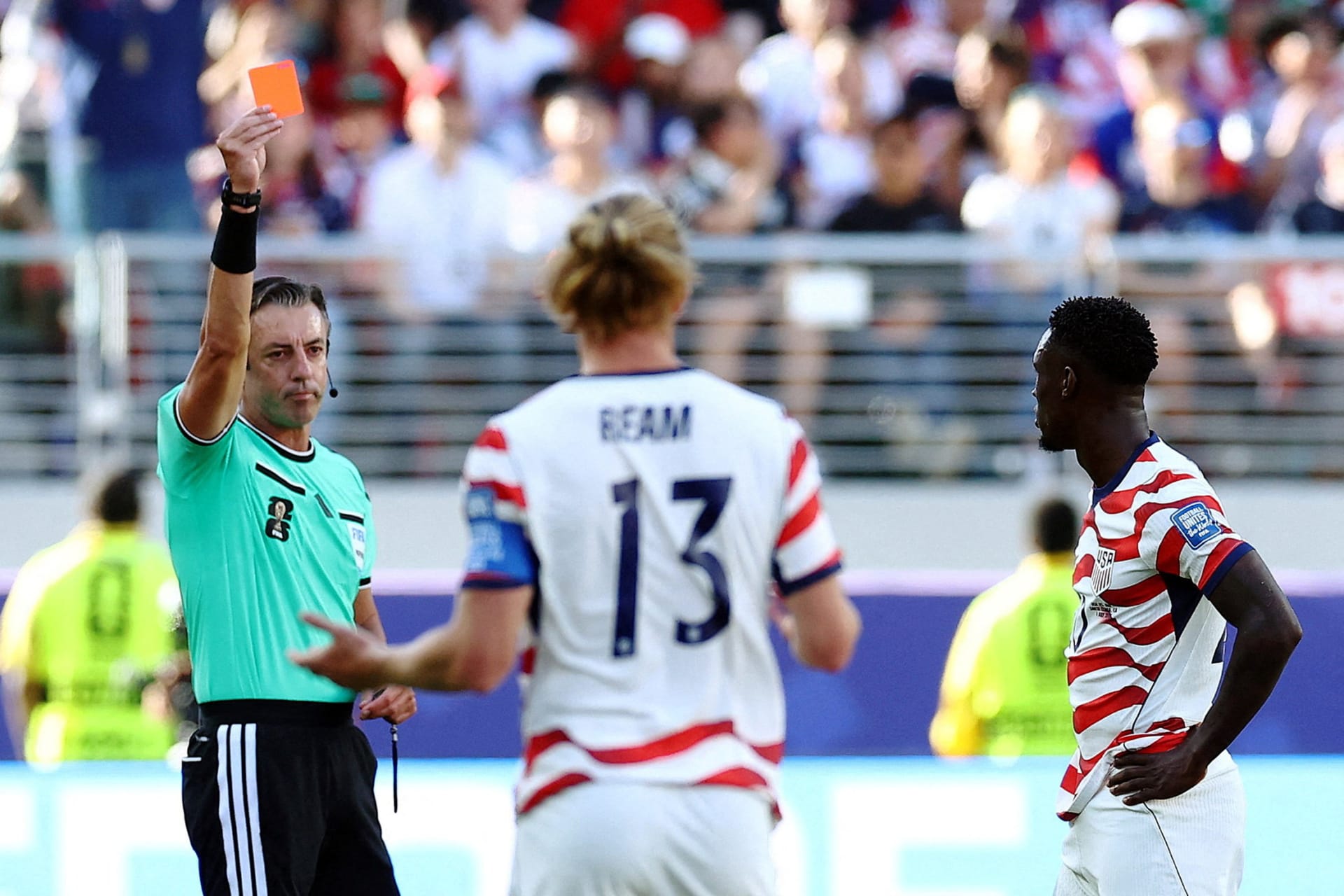
FIFA’s dramatic decision to rescind the red card issued to U.S. Men’s National Team (USMNT) star striker Folarin Balogun has left the world grappling with the question of who makes or unmakes the rules and whether or not they are consistently applied to all regardless of status.
The red card was issued in the second half of the round-of-thirty-two match against Bosnia and Herzegovina by Brazilian referee Raphael Claus on July 1. Many fans, especially those of the U.S. team, found the penalty to be unduly harsh. Some argued that the most the striker should have received for his offense, which was only brought to the attention of the referee by FIFA’s video replay system, was a yellow card.
President Donald Trump said he called FIFA President Gianni Infantino in the aftermath to “review” the red card decision. The soccer body then later dismissed Balogun’s suspension, a move that the U.S. president welcomed on his Truth Social account: “Thank you to FIFA for doing what was right, and reversing a great injustice!”
While controversy of this nature is par for the course, it is neither here nor there, for the incontrovertible fact is that FIFA has stoked a needless controversy by reversing a decision after the fact. This is a decision, incidentally, that the United States Soccer Federation didn’t even bother to appeal—no doubt aware it had no legal grounds to do so. But now, given the backlash, this move has done irreversible damage to the reputation of both the United States and FIFA, whether or not Balogun is in the squad to face Belgium.
For the United States, it further reinforces the perception that, particularly under the current administration, the country marches to its own beat. It now adheres to the rules (whether in international sport or international politics) only when it is convenient, and that when push comes to shove, the United States can be counted on to bend the rules to suit its interests. Trump’s critics will, perhaps justly, cite this as yet more evidence that the leader of the free world is prone to incessant violation precisely because he possesses an authoritarian instinct that understands no limits.
However, the Balogun affair is just the latest chapter in a longer U.S. story. In the immediate aftermath of the Russian invasion of Ukraine in February 2022, the foreign policy cognoscenti turned to the question of rules and norm-making in the international system. There was consensus, especially in the Western hemisphere, that the United States and its allies should stand up to Russia for its brazen violation of the territorial integrity of a neighboring state. And yet, at the same time, there was no shortage of critics—mostly from the developing world, and perhaps best embodied in a speech given by then-Kenyan UN Ambassador Martin Kimani—who accused the United States and many of its Western allies of hypocrisy. As those critics were eager to point out, although it was important for the international community to defend Ukraine, it should not be forgotten that most of those invoking the language of sovereignty were themselves notorious lawbreakers who have historically run two sets of books when it comes to the rules of international diplomacy.
The Trump administration’s decision to weigh in on Balogun’s red card now spreads this debate further. It is not just a layer to global conflict and international politics anymore. Trump’s call to Infantino represents a tainting of the innocence, joy, and fandom that surrounds this global soccer competition.
The decision will further stoke resentment among soccer aficionados worldwide who, before now, have taken exception to what they perceive as the gradual Americanization of the sport, whether in the form of commercial elements such as halftime shows and mandatory hydration breaks or expanding U.S. takeover of major European soccer franchises. At the moment, eleven English Premier League clubs—including traditional powerhouses Arsenal, Chelsea, Liverpool and Manchester United—are majority-owned or controlled by American individuals, families, or investment groups.
FIFA, too, has not covered itself in glory. For some time now, its top echelon has faced accusations of corruption. Back in 2015, the U.S. Department of Justice indicted more than two dozen officials for soliciting “more than $150 million in bribes in exchange for lucrative television, marketing, and World Cup hosting rights.” FIFA has sought to justify its rescission of Balogun’s red card on Article 27 of the FIFA Disciplinary Code, which apparently “allows a judicial body to fully or partially suspend a disciplinary measure and place the player on a probationary period.” Europe’s soccer governing body, UEFA, is having none of it. “When the certainty of rules is no longer guaranteed by its guardians,” UEFA said, “the integrity of the game is at stake and the credibility of a competition is undermined.” Those who, perhaps rightly, see FIFA as too amenable to political persuasion—and the FIFA president as too friendly with Trump—are unlikely to be convinced otherwise.
In recent years, the United States has lost face among allies who argue that it has failed to live up to its billing as the exemplar of liberal democracy. The idea of the U.S. president applying pressure on the FIFA boss to do what everyone knows to be wrong to secure an unfair advantage is unlikely to win the country new friends at a time of heightened unpopularity on the global stage.
What Trump and Infantino have done is not cricket, and the sporting world can see it clearly as below the standard of the sport. Preaching to others about the sanctity of rules while blatantly violating them is the height of hypocrisy. Neither soccer—nor politics—can thrive on the basis of one rule for me and another for thee.
This work represents the views and opinions solely of the author. The Council on Foreign Relations is an independent, nonpartisan membership organization, think tank, and publisher, and takes no institutional positions on matters of policy.