Time to Bolster Africa’s Security Institutions
By experts and staff
- Published
- Stewart M. PatrickJames H. Binger Senior Fellow in Global Governance and Director of the International Institutions and Global Governance Program
Given the tumultuous decade since 9/11, it’s easy to overlook one of the world’s unsung success stories: the spread of peace, prosperity, and good governance across much of sub-Saharan Africa. This hopeful trend is challenging the still-common Western view that Africa is doomed to be the perpetual ward of the international community. Fifty years after decolonization, Africans are shrugging off a sad legacy of violent conflict, stagnant growth, and venal political leadership.
One force behind this transformation is the African Union (AU), which succeeded the dysfunctional Organization of African Unity (OAU) in May 2001. A decade after its founding, however, the AU suffers from serious shortcomings in its ability to implement its grandiose ambitions. The goal of U.S. policy, as George Washington University professor Paul D. Williams argues in a new Council on Foreign Relations report, must be to help the AU close this “capabilities-expectations gap.” In short, Washington must persuade African leaders to commit themselves politically and financially to a more robust AU system of conflict management, including effective mechanisms for early warning, political mediation, coercive sanctions, and peacekeeping. Rather than charity, this would be an investment in the stability of a continent increasingly important for U.S. counterterrorism efforts, energy security, and trade and investment opportunities—not to mention ensuring peace within a post–Qaddafi and –Mubarak Africa.
In its short history, the AU has played a significant role in Africa’s improving security, economic, and political environment. The OAU was famously wedded to the principles of absolute sovereignty and non-intervention in the internal affairs of member states. The AU Constitutive Act turns this on its head. It declared a policy of “non-indifference” concerning the internal affairs of African governments, condemns “unconstitutional changes of government,” and legitimates coercive intervention in African states in situations of mass atrocities. Since 2003, the African Union has condemned every coup and, indeed, regularly peppers its official statements with expressions of support for democracy.
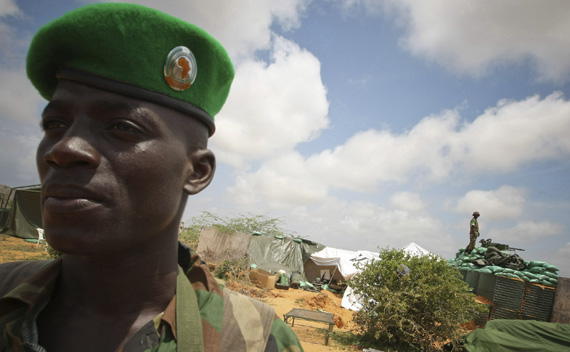
Under the rubric of African solutions to African problems, the AU has also created an African Peace and Security Council (PSC), deployed member state troops in AU-led peacekeeping missions, and begun developing subregional military capabilities within the AU’s eight recognized regional economic communities (RECs). AU troops are currently leading the UN mandated African Union Mission in Somalia (AMISOM), with a 9,000 person force, recently authorized to rise to 12,000 troops.
Regardless of the AU’s progress, the Internationalist finds the following areas merit U.S. concern:
As Williams’ paper suggests, it’s time that the Obama administration increase strategic cooperation between the AU and Africa Command, the focal point for U.S. military engagement on the African continent, including exchanges of officers. Second, the administration should deploy U.S. civilian experts in conflict management to help bolster the AU’s early warning, conflict prevention, and mediation efforts. Third, the United States should work with other likeminded governments with significant military assets to help fill the gaps in the AU’s operational capabilities, including in the areas of lift and logistics. Fourth, the Obama administration should work with Congress to ensure continuation of the Africa Contingency Operations Training Assistance (ACOTA) program and with its Group of Eight partners to extend the Global Peace Operations Initiative, to ensure that more African countries have professional troops they can deploy to AU operations. Finally, the United States should work to enhance the AU’s intelligence collection and analytical capabilities.
Again, given the ongoing leadership transitions taking place in North Africa, the AU will inevitably become even more of an indispensable regional institution. Let’s hope U.S. officials both recognize and act on this sooner rather than later.