Trump’s Defense Demands Are Pushing Asian Allies Toward China
The Trump administration now demands that Asian partners dramatically increase defense spending—the same pressure it has applied to NATO allies for years. This push is giving China an opening in Asia it has long sought.
By experts and staff
- Published
 Joshua KurlantzickCFR ExpertSenior Fellow for Southeast Asia and South Asia
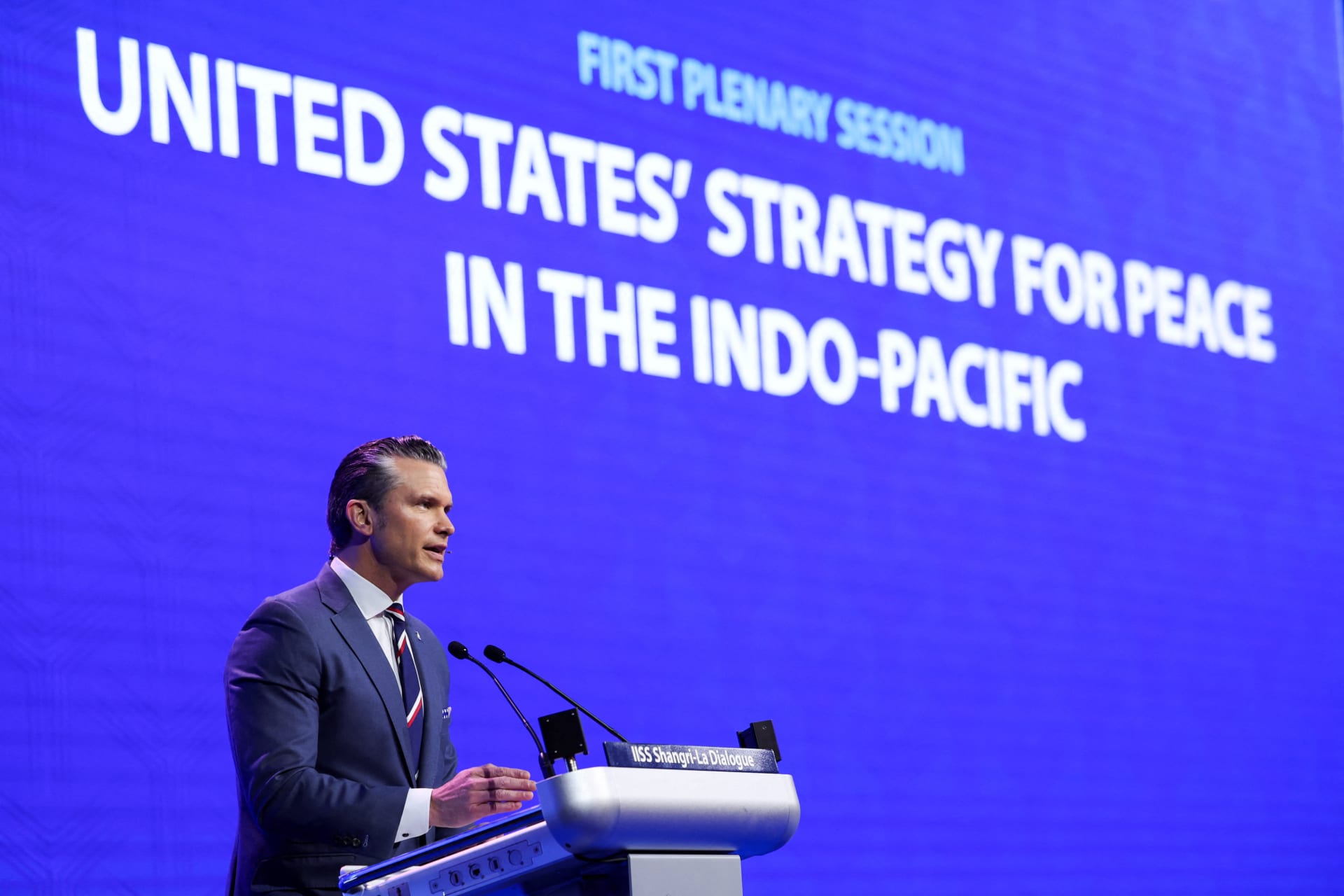
At the May 2026 Shangri-La Dialogue in Singapore—Asia’s premier annual defense forum—U.S. Secretary of Defense Pete Hegseth delivered a message any European defense minister would have recognized from a Trump-era NATO summit. “The era of the United States subsidizing the defense of wealthy nations is over,” he declared. “We need partners, not protectorates. We seek alliances built on shared responsibility, not dependency.” Then he put a number on it: every Asia-Pacific ally and partner should commit to spending 3.5 percent of GDP on defense—with some reports suggesting that Washington’s real floor is closer to 5 percent.
This is the same logic the Trump administration has pressed on European NATO members for years, but Asia is not Europe. The economic, political, and strategic obstacles to meeting these demands are far greater across the Indo-Pacific than across the Atlantic, Washington is far less likely to get what it wants, and the U.S. approach risks deepening Asian instability.
According to the Stockholm International Peace Research Institute, Singapore allocates 2.8 percent of its GDP to defense; South Korea, 2.6 percent; Taiwan, 2.1 percent; Australia, 1.9 percent; Japan, 1.4 percent; and the Philippines, 1.3 percent. Poorer Southeast Asian states spend even less. Closing those gaps to 3.5 percent—let alone 5 percent—would require historic budget increases from economies that are, in many cases, less wealthy than their European counterparts and are now absorbing severe fiscal shocks from the 2026 Iran war.
At the Shangri-La Dialogue, Vietnam’s President Tô Lâm, Australia’s Deputy Prime Minister Richard Marles, and Japan’s Defense Minister Shinjirō Koizumi all pushed back against Hegseth, arguing that the region’s real problem is a shortage of trust in Washington’s defense priorities and adherence to rules, not a shortage of arms. That pushback reflects genuine structural differences compared to Europe, as well as Asia’s collapsing trust in the Trump administration.
European countries operate within NATO’s integrated command structure, share a threat perception sharpened by Russia’s invasion of Ukraine, and carry decades of institutional habits around burden-sharing with the United States. Asian partners have none of that. In addition, European countries “have pulled more closely together in the face of U.S. threats to abandon their security through vehicles such as the coalition of the willing that supports a multilateral force in Ukraine,” Zack Cooper and Mira Rapp-Hooper recently noted in Foreign Policy. “They have begun to form a backup plan through bilateral pacts to build resilience in case the United States continues to rethink its commitment to transatlantic cooperation.”
U.S. allies in Asia have no such Plan B. “For Australia, Japan, the Philippines, and South Korea, the alliance with the United States cannot be replaced,” they added.
There is no Asian equivalent of NATO, and building such an alliance in Asia would take years, if not decades. ASEAN’s founding Treaty of Amity and Cooperation enshrines noninterference and consensus-based decision-making as bedrock principles—making bloc-wide defense commitments structurally impossible. Japan’s pacifist constitution—reinterpreted since 2014 but never formally revised, though that could change soon—still shapes its defense posture and domestic politics. Southeast and Northeast Asian governments conduct enormous volumes of trade with China; they cannot afford to be seen openly joining an anti-Beijing coalition.
Geography and economics compound the problem further. Indo-Pacific deterrence turns on maritime choke points, island chains, and the enormous distances of the Pacific Ocean—all of which require capital-intensive naval and air capabilities that take decades and hundreds of billions of dollars to build. Asking lower-to-middle-income states such as the Philippines or Vietnam to simply spend more badly misunderstands what credible deterrence in this theater actually costs.
To be sure, many Asian countries, worried about China’s military buildup and aggressive actions in regional waters, will increase defense spending in the years ahead—not in partnership with the United States, but out of mistrust in it. They will spend more because many, like Japan and South Korea, no longer feel confident that the United States will defend them if attacked. Many have become openly antagonistic to Washington, especially after the Trump administration tried in 2025 to impose sweeping tariffs on many Asian states and offered outright disdain for allies such as Australia.
Meanwhile, the Trump administration has taken an increasingly soft line toward China—holding off on arms sales to Taiwan and downplaying China’s military buildup and aggressive actions in regional waters. That posture has further convinced many Asian officials, in conversations I have had, that the White House cannot be trusted to protect them from Beijing. At the Shangri-La Dialogue, Hegseth said there was “rightful alarm” about China’s military buildup, but also declared, “We respect their ambitions.” He did not mention Taiwan, becoming the first U.S. defense secretary in more than a decade not to do so at the forum. As the New York Times reported, current and former officials in the United States and Asia read the signal clearly: “Mr. Trump intends to accommodate China, and other countries should fall in line.”
The signal that Taipei and other U.S. partners across the region have received is that the United States could treat Taiwan’s defense as a negotiating chip rather than a core interest worth defending. And if that is how the White House treats Taiwan, Asian officials have said to me, how can they be sure it would not treat them the same way?
The Trump administration’s disdain for Asian partners, willingness to accommodate China, and unreasonable demands for defense spending are leading Asian states to organize their defense planning how they want.
The United States does not want Japan or South Korea to develop nuclear weapons, but they could do so regardless. A March 2025 poll by the Asan Institute for Policy Studies found that 76 percent of South Koreans support acquiring an indigenous nuclear weapon—up five percentage points since 2024 and the highest level of support since the poll began in 2010.
In Japan, a substantial share of elites who have expressed openness to nuclearization have cited the absence of a long-term U.S. security commitment as their primary motivation. The relocation of THAAD missile interceptors from South Korea to the Middle East, tied to the Iran war, has already reinforced the message that U.S. security assurances are conditional rather than permanent—fueling a push toward independent missile defense and nuclear ambitions across the region, and in Seoul and Tokyo above all.
A nuclear-armed South Korea or Japan would rank among the most destabilizing developments in the post–World War II international order. No one knows how China and North Korea would respond, but proliferation pressures across the region would accelerate, and it would signal the collapse of the U.S.-led alliance structure in Asia.
As Thitinan Pongsudhirak of Chulalongkorn University in Bangkok notes, a regional defense buildup on a scale unseen since the Cold War could deliver little net security benefit to Asian states anyway, because China would simply respond in kind. An arms race in the Indo-Pacific, without clear U.S. leadership, could instead produce the kind of miscalculation between powers that led to World War I.
Cumulatively, the United States’ approach to Asia continues to hand China exactly what it has long sought: regional influence. China is already the dominant economic and trade power in the region, at a time when the United States has essentially withdrawn from multilateral trade agreements in Asia. Southeast Asian governments that spent decades carefully managing relationships with both Washington and Beijing now watch a United States that demands more from partners, offers weaker security assurances in return, and treats China as a great-power peer rather than a shared regional challenge requiring collective management.
The 2026 State of Southeast Asia survey found that Southeast Asian countries now prefer China to the United States as a partner. The survey also showed that U.S. leadership under President Donald Trump had become the region’s biggest geopolitical concern—rather than anything China is doing.
Sentiment toward the United States across Asia and Oceania has sunk further since the survey was released. An April Ipsos poll found that 55 percent of respondents across Asia now believe China will have a positive effect on the world over the next decade, while only 40 percent think the United States will.
After the Shangri-La Dialogue, Rory Medcalf, a former Australian diplomat and widely respected voice in Canberra, summed up the regional sentiment succinctly. He said of Hegseth’s speech: “This was perhaps the least confronting speech from a U.S. administration in the twenty-three-year history of the Shangri-La Dialogue.”
The White House, alas, shows little sign of understanding how deeply its actions are alienating the region. Asian states are thus acting in ways that simply ignore U.S. preferences. Some of those plans also could make one of the most dangerous regions in the world even more prone to conflict.
This work represents the views and opinions solely of the authors. The Council on Foreign Relations is an independent, nonpartisan membership organization, think tank, and publisher, and takes no institutional positions on matters of policy.