Trump’s State of the Union Addresses Domestic Policy
By experts and staff
- Published
Welcome to the Daily News Brief, CFR’s flagship morning newsletter summarizing the top global news and analysis of the day.
Top of the Agenda
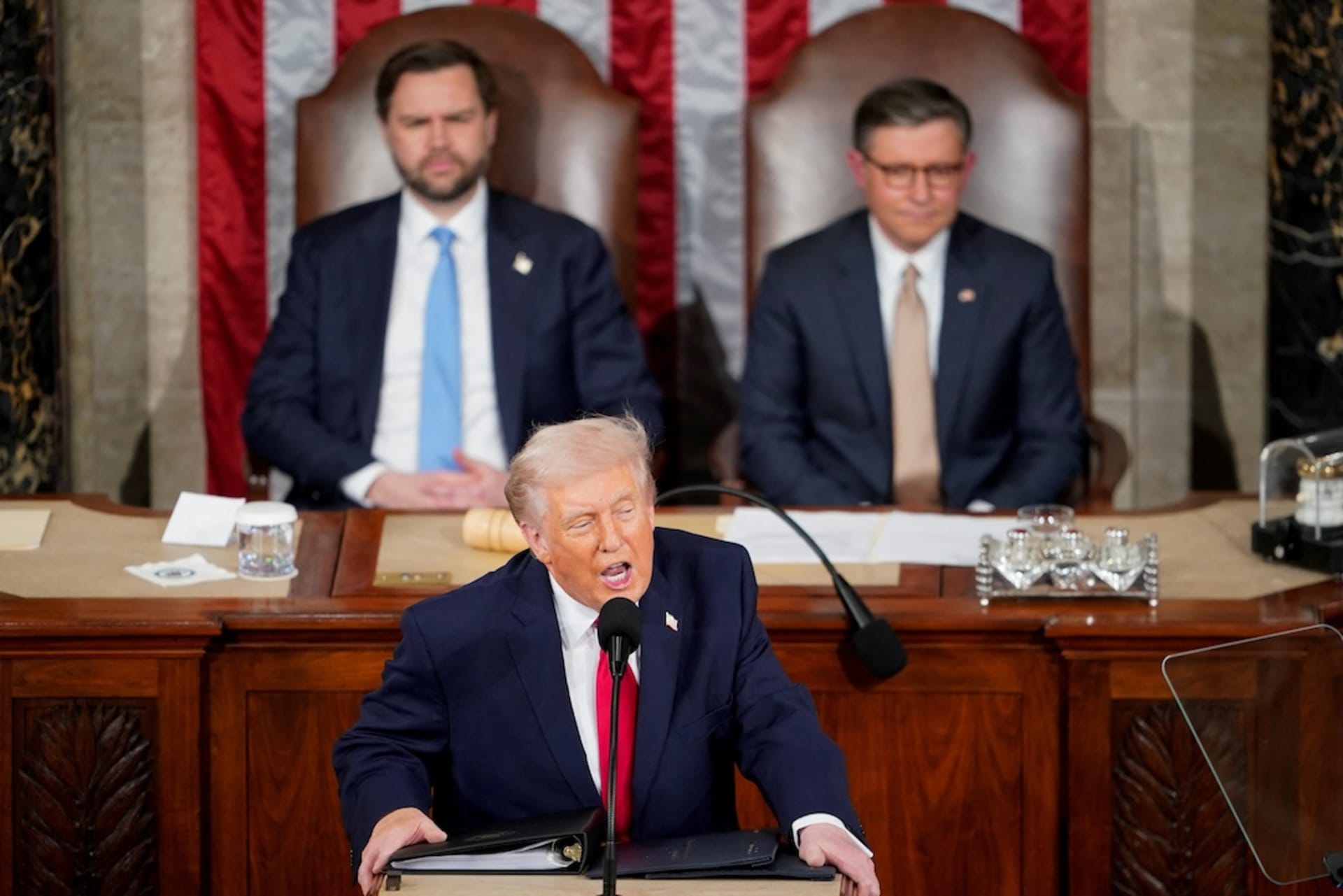
Trump focused primarily on domestic policy in his State of the Union speech last night and devoted most of his foreign policy comments to immigration. He argued that his economic policies had improved Americans’ lives over the past year and defended his “peace through strength” foreign policy posture. He notably made only a passing reference to China, for the most part focused on the Western Hemisphere.
On tariffs and the economy, Trump called last week’s Supreme Court ruling that struck down his emergency tariffs “unfortunate,” but vowed to maintain the duties under other legal statutes. He claimed most countries want to maintain the trade deals they struck in response to high U.S. tariffs. Trump criticized higher inflation during the Biden administration and pointed to lower levels in 2025. He also announced a new effort to control household energy prices via commitments from tech companies to provide for their own data center electricity needs.
On the Middle East, Trump said he sought a nuclear deal with Iran to thwart the country’s “sinister ambitions” to obtain nuclear weapons, but said he had yet to hear Iran commit to abandoning those ambitions. He also warned that Iran was trying to develop missiles that could reach the United States. Iran’s foreign ministry spokesperson broadly denied Trump’s claims about its missile and nuclear program today. Trump also celebrated progress toward peace in Gaza, taking credit for hostage returns during the truce, even as he said some violence persists.
On the Western Hemisphere, Trump hailed reduced immigration at the southern border, claiming it made the country safer, and celebrated his anti-drug boat strikes. He also praised the January U.S. military operation to oust former Venezuelan President Nicolás Maduro, saying that under an interim government led by Delcy Rodríguez—a Maduro ally—Venezuela has become “our new friend and partner.”
On Europe, Trump’s main mention of Russia and Ukraine was a quick reference to ongoing peace negotiations. He referred to NATO countries as “friends and allies” and hailed their commitment—following U.S. urging—to hike defense spending to 5 percent of GDP.
In the official Democratic response to Trump’s speech, Virginia Governor Abigail Spanberger contradicted his tariff claims, citing an estimate by Congressional Democrats that they cost U.S. households an average of at least $1,700 since Trump took office. She said Trump “continues to cede economic power and technological strength to Russia, bow down to China, bow down to a Russian dictator, and make plans for war with Iran.” Dozens of Democratic lawmakers boycotted the speech and attended alternate events where they criticized Trump’s policies.
“Trump’s advisers have been arguing for some time that the way to reverse his sliding poll numbers and boost Republican chances in November is to make the case that his policies are improving the economy and making life more affordable for average Americans…Foreign policy experts [are] listening to what Trump says—or doesn’t say about the rest of the world.”
—CFR Senior Fellow James M. Lindsay in an Expert Take
Across the Globe
Pentagon-Anthropic dispute. The Pentagon has issued an ultimatum to Anthropic over its technology use terms, multiple media outlets reported. If Anthropic does not agree by 5 p.m. Friday, the Pentagon reportedly threatened to label the firm a supply-chain risk or to invoke a law allowing the government to force the firm’s hand. Anthropic wants the Pentagon to comply with its policies that prohibit mass domestic surveillance and the use of autonomous weapons without human oversight, while the Pentagon seeks to use the technology for any lawful action.
UNGA vote on Ukraine. The United States abstained yesterday from a UN General Assembly vote on a resolution in support for “lasting peace in Ukraine.” The resolution passed 107-12, with 51 absentions. It called for an immediate truce, the release of illegally detained people, and the return of persons who had been forcefully transferred. The deputy U.S. ambassador to the United Nations said the resolution’s language was “likely to distract” from ongoing U.S.-led diplomatic efforts to get Russia and Ukraine to agree to a truce.
DEA back in Bolivia. Bolivia’s government has resumed cooperation with the U.S. Drug Enforcement Administration almost two decades after the country’s leftist Evo Morales administration ended joint counternarcotics operations and ordered the agency’s 2008 expulsion. The policy shift comes after a centrist government recently took power. Bolivia’s interior minister said Monday that the country was also cooperating with European intelligence and police and hoped to do so with neighboring countries as well.
Russian probe of Telegram chief. Telegram founder Pavel Durov confirmed yesterday that the Kremlin had opened an investigation into him over allegations of “aiding terrorism.” He wrote that the allegations were “pretexts” to suppress free speech and restrict access to the encrypted messaging platform. Russia has recently tried to coax citizens toward a state-run rival messenger and put restrictions on some of Telegram’s functions.
South Korea’s rising birth rate. The total number of babies born in the country last year rose 6.8 percent from 2024, bringing the country’s fertility rate to 0.8 for the first time in four years, the statistics ministry said yesterday. A ministry official attributed the jump to an increase in marriages among couples who had delayed their nuptials due to the COVID-19 pandemic. South Korea spent hundreds of billions of dollars over the last twenty years on policies aimed at boosting the birth rate.
Report on China’s military purge. More than one hundred Chinese military officers have potentially been ousted since 2022, according to a report published yesterday by the Center for Strategic and International Studies. The estimate far exceeds the government’s official total of thirty-six generals and lieutenant generals. The findings suggest that rebuilding China’s military leadership “will take time,” a report co-author and MIT professor wrote.
Japanese detainee in Iran. Tokyo today “strongly demanded” the release of a Japanese national detained in Iran since January, following a report by RFE/RL that Iranian authorities had arrested the Tehran bureau chief of the Japanese public broadcaster NHK World. The RFE/RL report cited unnamed sources. NHK said it was unable to provide further information.
Afghanistan-Pakistan clashes. Troops from the two countries’ militaries exchanged fire across their shared border yesterday following Pakistani airstrikes in Afghanistan over the weekend. Pakistan said the strikes targeted groups responsible for recent militant attacks in Pakistan. Afghanistan’s Taliban government said the strikes killed and injured dozens, including women and children.