Why a Nervous Mideast Braces for a New Round of Upheaval
The largest U.S. military buildup in the Middle East in decades has the region on edge and uncertain about what might come next. The Trump administration’s effort to spur Gaza’s reconstruction could be overshadowed by the prospect of a new war.
By experts and staff
- Published
 Steven A. CookCFR ExpertEni Enrico Mattei Senior Fellow for Middle East and Africa Studies
Steven A. Cook is the Eni Enrico Mattei senior fellow for Middle East and Africa Studies at the Council on Foreign Relations.
The U.S. military has amassed significant air power that reportedly could be poised to strike Iran within days. Diplomacy between the two sides has so far failed to yield clear progress on disputes over Iran’s nuclear program or a range of other issues, including the country’s missile program, support for regional armed proxies, and harsh crackdown on civilian protesters. For countries in the region, the prospect of U.S. strikes has stirred concerns over reprisals on their territory and a new round of regional upheaval. But U.S. President Donald Trump has repeatedly signaled that forcing change in Iran will lead to a more peaceful Middle East.
This is reportedly the largest buildup of U.S. air power in the Mideast since the 2003 Gulf War. What are regional expectations of a U.S. attack on Iran?
Officials and diplomats from Arab states have admitted that while the U.S. buildup in the region indicates the strong possibility of an attack, they remain unclear about Washington’s objective. This is making them nervous, especially Gulf states. They fear Iranian retaliation and regional chaos should a U.S. military campaign result in the collapse of the Iranian regime. Although they dislike the regime, they fear prolonged regional instability that would disrupt efforts to transform their economies. Both Saudi Arabia and the United Arab Emirates (UAE) have signaled that they will not play a role in any attack on Iran.
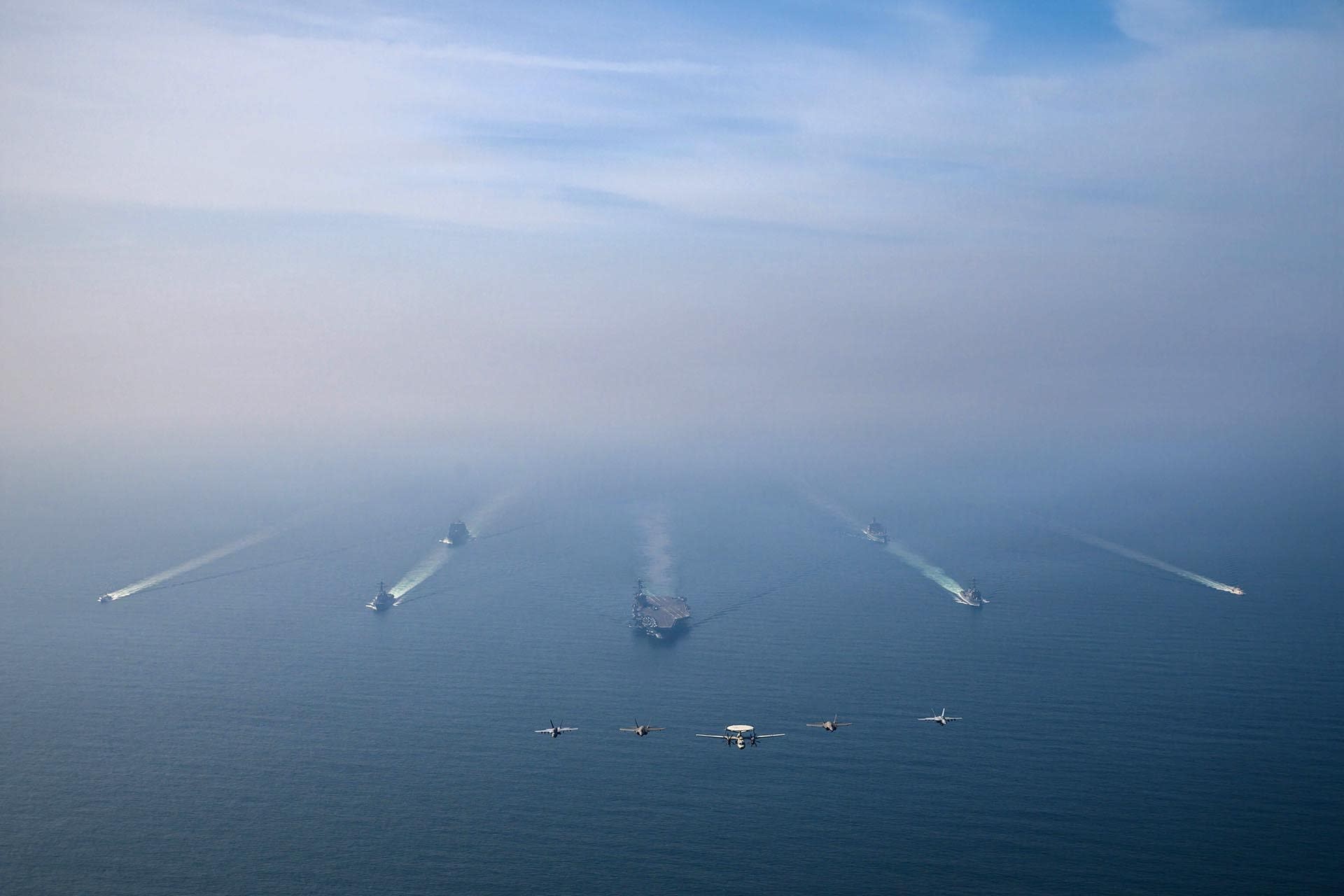
There have not been any noticeable military preparations in Bahrain, Kuwait, Qatar, Saudi Arabia, or the UAE despite the obvious increase in U.S. military preparations at bases and facilities in these countries where the United States has access. The arrival of the USS Gerald R. Ford aircraft carrier and its battle group in the region this coming weekend means that all the components for U.S. military operations are in place. The Ford, together with another carrier, the USS Abraham Lincoln, and its accompanying battle group, provide air defense and other critical capabilities. These deployments will supplement Israel’s own multi-layered system and help protect U.S. partners in the Gulf.
Iran’s Revolutionary Guard partially closed the Strait of Hormuz to conduct military drills. How disruptive can Iran be in the region if attacked?
U.S. security planners have long been concerned that Iran could disrupt the Strait—which connects the Persian Gulf to the Indian Ocean—during a crisis. That is why the United States has consistently warned Iran that closing the waterway would precipitate a war.
In the most recent incident, Washington let Tehran’s saber-rattling and bravado slide. The Iranians only disrupted freedom of navigation for a few hours; it is generally unwise to get lured into a conflict before a country’s forces are prepared.
What remains of Iran’s proxies, including the Yemen-based Houthis and various Iraqi Shia militias, may try to target Israel, U.S. forces, and other U.S. partners in the event of hostilities. No doubt, U.S. military commanders have considered this scenario. It is important to note that these groups sat out the Twelve-Day War between Iran and Israel in June 2025 apparently fearing that they would be targeted. Having lived to fight another day, they could potentially join hostilities to widen the conflict.
This week’s U.S.-Iran diplomacy in Geneva yielded what was described as an understanding of the “guiding principles” of talks, but are there any signs of a potential deal between the two sides?
The Iranian delegation left the meeting in Geneva trumpeting an agreement on principles, though the Americans were more circumspect. There is speculation among analysts and journalists that negotiations will resume in several weeks (if the United States does not decide to take military action), though no date has been set.
It is unclear exactly what the United States and Iran agreed to in Geneva. The scope of the talks has been subject to a fair amount of speculation. U.S. Secretary of State Marco Rubio initially indicated that negotiations would cover Iran’s nuclear program, its inventory of ballistic missiles and the capability to manufacture those weapons, and Tehran’s sponsorship of regional proxies. The Iranians are seeking a narrower agreement on its nuclear program that would limit, but not eliminate, its uranium enrichment. They have reportedly tried to sweeten any potential deal by offering to purchase Boeing airplanes and strike deals with the United States on mining and other investments.
Meanwhile, Trump promoted peace at his inaugural convening of the Board of Peace in Washington this week. How significant is the Board’s launch given the threat of war with Iran?
The president stated in his remarks at the inaugural Board of Peace meeting that the new body would focus on the reconstruction and stabilization of the Gaza Strip, though he did imply that it would play a role alongside and supervising the work of the United Nations. That seems unrealistic given the Board’s limited membership and the lack of interest in it among some of Washington’s traditional allies, notably France, Germany, and the United Kingdom.
The Board of Peace meeting itself was no different from other meetings after a round of conflict between Israel and the militant group Hamas. There were lots of commitments, particularly in terms of financial aid. It remains to be seen whether donors will follow through. Hamas’s refusal to disarm or renounce a political role in Gaza complicates reconstruction. Countries will be reluctant to invest financial resources in Gaza if they fear future conflicts will destroy housing, hospitals, and infrastructure for which they paid to be rebuilt.
Although not directly connected, the juxtaposition of the inaugural meeting of the Board of Peace and the possibility of war with Iran says much about how Trump views this idea of “peace through strength.” He believes that a demonstration of force will encourage the Iranians to negotiate in good faith. Barring that, he seems comfortable using the military to force change in Iran that he believes will forge a more peaceful region.
This work represents the views and opinions solely of the author. The Council on Foreign Relations is an independent, nonpartisan membership organization, think tank, and publisher, and takes no institutional positions on matters of policy.