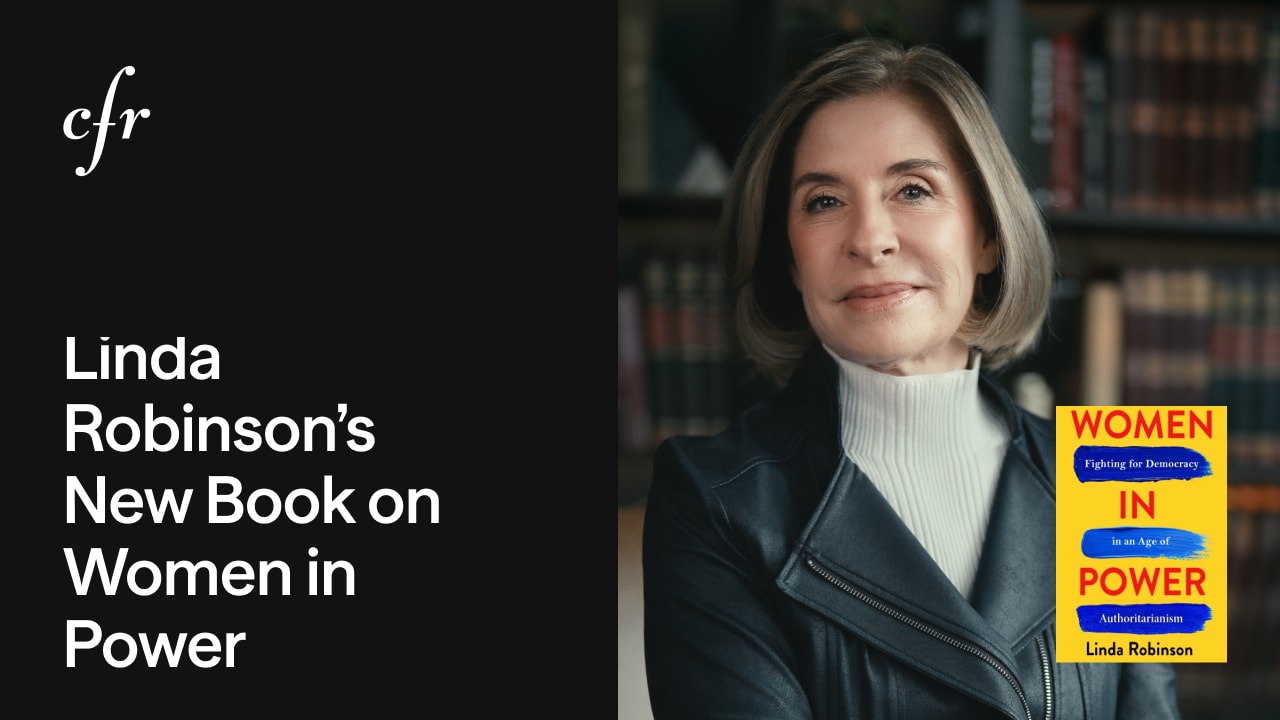
CFR Fellows’ Book Launch Series: Women in Power
Event date
Speaker
- Linda RobinsonCFR ExpertAuthor, Women in Power: Fighting for Democracy in an Age of Authoritarianism; Senior Fellow for Women and Foreign Policy, Council on Foreign Relations
Presider
- Former U.S. Ambassador to the United Nations (2021–25); Member, Board of Directors, Council on Foreign Relations
In Women in Power: Fighting for Democracy in an Age of Authoritarianism, Linda Robinson, CFR senior fellow for women and foreign policy and best-selling author of books on hybrid warfare, examines the governing formulas that women leaders are using to defend democracy and build domestic resilience. Robinson argues that women on the frontlines of existential threats have proven adept at combatting rising threats to democracy with diplomatic, informational, military and economic tools. On the international front, they are leading efforts to improve access to justice, make digital technologies safer, and stem violent extremism.
The CFR Fellows’ Book Launch series highlights new books by CFR fellows.
THOMAS-GREENFIELD: Hi. Hello, everyone. You are in for a treat. And if you have not already read this book, you certainly will enjoy this discussion, and I know that you all will go out and purchase it immediately after the discussion because it really is a great read.
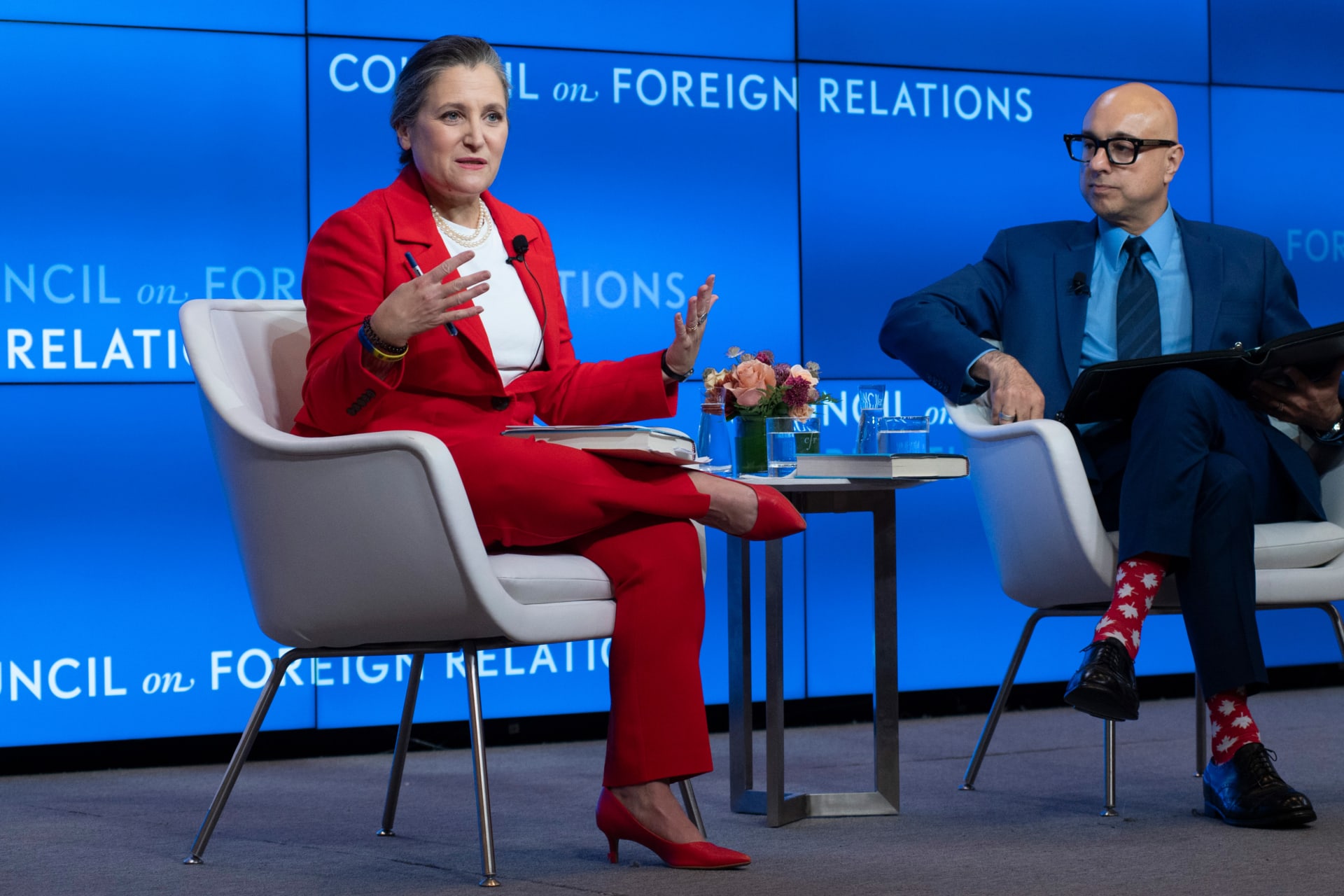
So let me start by welcoming all of you today to the Council on Foreign Relations meeting. My name is Linda Thomas-Greenfield, former U.S. ambassador to the United Nations and a member of the board of directors here at the Council. And I will be presiding over today’s discussion. I’m joined today by Linda Robinson, who is CFR’s senior fellow for women in foreign policy and the author of Women in Power: Fighting for Democracy in an Age of Authoritarianism. You all have her bio in front of you so I won’t take the time to share that with you.
So Linda—and I told Linda to call me Linda—(laughter)—Linda, I’d like to start by asking what motivated you to write this book, uniting the themes of democracy, authoritarianism, and women’s leadership?
ROBINSON: Thank you. And I do have to say, Madam Ambassador, it is such an honor to have you here with us this evening. I could not have dreamed to have a better moderator. So thank you.
So I was really motivated because, as you noted, we are in a time of historic decline for democracy globally. And the consequences for women, the situation of women and women in politics. is integrally related to what’s happening to democracy, writ large. They are not only affected by the forces that are causing democratic decline, but they are also a critical part of the antidote. They are—many of the women in power are contributing substantially and in novel ways with what I call fungible formulas to shore up democracy and pursue systemic reform. So it was really the crisis of democracy that motivated me.
But I identified what I call three headwinds that are particularly affecting women’s ability to achieve positions. We’re, in fact, at a plateauing now after decades of incremental gains for women. We are facing a plateauing of women’s participation. And I’d like to just throw out a few datapoints. But women are 27 percent of the world’s parliamentarians, 22 percent of the world’s Cabinet members, and only 7 ½ percent of the world’s heads of state and government. And that is after years of gains. We are now stalled. In the last cycle, 2024 election of the U.S. Congress, fewer women were elected than any time since 2010. That’s just one datapoint that shows we’ve really leveled off.
THOMAS-GREENFIELD: I read something in the book that I mentioned to you when we were in the green room that really shook me. And that is that 70 percent of people live under some form of dictatorship or authoritarianism. Tell us a bit about how you came up with that number and what that means for all of us.
ROBINSON: Yes. Thank you. And I think this is so important, since my goal is to center what’s happening to women within this larger context of democracy. And as half of the population, it should be kind of intuitive to many of us that what happens to women is really going to affect the course of democracy. But what I drew on were the three major democracy trackers or indices. There’s Freedom House, very well-known one, that says we’re in the twentieth year of democratic decline. There’s the Varieties of Democracy, Sweden-based, very thick measure of democracy. And the Economist Intelligence Units Democracy Index. And they may differ in the margins, but they all agree with the big picture. And it was Variety of Democracies that said 74 percent, actually, of the world’s population now live in autocratic regimes, that can be of an open or closed type.
So that is really a shocking statistic. And it also is important to note the trend. Forty-one percent of countries are in the process of autocratizing. So this is—it’s not just already widespread, it’s a continuing trend. And that has, I think, the attention of many people in the political science community, but it is particularly important here. We’re going to talk about foreign policy, but it also is important to note the U.S. has declined. All three indices show a U.S. decline. And that is so consequential, due to its size and influence. And while some countries have made U-turns—Hungary, Brazil, Poland, and Slovenia, one of the countries I focus on—that countries can come back. So once you have turned that way, and it’s really through internal erosion of democratic rule of law, rights, checks and balances, checks on executive power. Most autocratizing is occurring now through that internal degradation, rather than through coups or invasions.
THOMAS-GREENFIELD: So from your research and the times you spent writing this book, did you find that women lead differently? And what can you tell us about those who are not democrats or those who are from the far-left or far-right? We know from history that, of course, women can be authoritarian as well. So what can you tell us about that?
ROBINSON: Yes. Well, these are two questions. And they’re both important. And the caveats are really important, because there’s certainly no attempt in this book to claim that all women are good leaders, that all women are democrats. Those generalizations just don’t hold water. And I mentioned the longest-serving authoritarian leader until recently was Sheikh Hasina of Bangladesh. And she actually jailed her female opponent for many years, and was ousted by a youthful popular uprising that has given Bangladesh a new lease on life. But certainly not the only authoritarian leader. And many of the right-wing leaders of Europe include among them women—France and Germany’s parties, as examples. So women come in all types.
And they do—and the book’s examples draw across the political spectrum. So we look at women as—just as men, they’re socialized by the forces that are around them, by the cultures. And what I do think, though, is women—many women are socialized to be more attuned to health, education, welfare. We see that. We see the evidence of that as they come into parliament, which is the largest dataset, but also in the opposition of government. That they pay more attention to those social safety net issues. It turns out climate also, many of them drawn to focus on that systemic challenge. And I think there’s a predilection to negotiation, which is sort of part of how they grow up as well.
THOMAS-GREENFIELD: Good. How did you choose the women that you focused on?
ROBINSON: So what I wanted to do, and I really—I wanted to tackle this issue of authoritarianism, and that is both an internal phenomenon but also authoritarian attacks from abroad. And so I wanted to look at how women in power face challenges of some existential sort. And that brings my foreign policy and national security background to bear, looking at women leaders who are challenged, in this case, Russia, China, regional powers, destabilization, and systemic challenges, like climate. So I really tried to look at how they did the governing formula. And as it turns out, many of these attacks are really hybrid attacks designed to exploit a country’s divisions and their vulnerabilities.
And so their responses to this type of hybrid warfare really involved strengthening their society along social, economic, political, information, cyber, across not just military. Because the way societies fail or become vulnerable is if they’re not resilient domestically. So what I was really struck is that these examples of women, with variations, really focused on these kinds of formulas. And I saw the women coming up often by movements of protest against corruption. There was an opening for them to come to power. Not that women don’t still come through family ties or political dynasties, but when there was a crisis of party or country, that often provided an opportunity.
THOMAS-GREENFIELD: Yeah. And that leads me to the next question. And that relates to the fact that many women do come to power when their countries are in crisis. And we had an opportunity to talk about President Johnson Sirleaf of Liberia, who—where I served as ambassador. And I watched her take this war-torn country, during my tenure there, and really bring the country from the ashes of war. But are there other instances that you detail in the book of women who’ve actually taken those kinds of situations and really brought their countries back into normalcy?
ROBINSON: Yes. Well, thank you. And I really appreciate your direct experience with the iconic leader of Africa. I think she was certainly the first freely elected leader who was a woman. And definitely coming at a time where dictatorship—she was confronting that, she was powered by a women’s movement, very critically. She was a recipient of a Nobel Peace Laureate. But she also did incredible transformations at home, dealing with debt, with the media. Free media was a very big part of what she was doing. And truth and reconciliation. And I looked for other examples in Africa, and actually she was elected just as I was finishing the research, but Namibia I wanted to call out has its first woman president. And we welcomed her here to the Council on Foreign Relations for a very inspiring talk, Netumbo Nandi-Ndaitwah. And I think she is also really focused on youth education, employment, critical minerals being processed in a way that benefit the country. I see her really having an ambitious program of government that will transform Namibia and deal with some of the root causes of its poverty and struggles. So I’m excited for that.
My case studies, and I guess I’ll just maybe do a quick summary and we could go into one or two of those. And it’s no accident that many are from Europe, because half of the world’s heads of state women right now are from Europe. But those women facing challenges—well, I want to start—I’ll go from the north. Sanna Marin, of Finland, woman prime minister, led a five-party coalition, all of those led by women. So she had a Cabinet of women, but also men. And she faced some—even though that’s a pretty gender-equal country, she faced really a surprising amount of very gendered attacks, often online. And there are a lot of studies now being done that really measured this. And they found that she and her women Cabinet members received ten times more of that type of abuse than the men in her government. And that, of course, the famous video of her dancing, which in her own memoir she has the chapter called Scandals. And I told her she should put it in quotation marks, because if someone dancing at a private party with the leaked video constitutes a scandal of state, I don’t know—
THOMAS-GREENFIELD: We saw the Polish minister dancing in public. (Laughs.)
ROBINSON: But this eclipsed her achievement, and it really was hers, that brought a country with a historic policy of neutrality into NATO. And she was very strong right away about the need, because it has the longest land border—Finland does—with Russia. And she saw right away that coming to NATO would provide the country’s security. And the president actually left it entirely to her to sell it to the party. So this was one case where I think she really stood out in the foreign policy realm strong on defense, although she’s a progressive climate change champion, and she’s continued to very strongly support not only Ukraine, but European defense.
And the same can be said for Estonia’s first prime minister, Kaja Kallas, who’s now the European Union’s chief of foreign policy and security policy. And she has—she’s really been relentless in terms of support for Ukraine, building not only European defense, but also energy independence. She’s very—has been a long-time champion of that. And also accountability for Russia’s crime of aggression. And I think that—she’s center-right, but she also made a condition of her coalition members that they agree to a 50 percent women Cabinet, a gender parity in her Cabinet. She championed equal marriage. She’s been very strong in calling out the kinds of abuse and belittlement that she and others have received.
I can’t stop without Maia Sandu of Moldova.
THOMAS-GREENFIELD: I was about to ask you about Maia. I got to know her quite well when I was—when I was ambassador here. And she is extraordinarily impressive. So would love to hear what your thoughts are on her.
ROBINSON: So Maia is such an interesting, and as a number of these women, she said, you know, I’m an introvert. I really don’t like being out there on stage. And I could quite appreciate that. But she is an extraordinary example of resilience in one of the most sustained hybrid warfare attacks that I know of, with years of Russian probing. There are still Russian troops—it’s a former Soviet republic. They have a little breakaway sliver called Transnistria. But it’s really not the military piece of it so much as energy, blackmail, trade cutoffs, because the country was very dependent on Russia in many ways. But overwhelmingly, cyber, disinformation, vote fraud, vote buying schemes, using the Russian-backed oligarchy in the country. Just this panoply—the Russian Orthodox Church, just this full onslaught of relentless attacks.
And she’s now won—she was first prime minister, two times president, and she won a parliamentary majority last year, which also enshrined the bid for EU membership in the constitution. That was her failsafe, because that is how she sees the country gaining its security. And it’s already reoriented trade, and energy, and so forth. And she too has pursued reforms to strengthen the social safety net, the rule of law, while also advancing women’s equality. She has huge coattails. Forty percent of the parliament is now women, municipality—mayors are majority women. And she—it’s a very conservative country socially, but she’s, why—she said, they didn’t elect me because I was a woman. They elected me because they thought I was honest.
THOMAS-GREENFIELD: Yeah. Well, let’s talk about Mia Mottley. I reached out to her, she’s a good friend, and told her I was going to be doing this with you tonight. And she told me she’s looking forward to reading the book. And I said to her, when you’re—when you’re in New York the next time, would love to bring you here and interview you. But talk about Mia. She has been a real voice on climate issues, but also what she was able to do in her own country to deal with debt issues and really integrate, and bring the country—unify the country again.
ROBINSON: Yes. Mia Mottley is the last chapter in the book. And we did welcome her here last year. I’m missing the date, but I want her back. So hopefully we can get her to come back.
THOMAS-GREENFIELD: Good. We’ll let’s work on that together.
ROBINSON: But she is the first woman prime minister of Barbados. Quite a formidable person. She does have a family that was in politics, but she really had a lot of obstacles of a gendered sort to get through. And she has now just won her third re-election, landslide elections. But, as you say, she confronted—she came to office with this hidden fiscal crisis. She had thirty days—less than thirty days of reserves to pay the country’s bills when she came in. And no one knew about it, partly because this debt had been sold and resold, and it’s a middle-income country so it doesn’t have access to concessional lending from the World Bank and others.
And so a lot of the debt was really being recirculated at exorbitant rates, such that she was facing bankruptcy. Called Christine Lagarde, who was then the IMF head, and said: I need a standby package so I can get there and negotiate. And she held out for a landmark deal to require, if the country was hit by a climate disaster—which happens regularly in the Caribbean and other island states—that they would pause the debt service, so they could use the fund available to recover and rebuild more resilient economies. And she took that win and made it—the World Bank agreed to make that a universal condition.
So that was the first, really, of her campaign. It’s called the Bridgetown Initiative. And if you’re not aware of it, I really recommend you read it, because it’s this array of very innovative proposals. And she has pioneered climate debt swaps. She really was a force behind the Green Climate Fund to be grant-focused rather than debt-laden. You know, increasing the debt burden of these countries, and people don’t realize, since the pandemic the outflow from the developing world to the lenders, lending entities, $50 billion a year. So they are paying out. It’s a net outflow. And that is just not going to cut it for countries trying to rebuild their economies to survive what’s coming out.
THOMAS-GREENFIELD: Good. In chapter three of the book, you talk about digital technology and how that technology has been used against women to push them out of political space. And it really resonated with me, because I engage a lot with young African women politicians. And many of them have shared with me how difficult it is to be in politics when you get these digital attacks that are relentless, that put out misinformation about you, personal things about you, pictures, that really lead them to question whether they want to be in politics. Tell me a bit about that, and whether there were women—you mentioned with Sandu that she certainly had that problem, but—
ROBINSON: Every single one of them. And this is what—and there is real data now. For a long time there wasn’t globally comparable data, so it’s been hard. I know the Inter-Parliamentary Union has done a series of global and regional studies, but it’s getting better. But you can certainly see enough examples to show, without a doubt, women are disproportionately affected by these online attacks, the gendered attacks. And this is what—it’s not about policy debates. It’s really graphic, sexualized, violent material, including death threats. And in the case of Jacinda Ardern of New Zealand, tripled—death threats tripled against her. And she was really subjected to an incredible onslaught. Sigrid Kaag, the deputy prime minister of Netherlands, there was a very good university study done. And it actually was affecting women across the political spectrum there, but she received the most at one every fifteen seconds.
So it’s really trying to understand that the volume, speed, and really violent nature of this material has an effect. And really is driving women out. One in six parliamentarians who are women do not finish their term now. And young women report being less and less willing to engage. So this is very serious. And it’s important to note, I think, you know, we have a couple of phenomena, the things I call headwinds. There’s a very regressive strain of right-wing authoritarianism, saying women should stay home, tend to the family, even versions that say women—the right to vote should be withdrawn from women, and a head of household only vote. You also have violent misogyny that’s really become an ecosystem that lives online, but it actually is happening offline. So I think this—what’s happening through the digital world is married to what’s happening in real life.
And then finally, with the advent of generative artificial intelligence, the deepfake porn phenomenon. Every woman politician that I know of, that I investigated, have multiples. Giorgia Meloni, the first woman prime minister of Italy, she’s taken them to court. She’s pledged to do something to tighten up their own procedures and laws. Europe does have a law that I think is one of the landmark laws, the Digital Services Act. And it’s still early in its implementation, but the structure of it is right. It’s not about censorship. It’s about product safety. And the onus is on the companies to assess their creations for systemic risks, one of which is gender attacks, gender bias. And they are to come up with mitigating strategies. They’re to report the data that shows what they’re doing. And there’s a compliance lever in the form of 6 percent of gross revenue, which is a very hefty fine.
And I think that kind of thing, to put the onus on the companies to actually design, put safety in the mix of designing their products, is how we should be approaching it. And I actually see bipartisan support growing in our Congress for doing these things.
THOMAS-GREENFIELD: Fantastic. So one last question before we turn it over to the audience. You know that the race is on for the next secretary-general. The general sense and expectation is that this time around it’s going to be a woman. So, based on your research and your discussions with women leaders, what advice and recommendations would you make to the next female secretary-general?
ROBINSON: (Laughs.) Well, this—you would be much better, having been there in the halls, than I to answer this. But I do want to note there are four women candidates at this point. More may come forward. There’s been a campaign, one of the leaders of which was here speaking to us last year about it, that after eighty years it is time for a woman secretary-general. We’ll have to see if that works. But I think where—and you have worked for this as well. What it seems to me—and Mia Mottley, very strong in this regard—that a lot of people have—feel the U.N. has been less than promised, and some reform in the governance is imperative, to include a more representative U.N. Security Council. And I write a little bit about that in the book, and note some of the candidates that were there as of that time.
But I think it’s very important to push that reform agenda in the U.N. Security Council. And there have been some attempts to use the Charter as it is to boost the General Assembly powers, as maybe a bridge and a halfway house. But I think it’s imperative not only that the Council become more representative, but there are real constraints on the overuse of the veto, so that that more representative body can speak as such.
THOMAS-GREENFIELD: Well, as you know, we did take on the issue of U.N. reform when I was—when I was at the U.N. We didn’t get very far with it. (Laughs.) But it wasn’t for lack of trying. And I think the new secretary-general, whomever she is, will have to engage on that issue. The secretary-general didn’t really—the current secretary-general didn’t engage on the issue. He saw it as an issue for the members. But I think if we are to make any changes, if we are to have some success, the new secretary-general will have to be part of that.
ROBINSON: And, may I also add, I think the menu has to be defending the Sustainable Development Goals and the targets for 2030. That is something that Gro Harlem Brundtland, the prime minister of Norway multiple times, helped formulate in its first iteration. And I think that’s really one of the things the U.N.—it’s an underpinning of its essential mission of peace and security. If you’re not trying to address those drivers, I don’t think you move ahead. And I think the U.N. also has to keep this idea of women as central to good governance. And I think they are in a bit of a quandary now about pressures to tighten their budget, but if it’s already an underfunded mission, and women as part of the equality equation needs to be front and center.
THOMAS-GREENFIELD: Well, thank you very much.
(Gives queuing instructions.)
I saw a hand right there, second person. And then I’ll come on this side. I’ll alternate.
Q: Hi, my name is—
THOMAS-GREENFIELD: And please introduce yourself.
Q: Hello. My name is Elizabeth Blazey. I’m a trader at Bank of America. Thank you both for your discussion here.
We’ve spoke—or, you’ve spoken a lot about the challenges each of these very impressive women face. I’m curious, what are some of the personality qualities or tactics, commonalities that you’ve seen have enabled them to be successful and overcome a lot of these challenges?
ROBINSON: Thank you. I didn’t get to mention Tsai Ing-wen of Taiwan, who is the two-time president there. And she is a case that I think is representative of many of these women. Women in general have closed the education gap. As people who follow these things know, the World Economic Forum’s annual gender gap report says it’s entirely closed. So by and large you see women coming to power with very good education and technocratic backgrounds many times. And Tsai Ing-wen was one of those. She was a trade expert. She helped Taiwan navigate entry to GATT, and then the WTO. She then became the Mainland Affairs Council chair for cross-strait relations. And the party turned to her when it was amid a corruption crisis and said, why don’t you run? She didn’t make it the first time, but then she had two landslide elections.
So I think really coming to power with the knowledge base and the technocratic skills. She was also a very good negotiator. She’s also a very good tactician, politically, because it is—as Nancy Pelosi said, it’s about power, not influence. You have to, you know, realize you’re in a power game. It’s a question of whether you’re going to use it for the benefit of your population, or not. And I think it is that sensibility of the country is stronger. The game is domestic resilience. And a country is only strong if it has social cohesion. And that’s why I think there’s a general approach toward—and she conducted labor reform, education reform, pension reform. But she would not let go of the gender equality portfolio. And she was the first country in Asia to pass a gender—a marriage equality law. And she too had coattails bringing women in.
So I think it’s that commitment to govern for all, but also be inclusive about who’s been left out. And in her case, not just women, and not just—she really went after the indigenous population that was marginalized. And in fact, most people in Taiwan now believe—see themselves as Taiwanese. So it’s that new national identity that’s really formed. And I guess it’s that inclusiveness that I see as a commonality.
THOMAS-GREENFIELD: Yes.
Q: Thank you. This is fantastic conversation. Congratulations on the book. I’m Lauren Leader, the founder of All In Together. It’s wonderful to see the Lindas.
I was so glad that you brought up the discussion about online deepfake, just the relentlessness of the attacks, the brutal nature by which women in public positions all over the world are being really assaulted by what we’re—I think the world is really just beginning to understand how vast and how significant an issue this is. We are seeing women getting pushed out of the public sphere. But given that this book is about authoritarianism, and that we know that women’s voices are the primary enemy of authoritarianism, the most powerful tool to undermine authoritarianism, do you think—are we seeing signs that maybe some of that violence and online hate may be coordinated and actually organized by pro-authoritarian regimes? It’s very hard to get a sense of if it’s—you know, like in 2016 the way the Russians interfered with elections, do we think that there are larger, potentially even state, actors that may be animating just some of the volume of hate against these women leaders?
ROBINSON: Yes. Thank you. I want to call out two things as examples. But that’s very important, because it is—it is being weaponized by other countries. And really, I think it’s—I look at this authoritarianism wave as really a transnational phenomenon. They’re both movements within countries, but they’re also oftentimes linked. In the case I just mentioned, Tsai Ing-wen, the Chinese published a book portraying her as a prostitute, which, for a professorial—I mean, it was just an outrageous piece of garbage, meant to be—and it was used—to peel off pieces and propagate it through social media. And that was clearly traced to them. And in fact, one of the pieces of her resilience—her policies to bolster resilience is a lot of forensic ability to track where the disinformation is coming from, because China spares no expense and effort with its information warfare. And a lot of it was directed against her personally.
A group called She Persisted, #ShePersisted, has done a number of country studies really documenting where this material is coming from, what are the themes, how it’s being leveraged and picked up internally? Moldova was one of them. I think they have somewhere between six and ten country studies. So that’s another really good—they’ve really used the technical skills in their group to ferret out the provenance. And, as Jacinda Ardern commented when she was looking outside her window in the government building and saw a noose hanging there, and the flags waving from different countries, she said something about this protest feels imported. So I think it’s important to look at what’s happening that’s being targeted from abroad.
THOMAS-GREENFIELD: Thank you. We have a question from our online audience.
OPERATOR: We will take our next question from Joseph Bower. Joseph, over to you.
Q: Oh, just a minute. OK.
I have a reputation, I think, at the Council of being a bit impolite. I think the topic we’re on is amazing. And, as we usually do at the Council, we’re being very polite. What’s happened to the United States? (Laughter.) And, I mean, most of what you’ve talked about in terms of attack on women and so on have gone on here. The stuff that was around when Hillary was running, forget about whether you think she should have been president or you don’t, but it was terrible. She had the same kinds of attacks you’re talking about. And on the other hand, we have governors—I live in a state with a wonderful governor who’s female. So what—do you have any thoughts on how we can break out or move back—I don’t—restore ourselves to something that’s admirable? (Laughter.)
ROBINSON: So, yes, I think I heard most of your question. And thank you so much. And I’m pleased to—I’m pleased to have that. And last week I was in Texas, and had a few initial conversations at World Affairs Councils and others. And I was very pleased that this question was being asked. And I think it’s just important to step back with some of the statistics I mentioned before. The U.S. is firmly in the middle of the pack. We’re not a leader in gender equality. We’re not a leader in having women in government. We do have a record number of governors, and you mentioned governors, right now, but at the national level we have not exceeded, and we are now, as I said, in a plateau situation. And the women—there has been documentation. I mean, going back to Hillary Clinton, but also with Kamala Harris, also the six women who ran in the primary before, very clear documentation of the waves of sexist abuse they received, and, yes, death threats.
And this is the thing, the Inter-Parliamentary Union really tracks and disaggregates. There’s abuse. There are violent threats. And there are actual attacks. So this should be seen as a seamless continuum of things that are happening to women. Is there an awareness of it? I have to say, when I gave the manuscript to my husband to read, he came ashen faced. He’s, like, I can’t believe all of this. He really didn’t know. And that’s not an excuse, but what I’m hoping with this book—and because of my background, I’ve been in national security and foreign policy, that maybe people who aren’t already aware of this would be inclined to pick this up, and thus understand just how severe and disproportionate this is.
And it is, again, not an argument that women are necessarily better leaders. They just have a right to be in the game too. And they should not be discounted as good leaders, as we see them excelling. These cases that I have, these are the most adverse circumstances you could ask them to be governing in, because the countries are under threat, and they’re knocking it out of the park. I’m not saying all women will do that, but it’s my intent is to show how they do it and that they can do it.
THOMAS-GREENFIELD: I think the other part of the caller’s question was about the rise of authoritarianism in the United States, and what that means in particular for the rest of the world.
ROBINSON: Yes. So we have such an enormous influence and generally seen as a paragon of democracy. But in fact, as I mentioned, all three of those major indices downgraded the U.S. this year in the—for 2025, and on the rankings of political and civil rights, checks on executive power, and rule of law issues. What they didn’t demote them on was elections, but that could be coming, right? We’re having all of this, you know, turmoil as we run—in the runup to the elections, the midterms. But I think what to me—and in addition to safety regulation in the tech sector, that is, I think, a very important thing to do. We’ve given the companies a shield from liability that no other—drug, food manufacturing, they don’t have a get-out-of-jail-free card for their products.
But it’s electoral reform. And there is a bottom-up movement for ranked choice voting. Proportional representation is being advocated by the American Academy of Arts and Sciences. I think these are ways to get at the polarization in society, have a more representative Congress, and, as a result, also more women will come in. So I think I would like to see more candidates talking about structural reform. It would really help us regain our democratic culture and standards. And it is quite frightening to see how far—Varieties of Democracy actually demoted the U.S. from the top category of “liberal democracy” to “electoral democracy” this year. So we—and we’re already halfway through 2026. So we have to, I think, as citizens be aware and do our bit.
THOMAS-GREENFIELD: OK. Thank you. On this side, the lady in red.
Q: Thank you so much. I’m Lesley Rosenthal. I’m the COO of the Juilliard School and president of the Friends of the Afghanistan National Institute of Music.
And I just couldn’t even imagine a conversation about women and authoritarianism without thinking of our twenty-five million sisters in Afghanistan living under the worst case of gender apartheid in this world right now. And I’m just wondering if you have a sense of where is the world on Afghan women? There’s money now flowing into the country from official sources. There’s a new flowering of tourism, if you can imagine. Like as if nobody cares. And what can we, as women and allies of women, do to bring more attention to the plight of our sisters in Afghanistan?
ROBINSON: Thank you for bringing up one of the great tragic cases of this time. And I appreciate that, because it’s important to know, while I’ve been talking kind of global trends, there are really acute situations. And I believe that while the aid has dramatically diminished, and many women have found a way to get out, there are still some underground schools. Which, you know, if you look to the future, you know, women being able to continue to get an education. But when they’re bringing back the harsh penalties against women, you have to fear just right now for people’s lives. And I think that’s been kind of a dilemma for countries, how to exert their leverage when they do supply aid? How can they attach the conditionality that improves the conditions right now for women? But unfortunately, and I did spend a lot of time in Afghanistan, are very familiar with the countryside where the Taliban was always the latent and dominant force. So to see it come back—the cities, of course, had advanced much during those times. But I am, without—I’m deeply concerned that it’s going to be a generational loss of life, loss of education, and loss of progress.
THOMAS-GREENFIELD: If I can comment on that as well, I think part of what we’re seeing is we have very short memories. And if the press is not putting this in front of us every single day, people tend to forget. And I think it’s really important—if there are press people in the room—that you start doing more to make sure that we don’t forget. Because you don’t hear—you don’t hear about Afghan women. And I spent a lot of time in Afghanistan as well. You don’t hear very much about Ukraine anymore. Our memories are very, very short. Gaza is barely in the news now. South Sudan, not at all. Sudan, not at all. So, again, I think it’s really important that we ask for more information, we demand more information, and we ourselves try to put out more information on what is happening, because I do think the world has forgotten about Afghan women.
All the way in the back of the room. The young gentleman who’s standing up.
Q: So I’m not exactly—I’m seventy years old. (Laughter.) And, as a sidebar, I would say that Joe Bower, who asked an earlier question, was my professor fifty years ago. We should all be so lucky. (Laughter.)
But more seriously, two serious questions. One is, if you had to tradeoff between democracy and gender parity, where would you fall out? And I ask this as a native of India, that the independence movement, which led to more democracy, was clearly largely male dominated. There were not—women were absent. And would you have held back that independence movement in favor of gender equality? The second question is, there’s a certain pathological aspect of people running for higher office, regardless of whether they’re from the left or the right. Would you exempt women from this? Or would you give women a pass from being pathological in running for office?
ROBINSON So, by pathological I assume you mean power seeking. And I think that is kind of a tautology. You have to be willing to get in the ring and realize what you’re bidding for is power. The question I have is, are you using the power for good and betterment of your country, and hopefully the society at large? I do have to say, you pose a tough question on the first one, because what we saw in the third wave of democratization was really many of those—and I spent a decade as a Latin America correspondent—and a lot of that was powered by women’s movements. And I think that in that third wave, really, gender equality became part of democracy. And. as I mentioned at the beginning, to me that’s just always seemed quite obvious, because women are half of the population. And in principle, while we’ve had democracies for centuries that didn’t include all people, we now, I think, think of democracy as entailing full representation. And you can’t just leave half of the population out of the equation.
Independence movements the world over have been populated by different cohorts. I am so struck right now that we’ve had a wave with Nepal, Bangladesh, Madagascar, you know, youth are—and these are youth movements, some have more and less women—but I’m very heartened by that. Because my big concern, and it’s partly because of where we are in this country, there’s a great apathy. And I think there’s disaffection or disillusionment with how politics are being practiced now. So a lot of our young people are shying away from engaging the political system. And that is absolutely going to prevent the kind of democratic recovery and expansion of our democratic society that we need. So that’s really, frankly, my big concern, is how to bring young people in. And if I can say I’d like anything to happen with this book, is to maybe, with that back half of the book showing how these women—who aren’t natural power seekers, but they were part of a transformational moment in their country—Kosovo, I haven’t mentioned, but Vjosa Osmani—
THOMAS-GREENFIELD: Yeah, and Sudan.
ROBINSON —who helped write—yes. Women in Sudan brought about that change. So I just hope that changemaking can be something appealing and inspiring.
THOMAS-GREENFIELD: Are there any other questions from online? Yes. I see a young lady in the back. And I’ll come back to you. I looked over your head. Yes. Yeah.
Q: Young? (Laughter.) Sorry about my voice.
THOMAS-GREENFIELD: Everybody in this room when I look out. (Laughs.)
Q: I’m Marta Schaaf from Amnesty International.
And you mentioned a few different ways that gender is linked to authoritarianism. And you also noted that, you know, on the margins that women leaders may be more interested in environmental protection or in health, housing, et cetera. I’m wondering if you found any examples in your work of women leaders who lean into gender, in the face of these gendered threats, as a way to fight authoritarianism. So, to what extent they’re taking—they’re sort of coming face to face and exposing, and denouncing, and narrating what’s happening with regard to gender, or they’re sort of pulling because then they’re just playing into someone else’s game?
ROBINSON: Yes. Thank you so much for that, because I did mention a few things anecdotally. But what I found was so interesting was these women across the political spectrum were including that in their governing platform. And, again, the argument here isn’t that all women leaders do that. I think that we have a case in point with Giorgia Meloni, although I see her as kind of a work in progress in some respects. But I think that is—it’s yes, and, it’s not either/or. I think the real point is they’re not just there to govern for women or to advance gender equality. They realize they’ve come in and they’re aspiring to lead the whole country. They have to have a broad governing platform to address the issues confronting the society as a whole.
But that doesn’t mean they want to leave this issue behind. And Kaja Kallas is one who is so outspoken about this. And, again, she’s a center-right politician. And there’s a fair bit about her in the book. She was very frank in our conversations about how this irked her, how she was intent upon remedying it. And she devotes a lot of time, and also has thoughts about leadership—women in leadership, and how they can bring that to people’s attentions. And she was really quite—I think she’s still ticked off about it. She finds Estonia to be a very macho society. And she’s always been happier in Brussels. (Laughter.)
THOMAS-GREENFIELD: OK. Yes. Yes.
Q: Oh, can I sit?
THOMAS-GREENFIELD: You’re welcome to sit.
Q: My name is not Linda. I’m Evelyn Leopold. And I’m a journalist at the United Nations. And I lead an NGO there, the Dag Hammarskjöld Fund for Journalists.
And I’d like to ask you to talk about Russia. Women obviously have access to a first-class education. Are they respected? Are they treated as equals? And, Ambassador, do you still get faced with questions of Africa being one country? (Laughter.)
ROBINSON: Oh, dear. Yes. Well, I have to say, I think that is—you know, Russia had—certainly Vladimir Putin has this—speaking of macho—hyper-masculine persona. It’s been part of his brand, the shirtless, you know, gentlemen—
THOMAS-GREENFIELD: Horseback riding.
ROBINSON: Horseback riding. All of that. But it’s also been how women have been treated in general with regard to rights, decriminalizing domestic violence, you know, there have been specific measures that have been undertaken. Just as happened in Hungary. You know, it’s part and parcel of this, become known as the Hungarian playbook but I think Putin was the pioneer of much of this. And including this, a pronatalism movement. Not that people don’t want to have families, it’s about how you help them to do it. And Putin has, I think, a plan where every woman should have eight or nine children, but they don’t provide the means and the programs to support that. So it’s, I would say, really an exemplar. And he has been very active in these transnational movements to promote these, what I think of—and it’s not—I have no problem with conservatism. It’s a regressive conservatism that sends women back to a time where they have no voice, no vote, no agency. And I think that’s pretty clear, that he lines up on that side.
THOMAS-GREENFIELD: So I think most people in the world know that Africa is a continent and not a country. But they talk about Africa as if it’s one cohesive region. And it’s many different regions, in addition to being many different countries. And I think that’s something, again, that we have to work to correct. Yes.
Q: Good evening. Lisa Daniels. I’m an assistant U.S. attorney here in the Southern District of New York.
And my question is, from your study of the women in the book, are there any lessons learned or approaches that you can suggest to women in leadership positions, or even in the room, of our institutions, our federal agencies that are facing challenges, and erosion, of norms, to help protect against those challenges and further erosion?
ROBINSON: Thank you. I think definitely the broad playbook, as I call it, applies here, as well as abroad. In terms, I think we’re desperately in need of a focus on domestic resilience, and one that is more inclusive than divisive. And I think we have a lot of social safety net problems that are occurring and worsening now. I don’t know that we have—I know there is, in this country right now, documented in lots of polls, that people wish we would be less engaged in the world. But I think world leadership also pops up as something people are interested in when you ask them about, do you want to defend Europe from a possible Russian invasion? Which many people, Mette Frederiksen of Denmark, said, we’re under invasion. We’re under invasion, because they feel the hybrid attacks are just escalating and escalating.
So I think that finding that right middle in a foreign policy that isn’t overreach—isn’t over stretched, isn’t overly militarized, but is standing up for democratic principles. And then re-engagement with the international community, because we really have been abandoning at pace many organizations that we not only helped found, but that we were considered leaders in. But that’s kind of the broad sweep. And what I believe now is we need to really focus on some electoral reforms that will make more people—it’s, like, 8 percent of the people who vote determine contests. We have very uncompetitive contests. Gerrymandering is just part of it. It’s really about our system. And I think we need to have a conversation about that.
You’re obviously much more qualified than I am to talk about the problem with separation of powers and the checks and balances. I have a personal novice view that the shadow docket has gotten out of control, and we have too many partial rulings from our courts, and not timely rulings, as we’re allowing aid cuts to occur, congressional prerogatives to be overridden. I think we’re in a very scary moment right now, where it seems there is no—there are no effective checks on executive power, whether it’s from Congress or the courts. But I think that would be a whole ‘nother book that someone else would want to write. (Laughter.)
THOMAS-GREENFIELD: I’ve been given the five minute sign. I’ll take one last question on this side.
Q: Thank you both. It’s been fabulous. My name is Lauren Anderson. I’m a former FBI executive and working in the space of women, peace, and security.
And my question, going back to what you spoke about in terms of the attacks against women in public life, what differences, if any, are you seeing between more autocratic and democratic societies, in terms of the level of threats against women in public spaces and the response to those threats?
ROBINSON: Taking the broad measure of autocratizing countries, which now outnumber those that are not, I think there’s a clear correlation with attacks on women and lack of protections under the law. So I think women tend to be safer in democratic countries. But as we have that shrinking pool—and in this country we have violence against women is very much a problem. Our next-door neighbor, Mexico, femicide has been a huge problem. They have a woman president. They have gender equality in their constitution. So it’s a problem that extends across the range.
But if you don’t mind, I’d also just like to thank you for the work with women, peace, and security, which we did a policy report last fall. And people don’t realize, we’re the only country with a law—with those principles enshrined in a law, that Congress should be overseeing. There is some funding. It’s not dead, but it’s on life support. And it’s really about women’s roles in decision making, not just some of the narrower things like peacekeepers, and training police officers, and in training people to be able to deal with women in conflict zones, so they’re able to minister to their specific needs. And I find it’s a very important law to have on the books and hope we will return to more aggressively implementing it, rather than as the current secretary of defense wishes, to not implement it, even though he’s bound by law. Thank you.
THOMAS-GREENFIELD: Well, Linda, this has been an extraordinary conversation. And you can tell by the number of questions you got that people are really, really interested. So I want to thank you so much for sharing your extraordinary research and analysis with all of us here in the room, and for speaking with all of us today. I want to also thank all of you for your participation. There is a cocktail reception following this. And if you’d like to pick up a copy of Women in Power, books are available for purchase throughout the evening. Thank you very much. And let’s give them Linda Robinson—(applause).
(END)
This is an uncorrected transcript.