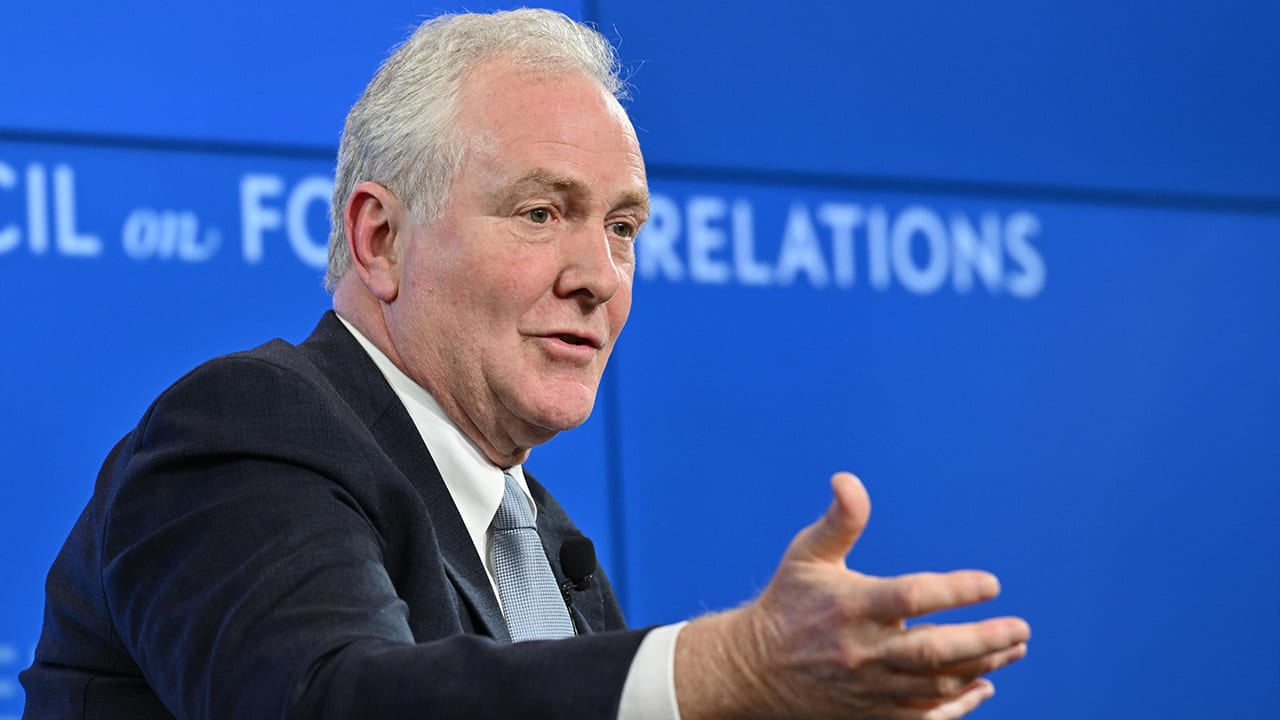
Paul C. Warnke Lecture on International Security: A Conversation With Senator Chris Van Hollen
Event date
Speaker
- U.S Senator from Maryland (D)
The Paul C. Warnke Lecture on International Security is dedicated to the memory of Paul C. Warnke, member and director of the Council on Foreign Relations. The series commemorates his legacy of courageous service to our nation and to international peace.
WADHAMS: Hi, everybody. Welcome to today’s Council on Foreign Relations Paul C. Warnke Lecture on International Security. My name is Nick Wadhams. I’m the team leader for national security at Bloomberg News and I will be your presider for this evening.
The Paul C. Warnke Lecture on International Security was established in 2002 and is dedicated to the memory of Paul Warnke, a member and former director of the Council on Foreign Relations. Paul Warnke is probably best known for coining the phrase “apes on a treadmill,” which referred to the U.S. and Soviet Union mindlessly accumulating nuclear weapons in a bid to deny each other strategic superiority. So maybe we can hit on themes of that nature tonight. He also left a legacy of courageous service to the nation and to international peace. I’d like to welcome Stephen Warnke and his son Paul here in person with us tonight, and other members of the Warnke family are tuning in virtually.
Tonight we are joined by Maryland Senator Chris Van Hollen. He has emerged as one of the most vocal Democrats on issues of foreign policy since being elected to the Senate in 2016, criticizing both Republicans and notably his own party on the handling of the Gaza conflict and the U.S. relationship with Israel. He serves on a variety of committees, including Appropriations, Budget, and for our purposes the Foreign Relations Committee. His father was a career Foreign Service officer and he was born in Karachi, Pakistan.
As a reminder, this conversation is on the record.
So we have a lot of ground to cover tonight. Senator Van Hollen, I’d like to start with your views broadly on U.S. foreign policy. In your bio that is on the Council’s website, you refer—you say you are pushing back on the administration’s foreign policy actions that undermine our national security and our standing around the globe. Of course, President Trump has said his actions have only enhanced U.S. national security. So explain to us what you mean by that.
VAN HOLLEN: Sure. Well, first, just on—I was born in Pakistan. Proud to be part of a Foreign Service family. Spent a lot of time, though, in India. So I know Donald Trump likes to take credit for the recent rapprochement, but I—talk to all sides on that.
But let me just say at the outset that I’m grateful to have been asked to give the Warnke Lecture, grateful to the family. I’ve known Stephen for many, many years. We’re good friends. And his son Paul is the namesake of Paul Warnke that this lecture is named after and has taken after his grandfather when it comes to an interest in national security as well as arms control issues. So just to the Warnke family, thank you for setting up this lecture in concert with the Council on Foreign Relations.
And I’m also pleased to be joined by my wife, Katherine, who is a foreign policy expert in her own right.
Look, let me—let me just say that Donald Trump I believe is undermining U.S. national security and foreign policy interests. One of the things Paul Warnke believed strongly—and I think this lecture has identified that as one of the themes—is that because the United States is a big and strong power we have a special responsibility when it comes to global affairs. It kind of reminds me of the Spider-Man principle. For those of you who remember the advice of his uncle, “With great power comes great responsibility.” And I would argue strongly that the Trump administration is violating that responsibility, first of all here at home—and we can get into more detail, but I believe a strong foreign policy begins with a strong foundation here at home. And Donald Trump is attacking the foundations of our democracy and our Constitution, clamping down on free speech, due process rights; and also cutting deeply into what I think are some very strategic investments, whether it’s in science research, whether that be medical science or other forms of science, sending a lot of scientists overseas. So that’s number one.
Number two, I strongly believe that his claim that he believes in America first has translated into America alone. You’ve heard that before, and that’s because we’ve alienated so many of our partners and friends and allies around the world. And in this multipolar world where we’re still the dominant power but we have rising powers, it’s important to have friends who work in concert with you.
And finally, one of the reasons we’re losing those friends is because he’s undermining the principles that U.S. foreign policy has been based on. We helped establish the post-World War II architecture based on rule of law, based on promotion of democracy, based on freedom of expression, based on free markets although with guardrails, and he has come in and literally taking a wrecking ball to that. If you listen to the Trump foreign policy, there is no mention of Ronald Reagan’s shining city on the hill, not at all. It’s not a principles/values-based foreign policy. We’ve never been perfect when it comes to implementing that, but we’ve always tried. That’s always been part, I believe, of the American identity, and I think it’s been a very important part of our foreign policy as someone who grew up in a Foreign Service family. And Donald Trump is dismantling that every single day—along with Secretary Rubio who used to when he was a senator talk about human rights all the time, talk about freedom all the time, and now as secretary of state has really undermined all that.
So I think he’s doing great damage. We’re only ten months in. It’s hard to see all the damage that’s been done in terms of the material impact, but you can see it in the lack of confidence so many of our friends and allies have in our leadership around the world.
WADHAMS: Well, let me ask you, then, is there any going back? You know, President Biden, shortly after taking the presidency, said America’s back, and Emanuel Macron said, well, for how long. And now it seems w have the answer. I mean, are you seeing any indication from foreign interlocutors no matter what you say, the arguments you make that you’ve made here, that they just say, well, we’re now going to just expect this whipsaw in U.S. foreign policy where it’ll be the Democrats and we get somebody we like, and then it’ll be the Republicans and we get somebody we don’t like?
VAN HOLLEN: Well, I think there’s been lasting damage. How irreparable it is it’s hard to say right now. I think it will be very hard to win over the trust of many of our partners around the world, whether they be in Europe or in—or in Asia or any other places around the world.
I’m not sure that the—I mean, as you well know, the Republican foreign policy for a long time was very different than the Trump foreign policy.
WADHAMS: Right.
VAN HOLLEN: And the question is whether or not the Republican Party going forward just becomes the Trump party. Very different than the Ronald Reagan-John Winthrop shining city on the hill party that welcomed everybody, that was inclusive here at home, that promoted American values overseas; versus Donald Trump, who’s much more the blood-and-soil candidate, native—nativist candidate, and promotes that kind of foreign policy around the world.
So I don’t think we have an answer to your question, other than I do believe a lot of damage has been done and it will be difficult to repair a lot of it. I will just say that in the United States Senate, despite deep polarization, during the first Trump administration the Senate especially was very effective at pushing back on some of Trump’s worst impulses. For example, we reestablished the Senate NATO Observer Group that had been dismantled because we didn’t think we needed it. I am part of that group. It’s a bipartisan group. Donald Trump, of course, had tried to dismantle the European Defense Initiative in his first term; Congress, on a bipartisan basis, helped restore it. So Congress did push back. And of course, the biggest one being the position that ultimately Donald Trump took as a candidate for a second round on Ukraine. For a long time, Senate Republicans pushed back. I can’t say that we’re seeing as much pushback today.
WADHAMS: Right. So could you envision a scenario, for example, USAID, which you have cared a lot about—you’re on the subcommittee that oversees USAID, though have to wonder what your subcommittee has been doing a lot of lately. Can USAID be reconstituted? Can USAGM be brought back to the full force and weight that it had prior to the Trump administration?
VAN HOLLEN: Well, it’s—your observation that the subcommittee that oversees the State Department and AID, subcommittee of the Foreign Relations Committee, has not met. It is very instructive about the fact that Congress has and the Senate has been AWOL when it comes to oversight. I have asked for hearings; we haven’t had any hearings. Meanwhile, as you say, they took a wrecking ball—or, as Elon Musk said, a—took AID to the woodchipper.
Look, I believe AID performs very important functions. Yes, it can be reformed. Yes, it can be improved. But I’m a big believer in the three Ds when it comes to U.S. foreign policy: defense, diplomacy, and development. And I would hope that a future administration would be able to restore that function. I mean, first of all, lots of lives have been lost around the world. This has been well documented. And it also does put America at greater risk, whether it’s the spread of disease like Ebola and whether or not by not providing the kind of surveillance systems we used to we’ll be much more likely to have that spread to the United States.
In my view, that investment is money well spent. It also does help, in my view, give people a sense of America as a caring country. And I think that has—it’s a good in itself, but it also has very practical material positive results for the conduct of foreign policy.
So I do think that kind of thing can be restored. Maybe not in the exact same form, but I do think it’s an important function.
WADHAMS: And we will turn it over to you in a little bit for questions from the audience both here and virtually.
I did want to drill down into a few—a few of the hotspots around the world. Gaza; you recently came back from Israel and the border with Gaza. You called President Biden’s handling of the Gaza conflict a stain on his otherwise exemplary foreign policy agenda, and we are now in a ceasefire that the Biden administration was not able to get over the line. Can you give us your thoughts on whether this will last and whether there’s anything we can say about President Trump’s policy approach that got us to a place the previous administration was not able to do?
VAN HOLLEN: Sure. A couple things here.
I mean, there was a period of time where the Biden administration succeeded in getting a short-term ceasefire and the return of lots of the hostages—I mean, more hostages returned overall than the most recent exchange—but it did not—it did not get the kind of ceasefire that we’re seeing now, as fragile as that is. So let me back up. I was very critical of the Biden administration because I think they failed to exercise U.S. leverage to bring that war to a faster close and in a way that I think would have been more conducive to finding a way toward greater stability going forward. I’ve been very clear from the beginning that Israel was perfectly within its rights—in fact, had a duty—to go after Hamas after the horrific October 7 attacks on Israel, and supported that, and supported President Biden’s decision to go to Israel at the very beginning of the war. But it became clear quite quickly that the Netanyahu government’s goal was not simply to go after Hamas, but to impose collective punishment on the Palestinian people through the actions they’ve taken, including long periods of time with total cutoffs of food and humanitarian assistance and multiple statements by the government leadership—including, by the way,
Netanyahu, who just last year made it a war aim to remove all the Palestinians from the Gaza Strip. That was a stated war aim for a period of time. You may remember that first meeting with Donald Trump in the Oval Office where Trump talked about getting rid of all the Palestinians in Gaza. And when he was asked the next day whether they could ever come back, at that time he said no. So that was a policy of the Netanyahu government, clearly stated.
Now, what Trump ultimately did was what could have been done, in my view, for a very long time: He finally exercised American leadership and influence and pressure, both with respect to the Netanyahu government, and he brought together some of the Arab and Muslim countries, like Turkey—predominantly Muslim countries—to put more pressure on Hamas. In my view, that’s something that could have been done much earlier if the Biden administration had been willing to do it.
Now, Donald Trump did benefit and does benefit from the fact that he’s far more popular in Israel than Bibi Netanyahu, so that does mean he has greater opportunity for pressure. But the United States under the Biden administration also had lots of tools at our disposal and they just were quite feckless. They would—they would make statements and then they would never enforce them. They would—they did some—they tried some good things. They developed something called NSM-20. I’m not going to go into detail. For those of you in the audience who followed that, it was an effort to make it clear that U.S. weapons supplied to Israel—or any other country, in fact—had to be used in compliance with U.S. law. They failed to, however, enforce the Humanitarian Aid Corridors Act, which is a U.S. law on the books that says countries that receive U.S. weapons have to facilitate the transfer of humanitarian assistance into a war zone where they’re using those weapons. In my view, a very clear violation of U.S. law. So my goal has all long been to get the United States to enforce our own laws. We should do that in the case of Gaza, and we should do that worldwide. And when we don’t apply a uniform standard, we lose credibility. We undermine our credibility when we have a double standard.
And so I’m glad we’re at the point we are, in the sense of the ceasefire and the return of the living hostages. As you know, the next phase, phase two, is going to be very, very, very difficult. And it will require the disarmament part. It will require the Israelis to move back further from the current yellow line. And it will require some other force to begin to go into Gaza. The Egyptians have been training a PA contingent, Palestinian Authority contingent. But others will be there. So we’re a long way away.
Let me just end with this, Nick. At the end of the day, if we don’t create a trajectory that assures Israel’s security, but also the security, and rights, and self-determination of the Palestinian people in Gaza and in the West Bank, this conflict will be with us forever. And so real leadership requires addressing that underlying issue—security and self-determination for Israelis and security and self-determination for Palestinians. If we don’t ultimately get to that point, we are going to be involved—there will be conflict there for a long time. And in my view, it’s better that we work to get to some of these root causes now.
WADHAMS: So it sounds, in some ways, like you’re saying that Israel’s position over the course of the conflict since October 7 evolved a great deal. And your views on this obviously evolved a great deal as well. I want to bring this back a little bit to the U.S. Can you talk about how or whether your views on issues like Gaza and other foreign policy issues are being shaped by the sort of younger, far more progressive wing of the Democratic Party, or a Mamdani, AOC, other members? Are you in conversation with them? Do they have influence over your thoughts and views? And are they changing or shaping the future direction of the party?
VAN HOLLEN: Well, those are different questions. The answer to your first question is absolutely not. My position has been based on long-held beliefs and are not influenced in any way by the more recent political turn of events. When I first spoke out about Gaza and what I thought the bad conduct in Gaza, I was a pretty lonely voice, frankly. And my position is actually not new. (Laughs.) I have always believed in the security of the state of Israel and making sure that Israel can have the self-determination that it has succeeded in achieving and the great growth it has seen, but also self-determination for the Palestinian people. And it was long before the Gaza war that that took a very different trajectory.
For those of us who are serious about a two-state solution, which, as you all know, has become more and more and more difficult to achieve as settlements have expanded over the decades and you’ve seen a growing, you know, violent settler movement—for those of us who have been long held in that position, it’s the rest of the world that’s changed, including the Netanyahu—this Netanyahu government, which took a particularly vicious right turn by inviting Ben Gvir and Smotrich into the coalition. People who had been on the fringes of Israeli politics for decades, had been shunned. And, frankly, the failure of the U.S. government to hold Israel accountable to our vision of a two-state solution.
I offered amendments in the Senate Foreign Relations Committee long before October 7 regarding what was happening on the West Bank with settlements, tying U.S. assistance to certain changes. Because you can’t say that you stand for a two-state solution and for decades ignore what the U.S. government has ignored, in terms of expansion of settlements. And so now it’s a very fair point that people raise that it’s almost impossible to achieve. I’m one of those who is hanging on to the hope that, with American influence and new leadership in Israel and the Palestinian Authority and a Palestinian leadership that’s not seen as corrupt and out of touch, that we could—we could still get there. But I’m also very aware of the challenges there. But the principle remains the same. You need some form of self-determination and rights—political rights and human rights for the Palestinians, as well as for Israel.
WADHAMS: And on the influence of the younger wing of the party?
VAN HOLLEN: So, look, what you’re seeing—I mean, the younger wing of the party is engaged on lots of different fronts. I mean, if you look at—you mentioned Mamdani. I mean, Mamdani caught fire in the Democratic primary in New York because of his platform about reducing costs. He essentially said something I strongly agree with, if you—if you work in New York you should be able to afford to live in New York. That was his platform. Then he has his first debate, and people are asking Mamdani and the candidates whether they pledge that their first overseas trip will be to Israel. And his answer was, no. I’m focused on New York. I’m not planning any overseas trips right now. So, yes, he has expressed strong views, and had previous strong views, when it comes to foreign policy.
When it comes to the issue of Palestinian rights going forward, I will say that the younger generation of both Jews and non-Jews in America take seriously the idea that we should have a principled, rights-based foreign policy—something I’ve long believed in. Donald Trump doesn’t believe in that. I mean, he has very consciously ripped that idea up. If you look at the State Department Human Rights Report, it used to at least have some credible holding of different countries accountable, whether they were friend or foe. It’s become a propaganda tool. I mean, literally when it comes to El Salvador, with his good friend Bukele, who calls himself the coolest dictator in the world, says there are no human rights problems in El Salvador.
And so, look, young people took seriously what we all taught them—(laughter)—which is a good thing. Which is, when they look at something they want to know if people are being treated fairly. And you can’t look at what’s happening on the West Bank or Gaza and say those individuals are being treated fairly, when they’re under occupation in the West Bank, and everything that’s happened in Gaza. And so that’s what young people are saying. And frankly, you know, if you go on college campuses you’ll find that being a view held by people of different faiths, including many, many young Jews in America, who, in many cases, are leading these efforts on college campuses and are having tough conversations with their parents. I know that both from the parent side as well as the student side.
But just as a people, regardless of faith, I mean, if you believe in what we say we stand for, then you’ve actually got to apply that uniformly. Or we are seen as simply using human rights and self-determination and expressions like that as a political cudgel. It’s easy to go after China for what they do to the Uyghurs. It’s easy to go after Russia for them clamping down on human rights and political rights. That’s easy. The test is whether we as a country apply those standards to our friends. Do we apply it to Modi in India, when it comes to religious rights? Do we apply it to Erdogan in Turkey, a NATO ally, when it comes to political rights? And do we apply it to the Netanyahu government, when it comes to their treatment of the Palestinians?
And if we don’t do that, we are seen as hypocrites. We would—we are hypocrites when we don’t apply that. And, frankly, the Global South sees this. And, frankly, China exploits it. They don’t have to say they’re better than us. All they have to say is, see, they don’t really mean what they say. They only apply those—you know, they only go after their adversaries on these issues. And they’re very effective. I mean, if you look at the most recent polling and standing, the Pew poll, of perceptions of the United States overseas, it’s gone way down. It went down a little bit under Biden in the Global South, a lot because of Gaza. Under Trump it’s gone further. Tomorrow I think there’s going to be a report that shows that the rule of law rankings, and that the United States is one of five countries that has regressed significantly since the beginning of the year. We’re in there, along with Sudan, Russia, Togo. (Laughter.) So that’s the company we are keeping.
WADHAMS: I do want to turn it over now to the audience. Before I do, though, I would be remiss in not asking you news of the day. You just came from votes on the Hill. Today the American Federation of Government Employees came out against the shutdown. Urged Democrats to drop their opposition to a continuing resolution. You have been in the absolute thick of this. There was some hope that there would be progress over the weekend, and some conversations. Are we any closer to ending this thing?
VAN HOLLEN: So I have voted seven times now to reopen the government without giving Donald Trump a blank check, and in a way that prevents this healthcare crisis that’s upon us with this huge spike we’re going to see in healthcare costs. Because the so-called big, beautiful bill extended tax cuts for billionaires and wealthy people permanently, but did not extend the one tax cut that helps working families afford health care through the Affordable Care Act. So I voted for that seven times. I would point out that since day one Donald Trump has been shutting down parts of the federal government, the parts that he doesn’t like, with Elon Musk and the chainsaw.
And so we’ve included in our proposal—which, as I say, I voted on seven times—provisions to create some guardrails against the illegal impoundment of funds. Not just my assessment. The GAO has found that funds have been illegally impounded. And to address this other issue of exploding health care costs. What we have said is, let’s sit down and talk, Donald Trump. And Donald Trump is spending all his time talking to foreign leaders. Now he wants to meet with Kim Jong-un. OK. All his time talking to foreign leaders, and not even a little bit of time talking to the Democratic opposition here at home to resolve this shutdown. That is unprecedented, to have a president who refuses to engage. It’s essentially his way or the highway.
And so I have—and this is what you might have been referring to about over the weekend—I did introduce legislation that says that federal employees should be paid during the shutdown, whether they’re called up to duty or furloughed under the administration. Because federal employees are innocent bystanders in this battle that they have nothing to do with. And they should not bear the burden. Because of legislation that Senator Cardin and I passed in the first Trump shutdown—that was the thirty-five day shutdown—federal employees are guaranteed full back pay when the federal government reopens.
Now the Trump administration that got a vote pretending that’s not true, but it was on their own website until September when they decided to pull it down. And it’s really pretty much undisputed as a matter of law. So my view is, why make them wait when some of them can’t pay their electric bills, can’t pay other bills? So we are in—just as I left, we’re we are still in negotiation on that—on that piece. And I do hope the whole thing comes to an end sooner rather than later.
WADHAMS: All right. At this time I would like to invite members to join our conversation. So I will just go around based on what I see. Michael Gordon in the front row. I know you.
Q: Michael Gordon, Wall Street Journal.
Senator, I have a Middle East question for you on Syria. President Trump has suspended sanctions on Syria to support the new Syrian authorities. And the administration favors repealing the Caesar Act. You, yourself, have taken a similar position, in favor of removing the Act, maybe, albeit, with some reporting requirements. Is this a case where you and President Trump agree on the next steps in the Middle East? Why is this important, to take this step? And what are the prospects of getting this through the House and making it actually happen?
VAN HOLLEN: So it’s interesting you asked that, Michael. I was thinking tonight whether I might get a question saying, is there anything you agree on with the Trump administration? (Laughter.) I will say, when it comes to their sort of effort to give the new Syrian government a chance, I’m with them. I think that there’s no real Plan B right there. So let’s go with Plan A. I will say that my original view—and I still think this is important—was to couple—was to couple the removal of the sanctions with snapback provisions. Originally automatic snapback provisions that would go in place if the new Syrian government doesn’t meet certain important criteria, including, you know, an inclusive government, including a constitutional assembly, so that we have actual more representative government where all the different groups in Syria are fairly represented in the government, making sure that they join the anti-ISIS coalition. A number of criteria that would have to be met.
In the Senate version of the National Defense Authorization bill, as you know, we have the removal of the sanctions. And then Senator Graham—Senator Graham I’ve actually worked with quite a bit when it comes to Syria, especially the SDF and the Syrian Kurds. So he and I originally were pushing for a snapback provision. It has now taken the form, as you say, of a report that the administration has to present on a periodic basis so that we can measure whether or not they are moving in the right direction. I will say, a lot of what’s coming from the field there right now is extremely troubling. And this is why I was in favor of snapback provisions.
Tom Barrack, who you know is our ambassador of Turkey but very involved in this, believes strongly that if you have a snapback provision it will create such a cloud over the situation that nobody would be willing to invest in any way, irrespective of lifting of the sanctions. So that is—I will say, the House of Representatives, I’m told, has a very different view on all this. But it is one of the very few areas where I have been working with the administration. I met with Ambassador Barrack many times. And I met with the Syrian foreign minister when he was here. And I remain very much in touch with Mazloum and the Syrian Kurds, and others.
WADHAMS: All right. Right here in the red coat.
Q: I’m Priscilla Clapp, formally—oh, I’m sorry—I’m Priscilla Clapp, formerly of the State Department Foreign Service and USIP, which is still in the courts so I shouldn’t say totally formally.
My question is whether this administration even has a foreign policy. Because it seems to me, without an NSC, without a coordinating body working with various departments of the administration, it’s just subject to daily whims on the part of the president. And foreign policy looks, to me, like a function of his ego as much as anything else, whether he’s using economic coercion to make countries do what he wants them to do, or whether he’s using it to enrich himself and his friends. I mean, the bailout for Argentina is the most egregious foreign policy move that I’ve seen in my years of practicing foreign policy. So what do you think of that?
VAN HOLLEN: I think the two strains of his foreign policy, which come out equally really no foreign policy, are exactly right. It’s like being in the pinball machine. I mean, just pinging all over the place depending on the two factors, I would say, you identified. Like, who’s the last person he talked to? But also, is it in his own self-interest, personal financial self-interest, or the financial interests of one of his buddies? And it’s all a matter of pique.
On the first—you know, on the first front, it really does seem the last person who walked in the door, the last thing he saw. I mean, he just slapped 10 percent additional tariffs on Canada, right, because Ontario ran an ad that quoted Ronald Reagan. Who used to be, like, the holy grail of Republican foreign policy, right? And he was talking about tariffs. Everything we all know about tariffs, which is when you do across the board tariffs it does increase the prices on everything. And, you know, there’s a lot of time for all this to continue to work its way through the system. That’s one thing.
But the second thing you identified is a real problem, which is rank corruption. And it’s a problem in itself, but it’s also a real problem when it compromises our national security interests. And this really came to the fore when it came to the UAE. And I’ve talked quite a bit about this, and then the New York Times did a long—or, Washington Post, or New York—anyway, did a long story about this. And the bottom line is that the Trump administration dropped the restrictions that Biden had placed on the transfer of very high-end chips and AI technology to the UAE.
They dropped those restrictions, right after the president’s son, Eric Trump, had done kind of the advance work. Normally you send your diplomats out for your advance work. Eric Trump went out ahead of Donald Trump to the UAE. And he cuts a deal whereby this UAE firm MSX uses $2 billion to invest in the new Trump family crypto scheme, which, by the way, the Witkoff family is also very involved in. Two billion dollars. Sent the value of that skyrocketing. This is why Donald Trump has made billions since he got into office. Sent it skyrocketing.
At the same time they do this deal to transfer U.S. technology to G42. So G42 is another UAE company. You know what they have in common? The chairman of the board is the same person. It’s Tahnoun. He’s the national security—he’s a member of the royal family. I don’t begrudge him anything. He cut a very good deal for the UAE. I’ve met with him before. He is a—he’s a dealmaker. And, boy, did he do a good deal for the UAE. Put $2 billion into the Trump family crypto stablecoin business, and he got a promise that we would send them the very highest-end technology without adequate safeguards. This is corruption, pure and simple. And it’s not a unique example, but it’s probably the biggest example if you follow all the ins and outs of this story.
Q: (Off mic.)
VAN HOLLEN: And the Supreme Court’s decision has essentially allowed him to conduct criminal activity, as long as it’s in its official capacity—an outrageous—an outrageous decision.
WADHAMS: All right. Let’s turn it to our online audience for a question.
OPERATOR: We’ll take the next question from Sherif Lotfi.
WADHAMS: Maybe another one. Sherif, are you there?
OPERATOR: Mr. Lotfi, please accept the unmute button.
Q: Yeah. All right. Sorry, I forgot to unmute myself. Sherif Lotfi with the Mizuho Financial Group.
Just a bit of a different direction, on nuclear proliferation. You know, from what we see, there’s a rapid increase in sophistication in China. Not just—it’s not just a matter of quantum, but of sort of the technology itself. And it doesn’t feel like any kind of treaty agreements that, like, we used to have with the Soviet Union are on the cards. And obviously there’s a risk of even further proliferation to nonstate actors. I didn’t know if you had any comments on that. Thank you.
VAN HOLLEN: No, thank you. Thank you for that question. You know, the United States—and, at least the Biden administration, I suspect the Trump administration as well—would be interested in talking to China about its nuclear weapons program. There were some conversations that took place during the Biden administration on this topic, but very preliminary. And Paul Warnke over here, I’m sure, would give you chapter and verse. But the position China has taken is that the nuclear arsenals of the United States and Russia are so large that they are—until we bring down our size of our nuclear arsenals, they haven’t been as willing to engage with us, and certainly not as part of a trilateral decision. I am glad that—well, we haven’t agreed yet—I’m glad that even with the with everything happening in Ukraine—we haven’t talked about Ukraine, but that’s another place where, in my view, Donald Trump has been played—but, as you know, Putin did propose to extend the START agreement. And I think the United States should extend the START agreement, agree to comply with the START agreement for another year.
I’m all—I believe we should engage with China, on a whole lot of issues. Obviously, we should compete with China, and are competing with China, on many, many fronts. And, you know, I supported the Biden administration’s effort to help de-risk our economy and our supply chains. A lot going on in that space now, in one way or another. Obviously, China is now withholding some of its rare earth materials. We’ll see what happens, maybe today. But I do think that we should engage on China’s nuclear program. There are other things we can do in the military sphere with China, including making sure we have the open lines of communication that got shut down for a while after everything with the balloon overflight. And there are all the other issues with respect to Taiwan, the straits.
But the nuclear program is something that doesn’t get discussed that much, so I’m glad you asked about it. I think China will still take the position that, you know, they have a small arsenal. They need that arsenal for their own protection. They’re not willing to negotiate limits unless we’re willing—we, the United States—are willing to bring down our nuclear arsenal size.
WADHAMS: All right. Let’s go back to the room, in the red tie—or, sorry—blue tie here. Yeah, go ahead. Yeah.
Q: Good evening, Senator, and thanks for taking the time to talk to us tonight. I’m John Uzom (ph), a second-year term member.
And I agree completely, the president has taken a wrecking ball to our foreign relations. But that’s going to end eventually. And I’d be curious for your thoughts on what the next president should do, and even more what the one after that should do, to start repairing that damage and how far we can get.
VAN HOLLEN: Sure. Look, as I said, I think there’s a huge amount of repair work to be done, even though it’s just been seven, eight, nine, ten months in the most recent wrecking ball. I do believe that begins at home, with some of the things that we need to do. You know, we didn’t—you’re a weak country when you’re divided against yourself. You’re a weak country when, you know, the rule of law, you know, survey shows that you’ve fallen, along with five other countries. Your rule of law when the president, you know, tries to bring himself up by pitting Americans against each other. And I think there are other things we’ve got to do here at home, in terms of investing in education, restarting bigger investments in in science and technology. So a lot of repair work to do there.
I do think resuscitating AID in some form is important. You know, overseas I believe it’s going to be very important that we restore sort of the view the United States does stand for these important principles. I want to stress, I’m not naive. I don’t think—you know, we’ve never been perfect in applying—in applying these principles. But if you look at sort of global surveys, one of the things—one of the reasons people around the world look up to us, or did look up to us, was because we stood for these things. This is why people come from all over the world to want to live in the United States of America. It really was what Ronald Reagan called the shining city on the hill. And Donald Trump’s taking a wrecking ball to the Statue of Liberty, taking the, you know, torch out.
I mean, so I do think that there’s an option to go back. I don’t know what the future of the Republican Party is. You know, back in the 1980s I was a staff member on the Senate Foreign Relations Committee for a guy called Mac Mathias. He was a liberal Republican senator from Maryland. And he believed in the universal principles. And he believed in the NATO alliance. And he believed in all the things that I believe in. I don’t know where the Republican Party goes, whether they become the party of Trump and it becomes sort of the Trump cult 2.0. I will tell you that if J.D. Vance is the next, you know, inheritor of this, we are going to see more of the same. I mean, I was in Munich this year when he lectured the Europeans, saying that their what he claimed was censorship was a greater threat than Russia. This is J.D. Vance.
And, by the way, this administration is going up and locking up students on college campuses for expressing their views on Gaza. In fact, they just picked up another guy, a Brit, ironically, from Britain, who was here giving lectures. And he was critical of the government of Israel. And apparently, he’s right now being held by ICE. So here’s our vice president lecturing everybody about the freedom of expression when we’re locking people up here. And he says that Russia—that what’s happening—that, you know, cracking down, or not supporting the far-right in Germany is somehow more dangerous than Vladimir Putin. So, sorry to go off on that. But I don’t know what the future of the Republican Party is. And that’s part of—part of the answer to your question.
I will say, for a Democrat who does believe what I thought was a sort of universal idea of the shining city on the hill and a foreign policy based on values and principles, however imperfect, that’s where we’re going to have to go back. And it will take a lot of time for anybody to even begin to believe us.
WADHAMS: All right. Yeah, right here, in the white shirt.
Q: Thank you. I’m Ana Lejava. I’m at the Georgetown Institute for Women, Peace, and Security. And I work on Ukraine and Eastern Europe.
Thank you for your leadership on supporting Ukraine, Georgia. My question is particularly about Georgia. There’s an act called MEGOBARI Act on the Hill right now that is blocked by Senator Markwayne Mullin of Oklahoma. And all of—all of us who are researching the region are quite surprised why a senator from Oklahoma is blocking a bill, an anti-authoritarian bill in Georgia. So I would love to ask if you have any insights on that. And if your colleagues, both Republican and Democrats, do understand a coordinated threat that Russia, China, North Korea, and Iran pose to U.S. national security? Thank you.
VAN HOLLEN: So he’s blocking the bill, you said?
Q: Yes.
VAN HOLLEN: OK. Is this Senator Shaheen’s bill? Yeah, yeah. So, yeah, no, I support Senator Shaheen’s bill on Georgia.
Q: (Off mic.)
VAN HOLLEN: Thank you. And I have to give her a shoutout. As ranking member of the committee, she’s special interest in the Balkans and that whole region. Look, the fact that he opposes it—I don’t know all the details—but it is a—it is a—it’s not—it’s consistent with sort of the Trump worldview, where, whether it’s there or Moldova or other countries, they really don’t really care about the Russian influence operations that have been present, you know, in a big way in that part of the world. The legislation is an attempt to push back on that. But this goes back to what—you know, what is the new Republican foreign policy? There are lots of—I will say, right now there are a lot of Republicans in the Senate that support the Shaheen legislation. In fact, I think it may even be the chairman of the committee, Risch, who’s the—who’s also on the bill.
So, yeah, this is—you’re seeing this shift in parts of the Republican Party. Again, I don’t—I don’t know the basis for his objection right now, whether he’s just holding out for something else, that I don’t know. But Donald Trump’s—President. Trump’s views, as we know, are very—sort of, he says a lot of nice things about Russia, and Putin is good buddy, and, you know, of course, in that first Oval Office meeting with Zelensky, you know, they just—that was just—it was an awful spectacle if you were a believer in, you know, the United States standing up for freedom in Ukraine and for the people in Ukraine. And he’s been all over the map. I mean, he’s been totally played by Putin. He goes up, you know, he does the summit in Alaska, and Putin just actually increases the tempo of his attack. So—
WADHAMS: So let me follow up on that one, on Ukraine. We saw the action last Friday sanctioning Lukoil and Rosneft. Do you think the president has now come around?
VAN HOLLEN: So one of the first good actions I’ve seen. It may well be in response to the fact that we’ve had this bipartisan bill on Capitol Hill that has over eighty co-sponsors in the Senate, I’m a co-sponsor of that bill, that would apply very tough across-the-board sanctions, with a lot less flexibility when it comes to implementation of it. And we’ve been pushing for a vote on that bill for a very long time. And it’s the White House that has been saying, don’t do it. I mean, Senator Thune has got on the calendar. This is a bill with Senator Graham and Senator Blumenthal. And, as I say, almost eighty co-sponsors, bipartisan. So obviously, more than enough to get through and survive a veto override.
But they’ve not put it up on the floor for a vote. And this may be partly an action there. Now, I’m for these sanctions. You know, the Biden administration, as you well know, had the cost—the cap, the price cap on oil. And said, if you—if you’re purchasing, you know, Russian oil at a price above the cap, you will get sanctioned. If you have it below, you can do it. And the idea was to reduce significantly the profits that Russia was making over the—off the sale of its oil. And it worked kind of, not—there were lots of run arounds. So this is—this is, in one sense, tougher than that. But it’s always in the implementation.
In other words, if the Trump administration—they get to choose whether they apply it to anybody. So they’ve fired a shot across the bow. This does apply to American companies immediately. I’m not sure how much business was being done by American companies directly with these two big oil companies or not. But with respect to others and secondary sanctions, it will depend entirely on whether or not they’re serious about implementation. So symbolically important, the question is on enforcement there. And, you know, I do think, you know, sanctions are not a be-all and end-all. But they’re one tool in the toolbox here. And I think it’s important to try to reduce the, you know, ability of Russia to, you know, fund its war economy. And we know that their oil and gas revenues are the primary source of that funding.
WADHAMS: All right, let’s take one more from the crowd. The red tie right here.
Q: Thank you, Senator, for being here. Sean Quirk. I’m a term member here at CFR.
My question goes to your point about enforcing law overseas. Do you think the U.S. military strikes on the drug boats in the Caribbean and Pacific are lawful? If not, what will Congress do to uphold domestic and international law?
VAN HOLLEN: I’m glad this came up. I was going to raise it. The short answer is, hell no. They’re not lawful. I mean, first of all, they’re not compliant with international law. International law does not give any country the authority to go blow boats out of the water, as we’re doing here. We have gotten—and it’s, of course, not authorized by U.S. law. Now, there has been a resolution, a war powers resolution filed. I think we’ll take it up next week. We could take it up this week, just in terms of it’s ripened. But probably we’ll take it up next week. And if that were to pass, then it would—it would prohibit the president from, you know, deploying U.S. forces against Venezuela, the country of Venezuela, without a, you know, declaration by the Congress.
We had an earlier version of this that applied to some of the—you know, to their designation drug—designated foreign terrorist entities and drugs. That earlier one failed. Rand Paul, who, I have to say, has been very consistent on this—we disagree about a lot of things, but he’s been very consistent on this. He’s been consistent also about, you know, the Posse Comitatus Act here at home and not deploying the National Guard against cities for law enforcement purposes. And in this case, this is normally a law enforcement function, as you know. It is important that people know that the Trump administration’s budget actually cuts the funding for the DEA, cuts funding for our domestic efforts to go after organized crime drug syndicates. I know, because I’m the ranking member of the subcommittee of Appropriations Committee on this. They cut that.
So this is not about really stopping drugs from coming into America. This is all a big spectacle, a big show by Donald Trump using the U.S. military for these purposes. It is illegal. These are extrajudicial killings. As Rand Paul points out, we have no idea actually who’s on the boats. And, by the way, they haven’t presented us with the evidence. They haven’t presented Congress with any of the evidence. Even if there’s evidence, you would think that if you were serious about, you know, cracking down on these things, you’d arrest these people, you’d go upstream, and go after the kingpins. And in terms of the people who were getting killed, we just don’t know. We do know the president of Colombia said that one of the people killed was just a fisherman fishing for his family. And, of course, recently they’ve sanctioned him and said he was a drug kingpin or king runner.
This is the Trump foreign policy. Somebody says something, you know, bad about you, and you just throw on sanctions. I do want to make the point about how dangerous this is here at home because we have a pattern where anybody in the professional civil service, the Foreign Service or the civil service, at DOD, or State Department, or the CIA, or the Justice Department, if they come up with a fact-based analysis—whether it’s just an analysis of the facts on the ground, or a legal analysis that’s inconsistent with the propaganda coming out of the White House—they get punished. They get fired. I was very involved in the Abrego Garcia case, which is a case where the guy got swept off the streets of Maryland and sent to the gulag in El Salvador. The lawyer in that case of the Justice Department, a fifteen-year veteran of the Justice Department—actually received an award during the first Trump administration for his work at the Justice Department—he wouldn’t lie to the judge. They fired him.
The DIA guy, the head of the DIA, came up with an assessment after the new strikes on the Iran nuclear facilities that had only set them back a little bit. He got fired. Guys at the CIA who come up with different analysis, they get fired. This is a—this is corrosive to the integrity and strength of our country. And it’s part of a pattern we’re seeing where Donald Trump is just using the power of the presidency to—not to get to the truth, not to advance American interests, but just to have his way and squash any kind of dissent. It’s a very dangerous development when people in the administration feel that if they tell the truth, that they present their best facts, that they will get—they’ll get punished. It’s a—it’s a really, really, really—it’s dangerous. There’s so many dangerous things going on. And one hasn’t gotten as much attention.
WADHAMS: I just—I want to close this out by following up on his question, which was what can Congress do? And there’s a real impression that, as the opposition party—the minority opposition party right now, the Democrats just can condemn the president, talk, as you say, about a lawless presidency. But there is just—what can you do?
VAN HOLLEN: Yeah. So I would—I would say, in the early days of the Trump administration, I would say that not enough—not enough Democrats recognized the threat to our democracy and our country. I mean, some of us were out there sounding the alarm very, very early. But I will say, Nick, at this point in time, I think that there’s a general consensus, I can certainly speak for the Senate Democratic Caucus, that people don’t think we’re just headed toward authoritarianism. We’re, like, in it now. Now, what can you do when you’re in the minority party? (Laughs.) You don’t control the House. You don’t control the Senate. You obviously don’t control the White House. And, by the way, they’ve changed the rules on the nominations. I mean, nominations used to have to go over sixty-vote hurdle. Now it’s fifty. And they just changed it again about three weeks ago to allow them to do these in packages, if you’re below—if you’re a sub-Cabinet level. So that allows them to process more of them.
What we have here—well, Steve Bannon said it best. You probably saw it. He called the Congress the Duma. You see that, right? You all know what the Duma is. So this is—this is—this goes back to what is the Republican Party these days. Right now, the Republican Party is a Trump cult. And whatever Trump says goes. He says, jump. The answer is, how high? No one will cross him. There’ll be a couple voices here and there, isolated voices on a particular topic. Rand Paul being good on Venezuela. Susan Collins and Lisa Murkowski being against some of the budget stuff. But no serious opposition. When I was on the Senate Foreign Relations Committee staff, Richard Lugar—Richard Lugar, a Republican from Indiana, conservative guy, led the veto override of Reagan’s veto of the comprehensive anti-Apartheid legislation on South Africa. That was a different era. You would never come close to that right now.
Now, I will say you wouldn’t even in the previous Congress. You know, there’s been less independence. But under this administration, it’s zero. They are much more afraid of a Trump tweet than they are the response of the majority of their constituents. Because, at the end of the day, Donald Trump will tweet out within twenty-four hours that he has a primary challenger lined up against them. And they’re much more worried about that. So I worry a lot about our system. I would ask them, you know, do you really want to be remembered as sort of the rubber stamp for Donald Trump? And a lot of the people justify it by saying, well, let’s just get through this moment. Maybe we’ll come out on the other side. And by the way, if I lose my primary wait till you see the other guy, and all that kind of stuff. But my view is, it’s a very hard moment.
And to your question, Nick, when you don’t have the majority—I mean, we’ve taken the position that, no, we want to open the government, but we do want to use this moment to rein in a lawless president. Part of our proposal, as I said, is to prevent the illegal impoundment of funds. What good is a budget agreement if the president just ignores it? So our alternative has that in it. It also has in it these provisions to prevent this ticking time bomb on health care costs from going up. But that is—you know, we can’t have a hearing. We haven’t had a hearing on the Venezuela situation, by the way. In the Senate Foreign Relations Committee, no hearing.
So this is—I want to just go back. It’s a very dangerous moment in our country. And I do believe the greatest threat right now is ourselves. I think it’s the internal threat. And you cannot have a strong, consistent foreign policy if your own house is so divided and in such disarray. And so if you go back and ask the question that, you know, Paul Warnke would ask, senior, about a great power needs to exercise that power responsibly around the world. Donald Trump is abusing that power here at home and not exercising American power in an effective and smart way for our country overseas. And so very, very, very dangerous moment, in my view, here at home and around the world.
WADHAMS: All right. We will leave it there. Thank you, Senator Van Hollen. And thank you all for joining today’s meeting. Please note that a video and transcript of the meeting will be posted on CFR’s website. Thank you all for joining. Have a great week. (Applause.)
VAN HOLLEN: Thank you.
WADHAMS: A pleasure. Thank you.
(END)
This is an uncorrected transcript.