What’s Next for Trade and Tariffs?
Event date
Speakers
- Independent Historian and Economist; CFR Member
- Senior Fellow for International Trade, Council on Foreign Relations
- Senior Fellow, Peterson Institute for International Economics; CFR Member (speaking virtually)
Presider
- Shannon K. O'NeilCFR ExpertSenior Vice President of Studies and Maurice R. Greenberg Chair, Council on Foreign Relations
Panelists discuss recent developments in U.S. trade policy and where it is heading.
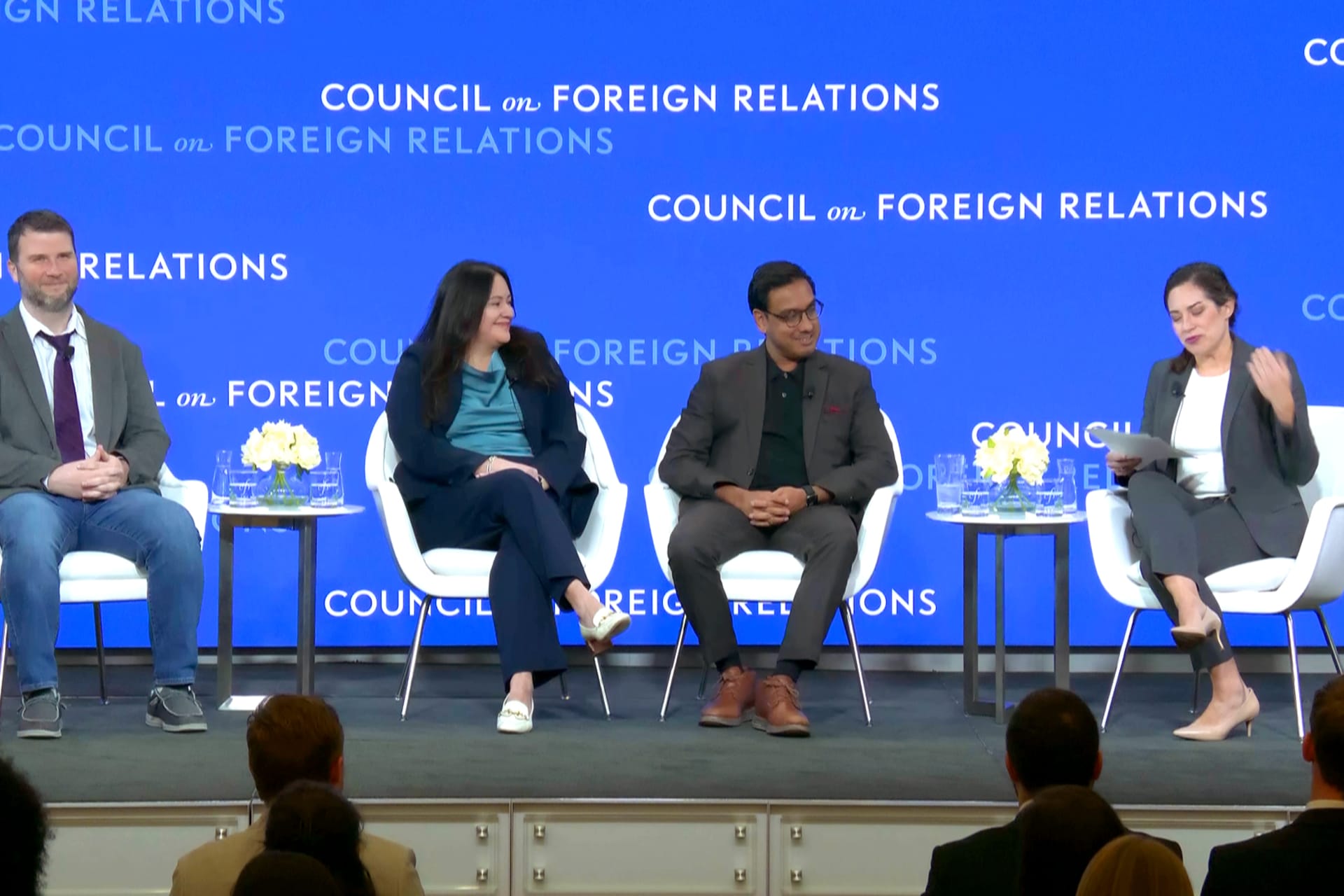
O’NEIL: Great. Well, good afternoon, everyone. Thank you all for coming. Great to see you. I am Shannon O’Neil. I’m senior vice president of studies and the Maurice R. Greenberg chair here at the Council on Foreign Relations. And it is my pleasure to preside over this meeting, which is titled “What’s Next for Trade and Tariffs?”
This meeting has been made possible by the generous contribution of Robert Pozen, who is here with us today—thank you very much for joining us—and has been helping us think through lots of these big issues in what you could, understatedly, say is a quite turbulent time.
I am joined here by three great speakers on the topic.
Inu Manak, who is part of the home team. She’s a senior fellow for international trade here at CFR.
Marc Levinson on the end, who is an independent economist and historian, has written a couple of great books, and has another one on the way that he was just talking to us about.
And on the screen is Alan Wolff, who is a senior fellow at the Peterson Institute for International Economics and longtime participant and person at the World Trade Organization. So brings that perspective.
I am going to open up here with a conversation with the three of us at the start, and then I will open it up to questions from our participants here in Washington as well as online.
So with that, let me get started. And I’m going to start with Inu. And here, you know, let’s just start with the current state of play, sort of just level-set where we are, right? We have had Supreme Court find the IEEPA tariffs, these were quote/unquote “reciprocal tariffs,” unconstitutional. So talk us through a little bit about what comes next. And we have sort of a short, medium term. We have, perhaps, potentially a long term. What kind of trading regime do you see the Trump administration trying to recreate or not, as the case may be?
MANAK: I think the Supreme Court case was not a surprise to a lot of trade folks who are watching this and thinking. We had a sense that the tariffs were illegal, and eventually the court would rule in that way. And it answered a lot of questions for the trade community about the use of IEEPA. And clearly tariffs are just a no-go there. So the administration had to pivot, and pivoted quite quickly. So the same day they announced that they would levy a 10 percent tariff under Section 122, which is the balance of payments authority. That is also facing a court challenge. So there is a concern whether or not that is something that can actually be used to levy the tariffs that the president has put in place.
They were supposed to go from 10 to 15 percent. Fifteen percent is the ceiling that you can do on Section 122. And they haven’t quite gotten there yet because, if they did, there’s a chance that that would actually breach some of the agreements that they’ve signed with many trading partners. So right now we’re in a holding pattern where we have this 10 percent tariff in place until mid-July, because it can only go on for 150 days. And at that point, the administration is going to need to replace it with some other tariffs. Likely going to be Section 301 tariffs. This is the unfair trade practices statute, which has been used in the trade war against China. And they’ll try to largely recreate the existing regime with that. It’s going to be a little harder as an investigation. You got to go country by country. It may be thematic. But I think they’re going to try to reconstruct most of it. And we could see those investigations start pretty soon, potentially get some information on that in the next couple of months. I think they’re going to expedite it. Probably in two, three months we’ll see what those tariffs are.
But then that would be it for a while. And I would imagine that they’ll use Section 301 as a way to modify tariffs, as we have against China over the years, to, again, try to get countries to negotiate additional concessions, especially for those who have not yet signed a trade deal. We have nineteen partners so far that have signed deals with us. There’s a lot more to go, because this is not, you know, the ninety deals in ninety days. So there’s a lot more work for the administration. And I think right now what we’re seeing is just kind of a status quo pause. Nobody’s kind of looking at this and saying, let’s breach the agreements. They’re holding. And they’re just waiting to see what comes next.
O’NEIL: OK. Great. Thanks.
Marc, let me turn to you and ask you to reflect a little bit, because you follow—as you follow these things, on sort of Trump administration’s sort of overall goals here. Because we’ve seen a lot of them. A lot have been—have been mentioned. How do you see these goals vis-à-vis the kinds of tools, the tariffs, and what Inu was just talking about, sort of this replacement? Where do you see it going? Where do you see, perhaps, the Trump administration doubling down in terms of its goals and the direction?
LEVINSON: We’ve got tariffs being used in ways that they really haven’t been used before. And I think that raises some issues in terms of where the administration is headed with this. For one thing, I think the Trump administration is quite unusual in openly and blatantly saying that it’s imposing tariffs for reasons not related to trade. OK, we’ve got anti-fentanyl tariffs. We had tariffs related to a court case in Brazil that had nothing to do with trade but with the ex-president of Brazil. We had at least a threat last week to impose tariffs on Spain because it didn’t want U.S. airplanes using airbases in Spain to bomb Iran. OK, that’s not the way tariffs have traditionally worked. So this whole realm is not any longer reserved for just economic concerns. I think that’s a significant departure from what we’ve had in the past.
I think that there are limits to what can be achieved by this. And so we’re going to have to see. If you look at the bilateral agreements that have been reached so far, they tend to be extremely one-sided. The U.S. typically takes on a single obligation, which is to reduce the tariffs on the other country, and the other country typically takes on pages and pages of obligations. You could consider this, I suppose, as a U.S. victory in this discussion of trade. But on the other hand, it suggests that these agreements may not be very stable because it will occur to people in these other countries that these agreements are, in ways, quite disadvantageous to them.
Just to give you a flavor of the kind of thing this goes into, Argentina has agreed not to examine U.S. pharmaceutical plants to see whether U.S. pharmaceutical exports to Argentina are being handled in safe plants, while the U.S. hasn’t surrendered any similar right in Argentina, OK? You’ve got lots of those sorts of provisions in these agreements. And I think they’re going to break. I think they’re going to prove very bothersome over time.
O’NEIL: Great. You know, Alan, let me bring you in. And let me just sort of pick up on what Marc was talking about, some of these other agreements. You know, what’s been very notable to me in the tariffs that have been put on is really the limited retaliation by other countries, right? As we just see—as Marc, you know, laid out, some of these agreements are very one-sided. There’s, you know, nineteen countries that have signed onto them. But we really haven’t seen sort of a tit-for-tat on these tariffs. But we have seen a lot of activity around the world. So could you talk a little bit about as you look at these various agreements—whether the ones the United States is—you know, these frameworks that they have signed, or the other agreements that have nothing to do with the United States, right? Europe, Canada, other nations are out there negotiating other agreements. Sort of, how do you see this flurry of activity in the trade framework, trade agreement area shaping or not reshaping kind of overall trade rules?
WOLFF: Yeah. The scene has been set really, very well by Inu and by Marc. The U.S. accounts for some 13 percent of world trade. And it has coerced other countries into these deals for a fair amount of that 13 percent. Really, our major trading partners have signed up. And one restraint on the president would have been the courts. And the courts have acted on IEEPA. And the courts will act again with respect to what happens next, because what’s been pledged is replication. Scott Bessent, and Jamieson Greer, and the president have all said, we’re going to have really the same regime but under other authorities. I don’t think that works. I think that gets struck down by the courts because of overreach. Because the courts said that actually Article One Section Eight, has the tariff power not—in the Congress, not Article Two. So other countries—in answer to your question—other countries are looking at, do these—what happens next?
The U.S. probably tries to replicate its tariff, because you don’t usually say to Mr. Trump, if you’re in the Trump administration, Mr. Trump, we can’t do this, you have real limits, you just can’t—you can’t go where you want to go. That’s not sort of the pattern. So we end up with overreach. The courts say, at that point, well, we’ve been here before. Yes, we had sort of one narrow finding on IEEPA, that it doesn’t include tariffs. And, yes, these statutes do include tariffs. That’s been—that’s been found by the courts already, under 232 and 301. But you can’t actually have all the tariff authority in the world.
And the other countries know this. So when Marc talks about instability of these agreements, that’s one element of the instability. The restraint is—one restraint is the markets. Of course, they’re busy reacting to oil in the Hormuz Straits right now, but the markets reacted very negatively on April 2 to the initial announcement of the reciprocal tariffs and the fentanyl tariffs. And then they got used to a 10 or 15 percent global tariff the United States had put into place. 301 and 232 may have a negative response in the markets.
So what do we get out of all of this? And this is something other countries are looking at, is there’s an election coming up in the United States. And while there’s a tariff president, there’s no tariff party, as such. If the president wanted to put tariffs into place of the sort he had, go to Congress. He has a majority in both houses. Clearly, A, he doesn’t want to do that, for his own reasons. And, B, he might not get the authority. So none of the—very few members of Congress really want to have a vote on putting into place these tariffs. So what we’re faced with is these international deals are pro tem.
They’re dealing with the United States because of Ukraine, if you’re Europe, the nuclear umbrella, if you’re Japan or Korea, is not far from the front of your mind with respect to why you enter into these agreements in the first place. It’s not just the tariff. It’s the fact that there are other things that you need the United States for at this point. And Mr. Trump, as he would say, holds the cards. But not ultimately. And it will change. But we can talk about future administrations later, and perhaps in our discussion.
O’NEIL: Excellent. Thanks, Alan.
And, Inu, actually let me turn to this, and turn to U.S. domestic politics, because, as you’ve noted in your work—and you’re working on a book on this—you know, Trump is not out of the norm in terms of sort of the zeitgeist right? We have seen previous presidents, whether the first administration or the Biden administration, you know, there has been a real shift in the sort of U.S. political space to be—you know, from a more open, bipartisan consensus toward free trade, towards one that is not there. And so talk a little bit about how you see the domestic politics, both now, but really, right, as Alan says, you know, there will be a new president, whatever the, you know, political flavor or party. Where does this go, actually? Because we have seen a real shift. So, one, where does the politics go? And also, where is the average voter?
MANAK: Yeah, no, good question. And I think Alan is right. Elections matter. How the public thinks about these issues matter. And you’re right, we’ve had this fascinating moment, I think, in U.S. trade policy history, right? So we’ve had the last two administrations very inward-focused in many ways, in foreign policy, on trade in particular. We’ve had the resurgence of industrial policy under the Biden administration. A lot of that continuing with the Trump administration, with a different flavor here. But fairly consistent on general areas of trade and tariff policy. And what we’re seeing is sort of this elite consensus about trade generally, where there is this sort of anti-China flavor that is really strong, which is a lot of the motivation behind some of the tariffs, and acceptance of some of that as well.
But the public seems to be thinking about this a little differently. So I actually ran a survey with our Geoeconomics Center team in January. We were trying to get there before the IEEPA tariff ruling came out, and so we were very lucky. And it was with—a collaboration with Morning Consult. And we wanted to know, like, what Americans think about trade and tariffs. Because in Washington we have a sense of, like, how folks here think about this stuff, but we wanted to, like, poll everyone to see and understand, like, where they understand that the impact of tariffs and the value of tariffs, and how it affects their daily lives. It’s fascinating, because what we found was that Americans are not only very knowledgeable about trade and tariffs, they understand the impact of tariffs specifically on themselves, personally, too.
So we saw a majority of Americans understand that tariffs are a tax. And they see it as a tax. That they understand that the impact is generally to raise prices. And there is a little bit of a break when it comes to the partisan splits on this, and that, I think, is very fascinating, and for what’s coming with the elections, will kind of shape how folks vote on these issues, right? So we saw that Democrats generally see tariffs as a tax. A lot of Republicans saw it as a fee that foreigners pay. I think that comes down to a lot of the political messaging, right? So you’re hearing stuff coming out from the GOP, from the president, saying that this is a fee, and foreigners are paying it, and that is sort of trickling down. So elite messaging has been very strong here, whereas the Democratic Party has been out there saying tariffs are a tax. Ad I think that’s resonating with a lot of voters.
But when you ask them about the impacts themselves, most Americans, on average, think that this hurts affordability. It hurts their household finances. Hurts the overall economy. And so they’re really aware that these tariffs are actually having a big impact on their day-to-day lives. So I think what we’re taking away from a lot of these findings is that Americans understand that the tariffs are having a bigger impact this time around than in the first Trump administration. There seems to be a big difference here. And this partisan split is emerging, where we see Republicans actually a little bit more willing to give the president leeway. But they’re watching the costs.
And so I think the affordability messaging is certainly what’s taking Trump’s attention a little bit too, and why he responded by limiting some of the IEEPA tariffs on sort of food products and other household goods, because he recognized that that would take a hit. So I would imagine we’re going to see a lot more exemptions coming forward when we see more tariffs go on. And this is going to be an issue that’s going to drag all the way into the midterms and potentially have a major impact on how people vote.
O’NEIL: Let me just ask one last follow up. So when we get a new administration, do you see sort of continuing in this vein, but, you know, the details will be different? Or do you think we might—there’s a possibility of a fundamental shift in the way we view tariffs and trade?
MANAK: Well, I guess it depends on who becomes the presumptive nominee of both parties in the next election. And I think we have seen a pretty big fundamental shift where there is a skepticism of trade institutions across the board, between Democrats and Republicans, that there is this desire to use tariffs more strategically, to think about the way that economic security can be sort of the main organizing principle of U.S. foreign economic policy, without clear definition of what that means, right? And so I think we’re all trying to figure out what it is that U.S. trade policy is going to be in the future. And it’s not really clear where it’s going to go.
The big question is, I think, for Democrats, is how they’re going to pivot in the midterm elections, and whether they’re going to carry that forward into the presidential elections. And whether that anti-tariff messaging is going to sort of hold. I’m not quite sure right now, because, in fact, one of the things that we asked people was, if you were to grant the president authority to raise tariffs, would it be OK? Could you do it with Congress only? Should the president be able to act alone, or should he have some sort of guardrail—like, a one-year time limit? We actually randomized the question so that people got a prompt that said the president’s Republican, he’s a Democrat, or we did not identify the party at all.
What we found was that Democrats were a lot more sensitive to this. And they were really opposed to the president having power when the president was a Republican. Republicans were also opposed when it was a Democrat that was a president. And what’s really interesting is that the effect was much stronger for Democrats. So what I take away from that is to say that Democrats right now are really against the tariffs because they’re really against Trump putting the tariffs in place. That may change if there’s a Democratic president. And so I think it still remains to be seen what’s going to happen, but I think we could really have a lot of continuity in this current policy for quite some time.
O’NEIL: Great. So this panel is about not just tariffs, but about trade more broadly. And so, Marc, let me turn to you. We’ve been talking about tariffs but there’s a lot of other tools out there that the U.S. government, across administrations, has been increasingly using, right? There’s lots of tools of economic statecraft. You know, we’ve talked a little bit of industrial policy. You know, there’s subsidies. There’s export controls. There are investment screening. There’s sanctions. All these have been ratcheted up. So as you look at sort of global trade and the like, where do these other tools fit in? How do you think about the U.S., government or others using it? Do you—I mean, this increases you’ve seen, is there—is it justified? Is it not? When is it justified? You know, how do you see it reshaping global trade, writ large, vis-à-vis tariffs, which, you know, is where we’ve been focused?
LEVINSON: Obviously, there’s a lot more use of industrial policy around the world. The U.S. is by no means unique in that. I think that we do see that there is a lot of power here in the United States that’s shifted from Congress to the president, deliberately. And I think that that makes it much easier to employ these different things as part of a larger scale approach to statecraft. I think the United States, though, is losing track of a couple of things here. We are—as Alan noted, we account for less than an eighth of world trade, OK? Our ability to influence and organize these things may not be quite as great as we like to think.
And we have to deal with the fact that other countries may be more willing to put money into this stuff than we are. We like the idea of industrial policy. We don’t really like the idea of putting a lot of taxpayer subsidy into industrial policy. So who’s going to pay for it? And then you see these situations that we have, for example, with respect to the steel industry, something that Alan knows a great deal about, where we’ve got this industrial policy to promote steel, which then has deleterious effects on much of the rest of the manufacturing sector because their input becomes much more expensive. So we’ve got these conflicts that arise from our unwillingness to just provide cash subsidies. And I don’t think that is going to vanish.
O’NEIL: Alan, let me ask you to talk a bit about the WTO, right? In this last year-plus, you know, WTO has been, you know, fairly quiet, or not part of sort of the back and forth and the way that many governments are thinking about, you know, raising or not tariffs. And, you know, I guess one question is, you know, is this a case where really it’s an existential moment for the WTO? Or is this one of these cases where it’s sort of, you know, reports of its death are greatly exaggerated? So where does the WTO fit into—I mean, we have all of these different—we have tariffs, we have, you know, all these other kinds of economic statecraft. What is the role? Is there a role for the WTO kind of going forward? How does it navigate this? And how might you revive or reimagine the WTO as we look forward in a global trading environment where governments are much more active in terms of all these kinds of policies?
WOLFF: It’s an interesting thing. You know, to try to say the WTO is ineffective, it’s really—it’s a member-driven organizations, it would be the first to say. And you have 166 countries currently members. Call the EU a country for this purpose, but also counting its member states. And they have trouble agreeing on more than they have already agreed to. Carrying either liberalization or rulemaking forward they find exceptionally difficult. That’s because the world’s a complex place. So if you say industrial policy, you know, if the United States said, well, are you saying that in the Biden administration that we shouldn’t be able to subsidize the purchase of electric vehicles when we’re trying to save the planet? But actually the Biden administration didn’t go to the WTO and say, we need a waiver, or we’re going to do this anyway because it’s so important, and we’ll tell you why it’s so important, and, yeah, we’re violating our obligations. They didn’t want to own up to it.
The first Trump administration, USTR, said an interesting thing. He said—among other things. He said that if we didn’t have a WTO we’d have to invent it. Why? Because you need some basic rules. And there are a lot of basic rules. We really don’t want to roll back, for example, sanitary and phytosanitary regulation, because food safety is very important to us. We don’t want to roll back our customs valuation. It’s one thing to raise tariffs at will, which this president is doing, but it’s another thing to say, well, the value things coming into your country at any way want to, and you’ll end up restricting trade that way.
Standards, other than agricultural standards, but also standards for goods. There’s a very effective means at the WTO of having notifications of specific trade concerns where, you know, the Chinese say to the Europeans, the way you’re—or the U.S.—the way you’re proposing to have autonomous vehicles have some problems. You have a standard that’s problematic. And the response from the United States isn’t, well—or the EU—we don’t want to listen to you. The response is, tell us what you think the problems are and we’ll see if we can’t work them out. And there’s very little litigation about standards, most things are resolved.
So the fact is, the WTO is effective. It’s highlighting its ineffectiveness with respect to new agreements. That has to change. Plurilateral agreements that have come forward, like the investor facilitation—investment facilitation for development, which most developing countries want to see in a legitimate part of the WTO, but they can’t agree on doing it. And the lack of agreement is not terribly surprising, in fact. I think that this will ultimately change. But, you know, there’s a ministerial meeting coming up before the end of this month. And will there be dramatic progress made there? Unlikely. The stars are not aligned. The planets are not aligned with a dramatic amount of progress. Some, maybe, but it’d be the beginning of looking at some really pretty serious issues.
There won’t be immediate agreement on level of subsidization. And what the EU and others say, this should be a level playing field. And they look at China. And they look at the United States. And we have the economic heft to go far ahead in areas that we choose to. They would like to see that restrained in some fashion, subject to rules. We’re not—we, and China, and others are not likely to come to an agreement on that in the near term. So vitally important to have an international organization for cooperation, that is at the WTO. Is it does it work well? No, there’s a lot to has to be improved.
O’NEIL: Let me ask one more question to each of you, and then I’m going to open it up to questions from members and participants. So this question is asking you to look a little bit into the future. And so, ten years from now, which, or how—are countries more or less connected by goods and services and they are today? Is it a different set of countries, perhaps? You know, does trade move in different ways? And how do you, perhaps, envision—what are the scenarios, at least in your mind, on what are the—you know, the rules of power and the rules of connection? What does this global trading system look like in terms of rules ten years from now?
MANAK: Well, maybe I’ll kick off, and maybe pick up on what Alan was talking about in terms of the WTO. I mean, maybe my unpopular take is the WTO will be just fine. And I think it’ll be around ten years from now. And it’ll still be working. People will be meeting in committees and trying to solve things. And the reason I say that is if you actually look at the trade deals that the administration has signed—you can go on our website. We track all of them. It’s called Tracking Trump’s Trade Deals. And we have an analysis of every single deal and the provisions in them. And you can kind of look and see where you’re seeing some similarities across. The fascinating thing is nearly all of them mention the WTO. And nearly all of them ask members to uphold WTO commitments. So SPS, as Alan mentioned, is there, technical barriers to trade, the GATS, TRIPS—like, all these things that you would imagine are U.S. priorities are in there. So it means the WTO is relevant.
So if you were to ask me, is USTR trying to disentangle us from the World Trade Organization? Well, why would you actually have these provisions in the deals if you’re trying to do that? You’re not going to withdraw if you’re trying to get folks to recommit to the things they’ve already signed up for. So I think that’s a really interesting thing that we’re starting to see. The other thing is, if we’re looking at just generally what’s going on right now in terms of the trade landscape. I mean, we’re starting to see that a lot of folks are not kind of going along with this general U.S. approach, right? So if you want to remake the trading system, it means everyone has to follow your rules. And right now, what we’re seeing is, in these asymmetrical deals, as Marc mentioned, is that we’re asking a lot for others but they’re not really buying this. They’re not replicating our approach with other countries.
In fact, most of our trading partners are negotiating traditional trade agreements with a lot of other countries. And they’re doing substantive deals. So I think what we’re likely to see is a lot more fragmentation. And if the U.S. tariffs continue, we’re going to see a higher tariff all around the United States. And we’re going to wall ourselves off from a lot of economic opportunities that others are going to grab. So if you look at India, for example, that was supposed to be one of the first deals we signed. There’s yet no deal. I mean the framework agreement that’s there is an interim framework agreement, which is the loosest of all the deals that have been negotiated so far. Meanwhile, the EU has a deal, Canada will probably have a deal, and I think the Indians are looking for other partners too. So we may just miss a big opportunity to actually access a lot of markets, new markets and new opportunities, while we pivot away from our big focus of the whole global sort of environment to a much more narrow focus around fortress America and maybe even just the Western Hemisphere.
O’NEIL: So you see continued trade, but maybe the United States is less a participant .That 13 percent that—of the global trade that Alan mentioned may not be the number anymore. Marc, how do you see global rules and also just the future of trade ten years from now?
LEVINSON: Yeah. So I think we continue to see growth in goods trade, but more slowly than in the past. We have now for a decade and a half seen goods trade increasing at a rate lower than the world’s GDP. And I think that’s going to continue. This is not insignificant, but services and unmeasured types of trade are really becoming much more significant, I think, in the current economy, I think, as Inu points out, the United States has, to a certain extent, written itself out of a lot of what’s going on in the trade arena. We’ve decided we don’t want to be parties to various agreements. We’ve left the door open for other countries to negotiate their own arrangements that we’re not involved with, some of them quite significant. And I think that’s going to be harmful to us at the end.
There’s a particular thing I want to point out looking ahead a few years. The United States Congress and the administration are both very interested in programs to restore maritime dominance, as it’s described by Trump, or other languages used by others. But the point is to establish a large U.S. shipbuilding program, to have a larger U.S. merchant fleet. And all of the proposals for funding this kind of program would draw the funds from imports. OK, the burden will be on international trade. There would be, depending on whose proposal you look at, a per container fee, perhaps substantial, depending upon the weight of what comes in. Fees on individual ships, depending on where they were built or who owns them.
And if you put all of these together, and then add to the fact that Congress is proposing to actually require certain goods to move in U.S.-flagged ship, which are more expensive than ships flagged in other countries in many cases, and will require other countries to ship a portion of their exports to the United States in U.S.-flagged ships, all of these are things that are designed, among other things, to raise the cost of trading. And because right now they are enshrined in pending legislation that’s supported by members of both parties, if these things are enacted I think there’s a good chance that they’ll hang around. They’re not going to simply be reversed when a new administration comes into office. And over the long term, this has a potential to be a significant burden on U.S. international trade.
O’NEIL: OK. Alan, your vision ten years from now, the global trading system, the flows and the rules?
WOLFF: You know, there’s the apocryphal story of Zhou Enlai, the Chinese foreign minister, asked what did he think the impact was of the French Revolution? He said, it’s too early to tell. (Laughter.) Ten years in WTO terms is just a heartbeat. You know, an eye blink. If you said, well, twenty-five years from now, well, that’s easier to envisage in some ways. Nevertheless, following on what Marc said and what Inu said, there are a lot of concerns now that didn’t exist in the great old world of the U.S. hegemony, when the GATT was formed, and still working with its partners in the EU and Canada and Japan and elsewhere, when the WTO was formed. There are a lot of issues that are going to impinge on trade. Marc has cited some of them.
The U.S. wants to—the EU wants to look at imbalances. Well, what do you do about imbalances? You know, the current rules really don’t have much to do with imbalances, unless they’re a balance of payments crisis. Resilience versus efficiency. I mean, the WTO is about efficiency. It’s about trade moving more smoothly. Climate. The EU is not going to give up on that. And actually, the solar system is not going to give up on the issue either. We’ll feel the impact of climate. So ten years from now or twenty years from now we’re going to have to factor into our trade rules what to do about climate change. Pandemics. We may not have seen the last of those. And we don’t have anything in the WTO about dealing with—nothing effective.
The EU—of the saddest thing I was over in Geneva is we had a great meeting on the pandemic. General Council meeting. Countries said what their problems were during the—you know, what supplies couldn’t they get during the pandemic? And then no follow up. So we didn’t change the rules in terms of sharing of supplies when there’s scarcity. The balance of adjustment measures, namely the so-called contingent protection, what do you do to ease the problems of rapid shifts from trade?
The AI. You know, what I failed to do—I knew your question was coming, and I didn’t ask AI for an answer. Had I asked that—(laughter)—you know, ten years from now instead of looking for the incoming email from your capital as to what you should be saying, you’ll probably consult AI and then go into the meeting, as you’re ambassador of a particular country, and say, well, I’m told by ChatGPT that what I should be saying is the following, and it’s actually quite coherent, and it’s wonderful, and it serves my interest. I can’t question it. But, you know, what the rules are with respect to AI’s effect on trade?
And there are about a dozen issues that are going to come up. And they are not about efficiency. They’re about other matters that weren’t at the top of concern when all these rules were put into place. And some fundamental things have been put on the table. Well, we still have most favored nation nondiscrimination. And the EU has questioned it. The U.S. doesn’t have any questions. It simply trashes it in the dustbin of history. Is that where we are in ten years? No. I think we’ll still have most—I think nondiscrimination, both in domestic relations and in and trade relations in Geneva, is still going to be front and center.
O’NEIL: Great. Well, thank you. So now I’d like to open it up and invite you all for your questions here in the room, and as well on Zoom. So anyone would like to start with a question? Please, right here.
Q: Bruce Stokes of the German Marshall Fund.
A question about something more immediate. Canada, the U.S., and Mexico need to revisit their deal this year. Any prognostications about how you think that’s going to play out?
O’NEIL: You want to take it, Inu?
MANAK: I can jump in. Thank you, Bruce. I think this is something certainly we’re all going to be watching very carefully. Both Canada and Mexico have managed to avoid talking a lot about the USMC review for quite some time. That’s probably a sound strategy on their part. We are going to start to see these talks, like, ramp up pretty soon. Mexico has already started talking bilaterally with the United States. The Canadians have a new ambassador in place, a new team that’s going to be negotiating. But when you look at sort of, like, the future of where this is going to head, I think in large part changing USMCA itself is going to be pretty difficult. To make amendments to it, it’ll have to go through Congress. They’re still an important body and this is their agreement that they ratified. So it’s going to have to go through there.
But I would imagine what we could see is maybe picking off a few issues, like rules of origin, whether it’s dairy, whether it’s AI, for Mexico there may be a whole different set of issues that the U.S. wants to address bilaterally. And we may end up with two separate bilateral deals that then layer on top of the existing USMCA. So without having to go through an entire amendment process, which would be very messy and very difficult to get those votes in this Congress or the next one, I think the administration will probably just do its framework agreements like they’ve done with other countries, and then call that a deal. So they’re going to need a deal fast, because the clock is ticking before the midterms. And they’re going to be a victory pretty soon. So I would imagine this will be a bit more expeditious than we’d imagine.
O’NEIL: I would just add to that, you know, the other option is you just go year to year. And so you don’t end it, but you don’t continue it fully. You just sort of kick it down. And then that gives you leverage. That’s an ongoing leverage year to year.
So right back here.
WOLFF: Dare I just add one little thing to that?
O’NEIL: Please do, Alan, yeah.
WOLFF: Yeah. Agreeing, really, with what Inu had to say, and your, you know, potential. Ross Perot isn’t out there. It’s not a big political issue the way it was, you know, when all of this started—the giant sucking sound to the south. In fact, there are constituencies that are highly reliant upon the borders, north and south, being open. So dealing with China, there would be tightening on rules of origin perhaps, that sort of thing. But scrapping of the deal, I think, would be a real political disaster for the administration, and economic disaster for the country.
Q: Hi, I’m Moushumi Khan.
I have a question regarding the refunds, but just two observations to kind of reinforce what I’ve been hearing. Domestically, I’m from the great state of Michigan. In Michigan, it’s less political but really more personal. And what I mean by that is that our soybean industry, I mean, manufacturing, auto, all of those impacts. I really think people are looking at it from an economic impact rather than political. And then internationally, what I’m observing is regional entities like ASEAN, et cetera, are really focusing and strengthening their own trade agreements, more so than they would have at any other time. So there’s much more—as you had said earlier, more reinforcing of trade agreements regionally, but also realizing this is something that should have happened earlier. So—but my question is about the refunds.
O’NEIL: Who would like to talk about the refunds? When are we going to get our money back, if we bought goods abroad? (Laughter.)
MANAK: I guess I can start, and Alan can join in.
So it’s a process we’ve been waiting for the court to give guidance. It’s a little bit of back and forth. So CIT essentially said that the refunds have to happen because the tariffs were illegal. I mean, the court was pretty clear that they’re illegal. And typically the process is not that complicated, right? So companies overpay tariffs all the time, and get their money back, right? And so there’s a correction that you can file. The question is, like, what’s this process going to look like? So we’re still awaiting clarity from CBP. They’ve said now that they probably could do this a little faster than they had imagined. Originally, they said this is going to be nearly impossible. But I would imagine in the next few months we’re likely to see some refunds start to come in.
Now, the question is whether everyone’s going to get them, or actually take the effort to file for refunds. Some companies haven’t paid that much. They passed on all those costs and so they may not need to recoup them. And then there’s just the question of, you know, whether or not they’re going to go through all that time and effort generally, right? So, thinking that there’s tariffs coming anyways, should they actually try to get those refunds? So I think a lot of small businesses also don’t know that they’re eligible for refunds. and those are the ones that are going to need them the most. So I think we’re going to see them probably at some point in the future, but the administration certainly cannot get away with not paying them.
O’NEIL: Yeah. Thank you. I’ll take—oh, go ahead. Alan. Yeah.
WOLFF: I agree with that. And, of course, there are the refunds from the 122 litigation, ultimately. And then there’ll be the refunds from the 301 and the 232s that go too far, because overreach is really where we’re headed. It’s just—it would be nice not to be able to predict things that that clearly, but they have said they’re going to replicate what they had. And when they do that, I think the Supreme Court will ultimately get around to saying, no, we meant what we said. Justice Gorsuch had it nailed.
O’NEIL: Well, there are 330,000 entities that have potential refunds in the making, so we’ll see how many of them get it. I have a question online, please.
OPERATOR: We’ll take the next question from Fred Hochberg.
O’NEIL: Go ahead, Fred.
Q: Thank you very much, Shannon and everybody else.
You know, for many years tariffs were sort of based on efficiency, based on reducing cost to consumers, moving a consumer-driven economy. And we seem to have shifted, partly due to COVID and the supply chains, and so the efficiency became most pronounced, but I hear people talk about tariffs, about fairness, which is a much more nebulous and harder thing to plan around. So how do you see, as the framework and sort of overarching theory of tariffs, going forward after this period? Because it seems like the consumer has been kicked to the side and is not really central in reducing tariffs, reducing friction, making—you know, we’ve been a consumer economy for so long. So I actually don’t know what the theory of the cases going forward.
O’NEIL: You know, Marc, let me maybe hand this one to you. And, yeah, how do you think about the effects on the consumer? And then also—you know, one is the framework, but, but the effects on the consumer, and does that change?
LEVINSON: This is tied up, obviously, in the more general discussion about what is now termed “affordability.” I think it used to be termed inflation, but it seems to be sort of the same thing. And so the discussion about who pays the cost of tariffs is probably a pretty boring one for the public at large. What they’re concerned about is the prices that they pay for things at the store. And when the tariffs affect that, then there’s your public response. And I think you can see that there is some alarm there.
At the same time, I think there’s a lot of evidence that the public really doesn’t care all that much about imports. And I think Inu raised this point earlier, that people at this point in time are pretty much accustomed to their goods being made in a whole lot of different countries. And they’re not all that excited about trying to punish one or another country by raising tariffs. So I don’t think tariffs, per se, really raise that much concern in the public. It’s really the ramifications.
I did want to raise one point though with respect to this question. And this—maybe this is something that Mike Froman can jump in on here. But one of the things that we have seen in the current situation is that tariffs are quite unstable. We have a tariff imposed. Then it’s revoked, or then it’s changed, or then it’s altered in some way. This makes life really hard for businesses. Makes it very hard for companies to figure out how to organize their supply chains. And that’s got to have some implications for employment in the United States. And that will affect your average voter.
O’NEIL: Go ahead, Mike.
Q: I’m just going to abuse the privilege of—not answering Marc’s question—but I’ve been wanting to respond a little bit. Let me be slightly contrarian, slightly devil’s advocate here. I think I’m in camp continuity, with Inu here, versus where Alan is. You’re absolutely right. These agreements that the Trump administration have negotiated are highly asymmetric. I’m not sure that makes them brittle. I think it makes it—demonstrates how much power actually the United States has. And, if you’re willing to use it, how you can get other countries to do things that we never thought they would have done before.
And when it comes to tariffs, I think what we’ve seen is that it’s hard to have a $300 billion tax increase get through Congress. And there’s going to be a lot of momentum to keep that revenue in place, including by the industries that feel like they’re benefiting from it. Hard for me to imagine even a Democratic administration having a strong platform about reducing tariffs. We saw in the Biden administration no real willingness to review seriously and reduce the tariffs that the first Trump administration had put in place. So it just feels like there’s a lot of continuity there.
I guess my question is, you’ve got China, that has a strategy based on excess capacity, exporting to the rest of the world, well on their way to having 50-60 percent of all the manufacturing capacity in the world. U.S. has responded with this protectionism. Other countries are likely, I think, to respond over time to this protectionism, even if it’s painful for them psychologically to get to where the U.S. is, or ideologically to get to where the U.S. is. If you’ve got China following one set of strategies, the U.S. and other countries following another set of strategies, and then you have other countries who would say, no, no, no. We just want to live by WTO, MFN, national treatment. We want to live by the rules of the last couple decades.
How do you create the necessary consensus to rebuild a global trading system when the two largest economies of the world are following their own set of rules and the rest of the world is somewhere in between, maybe wishing with nostalgia that they could go back? But how do you build the consensus of what the new system should look like? To answer the questions, Alan, that you laid out about resilience and MFN, national treatment, reciprocity, maybe it’s the new—the new—the watchword, or the like.
O’NEIL: Any takers? Alan, you want to go first?
WOLFF: Yeah. I am fundamentally optimistic about where we end up. Now how we get there is not necessarily the political courage of a Democratic or Republican presidential candidate saying, I’m for total free trade. That’s not likely. But, first, the Supreme Court intervenes, I think. And then the question is not who has the courage to remove tariffs and go back to a more open market. It’s who has the courage to raise tariffs again. And Mr. Trump has given us a wonderful lesson in tariffs aren’t great and uncertainty isn’t great. You know, who wants to go back to uncertainty? So I think that the future is a little rosier than, you know, the current set of deals. And that power relationships are what’s going to be the wave of the future.
No one’s followed the United States. The Chinese use coercion, trade coercion, really for political ends. If you want to say we’d really like to know where COVID came from, or, you know, you really—Lithuania, you really can’t recognize Taiwan. But that’s very limited. They haven’t used trade coercion as broadly as Trump has, frankly. And I think we’ll look back upon this time as an aberration. And, no, it’s not kumbaya, and we’re all going to do things together. But there’ll be laboratories. Mark Carney is, you know, busily working on a different approach of the middle powers coming together. And they’ll come together with the EU. There’ll be CPTPP going forward, as laboratories of experimentation. And eventually, the experiments will seep into the multilateral trading system, is the way I view the future.
O’NEIL: Yeah, let me—for either of you—just reframe Mike’s question a little bit. Because that’s one side of it, Alan. But the other side is this issue of China sending out all these goods to the world and sort of overwhelming lots of other countries’ industrial bases, that they would like to keep for jobs, for affordability, for these other issues, right? Last year, you saw record Chinese exports to the world. This first two months of the year it’s up 20 percent over record levels. I mean, this is a challenge for country after country, whether you’re an advanced manufacturing economy or you’re an emerging market with aspiration. So how do you manage that in these rules that Alan is talking about?
MANAK: Yeah. Maybe I can jump on that and just say, you know, we need our partners and allies to work with us here. Like, I feel like one of the challenges that we see with all these deals that we have, they’re all bilateral, very asymmetric. We’re asking folks to do a lot, but will they be able to do that is a big question, right? So it’s you can get words on a paper, but then you got to implement it. And you got to make sure that it lasts. And I think one of the things that’s been so successful about the existing trading system is that the United States got others to go along with rules that we favored, that were in our interest. And they did so out of their own free will, anyways, right? So we weren’t trying to coerce people into following along.
And I think right now that focus on coercion makes it actually quite difficult. And as Alan pointed out, we’re seeing some of our partners look elsewhere. And them looking elsewhere is going to make it very challenging for us to sort of band together and find a way to address these problems with China. I agree that everyone has a problem with China, to some degree, right? So a lot of our closest trading partners have a lot of concerns about diversion of trade into their markets, but you cannot basically stop the Chinese from actually flooding these markets if you’re just raising barriers around the United States, right? That’s all going to end up somewhere.
And so we’re going to need to coordinate. And I don’t think that the current system that we’re approaching right now is actually going to help us get there. And so I think that’s the problem, that China is going to continue to be a persistent issue because we’re actually not dealing with China. In fact, we don’t have a deal with them, by the way. So that’s still up in the air. And until we can deal with that, I think we’re going to be letting it be a problem for quite some time.
O’NEIL: I see Dan Rosen. I’m going to let you come in.
Q: Dan Rosen from Rhodium.
Mike asked my question. And then you asked my question, Shannon. (Laughter.) And so rather than ask it a third time, I’ll offer an answer. Which is that, regardless of what the U.S. chooses to do philosophically around trade, if China doesn’t alter its present systemic course there’s no way that the WTO works to address anyone’s interests in the world. You know, the only thing rising faster than global temperatures is China’s trade surplus, as you’re observing. Nothing in their current five year plan, their 2026 work plan that they just put on the table indicates they have any intention whatsoever to deal with the structural reasons why they’re so imbalanced. And nothing in what we are saying about our preparations for our visit to Beijing, March 31st, our president’s visit, indicates we have any intention of challenging their systemic directions. And so, like it or not, not ten years from now but, like, today and yesterday, WTO is not functioning in the way it would need to for this to be a viable way to look after our interests as consumers, as part of a liberal West, or otherwise, I would say.
O’NEIL: I’ll take the next question from Zoom.
OPERATOR: We’ll take the next question from Mara Lee.
Q: Hi. This is Mara Lee from International Trade Today.
I have a question about—we talk—Inu talked about fortress America and the Western Hemisphere. The current president has a lot of rhetoric about punishing Mexico and Canada for producing things, and we don’t need their things. You talked about continuity, but I wondered if you think that a future president might be more willing to have the integrated production economy that we’ve had up until now. You know, reversing the tariffs on Canadian aluminum, Canadian vehicles, Mexican vehicles, and so on.
MANAK: Yeah. So thank you, Mara, for the question.
I do think that there is a good chance that we’ll have some reversal on Canada and Mexico. And I say that because if you’re looking at the data that we’re seeing so far and how folks are reacting to it, just average Americans, they want us to distinguish between allies and adversaries in our trade policy. Even our survey found that. That Americans are quite well identified who is a trading partner that we’re OK to trade with, even when it comes to issues of essential security, is what we ask. So I think that there is a sense for Americans—and as we heard with a question before, it’s personal, right? Like, the Canadian travelers that come to the United States, that tourism has dropped significantly. There are not folks going down to Florida to their vacation homes anymore. These are real effects that people are feeling day-to-day. And I think there’s a sense that we need to reverse that, so that people-to-people ties, which is unique in North America. I think that’s going to be a bigger thing that weighs on the next president. So I do think we’ll have some reversal there, but it maybe will take a little bit of time for us to get there.
O’NEIL: I’ll take a last question here.
Q: Gary Horlick. Thanks.
Which, if any, plausible outcomes of the midterms would change current U.S. trade policy?
O’NEIL: Does the Congress get back into the action, I think, is also part of that question.
LEVINSON: Well, you know, it hasn’t been pointed out here yet, but what we’ve been seeing is actually a reversal of many years of delegation of power from Congress to the president, on the assumption that the president was much more positioned to speak for the entire U.S. economy, the entire United States, and move toward trade liberalization. Whereas individual members of Congress had a difficult time doing this because of their constituency concerns back home. OK. That theory now is pretty much shot. The administration is obviously quite protectionist. But when you get down to it, Congress has a long history of being quite protectionist too. And I would not expect to see a whole lot of change in that just because of change in the control of Congress.
I did want to raise an issue. And this goes back to a point that Inu made before, in terms of dealing with China, which really, I think, needs to be more of a consideration. And this, I guess, addresses the Canada-Mexico question also. Which is that if we want to deal with China and China’s vast and growing surplus of goods trade, we need friends. We need other countries that are willing to participate with us, because so much of what China produces is not shipped directly to the United. States but through other countries to the United States and incorporated into other types of goods. And so you can’t have—you can’t pick a fight with everybody. And I think that we have some need to decide who we really want to have fights with and who we really want to have on our team in terms of dealing with China in the trade policy arena.
O’NEIL: Alan, do you want thirty seconds? Please, to close out.
WOLFF: Just to add, the Congress is in different place than it was in 1930. I mean, we don’t have a Smoot-Hawley Congress. We have a Congress that voted to terminate the emergency so as to get the tariffs down on Canada, although that was not effective given the way things were structured under the emergency statute. With respect to China, I’d just say that the solution is not going to be in Geneva. It’s going to be the U.S. and others reacting. If I felt confident that the president would—I would hope he doesn’t actually get the wrong deal with Mr. Xi, because there’s a real problem. And I’m not sure the president’s focused on it. And it isn’t to have good relations with Beijing at the expense of the surplus that Beijing is intent on having—trade surplus it’s intent on having. I’ll stop there. Thanks.
O’NEIL: Great. Excellent. Well, thank you all for joining. And please join me in thanking Inu, Marc, and Alan. (Applause.)
(END)
This is an uncorrected transcript.