Trump’s Focus on Christians Misses Boko Haram’s Wider Threat in Nigeria
The Trump administration’s accusations that Nigeria is allowing targeted killings of Christians distract from the bigger problem of jihadist and other forms of indiscriminate violence.
By experts and staff
- Published
 Ebenezer ObadareCFR ExpertDouglas Dillon Senior Fellow for Africa Studies
Ebenezer Obadare is the Douglas Dillon senior fellow for Africa studies at the Council on Foreign Relations.
U.S. President Donald Trump recently announced that his administration would halt all aid to Nigeria and deploy U.S. troops to the country if it didn’t make a concerted effort to stop what he called targeted violence against Christians. Shortly after, the State Department officially designated Nigeria as a Country of Particular Concern (CPC), a label that Washington gives to countries engaging in “severe violations of religious freedom.” This is the second time the Trump administration has put Nigeria on the CPC list, the first being at the tail end of his first term in December 2020—a decision President Joe Biden later reversed.
Trump wrote on social media that the United States would go in “guns-a-blazing” if the Nigerian government “continues to allow the killing of Christians.” Violence has long been an issue in parts of Nigeria, but the government has rejected the characterization that it has been complicit in the targeted killings of Christians.
Many Nigerians, especially Christians, welcome the spotlight that Trump’s social media posts have brought to the plight of protracted jihadist violence. At the same time, they worry about the unintended effects of unilateral U.S. military action inside the country.
What does the landscape of violence against Christians and Muslims look like in Nigeria?
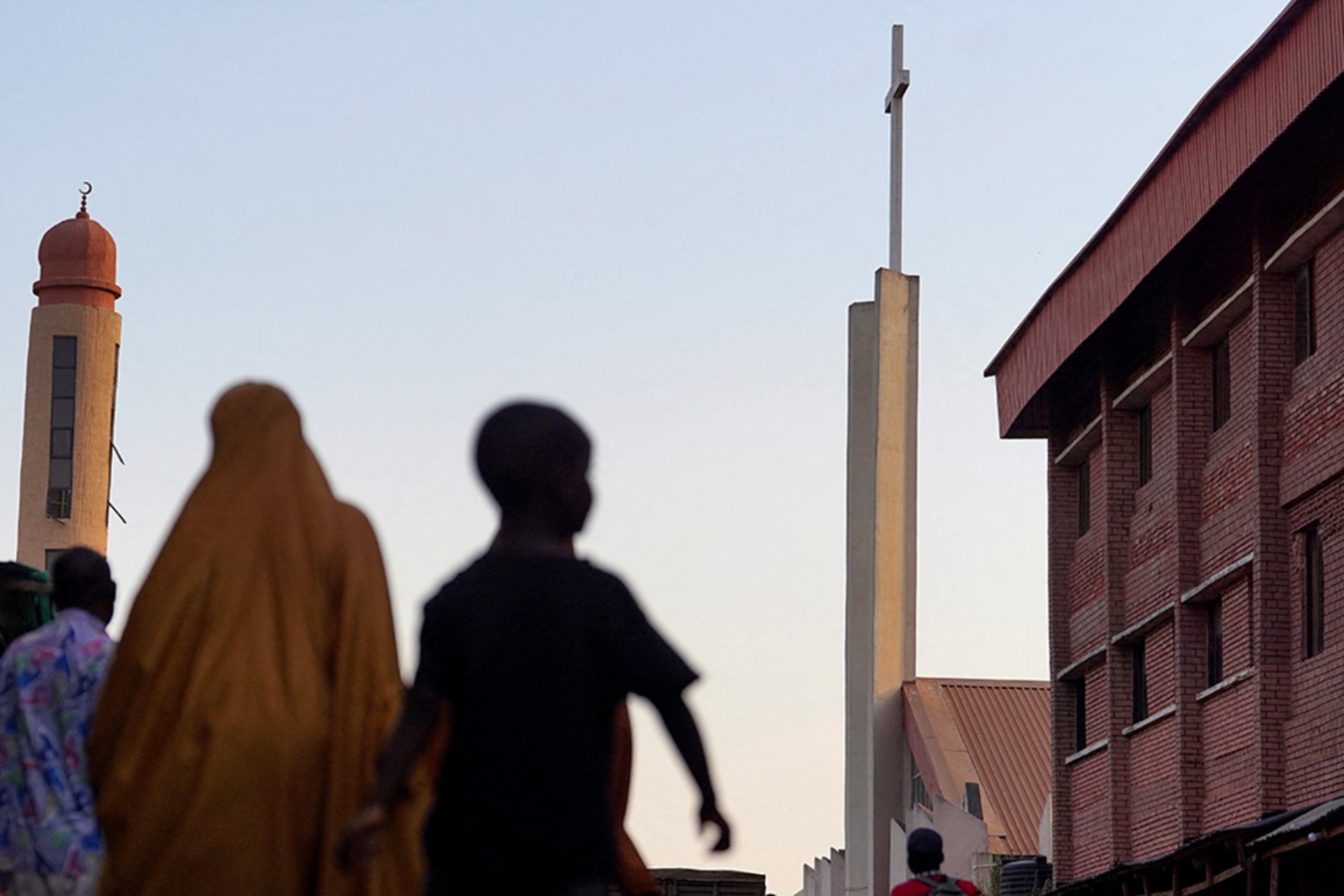
Nigeria’s population of 220 million is roughly equally split between Christians and Muslims. Due to the well-documented high level of insecurity in the country—including, but by no means limited to, armed robbery, kidnapping, banditry, violence involving law enforcement, and other forms of casual violence—Nigerians of all religious and ethnic stripes are exposed to daily violence. That being said, violence in the northern and middle belt regions of the country has a specific genealogy insofar as it is traceable to the activities of the Islamist insurgency group Boko Haram (meaning “Western education is forbidden” in Arabic), which has carried out a bloody campaign in that region of the country for nearly two decades.
Boko Haram’s stated goal is to abolish the Nigerian state and replace it with a Sharia-based theocracy. For this reason, the group has been indiscriminate in its violence, targeting Muslims and Christians, mosques and churches, as well as government infrastructure. A UN Development Program estimate puts the number of people killed by Boko Haram between 2009 and 2021 at 350,000. Within that same period, nearly four million people were displaced.
What has the Nigerian government done to address the issue?
Since the outbreak of the insurgency in 2009, successive administrations, including that of incumbent President Bola Tinubu, have pledged to stamp it out—though they have had little success. In September, after a Boko Haram attack claimed at least sixty lives in the northeastern state of Borno, Tinubu ordered a sweeping overhaul of military operations.
During his tenure, President Goodluck Jonathan (2010–2015) briefly considered granting amnesty to Boko Haram insurgents as a way of inducing them to lay down their arms. While the Tinubu administration appears to have had relative success in taming insecurity in general, as illustrated by the significant decrease in kidnapping incidents in 2024, Amnesty International still puts the number of Nigerians killed in various forms of violent encounters since 2023—when Tinubu took office—at more than ten thousand.
How does the CPC designation affect U.S.-Nigeria relations?
Nigeria’s CPC designation comes after months of intense lobbying by various influential advocacy groups and individuals, most notably Senator Ted Cruz (R–TX), who recently sponsored a bill to add Nigeria to the CPC list. The fact that the designation still appears to have caught Nigerian authorities by surprise, despite all the flashing signals, can be partly blamed on the fact that Nigeria lacks an ambassadorial presence in Washington.
A CPC tag is reserved for countries adjudged to have engaged in or tolerated “particularly severe violations of religious freedom.” The designation sends a clear signal of the U.S. government’s determination to impose appropriate sanctions on relevant Nigerian officials for what the Trump administration sees as an orchestrated campaign against Christians in the country. Specifically, the administration appears set to punish governors of twelve northern Nigerian states where the Islamic Sharia legal code is law.
While by definition a hostile move, a CPC designation in this particular case can be an effective diplomatic weapon if it helps increase pressure on the political class to take Boko Haram seriously and take action that will lead to its radical degradation as a fighting force.
How does the Nigerian public feel about the designation?
Most Nigerians welcome the global spotlight on the activities of Boko Haram, while Christian groups in particular see the attention as long overdue. At the same time, a cross-section of Nigerians worries that Trump’s rhetoric—especially the threat of unilateral action against the country—will be counterproductive and draw attention away from the specific problem of jihadist violence across the northern region, recurrent blasphemy violence, and the general problem of pervasive insecurity in the rest of the country.
Given the political mood in Nigeria, unilateral U.S. action could undermine the Tinubu administration and create a pretext for military intervention, which would most certainly sow chaos throughout the country. Instead of going it alone, the United States should invest in kinetic and intelligence collaboration with the Nigerian armed forces with the ultimate goal of defeating jihadism—primarily in Nigeria, and then across the Sahel.
This work represents the views and opinions solely of the author. The Council on Foreign Relations is an independent, nonpartisan membership organization, think tank, and publisher, and takes no institutional positions on matters of policy.