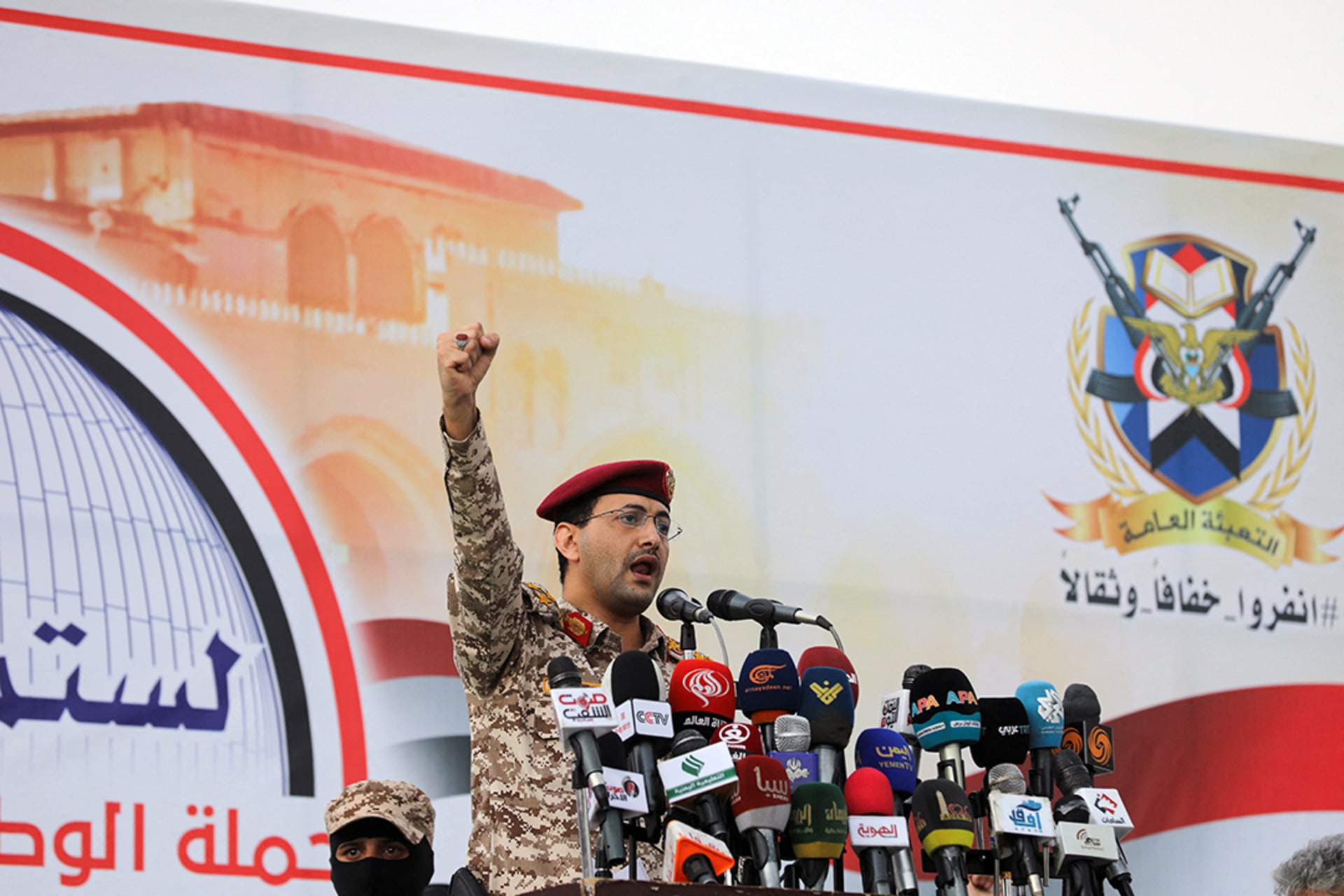
Houthi military spokesman Yahya Sarea delivers a statement announcing the targeting of three U.S. destroyers in the Red Sea during a rally to show support to Palestinians in the Gaza Strip and Lebanon’s Hezbollah, in Sanaa, Yemen, on September 27, 2024.Khaled Abdullah/Reuters
TYPE
Civil War
Terrorism
IMPACT ON U.S.
Medium
STATUS
Worsening
Related
Yemen
Updated September 24, 2026
RelatedYemen
Updated September 24, 2026
Overview
Since 2014, Houthi rebels have fought a Saudi-led coalition backing Yemen’s internationally recognized government, a conflict that quieted under a UN-brokered ceasefire in 2022. The Iran-backed group subsequently launched attacks on Red Sea shipping in protest of Israel’s military campaign in Gaza, drawing U.S. military retaliation and deepening Yemen’s entanglement in regional conflict. Houthi strikes on Saudi Arabia’s Abha Airport in July 2026 now threaten to reignite the civil war.
Houthi military spokesman Yahya Sarea delivers a statement announcing the targeting of three U.S. destroyers in the Red Sea during a rally to show support to Palestinians in the Gaza Strip and Lebanon’s Hezbollah, in Sanaa, Yemen, on September 27, 2024.Khaled Abdullah/Reuters
Yemeni Forces Carry Out Twenty Strikes on Houthis in Taiz
Yemeni government forces said they carried out twenty airstrikes targeting Houthi forces in Taiz governorate (Reuters).
The Saudi-led coalition reported that it intercepted a Houthi ballistic missile targeting Khamis Mushait in southern Saudi Arabia (Al Jazeera).
Houthi Forces Strike Medina Power Station
The Saudi-led coalition reported that Houthi forces struck a substation in Medina that powers the Prophet’s Mosque, an important Islamic holy site (Reuters).
The FBI arrested a U.S. Department of Energy employee on charges of attempting to provide material support to the Houthis (AP).
Yemeni Government Forces Launch Airstrikes Against Houthis in Taiz
Yemeni government forces reported that they launched six airstrikes against Houthi positions in the Haifan district of Taiz governorate (Al Jazeera).
U.S. Secretary of State and Saudi Foreign Minister Discuss Regional Security
U.S. Secretary of State Marco Rubio and Saudi Foreign Minister Prince Faisal bin Farhan Al Saud met to discuss regional security, including the situation in Yemen (Al Jazeera).
Yemeni government forces conducted two airstrikes against Houthi positions in Taiz governorate (Al Jazeera).
Houthi Negotiators Meet With UN Envoy
UN Envoy for Yemen Hans Grundberg said he met with the Houthis’ chief negotiatior in Muscat this weekend to prevent further escalation (AP).
Background
Yemen’s civil war began in 2014 when Houthi insurgents—Shiite rebels with links to Iran and a history of rising up against the Sunni government—took control of Yemen’s capital and largest city, Sanaa, demanding lower fuel prices and a new government. Following failed negotiations, the rebels seized the presidential palace in January 2015, leading President Abd Rabbu Mansour Hadi and his government to resign. Beginning in March 2015, a coalition of Gulf states led by Saudi Arabia launched a campaign of economic isolation and air strikes against the Houthi insurgents, with U.S. logistical and intelligence support.
In February 2015, after escaping from Sanaa, Hadi rescinded his resignation, complicating the UN-supported transitional council formed to govern from the southern port city of Aden. However, a Houthi advance forced Hadi to flee Aden for exile in Saudi Arabia. While he attempted to return to Aden later that year, he ultimately ruled as president in exile.
The intervention of regional powers in Yemen’s conflict, including Iran and Gulf states led by Saudi Arabia, also drew the country into a regional proxy struggle along the broader Sunni-Shia divide. In June 2015, Saudi Arabia implemented a naval blockade to prevent Iran from supplying the Houthis. In response, Iran dispatched a naval convoy, raising the risk of military escalation between the two countries. The militarization of Yemen’s waters also drew the attention of the U.S. Navy, which has continued to seize Yemen-bound Iranian weapons. The blockade has been at the center of the humanitarian crisis throughout the conflict. Saudi Arabia and the United Arab Emirates have also led an unrelenting air campaign, with their coalition carrying out over twenty-five thousand air strikes. These strikes have caused over nineteen thousand civilian casualties, and from 2021 to 2022 the Houthis responded with a spate of drone attacks on Saudi Arabia and the UAE.
On the battleground, the Houthis made fast progress at the start of the war, moving eastward to Marib and pushing south to Aden in early 2015. However, a Saudi intervention pushed the Houthis back north and west until the frontlines stabilized. A UN effort to broker peace talks between allied Houthi rebels and the internationally recognized Yemeni government stalled in the summer of 2016. In the south and east of the country, a growing al-Qaeda in the Arabian Peninsula (AQAP) threatened the government’s control, though its influence has since waned.
In July 2016, the Houthis and the government of former President Saleh, ousted in 2011 after nearly thirty years in power, announced the formation of a political council to govern Sana’a and much of northern Yemen. However, in December 2017, Saleh broke with the Houthis and called for his followers to take up arms against them. Saleh was killed and his forces were defeated within two days. Meanwhile, Hadi and the internationally recognized governments faced their own challenge: the Southern Transitional Council (STC). Established in 2017, the STC grew out of the southern separatist movement that predates the civil war and controls areas in the southwest around and including Aden. A 2019 Saudi-brokered deal incorporated the STC into the internationally-recognized governments, but the faction could still present challenges.
In 2018, coalition forces made an offensive push on the coast northward to the strategic city of Hodeidah, the main seaport for northern Yemen. The fighting ended in a ceasefire and commitments to withdraw troops from the city; the ceasefire largely held, but fighting continued elsewhere. Taiz, Yemen’s third largest city, also remained a key point of contention, having been blockaded by the Houthis since 2015. In 2020, the UAE officially withdrew from Yemen, but it maintains extensive influence in the country.
In February 2021, Houthi rebels launched an offensive to seize Marib, the last stronghold of Yemen’s internationally recognized government, and in early March, Houthi rebels conducted missile air strikes in Saudi Arabia, including targeting oil tankers and facilities and international airports. The Saudi-led coalition responded to the increase in attacks with air strikes targeting Sanaa. The offensive was the deadliest clash since 2018, killing hundreds of fighters and complicating peace processes.
Meanwhile, the conflict has taken a heavy toll on Yemeni civilians, making Yemen the world’s worst humanitarian crisis. The UN estimates that 60 percent of the estimated 377,000 deaths in Yemen between 2015 and the beginning of 2022 were the result of indirect causes like food insecurity and lack of accessible health services. Two-thirds of the population, or 21.6 million Yemenis, remain in dire need of assistance. Five million are at risk of famine, and a cholera outbreak has affected over one million people. All sides of the conflict are reported to have violated human rights and international humanitarian law.
An economic crisis continues to compound the ongoing humanitarian crisis. In late 2019, the conflict led to the splintering of the economy into two broad economic zones under territories controlled by the Houthis and the Saudi-backed government. In the fall of 2021, the sharp depreciation of Yemen’s currency, particularly in government-controlled areas, significantly reduced people’s purchasing power and pushed many basic necessities even further out of reach, leading to widespread protests across cities in southern Yemen. Security forces forcefully responded to the protests.
Separate from the ongoing civil war, the United States is suspected of conducting counterterrorism operations in Yemen, relying mainly on air strikes to target al-Qaeda in the Arabian Peninsula (AQAP) and militants associated with the self-proclaimed Islamic State. The United States is deeply invested in combating terrorism and violent extremism in Yemen, having collaborated with the Yemeni government on counterterrorism since the bombing of the USS Cole in 2000. Since 2002, the United States has carried out nearly four hundred strikes in Yemen. In April 2016, the United States deployed a small team of forces to advise and assist Saudi-led troops to retake territory from AQAP. In January 2017, a U.S. Special Operations Forces raid in central Yemen killed one U.S. service member, several suspected AQAP-affiliated fighters, and an unknown number of Yemeni civilians. Breaking from previous U.S. policy, President Joe Biden announced an end to U.S. support for Saudi-led offensive operations in Yemen in February 2021 and revoked its designation of the Houthis as a terrorist organization. In January 2024, the Houthis were redesignated as a terrorist organization due to their recent attacks on ships in the Red Sea and Gulf of Aden.
In April 2022, Yemen’s internationally recognized but unpopular president, Abd Rabbu Mansour Hadi, resigned after ten years in power to make way for a new seven-member presidential council more representative of Yemen’s political factions. Rashad al-Alimi, a Hadi advisor with close ties to Saudi Arabia and powerful Yemeni politicians, chairs the new council.
Recent Developments
Though a six-month UN-brokered cease-fire officially lapsed in October 2022, both sides have since refrained from major escalatory actions and hostility levels remain low. Peace talks between Saudi and Houthi officials, mediated by Oman, resumed in April 2023, accompanying ongoing UN mediation efforts. However, concrete progress remains elusive, and the first official Houthi visit to the Saudi capital since the war began, on September 14, yielded nothing beyond optimistic statements. The discussions were reportedly centered around a complete reopening of Houthi-controlled ports and Sanaa airport, reconstruction efforts, and a timeline for foreign forces to withdraw from Yemen. Negotiations have also been overshadowed by the suspension of the only commercial air route out of Sanaa and a late September Houthi drone strike that killed four Bahraini members of the Saudi-led coalition.
Talks between Iran and Saudi Arabia in April 2023, mediated by China, have raised hopes of a political settlement to end the conflict in Yemen. The talks led to a breakthrough agreement to re-establish diplomatic relations and re-open both sides’ embassies after years of tension and hostility. Iran’s UN mission said that the agreement could accelerate efforts to renew the lapsed cease-fire.
While hostility between the two warring sides remains low, AQAP’s political violence surged in May and June, reaching the highest monthly level since November 2022. Most of the violence has been centered around Yemen’s Abyan and Shawba governates, where AQAP has used drones and IEDs to target forces affiliated with the STC. In August 2023, AQAP launched an explosion that killed a military commander and three soldiers from the Security Belt Forces, an armed group loyal to the STC. Earlier that month, AQAP fighters killed five troops from another force affiliated with the separatist council. The recent use of drones by AQAP in Yemen’s south is likely an attempt to reassert its influence in the area despite its waning influence, and some speculate that this sudden and sustained use of drones signals external support. Additionally, AQAP has continued its anti-separatist efforts, with another attack in early October targeting and wounding five STC-backed fighters.
Three days following the October 7 attack on Israel, Yemen’s Houthi leader Abdel-Malek al-Houthi warned that if the United States intervenes in the Hamas-Israel War directly, the group will respond by taking military action. In mid-October, U.S. officials announced that the USS Carney downed several Houthi cruise missiles and drones fired toward Israel. The Houthis continued to launch several rounds of missiles and drones until it officially announced entry into the war to support Palestinians in the Gaza Strip on October 31. Houthi attacks of the same nature continued into November. On November 19, the Houthis hijacked a commercial ship in the Red Sea and have since attacked at least thirty-three others with drones, missiles, and speed boats as of late January 2024. As a result, major shipping companies have stopped using the Red Sea—through which almost 15 percent of global seaborne trade passes—and have rerouted to take longer and costlier journeys around Southern Africa instead. The situation has resulted in heightened shipping and insurance costs, stoking fears of a renewed cost-of-living crisis. In response to the consistent Houthi attacks in the Red Sea, the United States and United Kingdom carried out coordinated air strikes on Houthi targets in Yemen on January 11 and January 22. It is unclear whether the attacks will cease in the near future, with the Houthis vowing to persist in their military operations until a ceasefire is agreed to in the Gaza Strip and aid is allowed into the enclave.