Feeding the World, Saving the Planet
By experts and staff
- Published
By
- Stewart M. PatrickJames H. Binger Senior Fellow in Global Governance and Director of the International Institutions and Global Governance Program
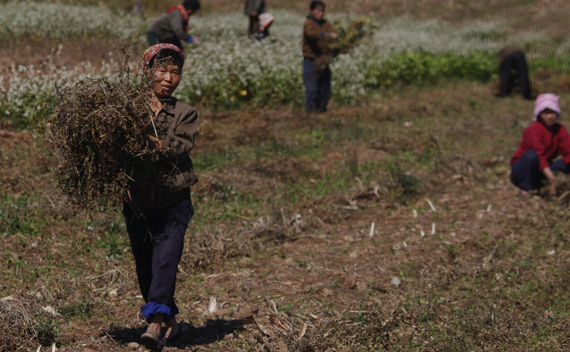
Appropriately enough, Halloween this year brings some scary news. On that date, the global population will surpass seven billion, according to the UN Population Fund. That’s quite a strain on an already crowded planet where one billion go to bed each night hungry or malnourished. And there’s no sign of a let-up. The planet should hit eight billion inhabitants by 2025—and could hit ten billion by 2083.
The dilemma for humanity—and earth itself—is stark. In recent years, the world has been rocked by recurrent volatility in the supply and prices of staple foods. And yet economists say that global agricultural production must double in the next forty years to keep up with population growth and changing dietary preferences (including growing consumption of meat in developing countries).
However, doubling agricultural production will subject the planet to tremendous ecological damage, unless agricultural methods are drastically altered. This is the conclusion of a groundbreaking study in the journal Nature, “Solutions for a Cultivated Planet.”
Bottom line? In trying to feed ourselves, we risk killing the planet.
The scale of contemporary agriculture is mind-boggling. Farming and animal husbandry now take up nearly forty percent of the planet’s ice-free land area. Having converted huge tracts of grassland, savannah and temperate forest, farmers and ranchers are now exploiting more sensitive areas. By 2010, they had cleared 27% of the world’s tropical forests. This is an ecological tragedy, because these biomes are irreplaceable components of the global ecosystem—for example, they serve as carbon sinks, contain the majority of the world’s biodiversity, and provide vast quantities of fresh water.
Furthermore, agriculture accounts for an astounding 30-35% percent of humanity’s greenhouse gases (thanks to deforestation, emissions from fertilized soil, rice cultivation and methane emissions from livestock). Fertilizer is also a major source of pollution, as it degrades aquatic ecosystems, damages marine fisheries, and disrupts natural processes that replenish soil nutrients. Finally, irrigation accounts for 70 percent of human demand for fresh water, which is simply unsustainable in many regions.
Fortunately, the Nature article provides five solutions to help humanity “meet the twin challenges of food security and environmental sustainability.”
Combined, these core strategies could “increase global food availability by 100-180%, meeting projected demands while lowering greenhouse gas emissions, biodiversity losses, water use and water pollution.” Implementing any one of these five solutions would be a Herculean challenge. But the message (NPR) from the scientists is even more sobering. We don’t get to pick and choose among them: We need to do them all.
Translating these proposals into action will be among the most daunting challenges humanity has ever faced. It will require a widespread sense of urgency, sustained political will on an international, national, and local level, and the deployment of economic and regulatory incentives to shift the market preferences of billions of individual producers and consumers. As so often in human endeavors, the binding constraints on performance are more likely to be political and economic than purely technical.