Africa’s Silence on the Iran War Speaks Volumes
The conflict in Iran spells trouble for its longtime efforts to influence African countries, although opinions on Iranian engagements—economic, diplomatic, and cultural—already varied widely within the continent.
By experts and staff
- Published
 Ebenezer ObadareCFR ExpertDouglas Dillon Senior Fellow for Africa Studies
Ebenezer Obadare is Douglas Dillon senior fellow for Africa studies at the Council on Foreign Relations.
As the war in Iran rumbles on, its diplomatic ripple effect is increasingly felt worldwide. This is partly due to the Iranian regime’s deliberate targeting of other states across the region in an effort to drag them into the conflict, and partly because of its blockade of the economically vital Strait of Hormuz—a conduit for an estimated twenty million barrels of crude oil and oil products daily. While the overall outcome of the conflict remains anyone’s guess, there is no question that it will leave Iran considerably weakened, thus jeopardizing its longstanding diplomatic, economic, religious, and military engagement in Africa.
The reaction from African countries has varied in direct proportion to their perceived economic and political interest and the quality of their diplomatic relationship with the United States, Israel, and Iran, respectively. Significantly, African countries have refused to side with Iran, a stance that will no doubt come as a disappointment to the regime in Tehran, given its diplomatic and military initiatives in Africa in recent decades.
Instead, many African countries have explicitly condemned Tehran’s attempt to internationalize the conflict. The overall cautious tone across the continent was set by the African Union, the umbrella body of all African states, which in an official statement called for “restraint, urgent de-escalation, and sustained dialogue” and urged “all concerned actors to prioritize diplomatic engagement.”
Even South Africa could only issue a muted condemnation (of the United States and Israel) by noting that “anticipatory self-defense is not permitted under international law.” Many might have expected the country to stand up for Tehran considering its robust ties with the Iranian regime dating back to the 1979 Islamic Revolution, that both are members of the anti-Western BRICS+ coalition, its outspokenness on the Israel-Hamas conflict on the side of the Palestinians, and the fact that currently there is no love lost between Pretoria and Washington.
African countries play it safe in the Iran conflict
African countries’ careful tread reflects their complex diplomatic entanglements and their anxiety over the economic fallouts of this conflict. Iran has been involved in sustained diplomatic and military engagement with major African countries, seeking to build new partnerships as a way of offsetting Western isolation of the Islamic regime. However, many African allies see Iran as only one of a set of options open to them as the Gulf states have expanded their diplomatic and economic footprint across Africa.
Furthermore, many African countries have been favorably disposed to Iran’s “anti-imperialist” rhetoric and efforts to build a new “axis of resistance” in conjunction with African countries. Others, however, particularly the Sunni-majority Muslim countries, have been quietly resentful, seeing Iran as a Shiite power merely disguising diplomacy as a vehicle for religious proselytism and proxy warfare.
Back in 2014, Sudan closed Iran’s cultural centers and expelled the cultural attaché and other diplomats following accusations that Tehran, which had been considered an ally, was involved in attempts to evangelize in the Sunni-majority country. At the time, Iran also faced accusations of using Sudan as a conduit to smuggle arms to Hamas and Palestinian Islamic Jihad, the second-largest militant group in the Gaza Strip and the West Bank after Hamas. Two years later, Sudan, along with Djibouti and Somalia, cut diplomatic ties. In Nigeria, the Iranian regime is known for its direct financial and material support for the Shiite Islamic Movement in Nigeria, including reported ideological and military training inside Lebanon.
Even though Iran has been aggressive in its courtship of African allies, the Israeli government has also worked behind the scenes to forge alliances with a range of African partners. In particular, Israel has been hugely successful in leveraging its Agency for International Development Cooperation within the Israeli Ministry of Foreign Affairs to assist in agriculture and rural development, technology, health care and emergency response, security, water management, and education to a number of important African allies, including Ethiopia, Ghana, Kenya, Rwanda, and Zambia. Understandably, these beneficiary countries have been loath to endanger their partnership with Israel by condemning the U.S.–Israeli alliance and taking sides with Iran.
In the same way, many African countries are leery of jeopardizing the agreements they have with Washington in an “America First” post-U.S. Agency for International Development (USAID) dispensation. Since dismantling USAID last year, the Trump administration has signed bilateral health memorandums of understanding totaling over $16 billion with at least seventeen African countries, including Burkina Faso, Eswatini, Ivory Coast, Kenya, Madagascar, Malawi, Mozambique, and Nigeria.
Washington has also moved to normalize relations with the three members of the military-led Alliance of Sahel States, Burkina Faso, Mali, and Niger, as part of an incipient and controversial “pragmatic cooperation.” These countries, in particular, would be anxious not to put at risk a burgeoning relationship with the world’s preeminent military and economic power.
African countries are also making hard-nosed economic calculations. Much of Africa—the Democratic Republic of Congo (DRC), Ethiopia, Ivory Coast, Kenya, South Africa, Tanzania, and Uganda top the list—is heavily dependent on imported fuel and fertilizer transported through the Strait of Hormuz, which Iran has effectively blocked in retaliation for U.S. and Israeli attacks. Whatever their feelings about Iran, these countries are understandably eager to avoid a repeat of the situation in the aftermath of the outbreak of the Ukrainian conflict when soaring fertilizer and oil and gas prices led to an increase in cost of living, exacerbating political pressure on many regimes.
Finally, the Gulf countries are increasingly strong economic partners for many African countries—in 2022 and 2023 alone, Gulf states invested approximately $113 billion in foreign direct investment in Africa. Apart from African countries being careful not to alienate these business partners, regionalization of the conflict by Iran and continued disruption to shipping through the blockade of the Strait of Hormuz are a direct obstacle to African economic interest.
Iran’s religious gambit in Africa backfires
Iran’s Africa outreach has been guided by a desire to bypass Western sanctions on the Islamic regime through the construction of an anti-Western alliance. However, being a theocracy, the country’s quest for new partnerships has invariably been freighted with a religious overtones.
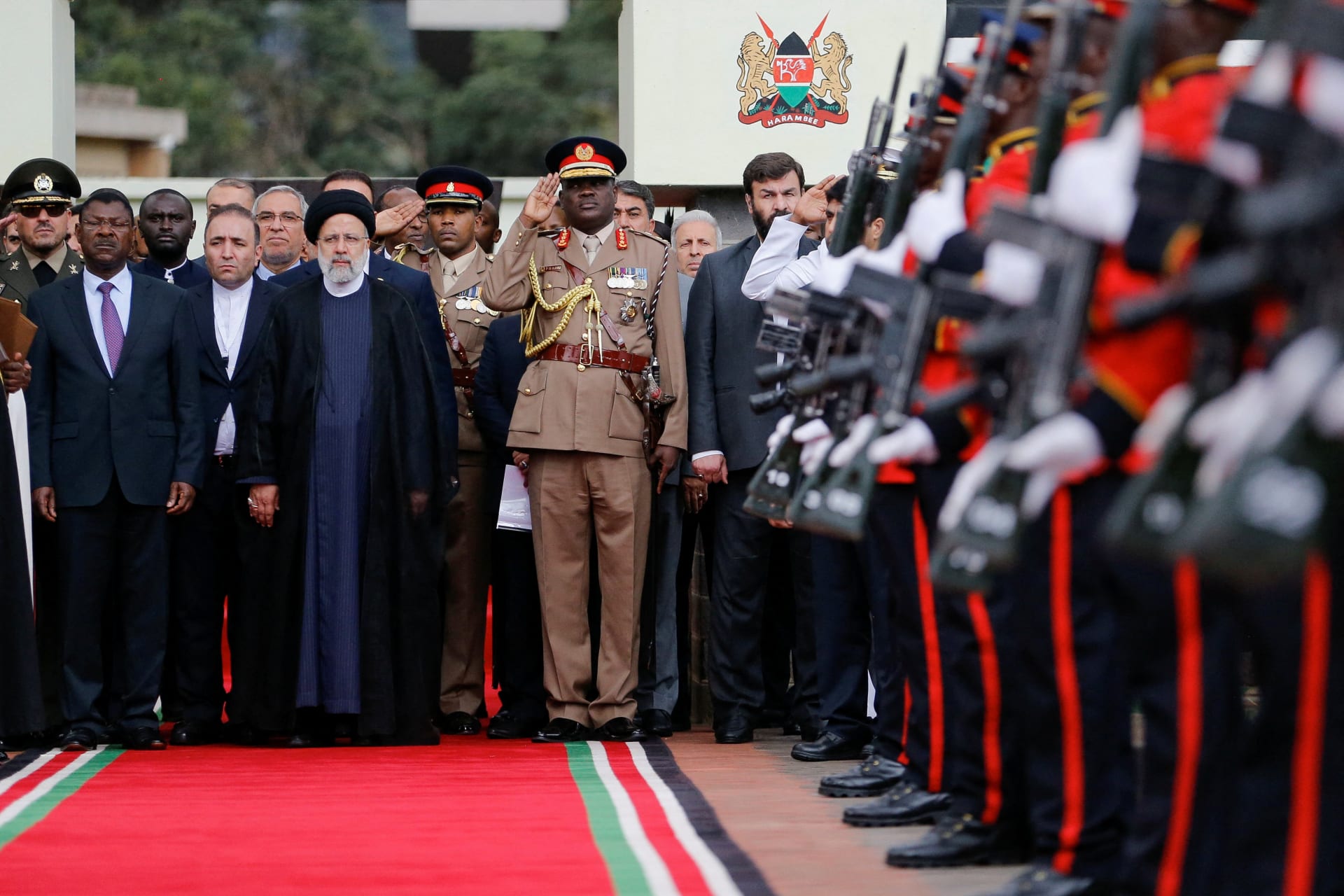
Iran has sought to present itself as a theocratic alternative to the Western model of liberal democracy. Seeing an opening in the continued intolerance of homosexuality and consequent criminalization of same-sex relations in the majority of African countries, the regime has been quick to associate homosexuality with Western (and Western-promoted) social decay. For example, during his visit to the region in 2023, former Iranian President Ebrahim Raisi repeatedly criticized Western countries for their support of homosexuality and LGBTQ+ rights. In Uganda, where a 2023 law allows the death penalty for “aggravated homosexuality,” Raisi described homosexuality as “one of the dirtiest things in human history,” assuring Ugandan President Yoweri Museveni that he thought their alignment on the issue provided “another area of cooperation for Iran and Uganda.”
Apart from promoting the country as a theocratic alternative to what it sees as a decadent Western liberal democracy, the Iranian regime also—and as previously stated—backs Shiite Islamic groups, many of which regarded the late Ayatollah Ali Khamenei as their spiritual guide. This relationship explains the reaction to the death of Khamenei across Nigeria where peaceful protests erupted across several northern states and the commercial nerve center, Lagos. The strength of the bond between Iran and the continent’s largest Shiite community suggests that we likely have not seen the last of such protests.
A diminished Iran in Africa
Using a combination of military and economic incentives, not to mention stoking the fires of cultural discord, the Iranian leadership has sought to present itself simultaneously as the fulcrum of opposition to the Western alliance and Western values in Africa. Based on the evolution of the conflict and what appears to be the advantage of the United States and Israel in taking out thousands of Iranian strategic and military targets, it seems probable that the conflict will leave Tehran considerably weakened.
At the same time, a weakened Iran will be less likely to pursue its military and diplomatic objectives in Africa with its accustomed vigor. Although this would be regrettable for those African countries that Iran has long courted, the surplus of opportunities in the Gulf means that they can easily recover their loss by pivoting to other Gulf states.
In the area of religious diplomacy, diminished Iranian capacity to bolster Shiite movements across Africa could lead to the weakening of their capacity to foment trouble. Much, of course, will depend on how the conflict itself unfolds in the coming weeks and subsequently how these movements recalibrate their relationships.
This work represents the views and opinions solely of the author. The Council on Foreign Relations is an independent, nonpartisan membership organization, think tank, and publisher, and takes no institutional positions on matters of policy.