U.S. Priorities at the UN General Assembly
By experts and staff
- Published
By
- Stewart M. PatrickJames H. Binger Senior Fellow in Global Governance and Director of the International Institutions and Global Governance Program
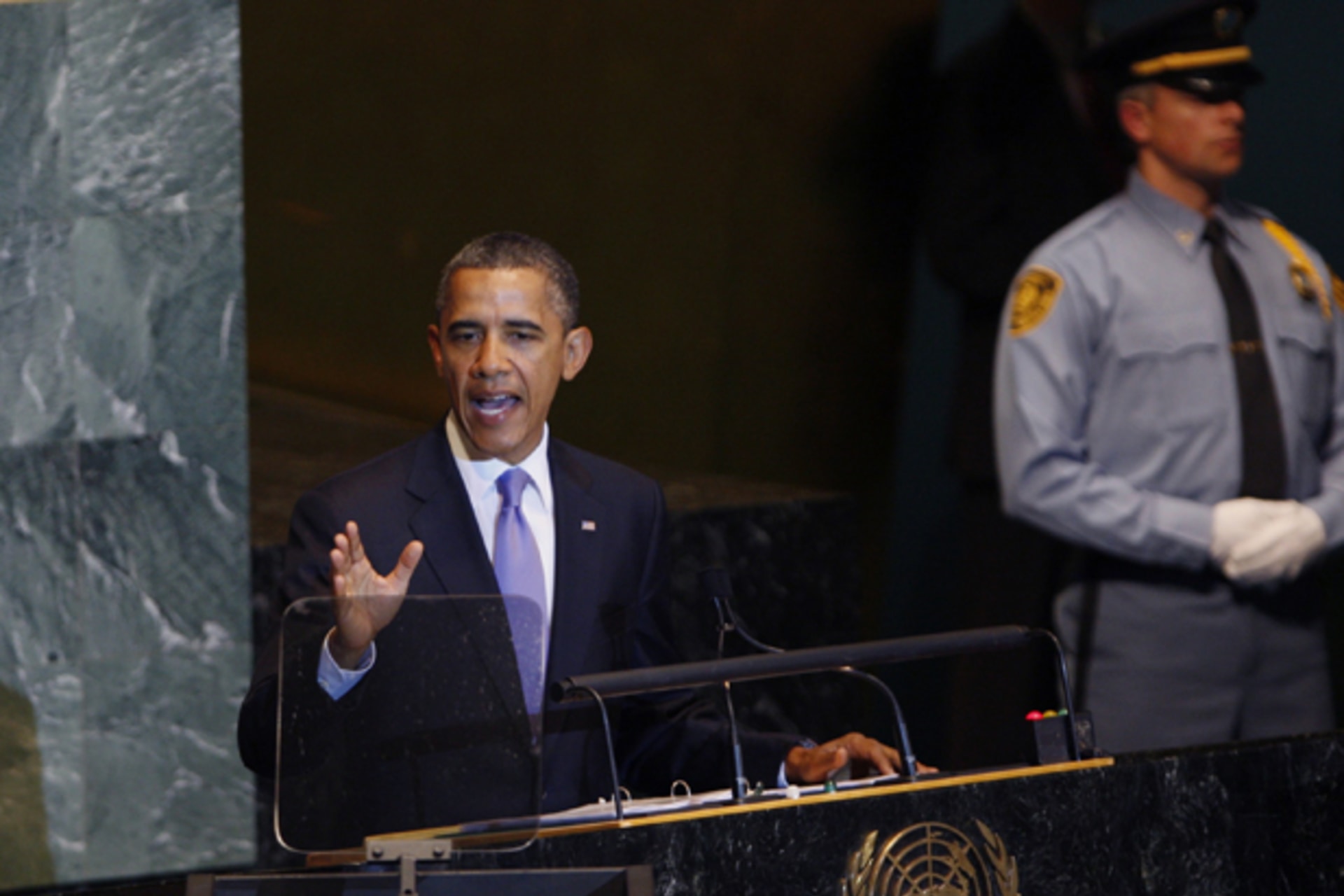
Next week, Obama will deliver his fourth (and perhaps last) speech from the podium in the Great Hall of the United Nations General Assembly. Given elections on November 6, the intended audience will, of course, be as much domestic as international.
The overall message of his address will be that “engagement” has paid off in spades, that the United States has restored its standing and good working relationships in New York, and that the hard work of retail diplomacy—of rolling up your sleeves and negotiating—has paid off. The message will be that engagement pays much greater dividends than—as Susan Rice memorably said at the start of the administration—simply “criticizing from the sidelines.” The accomplishments he is likely to enumerate include: the successful UN-authorized intervention in Libya; the U.S.-UN partnership in Iraq and Afghanistan, which has allowed gradual U.S. withdrawal from both countries; the successful conclusion of the Nuclear Nonproliferation Treaty review conference and the two Nuclear Security Summits; the toughest sanctions regimes ever imposed on North Korea and Iran; and the transformation of the Human Rights Council from a den of abusers into a group that is actually beginning to call them to account.
Given the GOP’s recent focus on “American exceptionalism” as the cornerstone of a Republican foreign policy, the president is almost certain to rebut GOP appropriation and definition of that term. He will agree that the United States remains an “exceptional” nation, but that what makes it truly exceptional is not that it goes its own way, throws its weight around, or hunkers down in an isolationist crouch with the misguided idea that the UN somehow threatens its “sovereignty.” Instead, the United States has been exceptional because it understands that leaders require followers, and that it alone has the power to build and promote strong and effective international institutions that serve both American and global interests. It recognizes the reality of interdependence—that countries are “all in this together”—and that few global problems can be solved without multilateral cooperation. Engagement with the UN rarely narrows U.S. sovereign options—it typically expands them.
The U.S. delegation has outlined four big-picture goals for the upcoming General Assembly:
Meanwhile, the Palestinian quest for UN membership may distract from the official agenda. Last year the Palestinians narrowly failed to gain UNSC support for UN membership. This year, Palestinian Authority president Mohammed Abbas has pledged to seek UNGA endorsement of enhanced status for the PA as a “non-member observer state.” Given solid support from the 120-member Non-Aligned Nations bloc, Abbas should easily secure the needed majority support within the 193-member General Assembly. Beyond this step, Abbas could also seek Palestinian membership in a variety of UN specialized agencies, just as he did with UNESCO last year. In principle, the PA could run the table on the United States, by seeking membership in important entities like WIPO, WHO, IAEA, and even conceivably the international financial institutions—forcing the U.S. to defund such agencies unless it gets a congressional waiver. Given voluble GOP criticism that he has already “thrown Israel under the bus”, and snubbed Prime Minister Netanyahu by declining to meet with him in New York, look for President Obama to place enormous pressure on the PA not to go down this road.