“America First” in Africa Is Still Undefined
Washington’s attempts at clarity raise more questions than answers.
By experts and staff
- Published
 Michelle GavinCFR ExpertRalph Bunche Senior Fellow for Africa Policy Studies
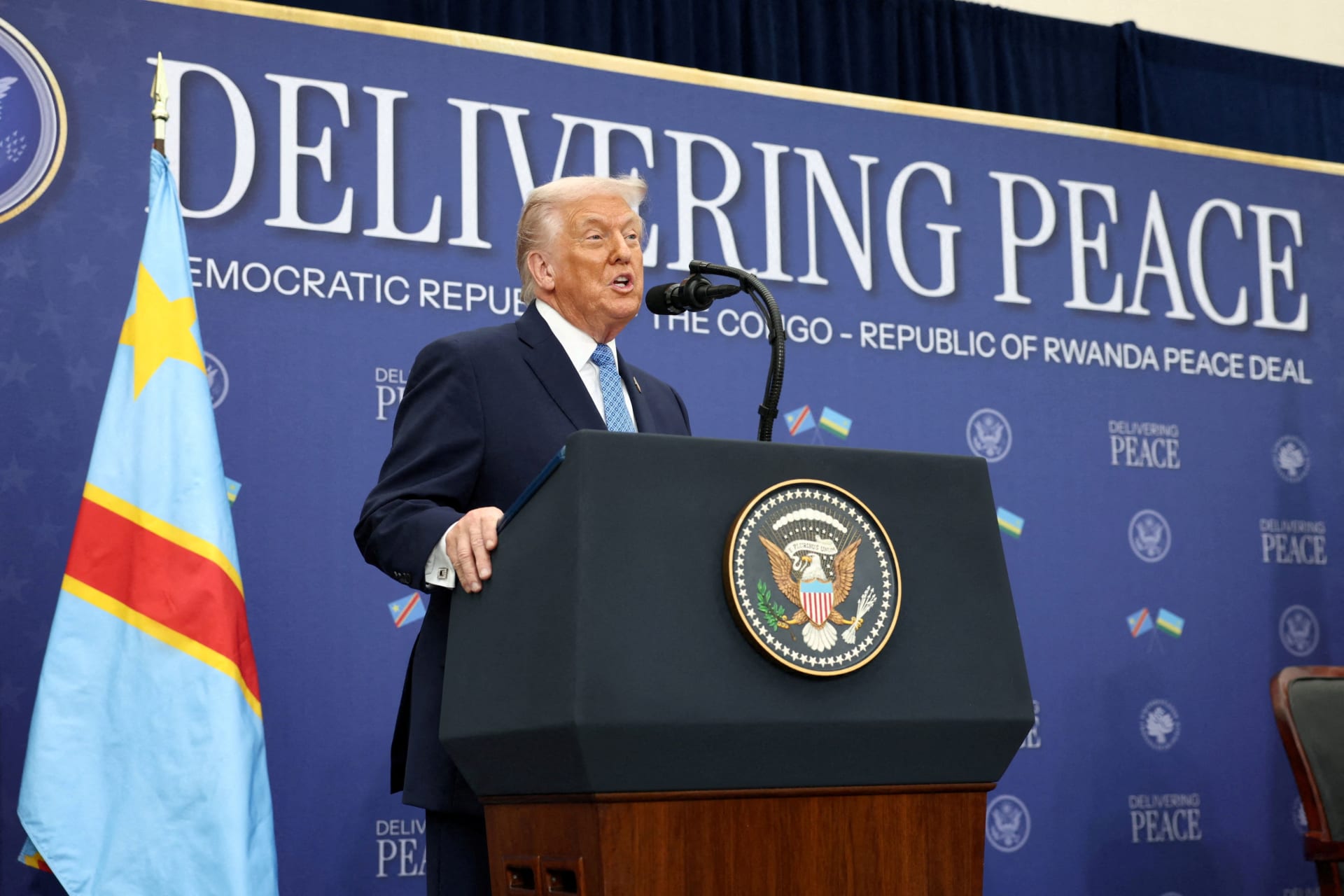
When Nick Checker, the State Department’s Senior Bureau Official for African Affairs, recently made a statement expounding on what an “America First” agenda means in Africa, he promised “insight and clarity.” On the positive side of the ledger, he offered an admirably straightforward explanation of a basic proposition that has too often been avoided as if it were in poor taste. The United States’ engagements in Africa, and indeed around the world, are guided by the pursuit of U.S. interests. Our expectation is that interlocuters are similarly motivated by their own interests, and progress is made in areas of overlapping or complementary objectives. It’s hardly a revelation, but it is a welcome shedding of the pretense that the United States’ competitors are out for themselves while we are not, or that Africa is a venue for something fundamentally different from basic statecraft.
But the promised “clarity” ended there. First, the devil really is in the details of how interests are defined and understood. Checker advised that “we must engage governments as they are, not as Washington wishes them to be.” It’s an insight that usefully acknowledges the limits of U.S. influence, but also sits uncomfortably beside the U.S. president’s insistence that he must approve of leadership selections in Venezuela and Iran. Checker talks about “tolerating instability where U.S. interests are not directly implicated.” But this is neither new—the persistent instability in the Sahel, South Sudan, and the Great Lakes over decades was clearly not deemed intolerable by earlier administrations—nor illuminating. When do the indirect effects of instability merit attention? What about the consequences of radical extremists consolidating control over vast swathes of territory? Are Americans safer in a world in which humanitarian law has been relegated to the dustbin of history? How do we imagine the exciting new investment partnerships the administration promises will be insulated from spreading insecurity and resulting destabilizing migratory flows?
Second, the administration’s words and its actions are full of contradictions and wishful thinking. It claims to have zero tolerance for waste, fraud, and abuse, but has adopted a model of bilateral health assistance that entails turning U.S. taxpayer dollars over to foreign governments, many with records of grand scale corruption, and hoping for the best. The statement talks about “avoiding public moralizing” in favor of “quiet leverage on values-based issues,” but the administration has gone to great lengths to publicly shame South Africa for a wholly imagined campaign of genocide against white South Africans. The Christmas day military strikes on onion farms in Nigeria—ostensibly to protect Christian Nigerians—hardly gave the impression that quiet leverage was valued over spectacle. Nor does characterizing Nigeria’s multifaceted security crisis as a straightforward matter of religious persecution square with the “realism” Americans are being promised. Instead, these African states have been used as a backdrop for virtue signaling to specific domestic constituencies—exactly what the administration claims to reject.
The administration promises new and creative thinking. But “trade not aid” is not a new idea. Bill Clinton emphasized it in the 1990s, as has every U.S. President since then. But the U.S. private sector has been skittish about exposure to Africa for a multitude of reasons. One involves concerns about insecurity—concerns that will not be alleviated by signing ceremonies or self-congratulation, but rather actual security on the ground. Long-term investments require stability, but if governments lack legitimacy and have an increasingly antagonistic relationship with their citizens, stability may well be elusive. A lack of confidence in the rule of law is another inhibiting factor—an issue that fundamentally implicates governance. Finally, what is particularly striking about Checker’s remarks and the desultory three paragraphs that Africa merited in the administration’s National Security Strategy is the absence of geopolitical context or strategic thinking. What is our comparative advantage relative to other external powers also interested in “deals” and amassing significant influence and leverage in Africa? What role do policymakers envision African states playing in the world in 2050, and how does that affect U.S. interests? From the immediate economic consequences resulting from the Iran crisis to the rejection of multilateralism, it’s not clear that the fallout of U.S. policy choices in Africa has been anticipated or mitigated to maintain U.S. access and influence. It’s hard to discern how obliviousness in Africa puts America first.