Coalitions of the Willing and the Strait of Hormuz
CFR President Michael Froman analyzes the United States’ efforts to unblock a key chokepoint for the world’s energy supply.

As the war in Iran enters its third week, the most pressing challenge facing the United States is opening the Strait of Hormuz. In an effort to get maritime cargo moving again, President Donald Trump earlier this week called on NATO and other allies, as well as China, to help the United States secure the waterway.
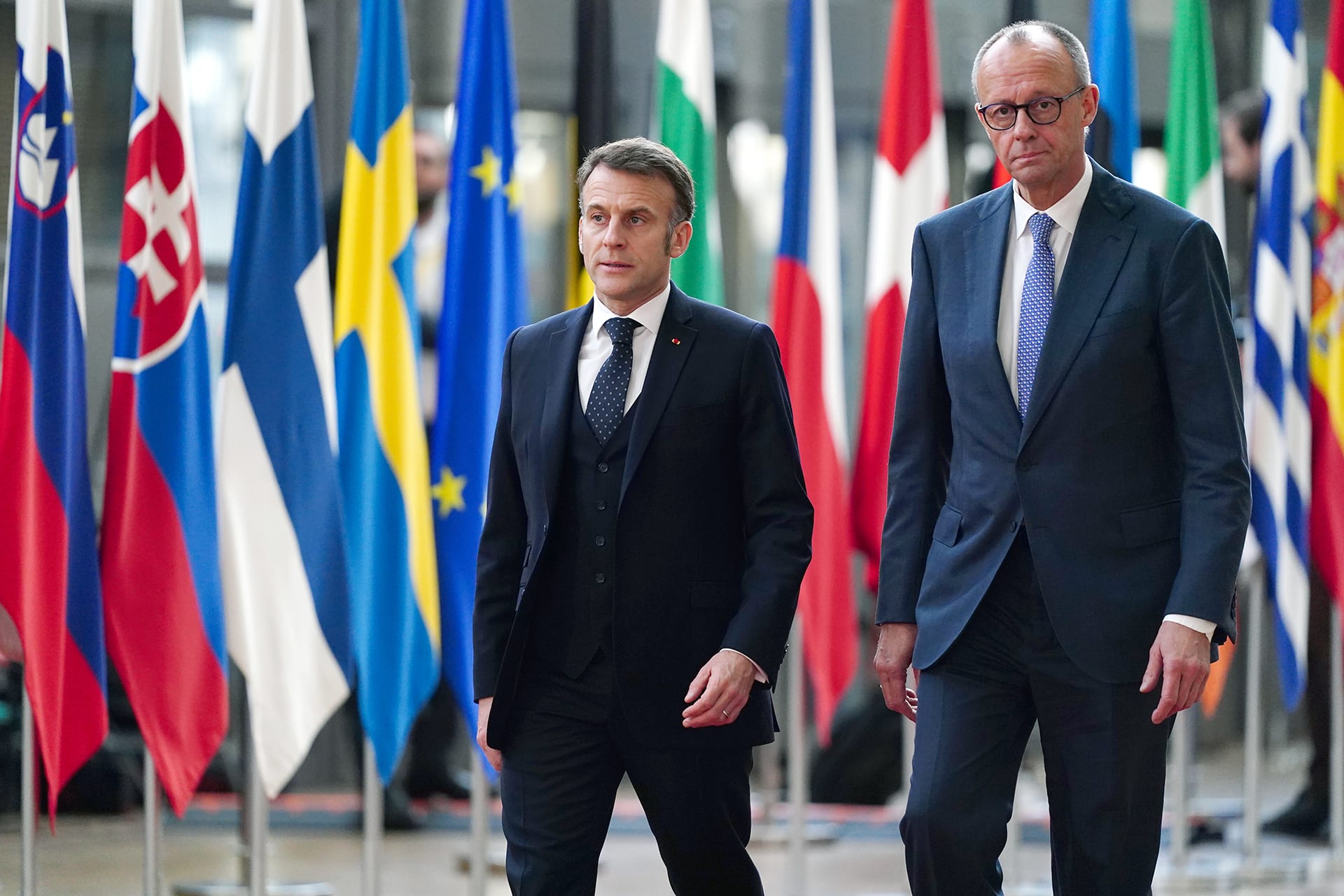
The initial response was not positive. Asian and European partners said something to the effect that this wasn’t their war. German Chancellor Friedrich Merz declared, “To this day, there is no convincing plan for how this operation could succeed. Washington has not consulted us and did not say European assistance was necessary.” French President Emmanuel Macron was more blunt: “We are not party to the conflict.” Finnish president Alexander Stubb suggested that Europe offer military support in Iran in exchange for more assistance to Ukraine and ensuring any peace deal favors Kyiv, not Moscow. Stubb’s offer hasn’t gained much traction, at least for now.
Then, in a joint statement released yesterday, Canada, France, Germany, Italy, Japan, the United Kingdom, and the Netherlands expressed their “readiness to contribute to appropriate efforts to ensure safe passage through the strait.” Trump might welcome this declaration, but it is a lukewarm commitment, to say the least.
China hasn’t offered to join the president’s coalition, which is not surprising but noteworthy, given the fact that the stakes of the current war are particularly high for Beijing. Some 40 percent of China’s crude oil imports and some 30 percent of its import Liquefied Natural Gas (LNG) typically flow through the Strait of Hormuz. That said, ahead of the war, China amassed a massive emergency stockpile of around 1.4 billion barrels of crude, and it has other means to import LNG—giving the country some buffer before domestic energy shortages occur. It also is benefitting from the fact that Iran appears to be letting ships bound for China through the strait. Indeed, China might see it as in its interest to have the United States bogged down with Iran (as some Chinese officials said of U.S. involvement in Ukraine). As Ed Luce analyzed for the Financial Times, “That China has no intention of sending minesweepers to the Strait of Hormuz is clear. The question is whether Xi Jinping wants to see Trump backed into a corner.”
The Asia Pacific region needs the strait reopened, and it would surely benefit Europe to see it reopened too. CFR’s Josh Kurlantzick wrote earlier this week that India, Japan, Singapore, South Korea, Taiwan, and Thailand are dependent on foreign oil imports, and some 80 percent of oil and LNG transiting the strait is headed for Asia. Europe relies on the strait for a significant share of its LNG, fertilizer, and crude oil imports as well. The LNG dependency is most acute, and Iran’s strikes on Qatar’s Ras Laffan Industrial City—the world’s largest LNG export facility—will cause lasting disruptions. Just Thursday morning, QatarEnergy announced that it might invoke force majeure and renege on large, long-term delivery commitments to Belgium, China, Italy, and South Korea as a result of damage from Iranian strikes. LNG terminals are uniquely costly, complex, and time intensive to build. Ras Laffan was built over three decades. As one energy analyst put it, “This has always been my nightmare scenario, my Armageddon scenario, the one I didn’t want to happen.”
Trump administration officials have repeatedly stated that “America First does not mean America alone.” In this case, at least with regard to our allies in Europe and Asia, it might. The president posted on Truth Social this week:
“I am not surprised by their action, however, because I always considered NATO, where we spend Hundreds of Billions of Dollars per year protecting these same Countries, to be a one way street — We will protect them, but they will do nothing for us, in particular, in a time of need...Because of the fact that we have had such Military Success, we no longer “need,” or desire, the NATO Countries’ assistance — WE NEVER DID! Likewise, Japan, Australia, or South Korea. In fact, speaking as President of the United States of America, by far the Most Powerful Country Anywhere in the World, WE DO NOT NEED THE HELP OF ANYONE!”
The United States does have the world’s most powerful military, but there’s strength in coalition building. During the 1991 Gulf War, more than 30 countries fought alongside the United States, contributing more than 160,000 troops, more than 500 combat aircraft, and more than 60 naval vessels. Compare this to when the United States invaded Iraq in 2003. Many allies and partners may have voiced support for the Iraq War but only a handful, including Australia, Denmark, and Poland, actually contributed combat troops and capabilities. And needless to say, the United States would stand to benefit from the support of Indo-Pacific and European partners in this war. For example, while the United States recently decommissioned a number of old minesweepers, Europe boasts extensive minesweeping capabilities—operating some 150 minesweepers and minehunters–with most of these hulls and crews having engaged in regular NATO mine countermeasure training.
In the context of actions the Trump administration has taken over the last fourteen months which have caused tension with allies and partners—from the imposition of tariffs to the threats to take territory—there has been a lingering question as to whether other countries would still be there for the United States when we needed their help. There are data points on both sides. On one hand, we saw more than fifty countries meet in Washington earlier this year to lay the groundwork for a new critical minerals value chain through the new Forum on Resource Geostrategic Engagement (FORGE) initiative. But as I noted then, this doesn’t mean that countries are willing to join any U.S.-led coalition of the willing, particularly when they see an issue—rightly or wrongly—serving U.S. interests more than their own. As a general matter, we should be able to expect countries to act according to their national interests, regardless of their pique over unrelated issues. It’s one thing to rally countries around decreasing their dependence on China in the wake of supply chain weaponization; it’s another to ask countries to fight alongside the United States in a war when they weren’t consulted about ahead of time and about which they might have serious misgivings.
Indeed, other countries have politics too. When it comes to controversial or unpopular actions, like going to war and sending troops into harm’s way, the Strait of Hormuz case might be an indication that the goodwill and political capital necessary to respond positively to a U.S. request is now limited. For all the progress that the administration has made in getting allies and partners to spend more on their own defense, we still have work to do to get them comfortable in continuing to follow our lead, particularly into conflict situations.
Let me know what you think about coalition building and what this column should cover next by replying to [email protected].